
Anxiety Relief Apps: What You Need to Know in 2026
Your chest is tight. Your thoughts are racing. You know rationally that the presentation will be fine, but your body isn't listening to reason. In that moment, you don't need a 12-week therapy course — you need something that works in the next 5 minutes. Anxiety relief apps are designed for exactly this: immediate, practical tools you can reach for when anxiety spikes.
We evaluated 33 anxiety relief apps across iOS and Android, scoring each on real user ratings, feature depth, and long-term value. This guide covers what we found.
What's Actually Happening in Your Body During Anxiety
Anxiety is not a feeling that starts in your mind and trickles down to your body. It starts in your body — specifically in the amygdala, a pair of almond-shaped structures deep in the temporal lobe — and your mind scrambles to make sense of the physical cascade that follows. Understanding this sequence matters because it changes how you intervene.
When the amygdala detects a potential threat, it triggers the hypothalamic-pituitary-adrenal axis before your conscious mind has any say in the matter. Cortisol and adrenaline flood the bloodstream. Heart rate accelerates to push blood to major muscle groups. Breathing becomes shallow and rapid to increase oxygen intake. Muscles tense for action. Digestion slows or stops — your body is not interested in processing lunch when it thinks a predator is nearby. Pupils dilate. Palms sweat. The prefrontal cortex, responsible for rational thought and planning, receives reduced blood flow because the brain is prioritizing survival circuits over deliberation.
This entire system evolved over millions of years to respond to physical threats: predators, falling rocks, hostile strangers. It is exquisitely well-designed for those situations. The problem is that it fires with nearly identical intensity for an unanswered text message, a performance review, or the vague sense that something is wrong. Your body cannot distinguish between a tiger and an email from your boss marked "urgent." The physiological response is the same.
This is precisely why the most effective acute anxiety interventions target the body first and the mind second. Slow diaphragmatic breathing activates the vagus nerve, which triggers the parasympathetic nervous system — the body's braking system that counteracts fight-or-flight. Progressive muscle relaxation interrupts the tension cycle by deliberately engaging and releasing muscle groups. Cold water on the face triggers the mammalian dive reflex, which rapidly slows heart rate. These are not relaxation luxuries. They are physiological interventions that directly reverse the chemical cascade. Cognitive reframing — examining whether the anxious thought is accurate — works too, but it works better after you have calmed the body enough to bring the prefrontal cortex back online.
Acute Anxiety vs Chronic Anxiety: Different Problems, Different Apps
The person in the middle of a panic attack and the person who has spent six months with a low hum of worry running beneath every waking moment are both experiencing anxiety. But they need fundamentally different tools, and an app that excels at one may be nearly useless for the other.
Acute anxiety — a panic attack, a sudden spike of fear, a moment of overwhelming dread — demands immediate intervention. The person cannot think clearly, may feel they are dying, and needs a tool that works right now with minimal cognitive effort. Grounding techniques are the first line: the 5-4-3-2-1 method (name five things you see, four you hear, three you touch, two you smell, one you taste) pulls attention out of the internal spiral and anchors it in sensory reality. Breathing exercises — particularly extended exhale patterns where the out-breath is longer than the in-breath — directly activate the parasympathetic nervous system. Some people find cold exposure effective: holding ice cubes, splashing cold water on the face. The apps that serve this need well have these tools accessible in one or two taps, with large buttons, clear instructions, and zero prerequisite engagement.
Chronic anxiety — generalized anxiety disorder, persistent worry, the background radiation of unease — requires a different approach entirely. Daily practice of CBT thought records teaches you to catch and examine anxious thoughts before they spiral. Worry scheduling, a counterintuitive but effective technique, involves designating a specific 15-minute window each day for worry and postponing anxious thoughts to that window. Exposure hierarchies gradually desensitize you to feared situations by approaching them in calibrated increments. These are not crisis tools. They are training regimens that reshape your relationship with anxiety over weeks and months.
The practical implication for app selection is significant. If your primary problem is panic attacks, prioritize apps with excellent in-the-moment crisis tools. If your primary problem is generalized worry, prioritize apps with structured CBT programs and daily practice frameworks. If you experience both — which is common — you may need either an app that genuinely covers both or a combination of two specialized tools.
When an App Isn't Enough
Anxiety exists on a spectrum, and apps occupy a specific band of that spectrum. Knowing where that band ends is as important as knowing where it begins.
For mild to moderate everyday anxiety — the nervousness before a presentation, the worry about an upcoming conversation, the general unease that comes with a demanding period at work — apps are genuinely effective tools. Research on digital CBT interventions consistently shows meaningful symptom reduction for this population. The techniques work, the self-guided format is sufficient, and the convenience of having tools in your pocket adds real value.
The boundary appears when anxiety begins to impair normal functioning. When you cannot fall asleep because your mind will not stop rehearsing catastrophic scenarios. When you avoid social situations, phone calls, or leaving the house because the anxiety is too intense. When physical symptoms — chest pain, chronic muscle tension, digestive problems, shortness of breath — have become your baseline rather than occasional episodes. When you are using alcohol, cannabis, or other substances to manage the anxiety because nothing else seems to work. These are signs that the anxiety has crossed from a manageable challenge into clinical territory that warrants professional evaluation.
This is not a failure of willpower or commitment to the app. Clinical anxiety involves neurobiological patterns that benefit from interventions apps cannot provide: the relational safety of a therapeutic alliance, the expertise of a clinician who can assess whether medication would help, the tailored treatment planning that accounts for your specific history and co-occurring conditions.
Apps retain an important role even after that clinical line is crossed — as complements to professional treatment rather than substitutes for it. Therapists increasingly encourage clients to use apps for between-session practice, mood tracking, and skill reinforcement. The data your app collects becomes clinically useful: showing your therapist a mood chart that reveals anxiety spikes every Sunday evening tells them something that your verbal recall might not. The most productive stance is not app or therapist but app and therapist, each doing what it does best.
4 Types of Anxiety Relief Apps — and How They Differ
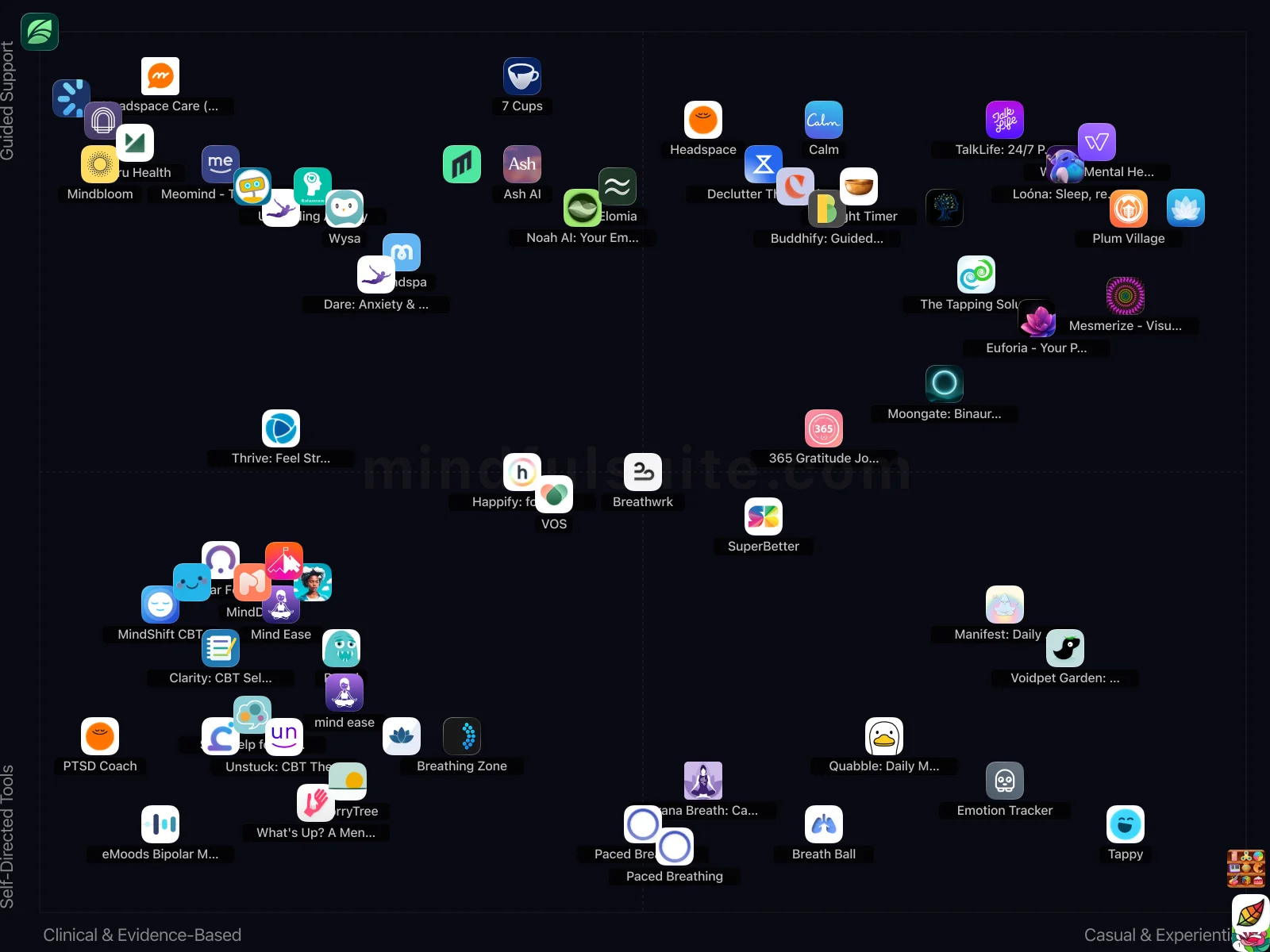
These 67 apps don't all solve the same problem. They cluster into 4 distinct groups, each built around a different philosophy. Understanding which group fits you is the fastest way to narrow your search.
Clinical & Evidence-Based + Guided Support
20 apps in this group, led by  Cerebral - Mental Health,
  Wysa, and
  Dare: Panic & Anxiety Relief.
What defines this cluster: mental healthcare access, licensed therapists, personalized care, ai-powered chatbot.
Dare: Panic & Anxiety Relief.
What defines this cluster: mental healthcare access, licensed therapists, personalized care, ai-powered chatbot.
Casual & Experiential + Guided Support
18 apps in this group, led by  Breathwrk,
  Loóna: Sleep, reduce anxiety, and
  The Tapping Solution.
What defines this cluster: goal-specific breathing exercises, guided breathwork library, customizable breath pattern intervals, daily breathing reminders.
The Tapping Solution.
What defines this cluster: goal-specific breathing exercises, guided breathwork library, customizable breath pattern intervals, daily breathing reminders.
Clinical & Evidence-Based + Self-Directed Tools
19 apps in this group, led by  Rootd,
  Clarity: CBT Self Help Journal, and
  MindDoc.
What defines this cluster: mood tracking, "rootr" panic button, guided breathing exercises, emergency contact list.
MindDoc.
What defines this cluster: mood tracking, "rootr" panic button, guided breathing exercises, emergency contact list.
Casual & Experiential + Self-Directed Tools
10 apps in this group, led by  Tappy,
  Prana Breath: Calm & Meditate, and
  Breath Ball.
What defines this cluster: simple mood tracking, log feelings with a tap, insights into mood patterns, breathing techniques.
Breath Ball.
What defines this cluster: simple mood tracking, log feelings with a tap, insights into mood patterns, breathing techniques.
What makes them different
The core tension in this category runs along two axes. On one side, Clinical & Evidence-Based apps prioritize simplicity and speed — you can be up and running in under a minute. On the other, Casual & Experiential apps offer depth and customization that rewards investment over time.
The second axis — Format — captures an equally important difference. Apps closer to Self-Directed Tools take a fundamentally different approach than those near Guided Support. Neither is objectively better. The right choice depends on your personality, your experience level, and what you're trying to accomplish.
33 Apps Reviewed
We scored every app using a weighted composite of real App Store and Google Play ratings. Out of 33 apps: 5 Essential · 22 Hidden Gems. 24 cross-platform, 8 iOS-only, 1 Android-only.
Top picks: Rootd and Wysa scored highest overall. MindDoc rounds out the top three. Switch to the Apps tab for the full list with ratings and download links.
How to Pick the Right One
Look at the cluster section above. If you already know whether you want Clinical & Evidence-Based or Casual & Experiential, that eliminates half the options instantly. Same for Self-Directed Tools vs Guided Support.
Try one app for a full week before judging. Most anxiety relief apps reveal their value around day 5, not day 1.
Quick start: Rootd and Wysa represent two different approaches and both scored highest. Pick whichever resonates, switch if it doesn't click.
Making It Stick: Practical Advice
Downloading the app is the easy part. The hard part — the part that actually produces results — is what happens in weeks two, three, and beyond. These tips are drawn from behavioral research and from patterns we've observed across hundreds of thousands of user reviews. They're not revolutionary, but they work:
Practice tools when you're calm, not just during crises
Breathing exercises and grounding techniques work much better when you've practiced them in advance. Your anxious brain doesn't learn new skills well — build muscle memory during calm moments so the tools are automatic when you need them.
Identify your personal triggers
Use the tracking features to log what situations, times of day, or thought patterns precede your anxiety. Pattern recognition is the first step toward proactive management.
Combine with professional support when needed
Apps are excellent for daily coping, but if anxiety is significantly impacting your life, relationships, or ability to function, they work best alongside professional therapy. Many therapists actively encourage app use between sessions.
Frequently Asked Questions
These are the questions that come up most often — from our own testing, from user reviews, and from the broader conversation around anxiety relief apps. If your question isn't here, the Apps tab has detailed information on every app we reviewed.
Can anxiety apps replace therapy?
For mild to moderate everyday anxiety, apps can be remarkably effective as standalone tools. For clinical anxiety disorders, they work best as a complement to professional treatment. If anxiety is severely impacting your daily functioning, please reach out to a mental health professional.
Do breathing exercises actually help with anxiety?
Yes. Slow, deep breathing activates the vagus nerve and triggers the parasympathetic nervous system, directly counteracting the fight-or-flight response. It's one of the fastest, most accessible ways to reduce acute anxiety symptoms.
How quickly do anxiety apps show results?
Immediate-relief techniques (breathing, grounding) can reduce acute symptoms in minutes. Building longer-term resilience through regular CBT exercises typically takes 2-4 weeks of consistent practice to show meaningful changes.
Find Your Calm: The Best Anxiety Relief Apps to Soothe Your Mind (2026)
It’s 3 AM, and your brain has decided it’s the perfect time to review every social misstep you’ve made since the seventh grade. Or maybe it’s that familiar, suffocating tightness in your chest right before a high-stakes presentation. Anxiety doesn’t care about your schedule.
In those moments when your thoughts are racing, you need more than just a distraction—you need an intervention. This is where the right app acts like a digital coach in your pocket, ready to untangle your worst-case scenarios and remind your nervous system how to breathe again.
A quick note: These apps are fantastic tools for daily support, but they aren't a replacement for professional help. If anxiety is severely impacting your life, please reach out to a qualified human professional.
"Break Glass" Support for Panic
When a full-blown panic attack hits, a 20-minute meditation about a babbling brook isn't going to cut it. You need immediate, grounding interventions to ride out the adrenaline wave. These apps are designed to be your digital "break glass in case of emergency" tools.

Present
A beautiful meditation timer featuring 100+ soundscapes and 6 bell themes to help you find stillness anywhere.
- Over 100 high-quality nature and ASMR soundscapes.
- Minimalist design that stays out of your way.
- Available as a Chrome extension for working peacefully.

Rootd
When a panic attack hits, you need help, fast. Rootd is designed for exactly that moment. Its standout feature is a big red button—the 'Rootr'—that you can press for immediate, guided steps to help you find your way back to calm. It’s an empowering tool for anyone who experiences anxiety and panic.
- The prominent "panic button" feature provides immediate, accessible relief during an acute anxiety or panic attack.
- Combines in-the-moment tools with long-term educational lessons, offering a comprehensive strategy for managing anxiety.

Dare: Anxiety & Panic Attacks
The Dare app is an evidence-based program designed to help you overcome anxiety and panic attacks by 'daring' you to confront them. It empowers users to break the cycle of fear.
- Its "Dare Response" method provides a specific, actionable framework for de-escalating panic attacks in real-time.
- The "Daily Check-in" and extensive audio library offer consistent reinforcement for managing anxiety patterns.

Clear Fear
Uses CBT principles to help children and young adults manage anxiety by changing anxious thoughts and behaviors.
- Specifically tailored for children and young people, providing age-appropriate CBT tools for anxiety management.
- Offers immediate coping strategies like "panic button" and "breathing exercises" directly within the app.
Rewiring the Anxiety Loop (CBT & Evidence-Based Tools)
If your anxiety makes you a chronic over-thinker, Cognitive Behavioral Therapy (CBT) is one of the most effective ways to fight back. Instead of just masking symptoms, these apps help you identify toxic thought loops, challenge irrational fears, and build long-term mental resilience.

Unwinding Anxiety
This app-based program provides daily exercises and a community to help users understand and manage anxiety. Unwinding Anxiety is a program to help unwind your mind.
- The structured, daily 'bite-sized exercises' are designed to build habits, making the program feel manageable and progressive.
- Features a direct connection to a 'supportive community' and potentially live coaching, offering a social aspect missing in many apps.

Clarity: CBT Self Help Journal
A mental health app offering CBT techniques to manage stress, anxiety, and mood, with mood tracking features.
- Clarity's strong focus on CBT principles provides a structured, evidence-based approach to challenging negative thoughts.
- The comprehensive mood tracker helps users identify triggers and track progress in developing healthier thought patterns.

What's Up? A Mental Health App
What's Up? is a treasure trove of free mental health tools. It beautifully combines principles from both CBT and Acceptance Commitment Therapy (ACT), offering a wide range of features from a negative thought pattern tracker to a fun grounding game. It's a fantastic starting point for anyone wanting to explore different techniques without a subscription.
- It uniquely combines both CBT and ACT methods, offering a broader range of coping strategies for users.
- The app's "What's Up?" approach is designed to be a quick, accessible resource when immediate support is needed.

Thrive: Feel Stress Free
This health and fitness app helps users manage stress, anxiety, and depression. It uses evidence-based techniques to address these issues.
- Offers a wide array of evidence-based techniques, including CBT and mindfulness, all completely free without hidden paywalls.
- The app includes immersive "Escape" environments for quick relaxation, providing a unique visual and auditory de-stressing experience.

My Possible Self
An NHS-approved mental health app, it delivers CBT exercises and personalized activities.
- Being NHS-approved provides significant credibility, assuring users that the CBT exercises and techniques are evidence-based and safe.
- Offers genuinely personalized activity plans and mood tracking, helping users build resilience and manage anxiety long-term, all for free.

MindShift CBT
Created by Anxiety Canada, MindShift CBT speaks directly to teens and young adults navigating the world of anxiety. It breaks down complex CBT concepts into practical, easy-to-use tools for tackling worry, panic, perfectionism, and phobias. It’s a friendly, no-nonsense guide to taking control of your thoughts.
- It provides free access to "scientifically proven strategies based on Cognitive Behavioral Therapy" for anxiety management.
- The focus on actionable CBT tools allows users to learn to relax and be mindful without subscription barriers.

CBT-i Coach
Developed by the U.S. Department of Veterans Affairs, this app is a focused and powerful tool for anyone struggling with insomnia. It uses the principles of Cognitive Behavioral Therapy for Insomnia to help you build better sleep habits, quiet a racing mind, and create a restful environment.
- It specifically supports users undergoing professional CBT-i with a health provider, enhancing therapy outcomes.
- Being completely free without IAP means full access to all CBT-i tools and resources.

OCD.app - healthier thinking
Uses CBT techniques to help users eliminate negative self-talk in short, daily sessions.

MoodTools
MoodTools is a thoughtful companion designed specifically for those navigating depression. It offers a suite of CBT-based tools, including a thought diary for challenging negativity and an activity tracker to encourage mood-boosting behaviors. Crucially, it also includes a suicide safety plan, providing a vital resource for those in crisis.
- Specifically designed to combat depression, offering targeted tools like thought diaries, safety plans, and activity schedulers.
- Provides accessible, evidence-based information and resources, empowering users to understand and manage their depression.

Self-Help for Anxiety Management (SAM)
Helps users understand and manage anxiety through self-help exercises. SAM is for those seeking tools to cope with anxiety.
- SAM offers a comprehensive toolkit of self-help exercises, including thought diaries and relaxation techniques, all completely free.
- Its "Anxiety Tracker" and "My Anxiety Toolkit" allow for personalized self-management without any paywalls.
AI Companions for 2 AM Spirals
Sometimes you need to vent at midnight, but you don't want to wake up a friend or wait a week for a therapy appointment. These AI-driven chatbots are programmed with evidence-based psychological frameworks. They won't replace a real therapist, but they are incredibly good at talking you off a ledge when you're spiraling.

Wysa
Chat with a cute, anonymous penguin who serves as your AI emotional support companion, ready to listen and guide you through evidence-based exercises.
- The AI chatbot offers instant, judgment-free support and evidence-based CBT/DBT techniques on demand.
- Accessible free tier provides valuable breathing exercises and mood tracking without immediate paywall pressure.

Woebot
Created by clinical psychologists from Stanford, Woebot is an AI chatbot that checks in with you daily, using CBT to help you reframe negative thoughts in a lighthearted way.
- Offers instant, 24/7 CBT-based mental health support through its AI chatbot, providing immediate coping strategies.
- It provides accessible mental health coaching without the immediate cost or scheduling of human therapy.

Youper
Youper is an AI assistant that feels like a wise, compassionate friend, using techniques from Cognitive Behavioral Therapy (CBT) to help you understand your thoughts and feelings.
- Its AI-powered chatbot offers instant, accessible CBT-based support for emotional health management.
- The high volume of Android ratings indicates a widely adopted and generally well-received platform.

Ash AI
Ash AI presents itself as the first AI designed specifically for therapy. It provides a judgment-free zone where you can explore feelings around stress, anxiety, and relationships, aiming to truly replicate the feeling of a supportive therapeutic conversation.
- Its specific focus on "Anxiety, Stress and Growth" provides targeted support, offering specialized tools for common struggles.
- Being completely free makes essential coping mechanisms and mental growth tools accessible to everyone, removing financial barriers.

Sonia
Sonia is an AI-powered therapist that delivers CBT through an empathic virtual voice. Much like Yuna, it focuses on verbal interaction, making therapy feel more accessible and less intimidating. Its perfect 5.0 rating on the App Store, while from a smaller user base, is a very promising sign.
- Focuses specifically on "Judgment-Free Anxiety Help," offering a safe, non-threatening space for those struggling.
- Being entirely free makes crucial anxiety management tools and immediate support accessible to anyone, without financial burden.

Elomia
Elomia is an AI chat companion that prioritizes creating a safe and anonymous space to talk. It's programmed to listen carefully and offer guidance based on established psychological practices, helping you gently navigate difficult emotions and tricky situations.
- Elomia offers a truly confidential and judgment-free space for users to vent and explore difficult emotions.
- The AI is designed to provide guidance rooted in established psychological practices, offering more than just a listening ear.

Mental: AI Therapy & Coaching
Offers AI-powered therapy and coaching tools for daily mental health training. It's for users seeking accessible mental health support and personalized guidance.
- Offers accessible AI therapy and coaching, providing instant, personalized support without traditional wait times or costs.
- "Tools for Daily Training" help embed positive habits and coping mechanisms, fostering long-term mental resilience.
Tracking the Tangles (Journaling & Mood Logs)
When your brain feels like a tangled ball of yarn, getting those thoughts out of your head and onto a screen can work wonders. Tracking your daily moods and writing down your worries helps you spot the specific patterns and triggers that send your stress levels spiking.

MindDoc
MindDoc acts like a thoughtful interviewer, asking you questions about your day to create a detailed emotional log and generate insightful reports on your mental health.
- Offers robust mood tracking combined with clinically-validated CBT exercises, providing structured mental health support.
- Generates personalized insights and progress reports, helping users understand their emotional patterns effectively.

Unstuck: CBT Therapy Journal
A simple and effective CBT-based journaling app designed to help you understand and change the thought patterns that impact your mental well-being.
- Offers a practical, guided approach to applying CBT principles for tangible improvements in mental well-being.
- The clean interface effectively breaks down complex thought patterns into manageable, actionable steps.

WorryTree
A focused journaling app specifically designed to help you manage anxiety. It guides you through Cognitive Behavioral Therapy (CBT) techniques to catch, challenge, and let go of your worries.
- Its direct application of CBT techniques offers actionable steps for managing specific worries, not just tracking.
- Unlike general mood trackers, WorryTree provides a structured problem-solving framework, a true "Proven CBT Tool."

CBT Thought Diary: Depression
CBT Thought Diary uses cognitive behavioral therapy in a journal format to challenge negative thoughts. It is designed for self-help in managing depression and improving mental well-being.

Mindspa
Offers self-therapy courses, a therapeutic diary, and an AI chatbot for emotional management. It's a self-help tool for improving mental well-being.
- Mindspa's combination of guided courses, a therapeutic diary, and an AI chatbot provides a holistic self-therapy ecosystem.
- The app offers a structured path for emotional regulation, moving beyond just reactive chatbot conversations.

Emotion Tracker
A mood tracker with a focus on privacy that enables quick journal entries and identifies patterns on a mood calendar.

eMoods Bipolar Mood Tracker
A mood tracker designed to help users monitor and report on their emotional states. It's privacy-focused, storing data locally without cloud connections.
Turning Calm Into a Game
Not everyone finds sitting cross-legged in silence relaxing. If your anxiety makes you physically restless, you might need an active distraction. These apps turn mental wellness into a game or a creative quest, giving your brain something beautiful and low-stakes to focus on until the storm passes.

Happify: for Stress & Worry
If the idea of journaling makes you yawn, Happify is here to change your mind. It turns mental wellness into a series of science-based games and fun activities designed to reduce stress and build resilience. Based on CBT and positive psychology, it transforms self-care into something you’ll actually look forward to doing.
- The "Tracks" system, based on specific psychological principles, provides a structured path for improvement.
- Interactive games, like "Uplift," make building positive habits genuinely engaging and less like a chore.

SuperBetter
SuperBetter turns your mental health journey into an epic adventure. You become the hero, taking on quests, activating power-ups, and battling "bad guys" (like self-criticism) to build real-life resilience and achieve your goals.
- The "Power-ups" and "Bad Guys" system offers a unique, engaging gamified approach to resilience building.
- Its focus on real-life challenges provides actionable steps rather than just passive tracking or journaling.
Direct Professional and Peer Support
Apps are fantastic daily maintenance tools, but when things get too heavy to carry alone, it's time to bring in backup. These platforms bridge the gap between your phone and licensed therapists, or connect you with supportive peer groups so you never have to navigate the tough stuff completely solo.

Meru Health
Delivers mental health care with continuous support from a licensed therapist through video calls and in-app chat. This is for people who need ongoing, accessible mental health support.

7 Cups
7 Cups is built on the power of connection. It offers free, anonymous emotional support by connecting you with trained volunteer listeners 24/7. For those seeking professional help, it also provides access to affordable online therapy.
- Connects users with real human listeners for immediate emotional support, offering a sense of connection during distress.
- Provides access to licensed therapists for more structured, professional counseling, a significant step beyond self-guided apps.

Brightside Health
Brightside Health provides virtual mental health care, tailoring treatment plans to individual needs. It offers therapy, medication, or both, with progress tracking.
Finding What Works for You
Managing anxiety is a deeply personal journey. What instantly grounds your best friend might make you feel completely claustrophobic—and that's entirely normal.
Take your time testing out these apps. Give yourself permission to delete the ones that feel like a chore, and lean into the ones that actually make your shoulders drop an inch. Building new mental wellness habits takes time, but discovering that perfect tool that finally helps you feel grounded is worth the experiment.