
AI Assistant Apps: What You Need to Know in 2026
Imagine having a research assistant, writing partner, brainstorming buddy, and scheduler in your pocket — one that never sleeps, never judges your questions, and can switch contexts in a sentence. AI assistant apps are the Swiss Army knives of the app world, applying artificial intelligence to make everyday tasks faster and smarter.
We evaluated 38 AI assistant apps across iOS and Android, scoring each on real user ratings, feature depth, and long-term value. This guide covers what we found.
What Are AI Assistant Apps, Exactly?
AI assistant apps use large language models and specialized AI to help with a wide range of tasks: writing, research, scheduling, summarization, brainstorming, translation, coding, and decision support. They go beyond traditional virtual assistants (Siri, Alexa) by handling complex, nuanced requests and maintaining conversational context.
These apps represent a new category of productivity tool — one that augments your thinking rather than just organizing your tasks.
What Separates a Great AI assistant app from the Rest
After evaluating 38 apps, clear patterns emerge. The apps that people install and keep — the ones with thousands of five-star reviews accumulated over years, not weeks — tend to share a specific set of qualities. These aren't "nice to haves." They're the features that determine whether an app becomes part of your life or gets deleted after three days:
Natural Language Understanding
Ask questions and give instructions in plain language — no special syntax required.
Context Memory
Remembers your conversation context so you can refine and build on previous requests.
Multi-Task Capability
Handles writing, research, analysis, creative brainstorming, and more within the same app.
Integration with Other Apps
Connects to calendar, email, notes, and other tools for seamless workflow automation.
4 Types of AI Assistant Apps — and How They Differ
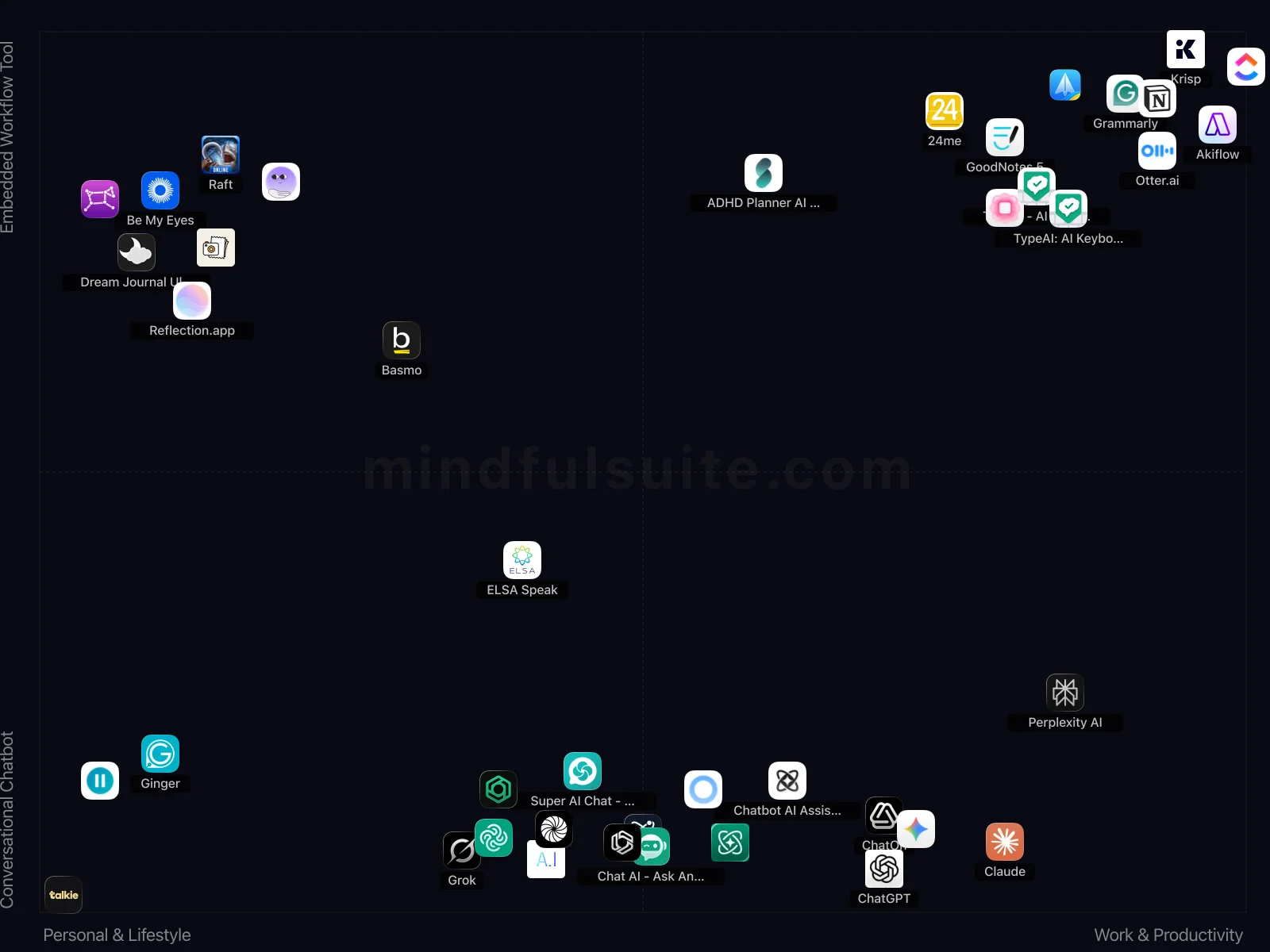
These 41 apps don't all solve the same problem. They cluster into 4 distinct groups, each built around a different philosophy. Understanding which group fits you is the fastest way to narrow your search.
Personal & Lifestyle + Embedded Workflow Tool
8 apps in this group, led by  Be My Eyes,
  Thunderspace, and
  Tiimo: Daily To Do AI Planner.
What defines this cluster: designed for blind people, designed for low vision, none.
Tiimo: Daily To Do AI Planner.
What defines this cluster: designed for blind people, designed for low vision, none.
Work & Productivity + Embedded Workflow Tool
12 apps in this group, led by  Grammarly,
  GoodNotes 5, and
  Notion.
What defines this cluster: free (iap), ai-powered writing assistant, grammar, spelling, punctuation check, keyboard integration.
Notion.
What defines this cluster: free (iap), ai-powered writing assistant, grammar, spelling, punctuation check, keyboard integration.
Personal & Lifestyle + Conversational Chatbot
12 apps in this group, led by  ELSA Speak,
  Talkie, and
  Grok.
What defines this cluster: free (iap), ai-powered language coach, improve english pronunciation, practice conversations with ai.
Grok.
What defines this cluster: free (iap), ai-powered language coach, improve english pronunciation, practice conversations with ai.
Work & Productivity + Conversational Chatbot
9 apps in this group, led by  ChatGPT,
  Perplexity AI, and
  ChatOn.
What defines this cluster: ai-powered search engine, chatbot functionality, provides cited sources, free (iap).
ChatOn.
What defines this cluster: ai-powered search engine, chatbot functionality, provides cited sources, free (iap).
What makes them different
The core tension in this category runs along two axes. On one side, Personal & Lifestyle apps prioritize simplicity and speed — you can be up and running in under a minute. On the other, Work & Productivity apps offer depth and customization that rewards investment over time.
The second axis — AI Integration — captures an equally important difference. Apps closer to Conversational Chatbot take a fundamentally different approach than those near Embedded Workflow Tool. Neither is objectively better. The right choice depends on your personality, your experience level, and what you're trying to accomplish.
38 Apps Reviewed
We scored every app using a weighted composite of real App Store and Google Play ratings. Out of 38 apps: 21 Essential · 10 Hidden Gems · 3 Mainstream. 29 cross-platform, 7 iOS-only, 2 Android-only.
Top picks: ChatGPT and  Claude scored highest overall. Grok rounds out the top three. Switch to the Apps tab for the full list with ratings and download links.
How to Pick the Right One
Look at the cluster section above. If you already know whether you want Personal & Lifestyle or Work & Productivity, that eliminates half the options instantly. Same for Conversational Chatbot vs Embedded Workflow Tool.
Try one app for a full week before judging. Most AI assistant apps reveal their value around day 5, not day 1.
Quick start: ChatGPT and Claude represent two different approaches and both scored highest. Pick whichever resonates, switch if it doesn't click.
Making It Stick: Practical Advice
Downloading the app is the easy part. The hard part — the part that actually produces results — is what happens in weeks two, three, and beyond. These tips are drawn from behavioral research and from patterns we've observed across hundreds of thousands of user reviews. They're not revolutionary, but they work:
Be specific with your requests
The more context you provide, the better the output. Instead of 'write me an email,' try 'write a polite email to my team postponing tomorrow's standup to Thursday, mentioning the client review as the reason.'
Iterate rather than starting over
AI assistants excel when you refine iteratively: get an initial draft, then ask for specific changes. This produces better results than trying to get everything perfect in one prompt.
Verify important facts
AI assistants can occasionally generate incorrect information presented confidently. For anything important, verify the facts independently.
Frequently Asked Questions
These are the questions that come up most often — from our own testing, from user reviews, and from the broader conversation around AI assistant apps. If your question isn't here, the Apps tab has detailed information on every app we reviewed.
Are AI assistants accurate?
AI assistants are highly capable but not infallible. They can occasionally generate confident-sounding but incorrect information. Use them for drafting, brainstorming, and efficiency — but verify critical facts independently.
Is my data safe with AI assistant apps?
Privacy policies vary significantly between apps. Some process data locally, others send it to cloud servers. Check each app's privacy policy, especially if you're handling sensitive or work-related information.
Your Ultimate Guide to the Best AI Assistant Apps in 2026
Remember the days of sticky notes losing their stick, notebooks filled with unreadable meeting scribbles, and the sheer panic of staring at a blank screen when you had to write a difficult email? We've all been there. Being completely organized and endlessly creative sounds great in theory, but reality is usually a lot messier.
Now, imagine having a brainstorming partner, a tireless note-taker, and a creative muse living right in your phone. That’s not science fiction anymore—it’s just what a good app can do. Whether you want to draft a tricky message in seconds, get a plain-English summary of a dense PDF, or finally build a real daily routine, there’s an AI companion ready to help.
The trick is finding the right one. The app stores are absolutely flooded with generic chatbots demanding expensive subscriptions for basic features. We've waded through the noise to find the tools that actually make a difference in your day-to-day life.
The Titans: General-Purpose Chatbots
These are the heavyweights. If you want an all-in-one partner capable of handling a massive range of tasks—from writing code and drafting meal plans to generating images—this is where you start. Keep in mind that while their free versions are incredibly capable, the truly cutting-edge reasoning usually hides behind a monthly fee.

ChatGPT
Developed by OpenAI, ChatGPT is the versatile chatbot that brought generative AI into the mainstream. It excels at natural language conversations, content creation, and complex problem-solving.
- As the official OpenAI app, it provides direct, reliable access to the foundational GPT models without third-party abstraction.
- Offers robust, consistently high-quality responses due to direct access to OpenAI's cutting-edge language models.

Claude
An AI chatbot focused on being helpful, harmless, and honest in its conversations.
- Claude consistently delivers remarkably nuanced, helpful, and contextually aware responses for complex queries.
- Its ethical "helpful, harmless, and honest" principles make it a refreshingly trustworthy AI assistant.

Google Gemini
Google's direct answer to ChatGPT, Gemini is deeply integrated with Google's ecosystem. It leverages Google's vast knowledge base to provide real-time information and creative assistance.
- Deeply integrated with Google's ecosystem, potentially offering seamless access to search and other services.
- Leverages Google's powerful Gemini models, providing state-of-the-art responses and multimodal understanding.

Grok
This AI assistant by xAI answers questions and generates images, emphasizing truthfulness and curiosity.
- Its "curious" persona often delivers unique, opinionated responses that stand out from generic AI.
- Integrates image generation directly, offering a creative edge beyond text-only chatbots.

Chatbot AI Assistant - Genie
An AI assistant with an AI Chatbot, AI Image Generator, Web Search, and Deep Reasoning to write, create, and research.
- Combines AI chat with an AI image generator and web search, offering comprehensive creative and research tools.
- Promises "Deep Reasoning," potentially providing more nuanced and complex answers than basic chatbots.

Super AI Chat - AI Chatbot
An AI-powered assistant that provides information and logo creation capabilities.
- Uniquely offers a "Logo Maker" feature, providing a creative tool beyond standard chatbot functions.
- Aims to be an "Ultimate AI-Powered Assistant," suggesting broad functionality for various needs.

AI ChatBot Assistant: AskEasy
Serves as a personal AI assistant using multiple models to streamline daily tasks and boost efficiency.
- Positions itself as a personal assistant for daily tasks, aiming for practical, everyday utility.
- Claims to be "Built on All Models," implying broad knowledge and adaptable AI capabilities.

Chat AI: Ask Chatbot Assistant
This chatbot provides an AI assistant experience, potentially including AI writing and image generation capabilities.
- Combines AI writing and image generation, providing a versatile tool for content creation.
- Promises an "unparalleled conversational experience," aiming for engaging and natural interactions.

Ask AI
This chatbot assistant answers questions and assists with writing tasks using GPT-5 and Gemini 3. It's for users seeking AI-powered information and writing support.
- Leverages cutting-edge GPT-5 and Gemini 3 models for robust, modern responses.
- Offers versatile assistance for both quick questions and complex writing tasks.

ChatOn
An all-in-one AI chatbot assisting with writing, question answering, and idea generation.
- Offers a truly broad range of AI tools, from content generation to quick answers, all within one convenient app.
- The integrated writing assistant is genuinely helpful for drafting emails or brainstorming creative concepts efficiently.

Chatbot AI
This AI chatbot integrates multiple AI models for intelligent conversations and task assistance, featuring voice chat and text generation.
- Integrates various AI models, offering adaptable intelligence for diverse questions and creative generation tasks.
- The voice chat feature provides a natural, hands-free interaction, enhancing accessibility and convenience for users.

ChatBox AI
This AI chatbot is designed for natural conversations and providing helpful information.
- Its direct access to "Top AI models" ensures generally high-quality, relevant, and engaging conversational responses.
- The integrated image generator is a compelling feature, offering creative visual output directly within the chat interface.

Nova
This AI chatbot helps with tasks ranging from answering questions to creative writing with a user-friendly interface.
- Provides a clean, intuitive interface that makes interacting with its AI for various tasks straightforward and pleasant.
- Its versatility across question answering and creative writing makes it a decent all-rounder for general AI assistance.

Chat AI: Ask Agent Anything
An AI chatbot that personalizes conversations and adapts to user moods for unique interactions.

Chat AI - Ask Anything
An AI chatbot that leverages language processing technology to provide thoughtful and personalized responses to user messages.

Ask A.I - Your Personal Helper
This app provides answers to questions, claiming to increase productivity and efficiency, geared towards users seeking instant information.
The Researcher: AI for Answers
Sometimes you don't want a conversational buddy; you just want a straight answer backed up by real facts. When you need verifiable information without the creative fluff, this is your digital librarian.

Perplexity AI
Perplexity positions itself as an "answer engine" rather than just a chatbot. It's built for researchers, students, and anyone who needs factual, sourced answers to their questions.
- Directly answers questions with incredibly useful cited sources, making research verifiable and efficient.
- The "Focus" feature allows precise searching within specific domains like academic papers or Reddit discussions.
The Productivity Powerhouses
These apps aren't trying to be your best friend. They use AI to sharpen your focus and quietly streamline specific, tedious tasks like note-taking, transcription, and email triage. They integrate into the workflows you already use to save you hours of busywork.

Grammarly
An AI-powered writing assistant that helps you improve your writing by checking for grammar, spelling, punctuation, and style errors. It integrates as a keyboard on your mobile device and as a browser extension on your computer, proofreading everything you write.
- Mobile keyboard integration provides real-time grammar and spelling corrections across almost all writing applications.
- Catches a remarkable range of common and subtle grammatical errors, significantly improving writing clarity and confidence.

Notion
Notion is an all-in-one workspace that you can customize to be anything you want—a notebook, a project manager, a database, or a goal tracker. Its flexibility is its greatest strength.
- Its incredible flexibility allows for highly customized, interactive vision boards that integrate seamlessly with notes, tasks, and entire life plans.
- Users can create databases for goals and link vision board elements directly, making it an unparalleled tool for organized manifestation.

Otter.ai
Trying to pay attention in a long meeting or lecture while also taking perfect notes is a recipe for cognitive overload. Otter.ai is your personal scribe. It records and transcribes audio in real-time, freeing you up to actually listen and engage, knowing you'll have a searchable transcript later.
- Provides incredibly accurate real-time transcription, making meeting notes and spoken content easily searchable and shareable.
- Its speaker identification feature is remarkably good, clearly distinguishing between different voices in a conversation.

Spark Mail
Tame your inbox with [Spark Mail](https://apps.apple.com/us/app/spark-mail-ai-email-inbox/id997102246). Its widgets offer a quick glance at your latest emails, a view of your priority inbox, or quick actions like composing a new message.
- The Smart Inbox intelligently categorizes emails, significantly reducing clutter and highlighting important messages.
- Widgets provide quick access to your unread count and compose new emails, streamlining your workflow effectively.

Krisp
Krisp is a touch of AI magic for your meetings. It cleverly sits between your microphone and apps like Zoom or Teams, zapping background noise before anyone else can hear it. It’s the secret weapon for professionals who need to sound polished, even when working from a bustling café or a chaotic home office.
- Offers exceptional real-time AI noise cancellation for outgoing audio, ensuring your voice is crystal clear during calls.
- Integrates seamlessly with popular communication apps, making it indispensable for remote work and online meetings.

24me
Imagine a personal assistant that pulls everything together for you. That's 24me. It consolidates your calendar, tasks, and notes into a single timeline, and then adds a layer of intelligence with smart alerts that tell you when to leave for a meeting based on traffic. It’s designed to be proactive, helping you stay one step ahead.
- Successfully integrates calendar, tasks, and notes, creating a powerful all-in-one personal organization hub.
- The smart notifications for bills, upcoming events, and daily tasks act as a diligent personal assistant.

Tiimo: Daily To Do AI Planner
A visual daily planner that helps neurodivergent individuals organize their lives and build routines.
- Visual and auditory cues are specifically designed for neurodivergent individuals, making routine adherence achievable.
- The "AI Planner" helps structure days with personalized activity suggestions, reducing ADHD decision fatigue.

ADHD Planner AI Task: Splitti
Uses AI to break down goals into actionable steps, created to aid users, especially those with ADHD, in overcoming procrastination.

ClickUp
A comprehensive productivity and collaboration platform with task management, project management, and AI assistant features, aiming to replace multiple apps.
- ClickUp's impressive range of views, from Gantt charts to Whiteboards, provides unparalleled flexibility for visualizing project workflows.
- The "Everything View" attempts to centralize all tasks and projects, offering a powerful holistic overview.

Akiflow
Akiflow is built for speed and for people who live and breathe by their calendar. It pulls all your tasks from different apps into a universal inbox, letting you drag, drop, and time-block your day in seconds.
- Excellent for consolidating tasks from numerous sources like Slack, Notion, and Gmail into one central inbox.
- The 'Command Bar' allows for incredibly fast task creation and scheduling using keyboard shortcuts.

TypeAI: AI Keyboard & Writer
An AI-powered writing assistant that elevates your writing. TypeAI includes translation and grammar/spell check functionality.
- Integrates AI directly into the keyboard, providing real-time writing assistance, translation, and grammar checks.
- Offers specific utility for improving written communication, a clear advantage over general chatbots.
TypeAI - AI Keyboard & Writer
An AI-powered keyboard and writing assistant that ensures your writing is professional, engaging, and impactful. It transforms how you write, making it useful for emails, social media, and chats.

GoodNotes 5
A leading note-taking app on iOS, GoodNotes lets you create digital notebooks where you can combine handwriting, text, and images, making it ideal for creating a scrapbook-style vision board.
- Superior handwriting recognition and fluid ink engine provide an authentic paper-like experience for digital journaling.
- Offers extensive template options and customizability, making it easy to design personalized daily check-in layouts.

Bloom - Build Apps with AI
Bloom helps users create mobile apps using AI. It allows you to describe your app idea, and the AI builds a working version directly on your phone.
The Creative & Lifestyle Suite
AI isn't just about crunching numbers or writing cover letters. It can also help you practice a new language, reflect on your subconscious, navigate the visual world, or just have a little fun exploring new ideas and hobbies.

Talkie
Talkie offers an engaging, game-like experience where you can interact with a diverse range of AI characters through both text and voice. It emphasizes deep and personalized conversations and allows you to create your own unique AI companions, making it a strong contender in the roleplaying space.
- Talkie's engaging, game-like interface with personalized voice and text chats makes interactions feel uniquely dynamic.
- The comprehensive character creation allows for deep customization, ensuring your AI companion truly reflects your preferences.

ELSA Speak
This AI-powered language coach focuses on improving the user's English pronunciation through conversation practice.
- Provides highly specialized AI feedback for English pronunciation, a unique and valuable niche.
- Interactive practice conversations with AI offer a low-stress environment to improve speaking skills.

Reflection.app
An AI-powered journal that not only guides your reflections but also helps you uncover insights from what you've written. It's designed to be your personal coach for self-discovery.
- Its "AI-powered guided reflections" genuinely help users dig deeper into thoughts, moving beyond simple entry logging.
- The ability to "uncover insights" from entries provides valuable, personalized self-awareness that manual journaling often misses.

Selfpause: AI Life Coach
Imagine having an AI-powered life coach in your pocket. Selfpause uses artificial intelligence to offer a more personalized self-improvement journey. It provides guided affirmation tracks and support tailored to your specific goals, whether you're working to overcome anxiety or build unshakeable confidence.
- The AI life coach offers personalized guidance and conversational support, a unique differentiator in this category.
- Its library of affirmation tracks, often AI-generated or curated, provides a fresh take on positive messaging.

Dream Journal Ultimate
If you're fascinated by your nightly adventures, this is the app for you. Dream Journal Ultimate is a specialized tool for recording, analyzing, and even influencing your dreams. It features AI-powered interpretation to help you decode symbols and a "Dream Wall" where you can share and read dreams with a global community.
- The AI-powered dream interpretation offers genuinely unique insights, helping users understand their subconscious mind.
- The "social dream wall" provides a fascinating community aspect, allowing sharing and discussion of dream experiences.

Basmo
Basmo is another excellent habit-focused app that blends goal setting with powerful note-taking features. It’s designed not just to help you read more, but to help you *remember* more of what you read.
- Unique AI ChatBook Assistant feature offers interactive summaries and character analysis.
- Excellent for taking detailed notes and capturing memorable quotes directly within reading sessions.

Be My Eyes
Be My Eyes connects blind or low-vision individuals with sighted volunteers for visual assistance via live video. It's beneficial for those needing remote assistance with visual tasks.
- Provides invaluable real-time visual assistance to blind and low-vision individuals through volunteer video calls.
- Its unique community-driven model fosters genuine connection and accessibility, a truly noble and impactful purpose.
Choosing the best AI assistant depends entirely on what's currently causing friction in your life. There is no single magic app that will fix everything, but combining a powerful general chatbot with a specialized productivity tool can radically change how you tackle your week. Try a few of the free tiers, see whose communication style clicks with yours, and welcome to a slightly easier future.