
AI Companion Apps: What You Need to Know in 2026
Sometimes you don't need a therapist or a coach. You just need someone to listen — without judgment, without agenda, without clock-watching. AI companions fill a space between therapy and social connection, offering a consistent, always-available presence for conversation, reflection, and emotional support.
We evaluated 26 AI companion apps across iOS and Android, scoring each on real user ratings, feature depth, and long-term value. This guide covers what we found.
The Loneliness Epidemic Meets Artificial Intelligence
In 2023, the United States Surgeon General Vivek Murthy issued a formal advisory declaring loneliness and social isolation an epidemic. The numbers are difficult to dismiss: roughly one in two American adults reports experiencing measurable loneliness. The health consequences — equivalent, the advisory noted, to smoking 15 cigarettes a day — include increased risk of heart disease, stroke, dementia, depression, and premature death. This is not a fringe concern. It is a public health crisis.
AI companion apps have emerged at this exact inflection point, and the timing is not coincidental. They offer something specific that other solutions do not: presence without preconditions. The 2 AM conversation when everyone you know is asleep. The judgment-free space to say the thing you cannot say to your partner or your friend or your therapist until you have said it to someone else first. The always-available entity that never cancels, never grows tired of your problems, never subtly checks the clock.
It is important to be precise about what AI companions are and are not. They are not a replacement for human connection. The depth, reciprocity, and genuine understanding that characterize real relationships cannot be simulated by a language model, no matter how sophisticated. But they fill a specific gap that human relationships structurally cannot: unconditional availability.
This gap has always existed, and humans have always found ways to fill it. Journals have served as conversation partners for centuries. People talk to pets with full awareness that the pet does not understand the words — the act of articulating thoughts aloud is itself therapeutic. Religious practitioners have prayed to entities they could not see, finding comfort in the practice of directed conversation. Writers have spoken to imagined audiences. Children have confided in stuffed animals.
AI companions are a technologically enhanced version of something humans have done since language began: externalizing internal experience by directing it at a recipient. The recipient does not need to truly understand for the practice to have value. The value is in the articulation itself — the act of converting chaotic internal experience into structured language, which forces a kind of clarity that thinking alone often cannot achieve.
What AI Companions Can and Cannot Do
Honesty about capabilities matters here more than in almost any other app category, because the stakes involve emotional wellbeing and the potential for misplaced trust. Here is a clear-eyed accounting.
AI companions can listen without judgment. This sounds simple, but it is remarkably difficult to find in the human world. Friends judge, even when they try not to. Therapists are trained not to judge, but the awareness that they are a professional being paid to listen creates its own dynamic. An AI has no opinion about you. It does not remember your confession and think less of you at the next dinner party. For people processing shame, embarrassment, or thoughts they have not yet figured out how to express, this absence of social consequences is genuinely valuable.
AI companions can remember context across conversations, creating a sense of continuity that makes the relationship feel less transactional. They can be available at any hour. They can provide CBT-style reframing — helping you examine whether your anxious thought is based on evidence or catastrophizing. They can help you articulate thoughts you are struggling to express, often by reflecting your words back in slightly different language that helps you see your own thinking from a new angle.
Now, what they cannot do. AI companions cannot truly understand your experience. They process language patterns and generate responses that are statistically likely to be helpful. This is not understanding. It is prediction. The distinction matters because genuine understanding — the kind that comes from a friend who has been through something similar — involves shared experience, emotional resonance, and mutual vulnerability that no model can replicate.
They cannot provide emergency help. If you are in crisis — suicidal ideation, self-harm, acute psychiatric distress — an AI companion is not an appropriate resource. Responsible apps detect crisis language and direct users to human crisis services. But the fundamental limitation is that an AI cannot assess risk, cannot call for help, cannot make clinical judgments about safety.
They cannot replace the deep bonds that protect against loneliness at its roots. Loneliness is not merely the absence of conversation. It is the absence of feeling known, understood, and valued by other humans. An AI can simulate some of these feelings in the moment, but it cannot provide the genuine reciprocity — the being needed, the mattering to another consciousness — that constitutes real connection. Overpromising on this front does not just set false expectations. It can delay people from seeking the human connections they actually need.
Privacy, Emotional Data, and the Questions Worth Asking
Consider for a moment the nature of the data you generate in conversations with an AI companion. You are not searching for restaurants or buying shoes. You are talking about your fears, your relationship problems, your mental health struggles, your secrets. Emotional conversation data is among the most sensitive information a human being can produce. And it deserves a level of scrutiny that most users do not think to apply.
The first question to ask is straightforward: who can read your conversations? Some AI companion apps process conversations entirely on-device, with no data leaving your phone. Others send conversation data to cloud servers for processing, where it may be accessible to the company's employees for quality assurance, model training, or safety review. The difference between these architectures is significant. Cloud processing means your most intimate thoughts exist on someone else's servers, subject to that company's security practices, employee access policies, and data retention schedules.
The second question is whether your conversations are used to train AI models. Some companies explicitly use user conversations to improve their language models. This means your words — your specific phrasing of your specific problems — become training data that influences how the AI responds to future users. Other companies commit to never using conversation data for training. Read the privacy policy. If it is vague on this point, assume the worst.
The third question is one most people never consider: can your conversations be subpoenaed? In most jurisdictions, conversations with an AI companion do not carry therapist-client privilege. If your conversation data exists on a company's servers, it can potentially be compelled by court order in legal proceedings — divorce cases, custody disputes, criminal investigations. This is not theoretical. Law enforcement has already sought data from various digital platforms in exactly these scenarios.
The fourth question is about deletion. Can you delete your conversation history completely? Does deletion mean the data is removed from all servers and backups, or merely hidden from your view? Does the company retain anonymized versions of your data even after you delete your account?
These are not paranoid questions. They are reasonable diligence for a product category that handles uniquely sensitive information. Before your first conversation with an AI companion, spend ten minutes reading its privacy policy. Look for clear statements about data storage location, encryption standards, employee access policies, model training use, legal compliance procedures, and deletion completeness. The companies that take privacy seriously make these answers easy to find. The ones that do not should give you pause.
4 Types of AI Companion Apps — and How They Differ
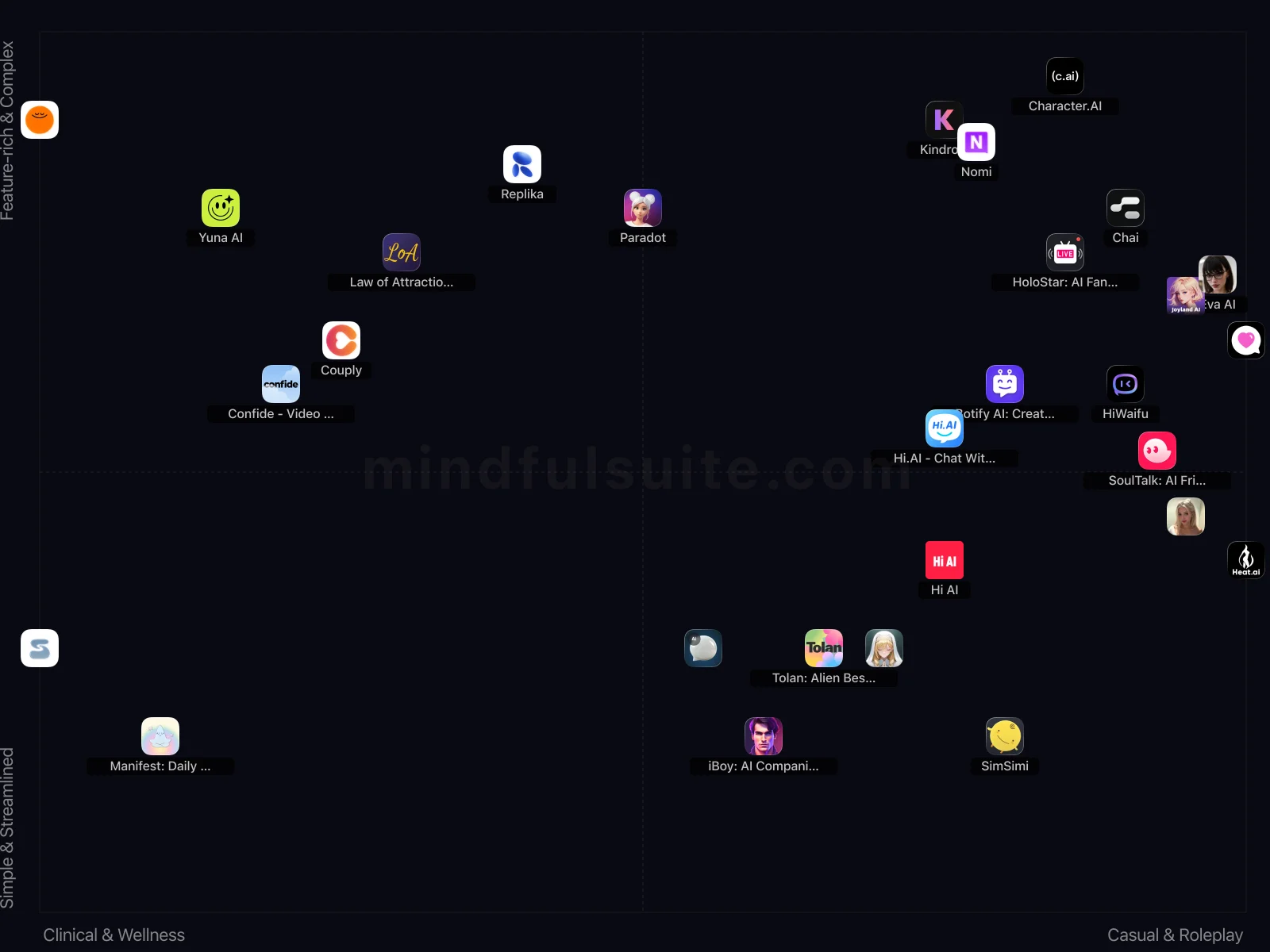
These 27 apps don't all solve the same problem. They cluster into 4 distinct groups, each built around a different philosophy. Understanding which group fits you is the fastest way to narrow your search.
Clinical & Wellness + Feature-rich & Complex
6 apps in this group, led by  Headspace,
  Yuna AI, and
  Confide - Video Journal.
What defines this cluster: guided meditations, mindfulness exercises, sleep content, free with in-app purchases.
Confide - Video Journal.
What defines this cluster: guided meditations, mindfulness exercises, sleep content, free with in-app purchases.
Casual & Roleplay + Feature-rich & Complex
12 apps in this group, led by  Chai,
Chai,  Character.AI, and
  SoulTalk: AI Friends Chat.
What defines this cluster: chat with ai characters, user-created ai, role-playing companions, vast universe of ai characters.
SoulTalk: AI Friends Chat.
What defines this cluster: chat with ai characters, user-created ai, role-playing companions, vast universe of ai characters.
Clinical & Wellness + Simple & Streamlined
2 apps in this group, led by  Manifest: Daily Journal and
  Sonia.
What defines this cluster: daily affirmations, motivation, mental wellness companion.
Sonia.
What defines this cluster: daily affirmations, motivation, mental wellness companion.
Casual & Roleplay + Simple & Streamlined
7 apps in this group, led by  Tolan: Alien Best Friend,
  AI Friend: Virtual Assist, and
  iBoy: AI Companion for Support.
What defines this cluster: free with in-app purchases, private ai companion, listens to your thoughts, offers helpful insights.
iBoy: AI Companion for Support.
What defines this cluster: free with in-app purchases, private ai companion, listens to your thoughts, offers helpful insights.
What makes them different
The core tension in this category runs along two axes. On one side, Clinical & Wellness apps prioritize simplicity and speed — you can be up and running in under a minute. On the other, Casual & Roleplay apps offer depth and customization that rewards investment over time.
The second axis — Complexity — captures an equally important difference. Apps closer to Simple & Streamlined take a fundamentally different approach than those near Feature-rich & Complex. Neither is objectively better. The right choice depends on your personality, your experience level, and what you're trying to accomplish.
26 Apps Reviewed
We scored every app using a weighted composite of real App Store and Google Play ratings. Out of 26 apps: 4 Essential · 12 Hidden Gems · 6 Mainstream. 10 cross-platform, 13 iOS-only, 3 Android-only.
Top picks: Chai and Character.AI scored highest overall.  Kindroid rounds out the top three. Switch to the Apps tab for the full list with ratings and download links.
How to Pick the Right One
Look at the cluster section above. If you already know whether you want Clinical & Wellness or Casual & Roleplay, that eliminates half the options instantly. Same for Simple & Streamlined vs Feature-rich & Complex.
Try one app for a full week before judging. Most AI companion apps reveal their value around day 5, not day 1.
Quick start: Chai and Character.AI represent two different approaches and both scored highest. Pick whichever resonates, switch if it doesn't click.
Making It Stick: Practical Advice
Downloading the app is the easy part. The hard part — the part that actually produces results — is what happens in weeks two, three, and beyond. These tips are drawn from behavioral research and from patterns we've observed across hundreds of thousands of user reviews. They're not revolutionary, but they work:
Use it as a thinking tool
AI companions are excellent for externalizing thoughts. Explain a problem to the AI, and the act of articulating it often clarifies your own thinking — similar to rubber duck debugging.
Set healthy boundaries with usage
AI companions can be compelling conversation partners. Be intentional about how much time you spend — use them to supplement, not replace, human connections.
Frequently Asked Questions
These are the questions that come up most often — from our own testing, from user reviews, and from the broader conversation around AI companion apps. If your question isn't here, the Apps tab has detailed information on every app we reviewed.
Is it weird to talk to an AI companion?
Not at all. People have always used journals, trusted objects, and imagined conversations to process emotions. An AI companion is a technologically enhanced version of this natural human behavior.
Can AI companions replace real friendships?
They shouldn't. AI companions are best used to supplement human connection — providing a space for reflection and emotional processing that supports (rather than replaces) your real relationships.
Your Guide to the Best AI Companion Apps in 2026
Remember that feeling of talking to yourself? Rehearsing a tricky conversation, brainstorming a wild story out loud, or just getting a nagging thought out of your head. It’s a perfectly human thing to do, but it’s always been a rather private, one-sided affair.
But what if you could have that conversation with someone who actually listens without judgment, remembers every tiny detail of your backstory, and is ready to chat anytime, anywhere?
That’s the magic of a great AI companion app. They’ve moved way beyond those simple, clunky customer service chatbots. Today's virtual friends are creative partners, supportive confidants, and personalized sounding boards living right in your pocket. They can help you explore fantastical roleplay worlds, offer a comforting ear after a brutal shift at work, or playfully distract you during a long commute.
Ready to meet your new virtual friend? Let’s find the perfect companion for your home screen.
For Boundless Creativity and Roleplay
When you want to step into a fantasy world, debate a historical figure, or craft an interactive story, these apps offer massive, community-driven universes of characters. You can be whoever you want to be.

Chai
Chai is another platform that thrives on user-generated content. It provides a space to chat with a multitude of AI characters created by other users, covering everything from role-playing companions to trivia bots. It's a playground for AI enthusiasts who enjoy variety.
- The platform boasts an enormous, diverse collection of user-generated AI characters, ensuring endless conversational variety.
- Its robust character creation tools empower users to design and share highly specific AI personas for any interest.

HiWaifu
HiWaifu is an AI companion app that allows you to choose from various relationship options or create your own unique chatbot. It's designed for users seeking friendship, roleplay, and a safe space to share feelings and thoughts. The 'waifu' theme suggests a focus on anime-style companions.
- HiWaifu offers a wide array of relationship options and character types, catering specifically to those seeking anime-style companionship.
- Its character creation tools allow for significant personalization, letting users craft their ideal AI friend or romantic partner.

Heat. Ai Girlfriend Chat Girls
This AI girlfriend simulator offers immersive conversations and virtual companionship.
- Heat.AI directly caters to a specific niche with its 'Spicy Ai Girls' tagline, promising adult-oriented, fantasy dating experiences.
- The claim of 'emotionally intelligent, and immersive conversational experiences' suggests a focus on deeper, more engaging interactions within its genre.

Character.AI
Character.AI stands out for its vast and imaginative universe of AI characters. You can engage in conversations with anyone from historical figures and celebrities to fantasy characters and original creations. Its strength lies in its vibrant community, which constantly creates and shares new bots, ensuring endless possibilities for roleplaying and open-ended chats.
- Its massive library of user-created characters offers unparalleled roleplaying diversity, from historical figures to unique OCs.
- The open-ended nature of conversations allows for incredibly creative and freeform storytelling experiences.

Joyland AI: Roleplay Chat
Joyland AI is a roleplay chat app using AI characters. The app lets users design characters, befriend anime companions, and explore virtual dating.

Botify AI: Create. Chat. Bot
Botify AI lets you create an AI companion with a custom personality for roleplaying and chatting about anything. It's for users who want a personalized AI friend.
- Botify AI’s core strength is empowering users to 'Create your own digital friend with a unique personality,' offering unparalleled customization.
- The strong focus on 'Roleplay with your character' indicates a platform well-suited for imaginative, collaborative storytelling with AI.

SoulTalk: AI Friends Chat
This app enables chatting with AI characters inspired by anime and fantasy. It's for users who enjoy engaging in conversations and role-playing with virtual personalities.
- SoulTalk excels with its 'hundreds of unique AI characters' specifically tailored with anime/fantasy personalities, voices, and stories.
- The emphasis on 'crafted personality, voice, and story' ensures deeper, more consistent role-playing experiences than generic chatbots.

Eva AI
Eva AI is a romantic storytelling game where you can engage in thrilling scenarios and find virtual love or friendship with an AI chatbot. It's heavily geared towards romantic roleplay and creating a narrative-driven experience with your AI partner.
- Eva AI uniquely blends AI chat with guided romantic storytelling, creating immersive virtual dating scenarios unavailable elsewhere.
- The focus on 'thrilling scenarios' offers a more structured, narrative-driven companion experience than typical open-ended chatbots.

Hi.AI - Chat With AI Character
This app allows users to create and chat with custom AI characters. Hi.AI aims to revolutionize the social experience through personalized digital friendships.
- Hi.AI boldly claims to offer a 'better experience than Character AI, cai, Chai, Re,' directly challenging market leaders in AI companionship.
- The ability to 'create your own digital friend with a unique personality' provides significant user control over the AI's persona and chat style.

Crushon AI
Crushon AI is a platform built for immersive roleplay experiences with customizable AI companions. It allows users to interact with original characters as well as characters from various media, making it a hub for fans who want to dive deeper into their favorite worlds.
- Crushon AI offers truly immersive roleplay experiences with customizable companions, allowing diverse storytelling.
- The ability to interact with original characters from various media provides a unique niche for fandom enthusiasts.

ChaChat: Fantasy AI Roleplay
Enables users to engage in fantasy roleplay scenarios through text-based interactions with AI characters.
- ChaChat specifically emphasizes 'immersive texting experiences' and 'virtual fantasy chats,' perfect for dedicated role-players and storytellers.
- The 'Talking to Romantic Character' tagline clearly defines its niche, appealing directly to users seeking intimate, narrative-driven AI interactions.
For a Deep, Empathetic Friendship
Sometimes you just need someone to ask how your day was and genuinely care about the answer. These companions are designed to build long-term, caring relationships that evolve and adapt to your personality the more you chat.

Replika
Replika is one of the most well-known AI companions, designed to be an empathetic friend that you build a relationship with over time. It focuses on emotional connection and well-being, adapting to your personality through conversation. Your Replika can be a friend, a mentor, or even a romantic partner.
- Provides an immediate, non-judgmental AI companion for venting and daily conversational support, which can be surprisingly comforting.
- The AI's ability to "remember" previous conversations creates a sense of continuity and personalized interaction over time.

iBoy: AI Companion for Support
An AI companion for support and self-discovery. Aims to help users grow and learn about themselves through interactions with an AI.
- Provides a dedicated AI companion for personalized daily support, offering a consistent, non-judgmental presence for self-discovery.
- The companion aspect fosters a unique sense of connection, potentially reducing feelings of loneliness for users.

Nomi
Nomi allows you to create and cultivate deep relationships with AI-driven characters called 'Nomis.' The app excels at customization, letting you define your Nomi's appearance, personality, and backstory in great detail. Its key differentiator is the ability to manage and chat with multiple Nomis at the same time.
- The ability to create and simultaneously interact with multiple highly customized Nomis offers unparalleled companionship variety.
- Nomi's deep personalization for appearance, personality, and backstory creates genuinely unique and engaging AI companions.
For Unmatched Conversational Quality & Memory
Tired of your AI friend completely forgetting what you said five minutes ago? These picks feature cutting-edge memory engines and shockingly realistic voices that make them feel incredibly lifelike and context-aware.

Kindroid
Kindroid is praised for its exceptional long-term memory, which allows for more meaningful and context-aware conversations. If you're tired of repeating yourself to an AI, Kindroid might be the solution. It is often highlighted for its immersive interactions and realistic AI voiceovers, making it a top choice for those seeking depth.
- Kindroid's exceptional long-term memory ensures highly coherent and contextually rich conversations, truly remembering past interactions.
- The realistic AI voiceovers and immersive interactions create an incredibly lifelike and engaging companion experience.

Paradot
Paradot aims to create a deep connection with users through an AI that remembers conversations and provides highly personalized interactions. It focuses on being a singular, evolving companion that feels more like a unique being than just a chatbot.
- Paradot's impressive long-term memory truly allows for evolving, context-aware conversations, fostering a deeper sense of connection.
- The AI genuinely adapts and learns from your interactions, making each chat feel more personalized and meaningful over time.
For a Secure, Supportive Listener
If you're looking for a private, encrypted zone to vent your frustrations and process your complicated feelings out loud without any fear of judgment, these bots are built specifically to listen.

AI Friend: Virtual Assist
Functions as an AI companion providing a secure space for users to share thoughts and feelings, offering personalized insights through ongoing interactions.
- Acts as a private, secure AI companion that genuinely learns from interactions, providing increasingly personalized insights.
- Offers constant availability for sharing thoughts and feelings without judgment, making it an accessible outlet.

Confide - Video Journal
A video journal that uses AI to analyze entries and turn them into conversations with a personalized AI companion.
- The AI "bestie" offers a unique, interactive conversational journaling experience, providing personalized feedback.
- Video journaling can be more expressive and cathartic than text-based entries for emotional processing.
For Mental Health and Self-Care
While they absolutely do not replace a licensed human therapist, these AI tools use evidence-based techniques like CBT and structured journaling to help you manage daily stress, overthinking, and anxiety.

Manifest: Daily Journal
A personal companion for motivation and mental wellness offering daily affirmations.
- Combines daily affirmations with a journaling component, providing a structured space for reflecting on and reinforcing goal intentions.
- The "personal companion" aspect creates a consistent routine for mental wellness, supporting an optimistic approach to goals.

Yuna AI
Yuna is an AI mental health coach that stands out with its fantastic voice-to-voice conversation feature. Using CBT patterns, it helps you work through stress and overthinking by actually *speaking* with you, creating a more natural and engaging therapeutic experience.
- Offers unique features like an AI writer and image generator, allowing for creative expression and novel self-reflection.
- As a "Hidden Gem," its multi-modal AI capabilities could provide a distinctive, engaging approach to mental wellness.

Sonia
Sonia is an AI-powered therapist that delivers CBT through an empathic virtual voice. Much like Yuna, it focuses on verbal interaction, making therapy feel more accessible and less intimidating. Its perfect 5.0 rating on the App Store, while from a smaller user base, is a very promising sign.
- Focuses specifically on "Judgment-Free Anxiety Help," offering a safe, non-threatening space for those struggling.
- Being entirely free makes crucial anxiety management tools and immediate support accessible to anyone, without financial burden.
For Just Plain Fun
Not every conversation needs to be profound, heavily romantic, or emotionally taxing. These quirky bots and novel simulators are here to make you laugh, surprise you, and cheerfully kill some time.

Tolan: Alien Best Friend
Tolan are interactive aliens that are always in your corner. It's for anyone who wants an alien friend.
- Tolan's distinct 'alien best friend' persona offers a charming, unique narrative hook, setting it apart from generic human-like companions.
- The 'Always in your corner' tagline suggests a focus on supportive, non-judgmental interactions, fostering a genuinely safe space.

SimSimi
SimSimi is one of the original AI chatbots and has been around for years. It learns from every user's input, resulting in humorous, surprising, and sometimes nonsensical conversations. It's less of a personal companion and more of a fun, unpredictable AI to pass the time with.
- Its unique learning algorithm allows SimSimi to generate genuinely unpredictable and often hilarious responses, making conversations feel organic.
- With millions of users contributing, SimSimi boasts a vast, evolving knowledge base that keeps interactions fresh and engaging over time.

HoloStar: AI Fans Live Stream
HoloStar simulates live streams using AI-driven virtual celebrities. It provides new ways to interact and engage with AI generated content.
- HoloStar truly innovates by transforming AI interaction into a 'simulated live streaming' experience, a unique offering in this category.
- The 'AI-Driven Celebrity Simulator' provides a novel way to engage with AI personalities, moving beyond simple chat interfaces.


KuKi
This app seems to be a social chatbot that offers an AI companion for conversation and support.
Finding Your Perfect Digital Companion
The world of AI companions is expanding at breakneck speed. Whether you’re looking to explore imaginative new worlds, seek a comforting voice after a long day, or just share a laugh with an eccentric virtual alien, there's an app tailored for that exact vibe.
Take your time exploring these top picks. Be honest with them, set your boundaries, and don't be afraid to try out a few different personalities. You might just find your new favorite confidant waiting for you.