
Noise Blocker Apps: What You Need to Know in 2026
The neighbor's dog. Construction down the street. Your partner's snoring. Traffic noise that never stops. You can't always control the sounds around you, but you can control what you hear. Noise blocker apps use white noise, brown noise, and active sound masking to create a personal bubble of acoustic calm.
We evaluated 19 noise blocker apps across iOS and Android, scoring each on real user ratings, feature depth, and long-term value. This guide covers what we found.
Noise Isn't Just Annoying — It's a Health Issue
The World Health Organization does not typically concern itself with annoyances. When it identifies environmental noise as a major public health risk — second only to air pollution in Europe — it is talking about measurable physiological damage, not mere irritation.
The health effects of chronic noise exposure are documented across dozens of large-scale epidemiological studies, and the findings are consistent. Sustained exposure to noise above 65 decibels — roughly the level of a busy street or a loud conversation — elevates cortisol production. Cortisol is the body's primary stress hormone, and chronic elevation is associated with impaired immune function, weight gain, cardiovascular disease, and cognitive decline. You do not need to feel stressed by the noise for these effects to occur. Your body reacts to acoustic stimulation whether you are consciously bothered by it or not.
Sleep disruption is perhaps the most consequential effect. Noise during sleep does not need to wake you to cause harm. Sounds above 40 decibels — well below the threshold of waking — can shift the brain out of deep sleep into lighter stages, fragmenting the architecture of your sleep cycle without your knowledge. You wake up feeling unrested without understanding why. Over months and years, this fragmentation compounds into chronic sleep debt with cascading effects on mood, cognition, and metabolic health.
The cardiovascular evidence is particularly alarming. A 2018 study published in the European Heart Journal found that road traffic noise exposure was independently associated with increased risk of heart attack, stroke, and heart failure. The mechanism is the sustained cortisol elevation and sympathetic nervous system activation described above — your cardiovascular system pays the price for your brain's constant noise monitoring.
Children are especially vulnerable. Studies of school performance near airports and highways consistently show that children chronically exposed to environmental noise have measurably impaired reading comprehension, memory, and standardized test performance compared to matched controls in quieter environments.
This context reframes noise blocker apps from a comfort product to a health intervention. For people living on busy streets, in thin-walled apartments, or near construction, consistent sound masking is not an indulgence. It is health infrastructure, addressing a documented risk factor with a simple, accessible tool.
Sound Masking vs Active Noise Cancellation: Different Technologies, Different Uses
These two approaches to noise reduction are frequently confused, but they work through entirely different mechanisms and excel in different situations. Understanding the distinction helps you build the right setup for your environment.
Sound masking — the approach used by noise blocker apps — works by addition. The app generates consistent audio (white noise, pink noise, nature sounds) that raises the ambient sound floor. Disruptive noises become less noticeable not because they are quieter but because the contrast between the noise and the background has been reduced. Think of it like adding background music to a restaurant: the clatter of dishes does not stop, but it no longer stands out. This approach is effective against irregular, mid-to-high-frequency sounds — voices, doors closing, dogs barking, keyboard clacking — because these are the sounds that the brain's orienting response finds most disruptive.
Active noise cancellation — the hardware-based approach built into headphones like the AirPods Pro, Sony WH-1000XM series, and Bose QuietComfort — works by subtraction. Microphones capture ambient sound, the processor generates an inverse sound wave, and the two waves cancel each other out through destructive interference. ANC is remarkably effective against consistent low-frequency sounds: airplane engine drone, HVAC rumble, traffic hum, train vibration. It is less effective against irregular, high-frequency sounds — the sudden voice, the door slam — because the processor cannot generate an inverse wave quickly enough for transient noises.
This complementary profile is the key insight. ANC handles the low-frequency drone that masking apps struggle with. Masking handles the irregular mid-frequency intrusions that ANC struggles with. The optimal noise reduction setup, for anyone in a genuinely noisy environment, is both: ANC headphones providing a foundation of low-frequency silence, with a masking app layering consistent ambient sound on top to smooth out the remaining mid-and-high-frequency disruptions.
The combined effect is greater than either technology alone. ANC removes the rumble. Masking removes the spikes. What remains is a controlled, consistent auditory environment that your brain can safely ignore — freeing cognitive resources for whatever you actually want to focus on.
A Note on Tinnitus: How Masking Apps Can Help
Tinnitus — the perception of sound (typically ringing, buzzing, or hissing) in the absence of an external source — affects between 10 and 15 percent of the adult population. For most, it is a mild annoyance. For a significant minority, it is a condition that disrupts sleep, impairs concentration, and degrades quality of life. There is no cure. But sound masking is one of the most effective and accessible management strategies available.
The mechanism is straightforward. Tinnitus is most noticeable and most distressing in quiet environments, because there is no competing auditory input. The phantom sound has the stage to itself. Sound masking introduces competing input that reduces the perceived loudness and salience of the tinnitus signal. The tinnitus does not disappear — it is still there — but it recedes from the foreground of awareness into the background, like a faint star that becomes invisible when the lights come on.
The most effective masking for tinnitus is frequency-matched — meaning the masking sound is tuned to overlap with the frequency of your tinnitus. If your tinnitus is a high-pitched ring at roughly 6000 Hz, a masking sound with significant energy at that frequency will be more effective than one concentrated at lower frequencies. Several noise blocker apps now offer frequency-adjustable masking specifically for tinnitus management, allowing you to fine-tune the sound profile to your particular tinnitus frequency.
Some clinical approaches go further. Notched sound therapy plays audio with the tinnitus frequency specifically removed, which some research suggests may reduce tinnitus perception over time through neural plasticity. Tinnitus retraining therapy combines low-level broadband noise with counseling to habituate the brain to the tinnitus signal. Both of these have stronger evidence than simple masking for long-term management, but they typically require professional guidance.
An important caveat: tinnitus can occasionally indicate an underlying medical condition — hearing loss, circulatory problems, or rarely, a tumor. Anyone experiencing new or changing tinnitus should get an audiological evaluation before relying solely on an app. That said, for the millions of people with stable, idiopathic tinnitus (tinnitus with no identifiable cause), a masking app used at night and during quiet work periods can meaningfully improve daily life. It is not a cure. It is not a substitute for medical evaluation. But it is a tool that works, immediately and reliably, for a condition that otherwise has few good options.
4 Types of Noise Blocker Apps — and How They Differ
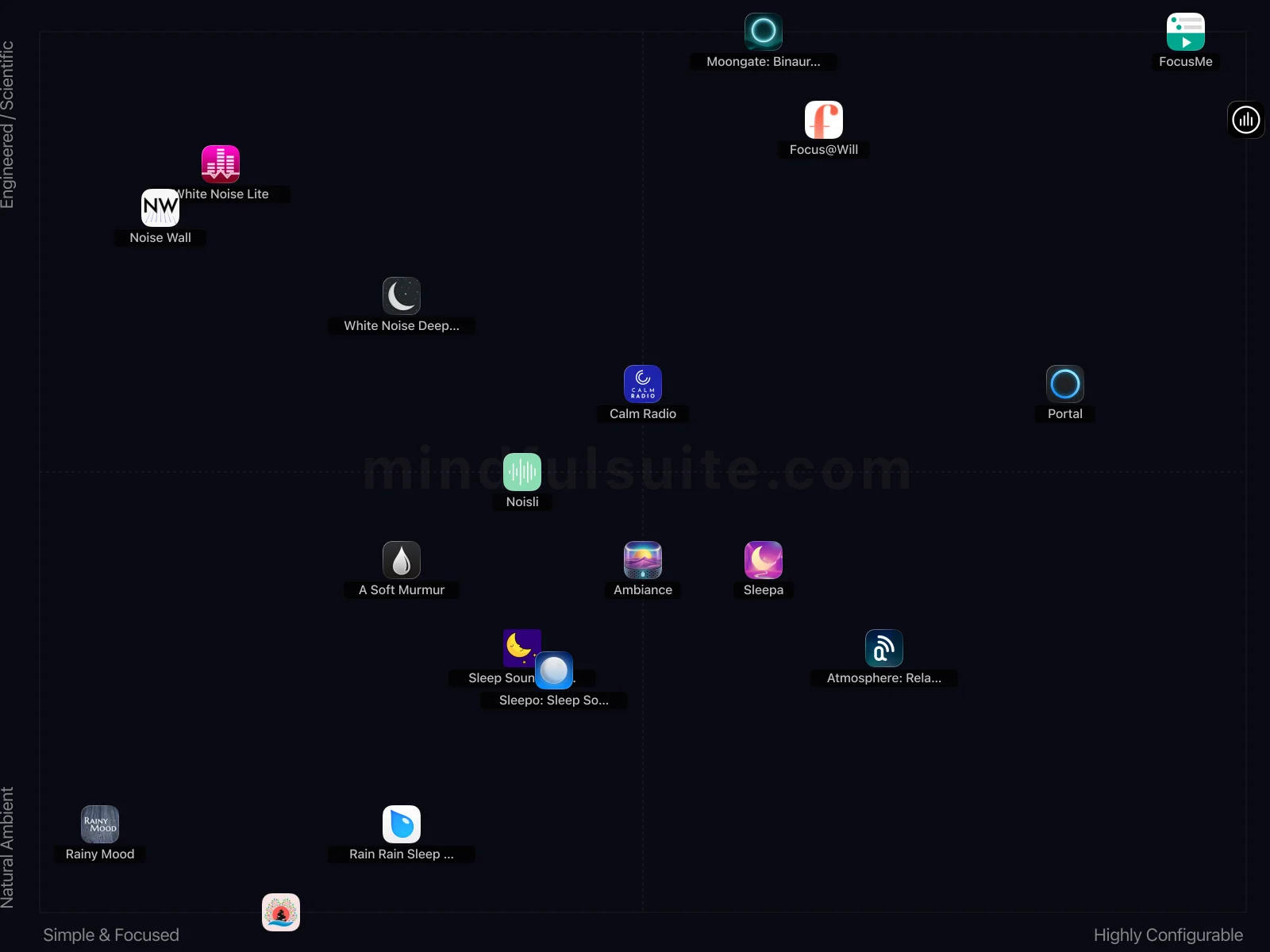
These 16 apps don't all solve the same problem. They cluster into 4 distinct groups, each built around a different philosophy. Understanding which group fits you is the fastest way to narrow your search.
Simple & Focused + Engineered / Scientific
4 apps in this group, led by  White Noise Deep Sleep Sounds,
  White Noise Lite, and
  Noise Wall.
What defines this cluster: calming sleep sounds, looping sounds, sleep and relaxation aid, generates white noise.
Noise Wall.
What defines this cluster: calming sleep sounds, looping sounds, sleep and relaxation aid, generates white noise.
Highly Configurable + Engineered / Scientific
3 apps in this group, led by  Calm Radio,
  Portal, and
  Focus@Will.
What defines this cluster: sleep music channels, meditation music channels, nature sounds, focus enhancement.
Focus@Will.
What defines this cluster: sleep music channels, meditation music channels, nature sounds, focus enhancement.
Simple & Focused + Natural Ambient
6 apps in this group, led by  Rain Rain Sleep Sounds,
  Nature Sounds - Relax & Sleep, and
  Rainy Mood.
What defines this cluster: relaxation aid, rain sounds, nature sounds, sleep aid.
Rainy Mood.
What defines this cluster: relaxation aid, rain sounds, nature sounds, sleep aid.
Highly Configurable + Natural Ambient
3 apps in this group, led by  Atmosphere: Relaxing Sounds,
  Ambiance, and
  Sleepa.
What defines this cluster: relaxing sounds, custom soundscape creation, for sleep and meditation, white noise.
Sleepa.
What defines this cluster: relaxing sounds, custom soundscape creation, for sleep and meditation, white noise.
What makes them different
The core tension in this category runs along two axes. On one side, Simple & Focused apps prioritize simplicity and speed — you can be up and running in under a minute. On the other, Highly Configurable apps offer depth and customization that rewards investment over time.
The second axis — Design Approach — captures an equally important difference. Apps closer to Natural Ambient take a fundamentally different approach than those near Engineered / Scientific. Neither is objectively better. The right choice depends on your personality, your experience level, and what you're trying to accomplish.
19 Apps Reviewed
We scored every app using a weighted composite of real App Store and Google Play ratings. Out of 19 apps: 5 Essential · 8 Hidden Gems · 1 Mainstream. 10 cross-platform, 7 iOS-only, 2 Android-only.
Top picks: White Noise Deep Sleep Sounds and White Noise Lite scored highest overall. Atmosphere: Relaxing Sounds rounds out the top three. Switch to the Apps tab for the full list with ratings and download links.
How to Pick the Right One
Look at the cluster section above. If you already know whether you want Simple & Focused or Highly Configurable, that eliminates half the options instantly. Same for Natural Ambient vs Engineered / Scientific.
Try one app for a full week before judging. Most noise blocker apps reveal their value around day 5, not day 1.
Quick start: White Noise Deep Sleep Sounds and White Noise Lite represent two different approaches and both scored highest. Pick whichever resonates, switch if it doesn't click.
Making It Stick: Practical Advice
Downloading the app is the easy part. The hard part — the part that actually produces results — is what happens in weeks two, three, and beyond. These tips are drawn from behavioral research and from patterns we've observed across hundreds of thousands of user reviews. They're not revolutionary, but they work:
Experiment with noise colors
White noise is the most common, but brown noise (deeper, more rumbling) is often preferred for sleep. Pink noise is a balanced middle ground. Try each for a few nights.
Volume matters — keep it moderate
The goal is to mask disruptive sounds, not overpower them. Set volume just high enough to blur the edges of environmental noise.
Frequently Asked Questions
These are the questions that come up most often — from our own testing, from user reviews, and from the broader conversation around noise blocker apps. If your question isn't here, the Apps tab has detailed information on every app we reviewed.
What's the difference between white, pink, and brown noise?
White noise has equal energy across all frequencies (like TV static). Pink noise emphasizes lower frequencies (like steady rain). Brown noise is even deeper (like a rumbling waterfall). Many people find pink or brown noise more comfortable for sleep.
Is sleeping with noise playing all night safe?
At moderate volumes, yes. Keep the volume at a level you can easily talk over. Consistently high volumes can potentially affect hearing over time. Most apps include guidance on appropriate volume levels.
The Ultimate Guide to the Best Noise Blocker Apps (2026)
You know the feeling. You finally sit down with a fresh cup of coffee, ready to tackle that big project you've been putting off. Then, right on cue, the neighbor’s leaf blower roars to life. Or maybe you're lying in bed at 2 AM, desperately trying to ignore the muffled bass of a car parked three streets over. We can't always control the chaos of the outside world, but we can build a fortress against it.
Our phones and computers have become incredibly powerful tools for taking back our auditory space. Instead of stuffing in foam earplugs and hoping for the best, you can now craft the exact environment you need. Whether you want to drown out office chatter with a solid wall of brown noise, drift off to a gentle thunderstorm, or find your flow state with scientifically tuned frequencies, there’s an app ready to serve as your digital sanctuary.
Here are the best noise-blocking apps to help you tune out the world.
Pure Noise: When You Just Need to Mask Everything
Sometimes you don't want a symphony of chirping birds or a crackling fire. You just want a solid, predictable wall of sound to swallow up distracting noises. These apps specialize in straightforward, highly effective noise generation.

Present
A beautiful meditation timer featuring 100+ soundscapes and 6 bell themes to help you find stillness anywhere.
- Over 100 high-quality nature and ASMR soundscapes.
- Minimalist design that stays out of your way.
- Available as a Chrome extension for working peacefully.

White Noise Deep Sleep Sounds
This app offers a wide selection of calming sounds, including various types of white noise, to help you fall asleep and stay asleep.
- Offers a truly vast library of white noise and natural sounds, ensuring everyone finds their preferred sleep aid.
- The simple, uncluttered interface makes finding and playing desired sounds incredibly straightforward.

White Noise Lite
Sometimes, the simplest solution is the best one. White Noise Lite does one thing and does it brilliantly: it masks distracting noises. Whether it's city traffic or a noisy neighbor, you can drown it out with a library of calming sounds like a crackling fire, ocean waves, or a classic box fan.
- Offers a diverse selection of high-quality, looping ambient sounds, including unique options like "Oscillating Fan."
- The timer and alarm features are robust and free, allowing precise control over sound duration and waking.

Noise Wall
It generates white, pink, and brown noise to mask background sounds for focus or sleep.
- Delivers pure, effective white, pink, and brown noise generation, ideal for straightforward background sound masking.
- The minimalist interface focuses solely on noise generation, providing a distraction-free experience for simple needs.
The Sound Mixers: Build Your Own Sonic Bubble
Why settle for a plain rain track when you can have rain on a tin roof, a distant rumble of thunder, and the subtle clinking of a coffee shop? These apps let you play audio DJ, blending multiple ambient tracks together until you find the exact mix that puts your brain at ease.

myNoise
MyNoise is for the true sound connoisseur. It's less of a sound library and more of a sound laboratory, offering an incredible level of customization. Each sound generator—from a calming temple bell to the rumble of a spaceship engine—comes with frequency sliders that let you shape the sound to perfectly match your hearing and preferences. It’s a uniquely powerful tool for creating a personal sonic sanctuary.
- Offers an unparalleled variety of highly customizable sound generators, from white noise to temple bells, with fine-tuned sliders.
- The unique "calibration" feature personalizes frequencies to your hearing, truly optimizing the sound experience.

Atmosphere: Relaxing Sounds
Atmosphere provides a wide variety of relaxing sounds that can be mixed to create personalized soundscapes for sleep, meditation, or focus.
- Allows extensive customization by mixing a wide range of ambient sounds to create truly personalized soundscapes.
- The high-quality sound library and intuitive mixing interface make it superior for creating perfect background noise.

Sleepa
Sleepa provides a great collection of HD sounds that can be mixed into the perfect relaxing ambiences for sleep or focus.
- The collection of HD sounds is impressive and can be effectively blended to create custom, relaxing ambiences.
- Its intuitive mixing interface makes combining multiple sounds and adjusting volumes incredibly simple for users.

A Soft Murmur
A straightforward and elegant ambient sound app that lets you mix various sounds like rain, thunder, waves, and coffee shops to create a calming atmosphere.
- The minimalist interface makes mixing ambient sounds incredibly simple and frustration-free, a breath of fresh air.
- Its focus on a core set of quality ambient sounds prevents overwhelming choices, perfect for quick relaxation.

Noisli
Noisli is your minimalist escape hatch for focus or relaxation. With a beautifully simple interface, you can mix high-quality sounds like a bustling coffee shop with gentle rain or crackling fire. It’s perfect for creating a distraction-free bubble to work in by day or a serene cocoon to sleep in by night.
- Empowers users to fully customize soundscapes by mixing multiple distinct sounds with individual volume controls.
- Features a clean, minimalist design that effectively highlights the sound-mixing functionality without distractions.
Nature Calls: Rain, Thunder, and Immersive Escapes
There’s a reason humans have been falling asleep to the sound of rainfall for millennia. It just works. These apps specialize in high-fidelity nature recordings, transporting you from a noisy apartment directly to a quiet forest or a stormy coastline.

Rain Rain Sleep Sounds
As the name suggests, this app specializes in high-quality rain and other nature sounds to aid with sleep and relaxation.
- Specializes in an extensive, high-quality collection of rain and storm sounds, offering nuances like "Rain on Tent."
- The simple, focused interface makes it incredibly easy to find and play your preferred rain sound quickly.

Portal
An iOS app that delivers immersive, spatial audio soundscapes from beautiful locations around the world, combined with smart lighting integration.
- Integrates dynamic soundscapes with stunning visuals, creating a truly immersive sensory experience.
- Features scientifically-backed sound frequencies and binaural beats specifically for focus and sleep.

Nature Sounds - Relax & Sleep
This provides nature sounds to relax and improve sleep quality, useful for insomnia sufferers.

Rainy Mood
The original rain sound generator, Rainy Mood provides the simple, calming sound of rain to help you sleep, study, or relax.
- Delivers a single, extremely high-quality rain sound that genuinely aids focus and relaxation effectively.
- It's completely free with no hidden costs or paywalls, offering its core feature without interruption.
Science-Backed Audio: Music & Brainwaves
If standard white noise leaves you feeling uninspired, these tools take a different approach. They use specific frequencies, binaural beats, and meticulously engineered music channels designed specifically to alter your brain state for deep focus or deep sleep.

Calm Radio
Calm Radio offers various calming music channels for sleep, meditation, and relaxation. It features a wide selection of nature sounds, sleep music, and meditation music.
- Provides a refreshing alternative with a curated selection of ambient music channels, not just basic white noise.
- The ability to blend multiple sound layers creates a unique, customizable audio experience.

Moongate: Binaural Beats
Uses science-backed sound therapy to help users fall asleep, release anxiety, and stay focused. It's for individuals seeking help with sleep, anxiety, and focus through binaural beats and frequency healing sounds.
- Leverages "science-backed sound therapy" like binaural beats to specifically target focus, anxiety, and sleep improvement.
- The impressive 4.8★ Android rating from 23,000 users indicates its effectiveness and user satisfaction.

Focus@Will
It provides scientifically optimized music designed to enhance focus and improve productivity.
- Provides unique, scientifically-backed instrumental music channels specifically designed to enhance focus and reduce distractions.
- The diverse range of genre-specific focus channels caters to individual auditory preferences for optimal concentration.
Massive Sound Libraries for Any Mood
For the folks who get bored easily and want an endless catalog to explore. One night you might want a bubbling brook, and the next you might need the rhythmic hum of a vintage box fan. These apps bring sheer volume and variety.

Ambiance
A soundscape app with a diverse library of sounds to help you focus, relax, or sleep.
- Boasts an exceptionally diverse and extensive library of high-quality sounds available entirely for free.
- The ability to download and manage sound files locally is a huge benefit for offline use.

Sleep Sounds - relax melodies
This app provides a library of relaxing sounds, including nature sounds, white noise, and brainwave frequencies. It's for anyone who wants to create a custom soundscape to help them fall asleep.

Sleepo: Sleep Sounds
This app offers sleep sounds and white noise to promote relaxation. It's for users who have trouble falling asleep or getting a good night's rest.