
Daily Check-in Apps: What You Need to Know in 2026
"How are you?" you ask yourself. "Fine," your autopilot responds. But are you really? Daily check-in apps take 30 seconds to break through that autopilot and get a genuine read on how you're actually doing — your mood, energy, stress, and what's on your mind. It's the simplest possible self-awareness practice.
We evaluated 15 daily check-in apps across iOS and Android, scoring each on real user ratings, feature depth, and long-term value. This guide covers what we found.
The 30-Second Pulse Check: Why Brief Self-Assessment Is Powerful
You do not need to journal for 20 minutes to benefit from self-reflection. You do not need to sit in quiet contemplation, light a candle, or find your center. You need 30 seconds and a structured prompt. That is the entire premise of daily check-in apps, and the research behind it is more robust than the simplicity might suggest.
A structured check-in — rate your mood, rate your energy, write one sentence about what is on your mind — accomplishes two things simultaneously. First, it interrupts autopilot. Most people move through their days on a kind of emotional cruise control, vaguely aware of how they feel but not examining it. The check-in forces a brief moment of honest self-assessment: not how you think you should feel or how you felt an hour ago, but how you feel right now. This momentary interruption of automatic processing is a micro-version of the metacognitive awareness that mindfulness meditation cultivates over much longer periods.
Second, it creates a data point. A single data point is not very informative. But 30 data points — one month of daily check-ins — form a dataset that reveals patterns no amount of retrospective self-analysis could surface. Human memory for our own emotional states is notoriously unreliable. We overweight recent and intense experiences. We reconstruct the past to match our current narrative. We forget the baseline days entirely. A log of actual, in-the-moment ratings corrects for all of these biases.
The accumulated dataset is where the power lives. After 30 days, you can see that your energy consistently dips on Wednesdays (the day after your late Tuesday meetings). You can see that your mood is reliably higher on days you exercised. You can see that your stress spikes on the first of each month (when bills are due). These patterns would take months of therapy sessions to surface through conversation alone — not because therapists are slow, but because the data is simply not available through retrospective recall.
The 30-second investment compounds. It is one of the highest return-on-time-invested practices available in the self-improvement space, precisely because it is small enough to sustain and systematic enough to produce genuine insight.
Morning, Midday, Evening: What Each Check-In Captures
A single daily check-in is valuable. Three daily check-ins, timed to capture distinct phases of your day, produce a qualitatively different kind of self-knowledge. The difference is the emotional arc — the trajectory from morning to evening that reveals how your day unfolds rather than just how it ends.
The morning check-in captures your baseline. How did you sleep? What is your energy level before the day has acted on you? What is your anticipatory mood — are you looking forward to the day, dreading it, or neutral? Morning data is particularly useful for isolating the effects of sleep. If your morning mood and energy consistently correlate with sleep duration or quality (and they almost certainly will), that correlation becomes a powerful motivator for better sleep habits because you can see the immediate, day-to-day impact.
The midday check-in captures your response to the day's events. Energy has shifted — up or down — from the morning baseline. Mood has been influenced by interactions, tasks, surprises, and stressors. The midday data point is where the day's impact becomes visible. Over time, midday check-ins reveal which types of mornings (meetings-heavy, deep-work-focused, social, solitary) leave you most energized or depleted by noon.
The evening check-in is the summary assessment. How was the day overall? What drained you? What energized you? What, if anything, are you grateful for? Evening data carries the most narrative weight — it is your verdict on the day. But it is also the most subject to recency bias, which is precisely why the morning and midday data points are important as correctives. A day that ended badly may have been mostly good; the evening check-in alone would miss that.
Three check-ins per day produce 90 data points per month. That density of data supports analysis that single daily check-ins cannot: time-of-day patterns, energy curves, the relationship between morning state and evening outcome. Some apps visualize this as a daily arc — a line that rises and falls through your three data points, showing at a glance whether your days tend to start strong and fade, build momentum through the afternoon, or crash after lunch.
The commitment is roughly 90 seconds per day total. The insight it produces is disproportionately large.
Avoiding Check-In Fatigue: When Less Tracking Is More
There is a predictable pattern in the self-tracking world. A person discovers the value of tracking, becomes enthusiastic, and immediately begins logging everything: mood, energy, stress, sleep hours, sleep quality, exercise type, exercise duration, meals, water intake, caffeine, alcohol, social interactions, screen time, and gratitude. The tracking itself becomes a 15-minute daily obligation. Within three to six weeks, the entire system collapses under its own weight. The person stops tracking entirely and concludes that "tracking doesn't work for me."
Tracking works. Over-tracking does not. The distinction matters because the failure mode is so consistent and so preventable.
The fix is deliberately starting with less than you think you need. One metric — mood — is enough to begin. A single mood rating, logged once or twice a day, takes under 10 seconds and is sustainable for months because the effort is genuinely trivial. After two or three weeks, when the habit of checking in has become automatic (you do it without thinking about whether to do it), you can add a second dimension. Energy is a natural complement to mood — together they capture the two axes most relevant to daily well-being. If that feels sustainable for another few weeks, add a third: sleep quality, stress, or a custom metric relevant to your life.
The principle is progressive loading, borrowed from strength training. You do not walk into a gym on day one and attempt your maximum deadlift. You start with a manageable weight, build the habit and the capacity, and add load gradually. Check-in tracking follows the same logic. The sustainable maximum for most people is three to four tracked dimensions plus an optional brief note. Beyond that, the logging burden exceeds the insight value for all but the most dedicated quantified-self enthusiasts.
Equally important: drop any metric you stop finding useful. If you tracked water intake for a month and learned nothing interesting, stop tracking it. The data is not valuable for its own sake — it is valuable only when it produces insights that change your behavior. A metric that tells you nothing new is not neutral; it is a friction cost that makes the entire tracking practice slightly less likely to survive.
The goal is a sustainable minimum — the smallest set of inputs that produces actionable self-knowledge over months, not an ambitious maximum that produces comprehensive data for three weeks before the whole system gets abandoned.
4 Types of Daily Check-in Apps — and How They Differ
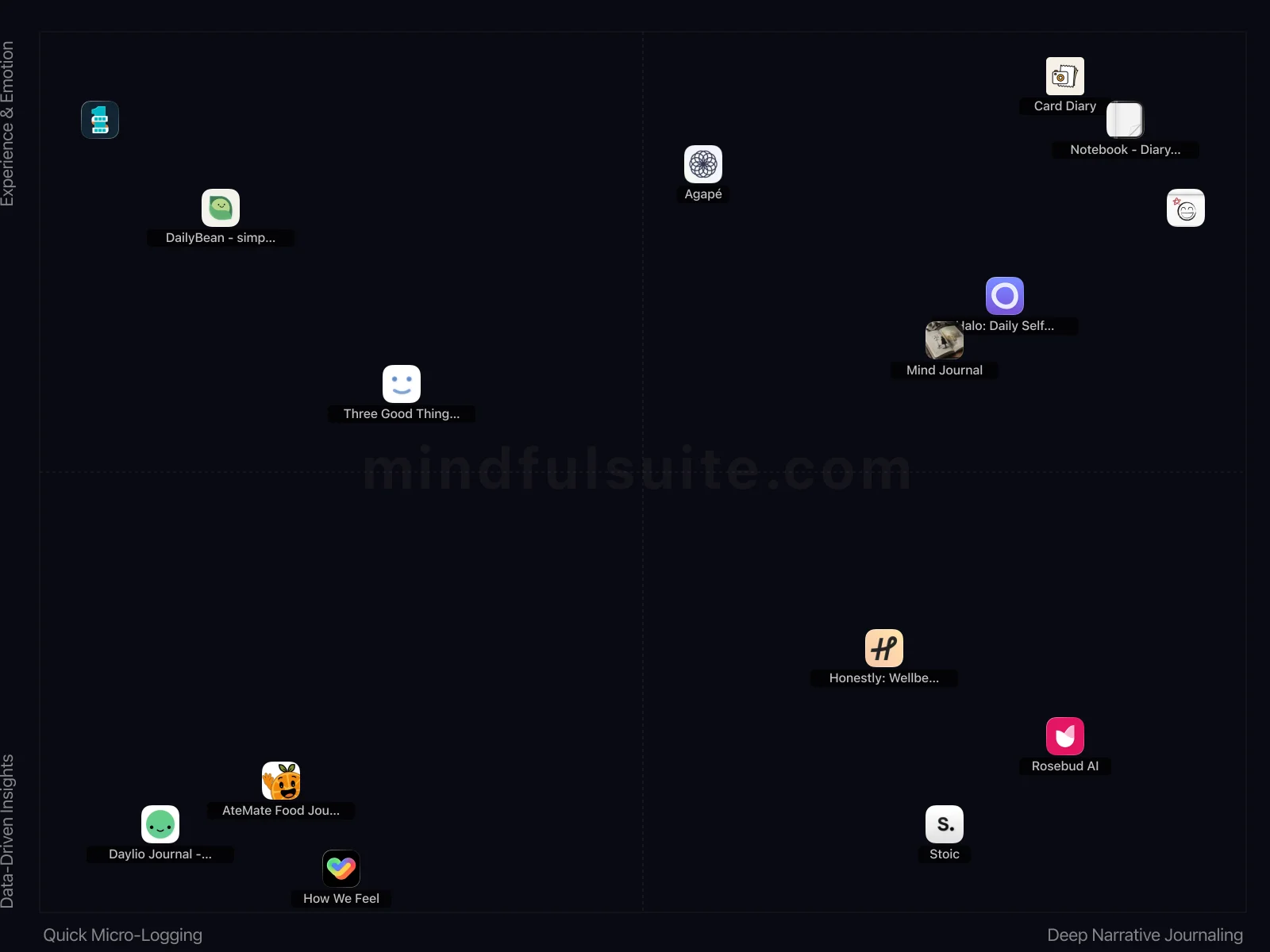
These 15 apps don't all solve the same problem. They cluster into 4 distinct groups, each built around a different philosophy. Understanding which group fits you is the fastest way to narrow your search.
Quick Micro-Logging + Experience & Emotion
3 apps in this group, led by  1 Second Everyday: Video Diary,
  DailyBean - simplest journal, and
  Three Good Things - A Happiness Journal.
What defines this cluster: free with iap, record one second daily, create a video diary, smart fill feature.
Three Good Things - A Happiness Journal.
What defines this cluster: free with iap, record one second daily, create a video diary, smart fill feature.
Deep Narrative Journaling + Experience & Emotion
6 apps in this group, led by  Agapé,
  Notebook - Diary & Journal App, and
  Card Diary.
What defines this cluster: relationship wellness, meaningful conversations, daily questions, free with iap.
Card Diary.
What defines this cluster: relationship wellness, meaningful conversations, daily questions, free with iap.
Quick Micro-Logging + Data-Driven Insights
3 apps in this group, led by  AteMate Food Journal & Diary,
  Daylio Journal - Mood Tracker, and
  How We Feel.
What defines this cluster: food journal and diary, meal tracker, habit formation, micro-diary.
How We Feel.
What defines this cluster: food journal and diary, meal tracker, habit formation, micro-diary.
Deep Narrative Journaling + Data-Driven Insights
3 apps in this group, led by  Honestly: Wellbeing Coaching,
  Stoic, and
  Rosebud AI.
What defines this cluster: mental health journaling, ai-guided prompts, voice entry, mood tracking.
Rosebud AI.
What defines this cluster: mental health journaling, ai-guided prompts, voice entry, mood tracking.
What makes them different
The core tension in this category runs along two axes. On one side, Quick Micro-Logging apps prioritize simplicity and speed — you can be up and running in under a minute. On the other, Deep Narrative Journaling apps offer depth and customization that rewards investment over time.
The second axis — Primary Value — captures an equally important difference. Apps closer to Data-Driven Insights take a fundamentally different approach than those near Experience & Emotion. Neither is objectively better. The right choice depends on your personality, your experience level, and what you're trying to accomplish.
15 Apps Reviewed
We scored every app using a weighted composite of real App Store and Google Play ratings. Out of 15 apps: 9 Essential · 5 Hidden Gems. 11 cross-platform, 3 iOS-only, 1 Android-only.
Top picks: Daylio Journal - Mood Tracker and How We Feel scored highest overall. Honestly: Wellbeing Coaching rounds out the top three. Switch to the Apps tab for the full list with ratings and download links.
How to Pick the Right One
Look at the cluster section above. If you already know whether you want Quick Micro-Logging or Deep Narrative Journaling, that eliminates half the options instantly. Same for Data-Driven Insights vs Experience & Emotion.
Try one app for a full week before judging. Most daily check-in apps reveal their value around day 5, not day 1.
Quick start: Daylio Journal - Mood Tracker and How We Feel represent two different approaches and both scored highest. Pick whichever resonates, switch if it doesn't click.
Making It Stick: Practical Advice
Downloading the app is the easy part. The hard part — the part that actually produces results — is what happens in weeks two, three, and beyond. These tips are drawn from behavioral research and from patterns we've observed across hundreds of thousands of user reviews. They're not revolutionary, but they work:
Check in at the same times each day
Morning, midday, and evening check-ins capture the full arc of your day. Consistency in timing makes the data meaningful and comparable.
Be honest, not aspirational
Log how you actually feel, not how you want to feel. The value of check-ins is in their accuracy as a self-monitoring tool.
Frequently Asked Questions
These are the questions that come up most often — from our own testing, from user reviews, and from the broader conversation around daily check-in apps. If your question isn't here, the Apps tab has detailed information on every app we reviewed.
What's the difference between a daily check-in and a mood tracker?
There's significant overlap. Daily check-in apps tend to be simpler and faster (10-30 seconds), while mood trackers may include more detailed logging, journaling, and analysis features. Both serve the same core purpose of emotional self-monitoring.
How many times a day should I check in?
2-3 times captures your day well: morning (baseline), midday (check trajectory), evening (reflection). Once daily is still valuable if that's more sustainable.
The Best Daily Check-In Apps for 2026
Remember the old ways of self-improvement? A calendar on the fridge marked with big red X's, a forgotten journal with only three entries, or a flurry of sticky notes losing their grip on your monitor. These noble efforts often end up as dusty monuments to forgotten goals.
Today, the simple act of checking in with yourself has a powerful new home: your phone. The right app can transform the abstract goal of "being better" into a concrete, delightful, and rewarding part of your daily rhythm. It’s like a personal coach, a non-judgmental diary, and an encouraging friend, all living right in your pocket. Let's find the one that feels less like a chore and more like a daily conversation with your future self.
When You Want to Track Your Mood Without Typing
Sometimes, at the end of a long day, the thought of writing a paragraph is exhausting. These apps let you log your emotional state in seconds using simple, intuitive interfaces. Over time, they reveal powerful patterns about what habits and routines actually make you tick.

Goals
A comprehensive habit and goal tracker inspired by Atomic Habits, featuring AI coaching and visual progress tracking.
- Deep integration with Atomic Habits philosophy.
- Visual progress tracking keeps you motivated.
- Cross-platform support (iOS and Android).

Daylio Journal - Mood Tracker
Daylio is a massively popular micro-diary that brilliantly answers the question: "What if I could journal without typing?" You simply pick your mood and tap icons for the activities you did that day. Over time, it creates fascinating charts that reveal what habits and routines actually make you happy.
- Effortlessly track moods and activities with a quick tap-based interface, making daily logging consistent.
- Generates insightful statistics and charts to visualize mood patterns and activity correlations over time.

How We Feel
Developed with scientists from the Yale Center for Emotional Intelligence, this app is like a coach for your feelings, helping you find the right words for your emotions.
- "How We Feel" is entirely free, offering science-backed emotion identification and well-being tracking without any paywalls.
- Its detailed emotion wheel and actionable strategies for regulating feelings provide practical, immediate support.
For Deep Mental Wellness & Coaching
If you're looking for more than just a place to vent, these apps actively guide your reflections. They use psychological principles, cognitive behavioral therapy frameworks, and smart, gentle prompts to help you untangle complex feelings and build genuine mental resilience.

Honestly: Wellbeing Coaching
Honestly is an AI-powered mental health journal. The app guides users through writing or speaking prompts to release stress and understand their mood.
- Its AI-driven journaling transforms your thoughts into personalized mood insights, offering genuine self-reflection.
- Gentle, daily prompts prevent writer's block, making consistent self-reflection and habit building surprisingly effortless.

Stoic
Stoic is more than a diary; it's a mental health companion grounded in philosophy and psychology. It uses the principles of Stoicism and Cognitive Behavioral Therapy (CBT) to help you not only record your feelings but understand them. Through guided exercises, meditations, and thoughtful prompts, it coaches you toward a more resilient and productive mindset.
- Offers a unique, philosophical approach to mental well-being with its "stoicism-based journaling" prompts.
- The "AI journaling" feature provides personalized reflections, making the self-improvement process more engaging.
When You Want a Fun, Visual Daily Record
Personal growth doesn't have to be entirely serious. Gamifying your daily check-in or turning it into a visual scrapbook makes it incredibly easy to stick with the habit. You get a daily dopamine hit and a beautiful, personalized retrospective of your month.

DailyBean - simplest journal
Imagine logging your day with adorable "mood beans." DailyBean is a simple and cute journaling app that makes self-reflection feel like a fun game. Like Daylio, it uses a visual system of moods and activity icons, giving you a delightful overview of your month at a glance.
- Its incredibly intuitive tap-based system makes logging mood and activities genuinely fast and effortless;
- The visual summary of daily emotions and activities is a clear differentiator in this category.

1 Second Everyday: Video Diary
Captures one-second videos daily and combines them into a movie, allowing users to create a time capsule of their life with features like Smart Fill.
- Uniquely creates a compelling video timeline of your life, offering a distinct daily check-in perspective;
- The "Smart Fill" feature genuinely simplifies compiling daily video memories from your camera roll.
For the Dedicated Digital Journaler
For those who process their thoughts best through words, a blank page is the ultimate tool. These apps provide a private, organized, and beautiful space to capture everything from fleeting moments of gratitude to deep, unstructured brain dumps.

Halo: Daily Self Care Journal
A private, safe space for daily journaling, helping users declutter their minds and build a consistent writing habit.
- Offers flexible writing durations, making it easy to integrate journaling into any busy schedule.
- Strong emphasis on self-care through its curated prompts fosters genuine emotional well-being.

Three Good Things - A Happiness Journal
This app is a testament to the power of simplicity. It’s built entirely around the evidence-based practice of noting three good things that happened each day. With a minimalist design that removes every distraction, it lets you focus on one thing: finding the positive.
- Its hyper-focused "three good things" method is perfect for a simple, consistent daily gratitude practice.
- The gamification elements effectively encourage daily engagement and habit formation for long-term use.

Rosebud AI
Rosebud AI offers a beautiful twist on mental wellness by focusing on AI-powered journaling. It acts as your personal guide for self-reflection, giving you intelligent prompts and analyzing your entries to reveal patterns in your emotional world. It’s perfect for anyone who finds clarity through writing.
- Focuses squarely on daily self-care and habit formation, providing structured routines to build positive mental health practices.
- As a "Hidden Gem," it likely offers a fresh, innovative approach to self-care tracking, differentiating from crowded markets.

Notebook - Diary & Journal App
A digital diary and note-taking app that mimics a physical book with page-turning animations.
- The aesthetic of "turning the pages of a book" offers a unique, nostalgic, and visually pleasing journaling experience.
- Its elegant and "natural" design prioritizes the writing experience, making entries feel more personal.

My Wonderful Days Journal
A straightforward diary app that allows easy writing with analog features, iCloud support, and photo integration across iPhone and iPad.
- Robust iCloud sync and universal iPhone/iPad support make it a truly cross-device personal journal.
- Charming "analog features" like diverse fonts and themes offer a personalized, aesthetically pleasing writing experience.

Card Diary
Card Diary is a lightweight journaling app that uses a pixel camera and retro-inspired gadgets. It blends photography with journaling, allowing you to snap photos and add messages to create pixel-style cards.
For Checking In Together
Daily check-ins aren't just for solitary reflection. Building a shared tracking habit with your partner can completely transform how you communicate, breaking you out of the "how was work?" rut and sparking genuinely meaningful conversations.

Agapé
Agapé is built on the simple but powerful idea that a daily question can spark meaningful conversation and bring you closer. With its clean interface and focus on wellness, it encourages consistent, positive interaction, even when you're apart.
- Daily tailored questions consistently spark meaningful conversations, preventing communication plateaus.
- The app's elegant design makes daily check-ins a simple and pleasant part of a routine.
For Building Better Physical Habits
Sometimes your daily check-in needs to be highly specific. If your primary goal right now revolves around physical health, nutrition, and understanding how your bodily habits impact your mood and energy, a dedicated tracking tool is the way to go.

AteMate Food Journal & Diary
AteMate is a food journal that tracks daily choices to help users understand their habits for consistent health. It's for individuals looking to build a foundation for lasting health through mindful eating.
- Specifically designed for food journaling, it offers focused insights into dietary habits and patterns;
- The "Easy Health Habit Meal Tracker" makes logging meals quick and intuitive, fostering consistency.
Which App is Right for You?
The 'best' app is simply the one you'll actually open every day. Your perfect tool depends on your personality, your specific goals, and how much complexity you're comfortable with.
Start by picking one app that resonates with you, commit to using it for a week, and see how it feels. The simple act of checking in with yourself each day is far more important than the digital tool you use to do it. Happy tracking!