
Water Drinking Reminder Apps: What You Need to Know in 2026
You know you should drink more water. Everyone knows. But somehow by 3 PM you've had two coffees and half a glass of water, wondering why you have a headache. Hydration is one of the simplest health habits — and one of the easiest to forget. Water reminder apps solve the 'forgetting' part with persistent, gentle nudges.
We evaluated 20 water drinking reminder apps across iOS and Android, scoring each on real user ratings, feature depth, and long-term value. This guide covers what we found.
What Mild Dehydration Actually Does to Your Brain
You will not feel thirsty at 1% body water loss. Your mouth won't be dry. You won't reach for a glass. But your brain is already operating below its baseline. A 2011 study by Matthew Ganio and colleagues, published in the British Journal of Nutrition, subjected healthy young adults to mild dehydration through exercise and fluid restriction. At just 1.36% body mass loss — a level most people experience routinely by mid-afternoon — participants showed significantly increased anxiety, fatigue, and tension, along with degraded working memory and impaired vigilance during cognitive tasks.
This finding is not an outlier. A companion study by Lawrence Armstrong found similar cognitive and mood impairments in women at comparable dehydration levels. The pattern is consistent across the literature: mild dehydration — the level you reach by skipping water for a few hours during a busy workday — measurably impairs the cognitive functions you need most for knowledge work. Attention suffers. Working memory degrades. Mood shifts toward irritability and fatigue. And here is the critical detail: you don't notice it happening.
Thirst is a lagging indicator. By the time your body signals thirst, the cognitive decline has already been underway for some time. This is the fundamental problem that water reminder apps address. The issue was never that people don't like water or don't know they should drink it. The issue is that the body's feedback system for hydration operates on a delay. You feel fine, so you don't drink. By the time you feel not-fine, your afternoon productivity has already taken a hit.
The 3 PM slump that most office workers attribute to post-lunch carbohydrate metabolism is, in many cases, partly a dehydration effect. The headache you treat with ibuprofen at 4 PM may be a water deficit. The irritability that creeps into late-afternoon meetings has multiple causes, but inadequate hydration is reliably one of them. A simple intervention — consistent water intake throughout the day, prompted by reminders until the habit becomes automatic — addresses a performance bottleneck that most people don't even realize exists.
How Much Water You Actually Need (It's Not 8 Glasses)
The recommendation to drink eight glasses of water per day is one of the most widely repeated pieces of health advice in existence, and it has essentially no scientific basis. Its likely origin is a 1945 report by the U.S. Food and Nutrition Board, which stated that adults need approximately 2.5 liters of water daily — but added, in a sentence that history conveniently forgot, that "most of this quantity is contained in prepared foods." The 2.5 liters was a total water intake figure, including the water in your coffee, your soup, your fruits, and your vegetables. Somewhere in the decades of telephone-game citation, the caveat disappeared and the number became a standalone prescription for glasses of pure water.
Actual hydration needs vary enormously. Body weight is the most significant variable: a 130-pound person and a 220-pound person have fundamentally different fluid requirements. Activity level matters — a construction worker in August needs substantially more water than an office worker in a climate-controlled building. Climate and altitude both increase requirements. And diet composition plays a larger role than most people realize: someone eating water-rich foods (cucumbers, watermelon, soups, oranges) gets a meaningful portion of their daily water from food.
A reasonable approximation, used by many sports medicine practitioners, is body weight in kilograms multiplied by 0.033 to get a baseline in liters per day. For a 70-kilogram person, that's roughly 2.3 liters. But even this formula is a starting point, not a prescription. The most practical indicator of adequate hydration is urine color: pale yellow indicates adequate hydration, dark yellow suggests you need more fluid, and clear or nearly colorless urine suggests you may be overhydrating — yes, that is possible, and it dilutes electrolytes.
The best water reminder apps let you set a personalized target based on your weight and activity level rather than defaulting to a magic number. They also account for variation — hotter days, workout days, illness — and adjust accordingly. An app that tells everyone to drink eight glasses regardless of whether they weigh 110 pounds or 250 pounds is dispensing the nutritional equivalent of "one size fits all" clothing. It fits almost no one well.
Turning Hydration From Afterthought to Habit
The dirty secret of water reminder apps is that the best outcome is not needing the app anymore. A well-designed hydration reminder should function as a two-to-four-week training tool that builds an automatic behavior, not as a permanent dependency that sends you notifications for the rest of your life. If you are still relying on an app to tell you to drink water after six months of daily use, something in the habit formation process has stalled.
The most effective approach borrows from habit stacking — the technique of anchoring new behaviors to existing ones. Rather than scattering reminders randomly throughout the day, tie water consumption to actions you already perform without thinking. A glass when you wake up: your feet hit the floor, you walk to the kitchen, you drink water before anything else. A glass before each meal: you sit down to eat, but first you drink. A glass after each bathroom break: you finish, you wash your hands, you refill and drink. These anchors are reliable because the triggering behaviors are already automatic.
The reminder app serves as scaffolding during the construction phase. For the first week or two, the notifications remind you of the anchors you are building. "Time to drink water" gradually becomes unnecessary as the anchor behaviors begin triggering the response on their own. By week three or four, most people report that they reach for water automatically at their anchor points — the reminder arrives after they've already taken a sip.
There is a meaningful difference between apps that understand this trajectory and apps that don't. Apps designed for habit formation gradually reduce notification frequency as your logging consistency improves, eventually suggesting that you try a day without reminders. Apps designed for engagement — the ones whose business model depends on daily active users — have no incentive to wean you off. They keep the notifications coming because your continued dependency is their metric of success. When choosing a water reminder app, look for the ones that want to make themselves unnecessary. That design philosophy is a reliable signal that the developers understand their purpose: to build a habit, not to own your attention.
4 Types of Water Drinking Reminder Apps — and How They Differ
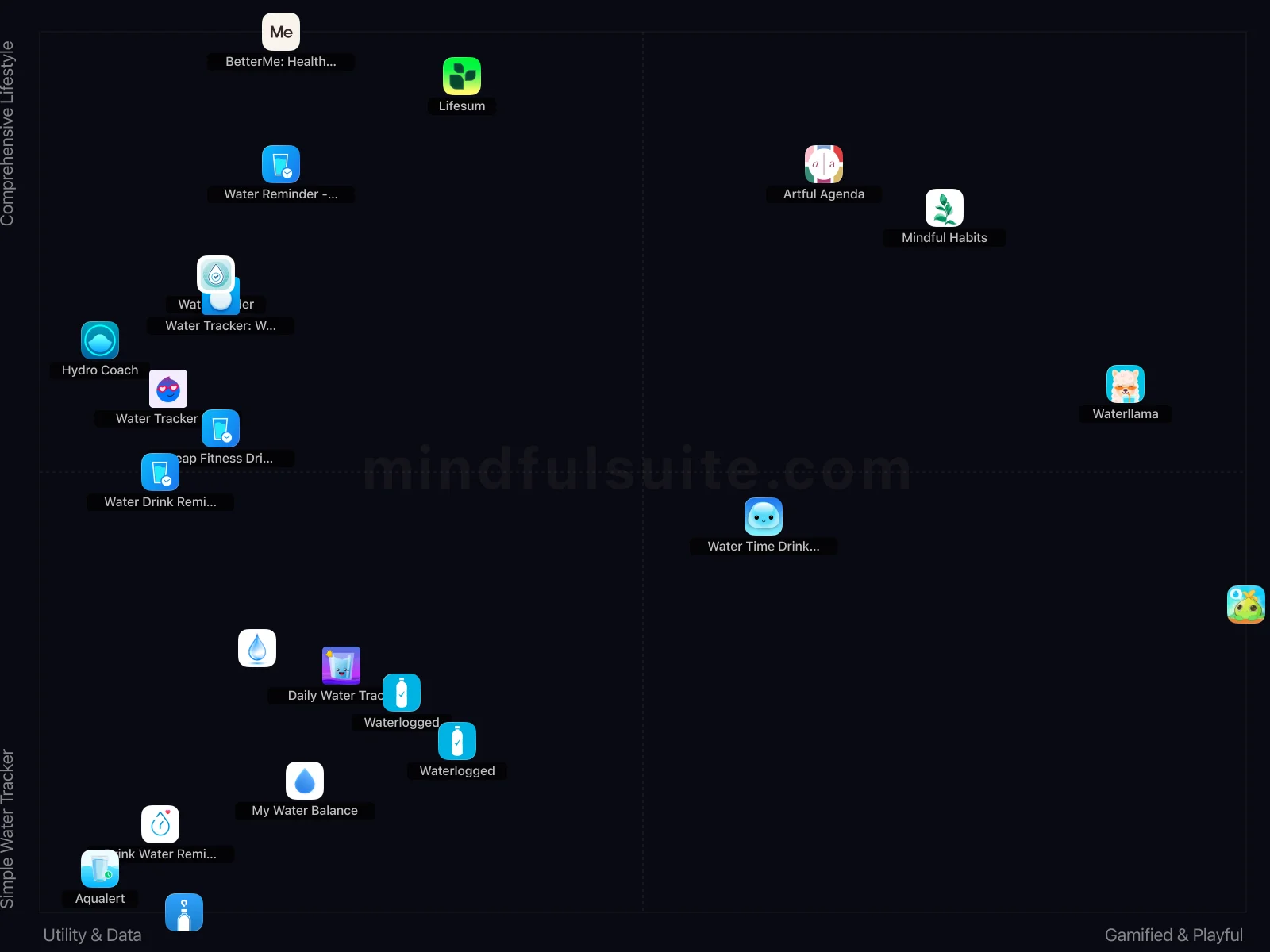
These 20 apps don't all solve the same problem. They cluster into 4 distinct groups, each built around a different philosophy. Understanding which group fits you is the fastest way to narrow your search.
Utility & Data + Comprehensive Lifestyle
8 apps in this group, led by  Lifesum,
  Water Tracker - Hydro Coach, and
  Leap Fitness Drink Water Reminder.
What defines this cluster: nutrition and healthy eating app, offers meal plans, provides recipes, features food diary.
Leap Fitness Drink Water Reminder.
What defines this cluster: nutrition and healthy eating app, offers meal plans, provides recipes, features food diary.
Gamified & Playful + Comprehensive Lifestyle
3 apps in this group, led by  Waterllama,
  Artful Agenda, and
  Mindful Habits.
What defines this cluster: cute animal companions, digital planner, paper planner look and feel, sync and organize.
Mindful Habits.
What defines this cluster: cute animal companions, digital planner, paper planner look and feel, sync and organize.
Utility & Data + Simple Water Tracker
8 apps in this group, led by  My Water Balance,
  Drink Water Reminder N Tracker, and
  Daily Water Tracker - Waterful.
What defines this cluster: tracks water intake, hydration reminders, free with iap, track daily water consumption.
Daily Water Tracker - Waterful.
What defines this cluster: tracks water intake, hydration reminders, free with iap, track daily water consumption.
Gamified & Playful + Simple Water Tracker
1 apps in this group, led by  Water Time Drink Tracker.
What defines this cluster: reminds you to drink, daily consumption goal.
Water Time Drink Tracker.
What defines this cluster: reminds you to drink, daily consumption goal.
What makes them different
The core tension in this category runs along two axes. On one side, Utility & Data apps prioritize simplicity and speed — you can be up and running in under a minute. On the other, Gamified & Playful apps offer depth and customization that rewards investment over time.
The second axis — App Scope — captures an equally important difference. Apps closer to Simple Water Tracker take a fundamentally different approach than those near Comprehensive Lifestyle. Neither is objectively better. The right choice depends on your personality, your experience level, and what you're trying to accomplish.
20 Apps Reviewed
We scored every app using a weighted composite of real App Store and Google Play ratings. Out of 20 apps: 13 Essential · 2 Hidden Gems. 7 cross-platform, 8 iOS-only, 5 Android-only.
Top picks:  Plant Nanny - Water Tracker and Water Time Drink Tracker scored highest overall.
  Water Reminder - Remind Drink rounds out the top three. Switch to the Apps tab for the full list with ratings and download links.
How to Pick the Right One
Look at the cluster section above. If you already know whether you want Utility & Data or Gamified & Playful, that eliminates half the options instantly. Same for Simple Water Tracker vs Comprehensive Lifestyle.
Try one app for a full week before judging. Most water drinking reminder apps reveal their value around day 5, not day 1.
Quick start: Plant Nanny - Water Tracker and Water Time Drink Tracker represent two different approaches and both scored highest. Pick whichever resonates, switch if it doesn't click.
Making It Stick: Practical Advice
Downloading the app is the easy part. The hard part — the part that actually produces results — is what happens in weeks two, three, and beyond. These tips are drawn from behavioral research and from patterns we've observed across hundreds of thousands of user reviews. They're not revolutionary, but they work:
Link drinking water to existing habits
Drink a glass when you wake up, one before each meal, and one after each bathroom break. Anchoring to existing routines is more reliable than timer-based reminders alone.
Keep a water bottle visible
The app reminds you; a visible bottle makes it effortless to act on the reminder. Put a bottle on your desk, by your bed, and in your car.
Frequently Asked Questions
These are the questions that come up most often — from our own testing, from user reviews, and from the broader conversation around water drinking reminder apps. If your question isn't here, the Apps tab has detailed information on every app we reviewed.
How much water should I drink daily?
A common guideline is 8 glasses (about 2 liters) daily, but actual needs vary based on body weight, activity level, climate, and diet. Most water apps calculate a personalized target when you enter your details.
Do these apps actually help people drink more water?
Yes. The combination of tracking and reminders is very effective for building hydration habits. Most users report noticeably increased intake within the first week of consistent app use.
Sip, Track, and Thrive: The Best Water Reminder Apps (2026)
It’s 3 PM. Your head feels a little foggy, your energy is tanking, and you’re reaching for that third cup of coffee. We’ve all been there, blaming the afternoon slump. But what if the real culprit isn't fatigue, but dehydration?
That sad, half-empty water bottle on your desk is a classic sign of good intentions gone astray. Remembering to drink water is one of those simple things that’s surprisingly hard to do consistently. Thankfully, you don't have to rely on fading willpower or sticky notes that have lost their stick.
A brilliant app on your phone can turn the chore of hydration into a delightful game, a satisfying goal, or a seamless part of your day. We've tested the top options on the market to see which ones actually help you build a lasting habit without driving you crazy with notifications. Let's dive into the best digital companions ready to help you feel refreshed and energized.
For Gamers and Gardeners
Hydration doesn't have to be a dry, clinical chore. If you respond best to bright colors, cute characters, and a little bit of playful guilt when you neglect your digital pets, these apps turn drinking water into a genuinely fun daily quest.

Plant Nanny - Water Tracker
Imagine turning every glass of water into a life-giving drink for a tiny, adorable plant. That’s the magic of Plant Nanny. This app transforms hydration into a delightful caretaking game. As you drink, your collection of cute digital plants grows and thrives right along with you. It’s a wonderfully visual and motivating way to build a healthy habit.
- The unique plant-growing mechanic provides a genuinely motivating and visually rewarding gamified hydration experience.
- It offers a wide variety of adorable plants to unlock and nurture, keeping long-term engagement high.

Water Time Drink Tracker
Reminds you to drink water to meet your daily hydration goal.
- The app's visually engaging interface and motivational elements make tracking hydration more appealing and less mundane.
- It offers personalized goal setting based on activity levels and body metrics for accurate recommendations.

Waterllama
Staying hydrated is simple self-care, and Waterllama makes it fun. This creative water tracker uses cute characters and challenges to motivate you to drink enough water throughout the day.
- The cute animal companions and gamified tracking make hydration genuinely engaging and less of a chore.
- Waterllama differentiates by offering unique drink types like coffee and juice, providing a more realistic intake overview.
For Data Lovers and Detail-Oriented Drinkers
Some of us don't want a virtual plant. We want charts, graphs, climate-adjusted intake goals, and seamless Apple Health or Google Fit integration. If you treat your body like a highly calibrated machine and want the exact numbers to prove it, these robust trackers are built for you.

Water Reminder - Remind Drink
This application reminds you to drink water throughout the day.
- Integrates a "Nutrition & Calorie counter" for a more comprehensive health tracking ecosystem beyond just water.
- Robust performance and a massive user base validate its reliability for consistent water intake reminders.


Hydro Coach
Think of Hydro Coach as your personal hydration scientist. This app goes deep, calculating your optimal water intake based not just on your body and lifestyle, but even on the local climate. It provides detailed statistics and graphs to help you understand your habits over time and offers smart reminders that learn your schedule.
- It excels at providing detailed statistics and graphs of daily, weekly, and monthly hydration, ideal for data-driven users.
- The flexible reminder system allows extensive customization of intervals and notification sounds.

Aqualert: Water Tracker Daily
Tracks water intake and provides reminders to encourage regular hydration, helping users develop healthy drinking habits.
- The app offers detailed intake history and graphical representations, empowering users to analyze their hydration trends effectively.
- Its clean, straightforward design focuses on core tracking without unnecessary frills.

Water Tracker: WaterMinder app
This app reminds you to drink water, helps you track your hydration, and awards you for achieving goals.

WaterMinder
If you love clean design and powerful data, WaterMinder is your perfect match. This award-winning app visualizes your hydration progress with a simple, elegant circle that fills up as you drink. It calculates your needs based on your body weight and activity level and syncs flawlessly with health ecosystems like Apple Health, making it a seamless part of your wellness toolkit.
- It effectively calculates personalized hydration goals based on body weight, activity, and climate, offering precise tracking.
- The Apple Watch complication and widgets provide convenient logging without opening the app.
For Minimalists and Efficiency Experts
No fuss, no frills, no complicated menus to navigate when you just want to log a quick glass of tap water. These apps are designed to get out of your way. They offer lightning-fast logging and straightforward reminders so you can tap, sip, and get right back to your busy life.

Water Drink Reminder
Reminds users to drink water daily to stay hydrated and develop healthy habits.
- The app offers highly customizable reminder schedules, allowing users to tailor notifications precisely to their daily routine.
- It supports synchronization with health apps like Google Fit, providing a holistic health overview.

My Water Balance
It tracks your water intake and reminds you to stay hydrated throughout the day.
- The simple, uncluttered interface makes logging water quick and efficient, perfect for users who want minimal fuss.
- It offers a clear visual representation of your daily progress towards your hydration goal.

Drink Water Reminder N Tracker
Tracks daily water consumption and provides reminders to help users stay hydrated.
- Its straightforward design and quick logging make tracking daily intake incredibly efficient for busy users.
- The app provides a clear, at-a-glance overview of your hydration progress throughout the day.

Leap Fitness Drink Water Reminder
This app is a powerhouse in the Android world for a reason. It's a straightforward, reliable, and feature-rich tool focused on one thing: helping you build a consistent hydration habit without any fuss. The interface is clean, tracking is effortless, and it comes packed with everything you need to succeed.
- Its robust integration with Google Fit and Samsung Health seamlessly incorporates hydration into your broader fitness ecosystem.
- The app's comprehensive statistical charts provide valuable insights into long-term drinking habits.

Daily Water Tracker - Waterful
A water tracker app that reminds users to drink water regularly, helping them stay hydrated throughout the day.

Water Coach
This water tracker app sets hydration goals and provides reminders to drink water throughout the day.
- Offers a completely free experience, providing essential reminders and goal tracking without paywalls.
- Its straightforward interface and reliable notifications make basic water intake tracking incredibly simple and effective.

Waterlogged
For those who believe speed is everything, Waterlogged offers a brilliantly simple solution. Instead of fussing with numbers and menus, you can just take a picture of your favorite water bottle or glass. From then on, logging a drink is a single, lightning-fast tap. It's the ultimate no-frills tool for efficient, on-the-go tracking.
- The unique "snap a photo" feature for logging drinks is innovative and genuinely simplifies tracking custom cup sizes.
- It offers excellent integration with Apple Health, ensuring your hydration data contributes to your overall wellness picture.
Beyond Just Water: All-In-One Trackers
Sometimes you don't want a standalone app cluttering up your home screen just for water. If you prefer to keep your hydration goals neatly tucked inside your broader fitness routine, diet diary, or daily digital planner, these multi-purpose heavy-hitters have you covered.

Lifesum
Lifesum is a nutrition app that helps you build healthy eating habits with meal plans, recipes, and a food diary.
- The app's personalized "diet plans" and "recipes" are excellent for users seeking structured guidance beyond basic calorie counting.
- Its visually appealing interface makes logging food and tracking progress far more engaging than many other nutrition apps.

BetterMe: Health Coaching
If you want one app to rule them all, BetterMe is an all-in-one solution for fitness and nutrition. It creates personalized workout and meal plans tailored specifically to you and your goals.
- Its tailored workout plans adapt to user feedback and progress, offering a genuinely personalized fitness journey.
- The variety of bodyweight exercises and quick routines makes fitness accessible for users without gym equipment.

Artful Agenda
A digital planner that combines the look and feel of a paper planner with the convenience of a digital calendar.
- Artful Agenda's beautiful, customizable digital planner interface genuinely replicates the aesthetic joy of a paper planner.
- The ability to handwrite notes and decorate pages offers a creative and personalized planning experience.

Mindful Habits
Combines habit tracking with mindfulness exercises, using plants as a visual metaphor for growth. It's for people wanting to build habits with intention.
- Uniquely combines habit tracking with integrated mindfulness exercises, encouraging a more intentional and holistic approach to self-improvement.
- The plant-themed visual progress adds a delightful and calming aesthetic to daily check-ins.