
Goal Visualization Apps: What You Need to Know in 2026
Numbers on a spreadsheet don't inspire anyone. A visual progress bar steadily filling toward 100% does. Goal visualization apps transform abstract progress data into compelling visual representations that make achievement feel tangible and momentum visible.
We evaluated 10 goal visualization apps across iOS and Android, scoring each on real user ratings, feature depth, and long-term value. This guide covers what we found.
The Goal Gradient Effect: Why Visual Progress Accelerates Effort
In 1932, the behaviorist Clark Hull observed something peculiar about rats running mazes: they ran faster as they approached the food at the end. The closer to the reward, the greater the effort. He called it the goal gradient hypothesis, and for decades it remained a curiosity of animal psychology — interesting, but seemingly irrelevant to human behavior in any practical sense.
Then Ran Kivetz, Oleg Urminsky, and Yuhuang Zheng published a study in the Journal of Marketing Research in 2006 that brought Hull's rats into the coffee shop. They gave customers loyalty cards requiring ten purchases for a free coffee. Some cards were blank — ten empty stamps. Others were pre-stamped with two purchases already filled, requiring twelve total but with two already done. The cards with the head start were completed significantly faster, even though they required more total purchases. The customers weren't responding to the math. They were responding to the visual proximity to completion.
This is the goal gradient effect in action, and it has profound implications for how goal visualization apps should present your progress. A progress bar at 75% doesn't just inform you that you're three-quarters done. It creates a psychological pull toward the finish line. The remaining 25% feels smaller, more conquerable, more urgent than the first 25% ever did. You don't experience progress linearly — you experience it exponentially as the end approaches.
The best goal visualization apps exploit this deliberately. They make the early phase of a goal feel like progress (even small movements from zero register as meaningful) and make the late phase feel like momentum. Some use visual metaphors — a mountain where the summit gets closer, a path where the destination comes into view — that amplify the gradient effect beyond what a simple percentage could achieve. The mechanism is straightforward: when your brain can see the finish line, it allocates more energy to reaching it. The apps that make that finish line visible, tangible, and emotionally compelling are the ones that keep you moving when motivation alone would falter.
Visualizing the Process vs the Outcome: Which Actually Works
Gabriele Oettingen spent twenty years studying a question that should have a simple answer but doesn't: does visualizing success help you achieve it? The answer her research produced is uncomfortable for the entire visualization industry. Fantasizing about positive outcomes — imagining yourself at the finish line, savoring the promotion, admiring the bank balance — can actually reduce the motivation and effort needed to get there.
The mechanism Oettingen identified is premature satisfaction. When you vividly imagine achieving a goal, your brain experiences a muted version of the emotional reward. You get a taste of the satisfaction without doing any of the work. This lowers your energy, reduces the urgency to act, and creates a gap between how good you feel (great, because you just mentally experienced success) and what you've actually done (nothing). Her studies found this pattern across domains: students who fantasized about getting good grades got worse grades. Dieters who fantasized about losing weight lost less weight. Job seekers who fantasized about getting hired submitted fewer applications.
Process visualization — imagining yourself doing the work, step by step, handling the obstacles — produces the opposite effect. When you mentally rehearse the early morning runs rather than the finish line, the daily deposits rather than the final balance, you prepare your brain for the effort rather than the reward. You build neural familiarity with the actions required, not just the outcome desired.
Oettingen developed a framework called WOOP: Wish, Outcome, Obstacle, Plan. You identify the wish, imagine the best outcome, then immediately confront the main obstacle and form a plan for handling it. This mental contrasting — holding the positive outcome and the real obstacle in mind simultaneously — produces significantly more goal attainment than positive visualization alone.
The best goal visualization apps show both the destination and the path, but they emphasize the path. They track daily actions completed, not just percentage toward the final number. They celebrate the process — the workout logged, the chapter written, the dollar saved — because the research is unambiguous: the apps that make you fall in love with the process, not the outcome, are the ones that actually get you there.
Progress Bars, Milestone Maps, Photo Journals: Matching Format to Goal
A progress bar is not a neutral container. It carries emotional weight, and that weight shifts depending on what it represents. Watching a savings thermometer fill from $2,000 to $2,100 feels different from watching a fitness calendar turn from 12 green squares to 13. Both represent progress. But the emotional experience — and therefore the motivational impact — depends on whether the visual metaphor matches the nature of the goal.
Weight loss and body composition goals benefit from photo timelines. Numbers on a scale fluctuate daily and can be demoralizing, but a side-by-side comparison of photos taken four weeks apart reveals changes that the scale misses entirely. The visual format captures what the goal is actually about — how you look and feel — rather than reducing it to a number that bounces around based on water retention and meal timing.
Financial goals map naturally to thermometers, progress bars, and filling containers. Money accumulates in a satisfying, mostly linear way. Seeing a savings bar move from 40% to 45% provides a clean emotional signal: you're getting closer. The metaphor of filling something up matches the psychological experience of building toward a target.
Learning goals work best with skill trees or module-completion maps. Learning isn't linear — it branches, it deepens, it connects topics to other topics. A single progress bar for "learn Spanish" is meaningless. A skill tree showing that you've mastered greetings and numbers but haven't touched verb conjugation gives you both a sense of accomplishment and a clear picture of where to focus next.
Fitness and habit goals thrive on calendar heatmaps — grids where each day is colored based on completion. The visual pattern of a mostly-green month is immediately satisfying. The gaps stand out too, and not always negatively: they reveal patterns. You skip Fridays consistently. You're strongest on Monday mornings. The heatmap becomes diagnostic, not just motivational.
The problem with many goal visualization apps is that they offer one format — usually a progress bar or a percentage — and apply it uniformly to every goal type. This forces a mismatch for most users. Your financial goal gets the same visual treatment as your meditation streak, which gets the same treatment as your marathon training. The apps that let you choose or automatically assign visual formats based on goal type produce a more emotionally accurate picture of your progress. And emotional accuracy is what keeps people engaged over the weeks and months that meaningful goals require.
4 Types of Goal Visualization Apps — and How They Differ
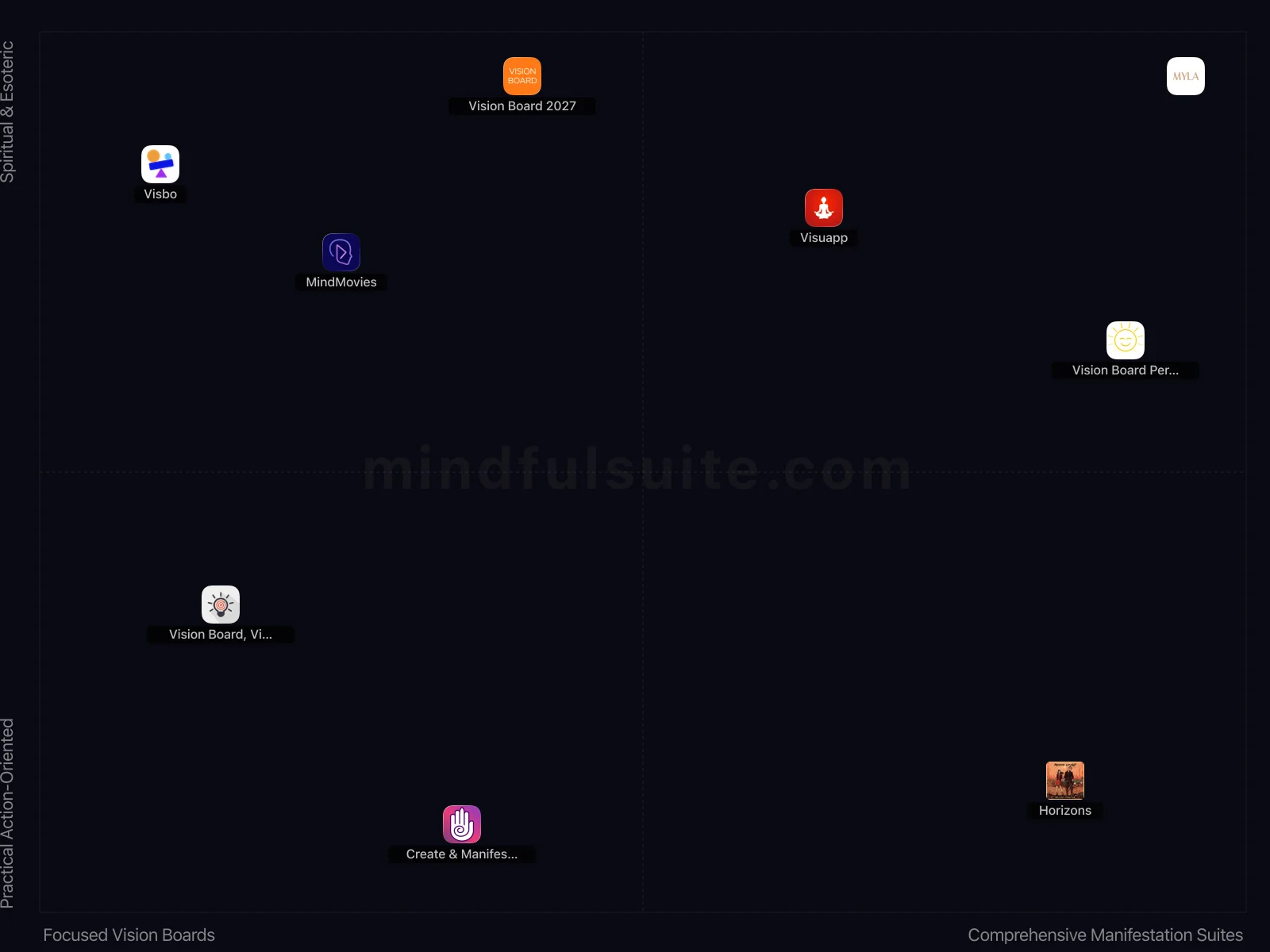
These 9 apps don't all solve the same problem. They cluster into 4 distinct groups, each built around a different philosophy. Understanding which group fits you is the fastest way to narrow your search.
Focused Vision Boards + Spiritual & Esoteric
3 apps in this group, led by  Visbo,
  Vision Board 2027, and
  MindMovies.
What defines this cluster: vision board creation, inspiring imagery, music integration, free with in-app purchases.
MindMovies.
What defines this cluster: vision board creation, inspiring imagery, music integration, free with in-app purchases.
Comprehensive Manifestation Suites + Spiritual & Esoteric
3 apps in this group, led by  Vision Board Perfectly Happy,
  Visuapp, and
  Manifest: Law of Attraction App.
What defines this cluster: vision board, gratitude journal, daily affirmations, motivation.
Manifest: Law of Attraction App.
What defines this cluster: vision board, gratitude journal, daily affirmations, motivation.
Focused Vision Boards + Practical Action-Oriented
2 apps in this group, led by  Create & Manifest Dream Goals and
  Vision Board, Visualize dreams.
What defines this cluster: 30-day challenges, law of attraction tools, free, goal setting.
Vision Board, Visualize dreams.
What defines this cluster: 30-day challenges, law of attraction tools, free, goal setting.
Comprehensive Manifestation Suites + Practical Action-Oriented
1 apps in this group, led by  Horizons.
What makes them different
The core tension in this category runs along two axes. On one side, Focused Vision Boards apps prioritize simplicity and speed — you can be up and running in under a minute. On the other, Comprehensive Manifestation Suites apps offer depth and customization that rewards investment over time.
The second axis — Approach — captures an equally important difference. Apps closer to Practical Action-Oriented take a fundamentally different approach than those near Spiritual & Esoteric. Neither is objectively better. The right choice depends on your personality, your experience level, and what you're trying to accomplish.
10 Apps Reviewed
We scored every app using a weighted composite of real App Store and Google Play ratings. Out of 10 apps: 8 Hidden Gems. 4 cross-platform, 5 iOS-only, 1 Android-only.
Top picks: Visuapp and Vision Board Perfectly Happy scored highest overall.  Vision rounds out the top three. Switch to the Apps tab for the full list with ratings and download links.
How to Pick the Right One
Look at the cluster section above. If you already know whether you want Focused Vision Boards or Comprehensive Manifestation Suites, that eliminates half the options instantly. Same for Practical Action-Oriented vs Spiritual & Esoteric.
Try one app for a full week before judging. Most goal visualization apps reveal their value around day 5, not day 1.
Quick start: Visuapp and Vision Board Perfectly Happy represent two different approaches and both scored highest. Pick whichever resonates, switch if it doesn't click.
Making It Stick: Practical Advice
Downloading the app is the easy part. The hard part — the part that actually produces results — is what happens in weeks two, three, and beyond. These tips are drawn from behavioral research and from patterns we've observed across hundreds of thousands of user reviews. They're not revolutionary, but they work:
Choose visual formats that resonate with you
Some people are motivated by progress bars, others by milestone maps or streaks. Use the format that actually makes you feel something when you look at it.
Set intermediate milestones
A goal that's months away needs visible checkpoints along the way. Every milestone reached triggers a small dopamine reward that sustains motivation for the next leg.
Frequently Asked Questions
These are the questions that come up most often — from our own testing, from user reviews, and from the broader conversation around goal visualization apps. If your question isn't here, the Apps tab has detailed information on every app we reviewed.
Does visualizing a goal help achieve it?
Visualizing progress (process visualization) is more effective than visualizing the end state alone. Seeing yourself making incremental progress toward a goal sustains motivation and effort. Goal visualization apps excel at this by making progress tangible.
Unlocking Your Potential: The Best Goal Visualization Apps for 2026
Remember that graveyard of good intentions? It’s probably in a drawer somewhere. It’s filled with half-used planners, notebooks with a single optimistic entry, and a fossilized sticky note that just says "DRINK MORE WATER!" We’ve all been there. A brilliant new goal sparks, but turning that spark into a steady flame feels impossible when your only reminder is a boring, endless to-do list.
What if your goals weren't just a list of chores, but a vivid picture of the life you're actually trying to build? That’s the magic of a great goal visualization app. They take the messy, inspiring process of cutting up magazines for a poster board and put it right in your pocket. These digital companions help you clearly picture your ambitions, keep your mindset positive with daily affirmations, and bridge the gap between "someday" and today. Let's find the perfect one to help you clear out that drawer for good.
For the Vision Board Purist
You want a digital corkboard that feels intentional, maybe even a little spiritual, without the mess of glue sticks. These apps focus entirely on helping you build beautiful, static boards using specific frameworks and layouts.

Vision
A vision board app that keeps your goals always visible on your lock screen with custom widgets, backgrounds, and an extensive motto library.
- Always-visible vision board through iOS 26 widgets.
- Extensive motto library covering anxiety, ADHD, self-acceptance, and atomic habits.
- Beautiful custom background layouts and dynamic effects.

Vision Board 2027
A highly customizable iOS app that lets you create not just static vision boards but also "vision board movies" with music and personal affirmations.
- Its unique focus on the "Bagua map" and visualization provides a distinct, spiritually aligned approach to goal setting and manifestation.
- The integration of "Affirmations" directly supports a positive mindset, which is crucial for staying motivated towards long-term goals.

Visuapp
A dedicated vision board app that uses Feng Shui principles to help structure your goals. It also includes a gratitude journal to enhance the visualization process.
- As a dedicated vision board app, it uniquely incorporates Feng Shui principles into board creation, adding a distinct spiritual dimension.
- The integrated gratitude journal and daily affirmations provide excellent support for mental well-being alongside goal visualization.

Visbo
Visbo is a dedicated Law of Attraction tool for creating vision boards. You can add inspiring imagery, text, and music to create a personalized manifestation tool.
- Visbo integrates music and inspiring imagery, directly catering to Law of Attraction principles for a more immersive manifestation experience.
- It's specifically designed for vision boards, providing a focused environment without unnecessary clutter.

Vision Board, Visualize dreams
This vision board app helps users visualize dreams and manifest goals through visualization and affirmations. Vision Board allows users to focus, plan, and track life goals.
For the Holistic Manifestor
You believe seeing your goals is only half the puzzle. You want to pair your visual inspiration with daily affirmations, gratitude journaling, and mood tracking to keep your mindset fully aligned with where you're going.

Vision Board Perfectly Happy
An all-in-one wellness app that seamlessly integrates vision boards with tools like affirmations, a gratitude journal, and mood tracking to provide a holistic approach to manifestation.
- Offers a unique "vision board" feature, allowing visual goal setting alongside daily affirmations.
- Combines "visualization, daily affirmations, motivation" for a comprehensive manifestation approach to happiness.

Manifest: Law of Attraction App
This app aims to be your one-stop shop for manifestation. It neatly integrates the core pillars of the practice—meditation, gratitude, affirmations, and visualization—into a single, streamlined experience to keep you focused and inspired.
- Its all-in-one approach, combining meditations, journaling, affirmations, and vision boards, provides a comprehensive manifestation toolkit.
- Specific techniques like the 369 method are integrated, offering structured guidance for those familiar with Law of Attraction practices.
For the Action-Oriented Goal Setter
Dreaming big is great, but you need a firm bridge between your future vision and what you actually need to do this Tuesday. These apps blend visual inspiration with concrete daily tracking, mind mapping, and structured challenges.

Horizons
This app frames goal-setting as a journey. It combines a vision board with an action tracker and a progress journal to help you visualize and actively work towards your future.
- Uniquely combines mind mapping with affirmations, allowing for structured goal setting alongside visual inspiration.
- The daily affirmation feature provides consistent reinforcement for goals visualized on your board.

Create & Manifest Dream Goals
This app brings a dose of structured focus to your practice. It frames manifestation as a series of 30-day challenges, guiding you to pour intense energy into one specific desire at a time using a variety of Law of Attraction exercises.
- The structured 30-day challenges offer a clear, actionable roadmap for users new to consistent manifestation practices.
- It's genuinely free, without hidden subscription paywalls, which is a rare and refreshing find in this category.
For the Multimedia Director
A static image just doesn't do it for you. You want a cinematic, gamified experience with music, transitions, and moving parts to really feel the emotion of your goals every time you open the app.

MindMovies
A unique take on the vision board, MindMovies allows you to create dynamic "video vision boards" by combining your images, powerful affirmations, and uplifting music.
- Creating dynamic "video vision boards" with music and affirmations offers a uniquely immersive and engaging visualization experience.
- The gamified personal development aspect provides a novel, interactive way to track and achieve goals.