
App Blocker Apps: What You Need to Know in 2026
You unlocked your phone to check the weather and somehow lost 40 minutes on social media. It's not a willpower problem — these apps are engineered by teams of brilliant designers to be as addictive as possible. App blockers level the playing field by removing the choice entirely during times when you need to focus.
We evaluated 37 app blocker apps across iOS and Android, scoring each on real user ratings, feature depth, and long-term value. This guide covers what we found.
The Attention Economy Is Designed to Beat You
Here is something worth internalizing: the apps you are trying to put down were built by some of the smartest engineers on the planet, backed by billions of dollars in R&D, with a single objective — to keep you scrolling. This is not a fair fight, and pretending otherwise is the first mistake most people make.
The techniques are well-documented. Variable reward schedules — the same psychological mechanism that makes slot machines addictive — drive the pull-to-refresh gesture. You never know if the next refresh will surface a like, a message, a piece of outrage, or nothing at all. That unpredictability is precisely what makes it compulsive. Infinite scroll removes the natural stopping cues that exist in every other medium. A book has a chapter ending. A TV show has credits. Social media feeds have no bottom.
Then there are social validation loops. Every notification that someone liked, commented on, or shared your post delivers a micro-dose of social approval — the currency our brains evolved to crave when we lived in groups of 150 people where social standing meant survival. Tristan Harris, the former Google design ethicist who founded the Center for Humane Technology, has called smartphones "slot machines in our pockets." He would know. He helped build the persuasion techniques before spending the rest of his career warning people about them.
This context matters for understanding app blockers. You are not weak for checking your phone 90 times a day. You are behaving exactly as intended by designers who A/B tested every pixel on your screen. App blockers do not fix your willpower — they change the environment. They remove the slot machine from your pocket during the hours when you have decided, with your rational mind, that you want to be doing something else. That is not defeat. That is strategy.
Types of Blocking: Gentle Nudges vs Nuclear Options
App blockers exist on a spectrum, and understanding where different tools fall on that spectrum is critical to choosing the right one for your situation.
At the gentle end, you have awareness-based tools. These track your usage and show you how much time you spend in each app, sometimes with a notification when you hit a self-set limit. Apple's Screen Time and Android's Digital Wellbeing fall here. They inform you. They do not stop you. You tap "Ignore Limit" and keep scrolling. For people with mild overuse — those who just need a reality check about their habits — awareness tools can be enough. The data alone changes behavior for some users.
In the middle, you have schedule-based blockers. These let you define time windows during which specific apps are inaccessible. You might block social media from 9 AM to 5 PM on weekdays, or block everything except phone calls after 10 PM. The key distinction is that you set these schedules in advance, during a moment of clear-headed intention, and they execute automatically. Most schedule-based blockers allow you to override the block with some friction — a waiting period, typing a phrase, or navigating several confirmation screens. The friction is the point. It creates a pause between the impulse and the action.
At the strict end, you have lockout-mode blockers. Once activated, these cannot be bypassed. Some require you to wait until the scheduled end time. Others require a second person's password to unlock. A few make you physically restart your device. These exist for people who know — honestly and without judgment — that they will override anything they can override. If you have tried gentler approaches and found yourself tapping past every warning, strict mode is not an escalation. It is an acknowledgment that the problem requires a stronger structural solution.
The right choice depends on honest self-assessment. Gentle nudges work for people who overuse apps out of habit rather than compulsion. Strict lockouts work for people whose relationship with certain apps more closely resembles addiction. There is no shame in needing the nuclear option. The goal is results, not proving something about your character.
When Blockers Actually Work (and When They Don't)
App blockers are a tool for environment design, not a willpower replacement. Understanding this distinction determines whether a blocker helps you or just adds another app to your home screen that you eventually delete.
Blockers work best when you pre-commit. The most effective pattern is to set your blocking schedules during a calm, intentional moment — a Sunday evening planning session, for instance — and then let them run automatically through the week. In the moment of temptation, your prefrontal cortex is already losing the fight to your limbic system. The decision should have been made hours or days earlier, when your rational mind was in charge. This is the same principle behind packing a healthy lunch the night before instead of deciding what to eat when you are already hungry in front of a vending machine.
Blockers also work when they are part of a broader behavior change strategy. The best results come from combining blocking with replacement activities. If you block social media from 8 to 10 PM, what will you do instead? Reading, conversation, a hobby — the void needs to be filled with something satisfying, or you will spend those two hours feeling deprived and resentful.
Blockers fail when you can easily circumvent them. If your blocker lets you uninstall and reinstall it, or if you simply pick up a different device, the structural barrier is gone. The most common failure mode is not that the blocker does not work — it is that the user chooses a blocker with escape hatches and then uses them. Be honest with yourself about this before choosing a tool.
Blockers also fail when they treat the symptom without addressing the cause. If you reach for your phone every time you feel anxious, bored, or lonely, blocking the apps forces you to sit with those feelings — which can be genuinely uncomfortable. That discomfort is actually productive, but only if you recognize it for what it is. The phone was a coping mechanism. Removing it without understanding what you were coping with leaves you without a strategy. The most transformative approach combines a blocker with genuine curiosity about why you are reaching for the phone in the first place.
4 Types of App Blocker Apps — and How They Differ
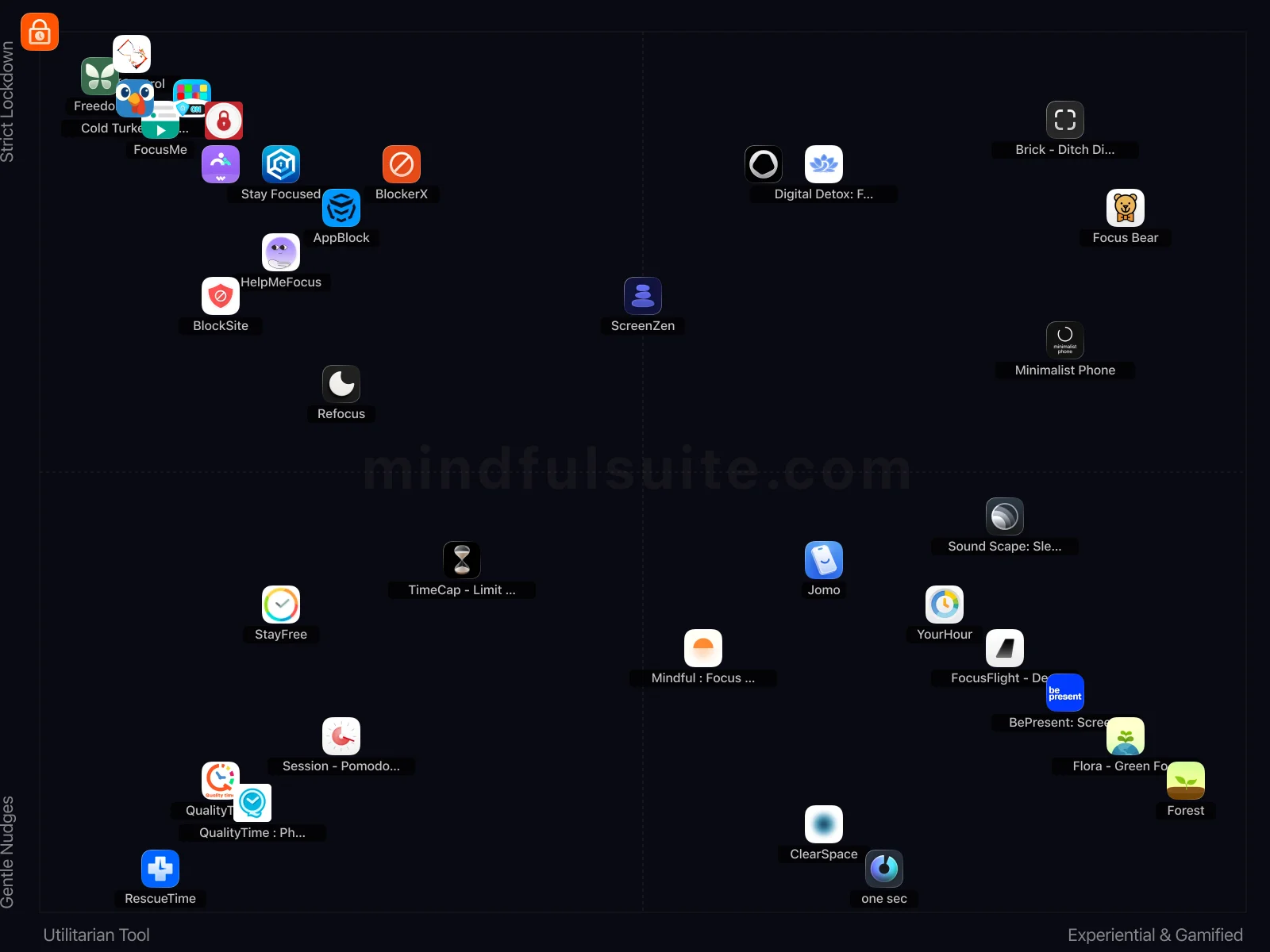
These 33 apps don't all solve the same problem. They cluster into 4 distinct groups, each built around a different philosophy. Understanding which group fits you is the fastest way to narrow your search.
Utilitarian Tool + Strict Lockdown
11 apps in this group, led by  Stay Focused,
  AppBlock, and
  FocusMe.
What defines this cluster: block apps and websites, set usage limits, track app usage, free (iap).
FocusMe.
What defines this cluster: block apps and websites, set usage limits, track app usage, free (iap).
Experiential & Gamified + Strict Lockdown
6 apps in this group, led by  Digital Detox: Focus & Live,
  Minimalist Phone, and
  ScreenZen.
What defines this cluster: digital detox launcher, distraction-free home screen, free with in-app purchases, app usage limits.
ScreenZen.
What defines this cluster: digital detox launcher, distraction-free home screen, free with in-app purchases, app usage limits.
Utilitarian Tool + Gentle Nudges
6 apps in this group, led by  StayFree,
  Session - Pomodoro Focus Timer, and
  QualityTime : Phone Addiction.
What defines this cluster: screen time tracker, app blocker, set screen time limits, pomodoro timer.
QualityTime : Phone Addiction.
What defines this cluster: screen time tracker, app blocker, set screen time limits, pomodoro timer.
Experiential & Gamified + Gentle Nudges
10 apps in this group, led by  Flora - Green Focus,
  one sec, and
  BePresent: Screen Time Control.
What defines this cluster: free with iap, free with in-app purchases, grow virtual trees, app usage limiter.
BePresent: Screen Time Control.
What defines this cluster: free with iap, free with in-app purchases, grow virtual trees, app usage limiter.
What makes them different
The core tension in this category runs along two axes. On one side, Utilitarian Tool apps prioritize simplicity and speed — you can be up and running in under a minute. On the other, Experiential & Gamified apps offer depth and customization that rewards investment over time.
The second axis — Restriction Level — captures an equally important difference. Apps closer to Gentle Nudges take a fundamentally different approach than those near Strict Lockdown. Neither is objectively better. The right choice depends on your personality, your experience level, and what you're trying to accomplish.
37 Apps Reviewed
We scored every app using a weighted composite of real App Store and Google Play ratings. Out of 37 apps: 11 Essential · 12 Hidden Gems · 3 Mainstream · 2 Popular. 19 cross-platform, 12 iOS-only, 6 Android-only.
Top picks: AppBlock and Stay Focused scored highest overall.  Forest rounds out the top three. Switch to the Apps tab for the full list with ratings and download links.
How to Pick the Right One
Look at the cluster section above. If you already know whether you want Utilitarian Tool or Experiential & Gamified, that eliminates half the options instantly. Same for Gentle Nudges vs Strict Lockdown.
Try one app for a full week before judging. Most app blocker apps reveal their value around day 5, not day 1.
Quick start: AppBlock and Stay Focused represent two different approaches and both scored highest. Pick whichever resonates, switch if it doesn't click.
Making It Stick: Practical Advice
Downloading the app is the easy part. The hard part — the part that actually produces results — is what happens in weeks two, three, and beyond. These tips are drawn from behavioral research and from patterns we've observed across hundreds of thousands of user reviews. They're not revolutionary, but they work:
Block proactively, not reactively
Set up block schedules in advance. Trying to activate a blocker after you're already distracted rarely works. Pre-commitment is the whole point.
Start with your top 3 time-wasters
Don't block everything at once. Identify the 3 apps that consume the most unintentional time (check your screen time data) and block those first.
Use strict mode if you're serious
Gentle reminders that you can dismiss don't work for most people. If you find yourself overriding the blocker, switch to strict mode where the choice is removed entirely.
Frequently Asked Questions
These are the questions that come up most often — from our own testing, from user reviews, and from the broader conversation around app blocker apps. If your question isn't here, the Apps tab has detailed information on every app we reviewed.
Can app blockers really reduce phone addiction?
They're one of the most effective tools available. By removing access to addictive apps during planned periods, they break the automatic checking habit and create space for more intentional phone use. Many users report significant reductions in screen time within the first week.
Won't I just use another device?
Some people do initially. But most blockers work across devices, and the friction of switching to a laptop to check Instagram is usually enough to break the compulsive check. Over time, the urge itself diminishes.
Reclaim Your Focus: The Best App Blockers (2026)
It starts with a single buzz. You pick up your phone to check one quick message, and forty-five minutes later, you surface from a deep dive into celebrity pet drama, your original task completely forgotten. That little jolt of, "Wait, what was I even doing?" is a modern-day curse. Before you know it, sticky notes with your "to-do" list are buried under a phone that promises endless, shiny distractions.
These digital rabbit holes are designed to capture us, but we're not helpless. App blockers are like a friendly guide who gently taps you on the shoulder and asks, “Is this really what you wanted to do right now?” They help you build a digital space that serves your goals, not the goals of an algorithm. Ready to take back your time and attention? Let's find the perfect tool for you.
Cross-Platform Powerhouses
These apps are the swiss army knives of focus. They sync seamlessly across your phone, tablet, and computer so your good intentions follow you everywhere, leaving absolutely no loopholes.

Present
A beautiful meditation timer featuring 100+ soundscapes and 6 bell themes to help you find stillness anywhere.
- Over 100 high-quality nature and ASMR soundscapes.
- Minimalist design that stays out of your way.
- Available as a Chrome extension for working peacefully.

Freedom
When you need to go into full lockdown mode, Freedom is the answer. It’s a powerful tool that lets you block distracting websites and apps across all your devices—Mac, Windows, iOS, and Android—all at once. You can even schedule recurring blocks to build distraction-free work habits.
- Cross-device blocking ensures complete digital lockdown, preventing easy workarounds on other gadgets.
- Its unique "Locked Mode" makes it impossible to disable blocks prematurely, enforcing true focus discipline.

AppBlock
AppBlock is all about context. It understands that the apps you need for work are different from the ones you use to unwind. You can create different "profiles" for different situations—like a 'Work' profile that blocks social media from 9-to-5, a 'Study' profile for the library, or a 'Weekend' profile with fewer rules.
- The ability to create custom blocking profiles for different scenarios (work, study, sleep) is highly flexible.
- Scheduling blocks and usage limits provides robust, automated control over app and website access.

Stay Focused
An Android app to block apps/websites, set usage limits, and track app usage for improved self-control.
- Offers extensive customization for blocking specific apps and websites with detailed daily or hourly limits.
- The "strict mode" prevents uninstalling the app or disabling blocks during active sessions, enforcing discipline.

StayFree
If you love data, you'll love StayFree. It's a comprehensive screen time tracker that gives you beautiful, detailed graphs of your phone usage. It helps you understand your digital habits on a deeper level and then provides the tools you need to set limits and block apps when you go over them.
- Provides detailed usage statistics and app usage history, offering clear insights into your digital habits.
- The free version offers robust app blocking and usage limits without immediate paywalls, making it highly accessible.

BlockSite
Simple, effective, and popular, BlockSite gets the job done without a fuss. It works as both a mobile app and a browser extension, making it a great choice for quickly blocking a few problem websites or apps that consistently pull you off track.
- Flexible scheduling allows users to automate blocking during specific work hours, promoting consistent habits.
- The "Work Mode" feature quickly activates pre-defined blocking profiles for instant distraction elimination.

BlockerX
BlockerX is primarily a porn blocker but can also block distracting websites and apps. It's aimed at users who want to quit porn or limit access to specific online content.
- Its robust porn blocking capabilities are highly effective and specifically tailored for addiction recovery, making it unique.
- The "Companion Mode" adds an accountability layer, involving a trusted friend for monitoring and support.

Focus Bear
Focus Bear acts as a friendly but firm guide for your day. Designed for neurodiverse minds, it helps you build powerful morning and evening routines and then stands guard during your focus blocks, blocking the distracting websites and apps that lure you off-task.
- Specifically designed "Focus Sessions" with guided routines provide structured support for AuDHD brains.
- Comprehensive cross-device blocking and routine enforcement makes it harder to bypass distractions.

FamiSafe
This is a parental control app that offers features like app blocking, website filtering, and screen time management.
- Comprehensive parental controls extend beyond app blocking, offering location tracking and web filtering for family safety.
- Cross-platform support allows parents to manage screen time effectively across various Android and iOS devices.
Gamified & Unique Approaches
Who said focus had to be boring? These apps use creative mechanics, physical boundaries, financial stakes, and fun rewards to make staying on task feel less like a chore and more like a game you can actually win.

Forest
Forest takes a unique approach to habit building. Instead of tracking a completed task, it helps you build the habit of *focus*. You plant a virtual tree that grows while you work on a task. If you leave the app, the tree withers.
- The gamified tree-planting mechanic effectively encourages deep, uninterrupted focus sessions with visual motivation.
- Offers unique social impact by planting real trees for virtual coins, providing powerful incentive beyond personal productivity.

Flora - Green Focus
Similar to Forest, Flora uses the idea of growing plants to keep you off your phone. But Flora adds a daring twist: you can set a real-money "price" for failure. If you kill your tree by getting distracted, the app can charge you, with the money being donated to plant real trees.
- The unique "grow trees with friends" feature provides a strong social accountability boost for group focus.
- Successfully gamifies focus by punishing phone usage with a withered virtual tree, enhancing discipline.

Brick - Ditch Distractions
Brick - Ditch Distractions aims to make phones less distracting and more helpful. It helps users focus on what matters by reducing unnecessary phone usage.
- Completely free across both iOS and Android, removing any paywall barriers to reclaiming phone balance.
- Its unique "Brick" concept aims to fundamentally change phone usage, not just block apps temporarily.

BePresent: Screen Time Control
This app helps you control screen time with app blocking and focus features, offering rewards for staying off your phone. It's for users wanting to improve productivity, mental health, and quality of life.
- Motivates users with a "rewards" system, gamifying screen time control to encourage healthier digital habits.
- Focuses on broader benefits like "mental health," not just productivity, for a holistic approach.

FocusFlight - Deepfocus Timer
A focus timer app using a flight theme to help users maintain concentration and avoid distractions.
- Novel "flight theme" gamification provides a unique, engaging incentive to maintain focus during work sessions.
- Landing your "flight" successfully offers a clear visual reward, effectively reinforcing task completion.

Sound Scape: Sleep & Calm
Sound Scape provides a variety of soothing sounds and music to help with sleep, meditation, and relaxation.
- The integrated "App blocker" feature is a standout, preventing distractions during focus or relaxation sessions.
- Provides a good variety of soothing sounds and music, effectively catering to different relaxation needs.
Mobile-First Champions
These tools are designed from the ground up to master the mobile experience. Whether it's adding a mindful pause before opening Instagram or turning your entire phone's interface into a minimalist dream, these transform your device back into a useful tool.

one sec
This app is pure genius. Instead of a hard wall, `one sec` introduces a moment of friction. When you try to open a distracting app, it forces you to take a deep breath for a few seconds. This tiny pause is often all it takes to break the cycle of mindless, habitual app-opening, making you ask yourself, "Do I really want to do this?"
- The core deliberate pause feature is incredibly effective for interrupting habitual app opening without aggressive blocking.
- It supports a wide range of apps and websites, making it highly versatile for promoting digital mindfulness.

Opal
Opal is a powerful and beautifully designed screen time manager built exclusively for iPhone users. It helps you schedule regular "Focus Sessions" where distractions are completely locked down, making it one of the most effective blockers on the platform.
- "Focus Sessions" provide robust, unyielding app blocking on iOS, making it difficult to bypass distractions.
- The clean, modern iOS-native interface offers a premium experience, differentiating it from many cross-platform solutions.

ScreenZen
ScreenZen helps you control your screen time by setting limits and scheduling "Zen time," encouraging you to disconnect and be more present.
- "Zen time" scheduling provides dedicated periods for disconnection, promoting healthier digital boundaries.
- The iOS-native integration allows robust app usage limits that are difficult to bypass, unlike cross-platform tools.

Minimalist Phone
Replaces your default home screen with a minimalist, distraction-free interface to reduce phone usage. It's for users wanting to cultivate mindful phone habits.
- Its stark, grayscale interface and limited app access fundamentally reframe phone interaction, effectively curbing mindless scrolling.
- The built-in app usage limits and notification filtering are powerful tools for actively reducing digital distractions and promoting focus.

ClearSpace
Much like `one sec`, ClearSpace helps break the cycle of mindless tapping by making you pause and confirm your intent before opening an app. It's a small step that makes a huge difference.
- The unique "moment of pause" before app launch is an innovative psychological nudge to break mindless habits.
- Its focus on intentionality rather than brute-force blocking offers a gentler, more mindful approach to screen time.

Jomo
This app is all about finding the "Joy of Missing Out." Jomo is a friendly iOS blocker that helps you set limits and schedule downtime with a positive and mindful approach.
- Comprehensive screen time insights and scheduled downtime features genuinely help build healthier digital habits.
- Its elegant interface and focus on a holistic approach make digital well-being feel less punitive.

Refocus
A simple and straightforward app and website blocker for iPhone. If you don't need tons of bells and whistles, Refocus is a great pick for setting basic time limits.
- Specific time limits for individual apps and websites allow granular control over distractions.
- Its iOS-first design likely ensures seamless integration and optimized performance on Apple devices.

Lock Me Out
A powerful Android blocker that lives up to its name. It allows for scheduled lockouts and usage-based restrictions, making it a strong choice for those who need strict rules.
- Offers highly flexible scheduling for lockouts and usage-based restrictions, giving users precise control over their Android device.
- The ability to create "quick lockouts" on demand is perfect for spontaneous focus sessions without prior setup.

Lock Me Out - App/Site Blocker
Aims to help users focus by blocking distracting apps and websites.

YourHour
This app gives you a "phone addiction level" and a dashboard of tools to help you lower your score and improve your digital wellbeing.
- Its detailed daily usage reports and "Dopamine Meter" offer insightful, gamified feedback to understand phone habits.
- The "Challenge Mode" encourages active reduction of screen time with structured goals for self-improvement.

HelpMeFocus
It's an app blocker for Android. HelpMeFocus restricts access to distracting apps and websites to enhance focus and productivity.
- Its comprehensive blocking includes both apps and websites, offering a robust digital barrier on Android.
- The "Routine Tracker Task Organizer" tagline hints at broader productivity integration beyond simple blocking.

Digital Detox: Focus & Live
I am sorry, I do not have enough information about this app to provide a description.

Cold Turkey: Quit for Good
A recovery app to help users break free from addictions such as porn, fast food, gambling, and alcohol.

Session - Pomodoro Focus Timer
Helps users stay focused and track productivity using the Pomodoro Technique. Session provides detailed analytics of study and work time.
- Provides incredibly detailed productivity analytics and visual reports to track your focus trends over time.
- The "Goals" feature helps set and monitor specific focus targets, adding structure and accountability to your work.

Mindful : Focus & Screen Time
Helps break the cycle of endless scrolling and phone addiction. It's for individuals who want to be more mindful of their screen time.

QualityTime : Phone Addiction
This app helps users track and manage their phone usage to address potential phone addiction.

QualityTime
It monitors smartphone usage in real-time, allowing users to set usage alerts and restrictions to manage their screen time.
- Provides incredibly detailed real-time usage reports and activity timelines, offering deep insights into phone habits.
- The ability to set usage alerts for specific apps is a valuable, free self-monitoring tool without a paywall.

TimeCap - Limit Screen Time
Limits social media use by letting you set a time budget and browse distraction-free on Instagram, X, YouTube, and Reddit. For social media users who want to control their time.
Desktop & Browser Extensions
When your biggest distractions live on your computer, these dedicated, unforgiving tools are here to lock down your workflow and keep your eyes firmly on the prize.

Cold Turkey Blocker
Cold Turkey is the ultimate weapon for desktop focus. It's designed to be mercilessly strict—once you start a block, there is virtually no way to turn it off until the timer is up. It can block websites, applications, and even your entire internet connection.
- Ability to block entire applications, not just websites, provides comprehensive distraction control on your desktop.
- The "Frozen Turkey" feature can lock you out of your entire computer, forcing complete disengagement from distractions.

SelfControl
A free, no-frills, and legendary tool for macOS. You give it a list of sites to block, set a timer, and click start. Until that timer ends, those sites are completely inaccessible—even if you restart your computer or delete the app itself. It's simple, powerful, and irreversible.
- As a free and open-source macOS app, it provides powerful, no-cost distraction blocking for websites.
- The "no turning back" mechanism ensures strong adherence by blocking chosen sites until the timer expires.

RescueTime
RescueTime is like a fitness tracker for your digital life. It runs quietly in the background on your devices, automatically tracking where your time goes. It gives you a clear, honest picture of your digital habits and can even proactively block your personal time-wasting sites when you need to focus.
- Automatic background tracking provides incredibly honest insights into actual digital work habits without manual entry.
- Detailed productivity reports and distraction alerts help users identify and mitigate time-wasting activities effectively.

FocusMe
It helps users control their screen time and block distracting apps to improve focus and productivity.
Take Back Your Time
Finding the right app blocker isn't about punishing yourself; it's about setting boundaries that let you thrive. Whether you need a gentle nudge to pause before opening social media or a strict, device-wide lockdown during work hours, the tools above are designed to fit seamlessly into your workflow. Experiment with a few, find the approach that clicks for your brain, and enjoy the profound satisfaction of actually crossing everything off your to-do list. Your future, focused self will thank you!