
Routines Apps: What You Need to Know in 2026
The most productive people in the world don't make hundreds of decisions about what to do each morning. They have routines — automatic sequences that handle the predictable parts of their day so their mental energy is preserved for decisions that actually matter. Routines apps help you design, execute, and maintain these sequences.
We evaluated 38 routines apps across iOS and Android, scoring each on real user ratings, feature depth, and long-term value. This guide covers what we found.
Decision Elimination: The Real Value of a Routine
Barack Obama wore the same color suit every day. Mark Zuckerberg wears the same gray t-shirt. These choices are not fashion statements — they are cognitive strategies. Every decision you make, no matter how trivial, draws from a finite pool of mental energy. Roy Baumeister's research on ego depletion (contested in some replications but supported in its broader outlines) established that decision-making is a depletable resource. The more decisions you make early in the day, the worse your decisions become later.
A well-designed routine eliminates 20 to 30 micro-decisions that would otherwise consume your morning. What time to wake up: decided. What to eat for breakfast: decided. Whether to exercise and for how long: decided. In what order to tackle your morning tasks: decided. Each of these decisions, individually, seems insignificant. Collectively, they represent a substantial draw on the cognitive resources you need for the decisions that actually matter — the strategic choices, the creative problems, the interpersonal judgments that define the quality of your work and relationships.
Routines apps automate the automation. They take the sequence you have designed and present it to you step by step, so you don't even need to remember what comes next. This is not laziness. It is the same principle that makes checklists valuable for surgeons and pilots — not because they can't remember the steps, but because cognitive resources are better spent on judgment calls than on remembering whether you've already completed step four.
The objection to routines — that they make life boring, robotic, overly structured — misunderstands their purpose. A routine doesn't govern your entire day. It governs the predictable parts — the morning startup, the evening wind-down, the transition into focused work — so that your unpredictable parts have more energy available. The most creative, spontaneous, interesting parts of your day benefit from routines not because they are routinized, but because routines protect the cognitive resources that creativity demands.
Morning, Evening, Work: Designing Routines That Actually Survive Contact with Reality
The internet is full of aspirational morning routines: wake at 5 AM, meditate for 20 minutes, journal for 15, exercise for 45, prepare a nutritious breakfast, review your goals, and arrive at your desk by 7:30 feeling centered and energized. This routine takes approximately 90 minutes to complete. It also bears no resemblance to how most people actually live.
Morning routines fail when they are designed for a fantasy version of yourself — the version that springs out of bed with enthusiasm, never hits snooze, and has no children, no commute pressures, and unlimited morning time. A realistic morning routine for most working adults is 15 to 30 minutes. Start there. If you consistently complete a 15-minute routine for three weeks, expand to 20. If that holds, expand to 25. The routine that works is the one you actually do, and the routine you actually do is the one that fits the life you actually have.
Evening routines fail when they compete with exhaustion. By 9 PM, your willpower reserves are at their daily low. An evening routine that requires significant effort — a long skincare regimen, extended journaling, a full meditation session — will be abandoned within days. Effective evening routines are short, low-friction, and focused on winding down rather than achieving. Set out tomorrow's clothes. Review tomorrow's schedule. Read for ten minutes. Turn off screens. The goal is transition, not accomplishment.
Work routines fail when they don't account for interruptions. If your work routine assumes four hours of uninterrupted deep focus, and your actual work environment delivers interruptions every 20 minutes, the routine is a fiction. Build in buffer time. Expect interruptions and design around them. A work routine that allocates 45-minute focus blocks with 15-minute buffer periods is more realistic — and more durable — than one that assumes a hermetically sealed workday.
The meta-principle across all three: time each step honestly. Do your routine with a stopwatch for three days. A routine that you think takes 20 minutes but actually takes 35 will break within a week because it bleeds into the rest of your schedule. Honest timing reveals the truth, and routines built on truth survive.
Routines for Brains That Resist Routines
People with ADHD, autism spectrum conditions, or other executive function differences often need routines more than anyone — and find them harder to maintain than anyone. This creates a painful paradox: the tool that would help the most is the tool that their neurology makes most difficult to use. Understanding why, and designing around it, is essential.
Executive function encompasses the cognitive skills that routines require: planning a sequence, initiating each step, transitioning between steps, maintaining awareness of where you are in the sequence, and resisting distractions during each step. For people with ADHD, several of these skills are impaired. Initiation — simply starting the first step — can be the hardest part. Transition — moving from step two to step three without getting sidetracked — is another common failure point. The full sequence may live in their mind as a clear plan, but executing it requires a level of moment-to-moment self-regulation that their neurology doesn't reliably provide.
Apps designed with this population in mind share several features that distinguish them from standard routines apps. First, they show one step at a time rather than displaying the full routine as a list. A list of twelve steps can trigger overwhelm and decision paralysis. A single step — "Brush your teeth" — with a "Done" button is actionable. Second, they provide transition warnings: a notification or sound five minutes before the current step's timer expires, giving the brain time to prepare for the shift rather than experiencing an abrupt context switch. Third, they allow flexibility for off days without treating incomplete routines as failures. A completion rate of 70% is not a failing grade — it is a significant improvement over 0%.
Gamification — points, streaks, visual rewards — serves a specific neurological function for ADHD brains. Dopamine regulation is atypical in ADHD, and the dopamine hit from a game-like reward can provide the external motivation that neurotypical routines assume is available internally. This is not a gimmick. It is a legitimate accommodation for a neurological difference.
The routine should guide, not punish. An app that makes you feel bad for missing a step is worse than no app at all. An app that celebrates what you completed, gently notes what you skipped, and shows up fresh the next morning without judgment is one that people with executive function challenges will actually keep using.
4 Types of Routines Apps — and How They Differ
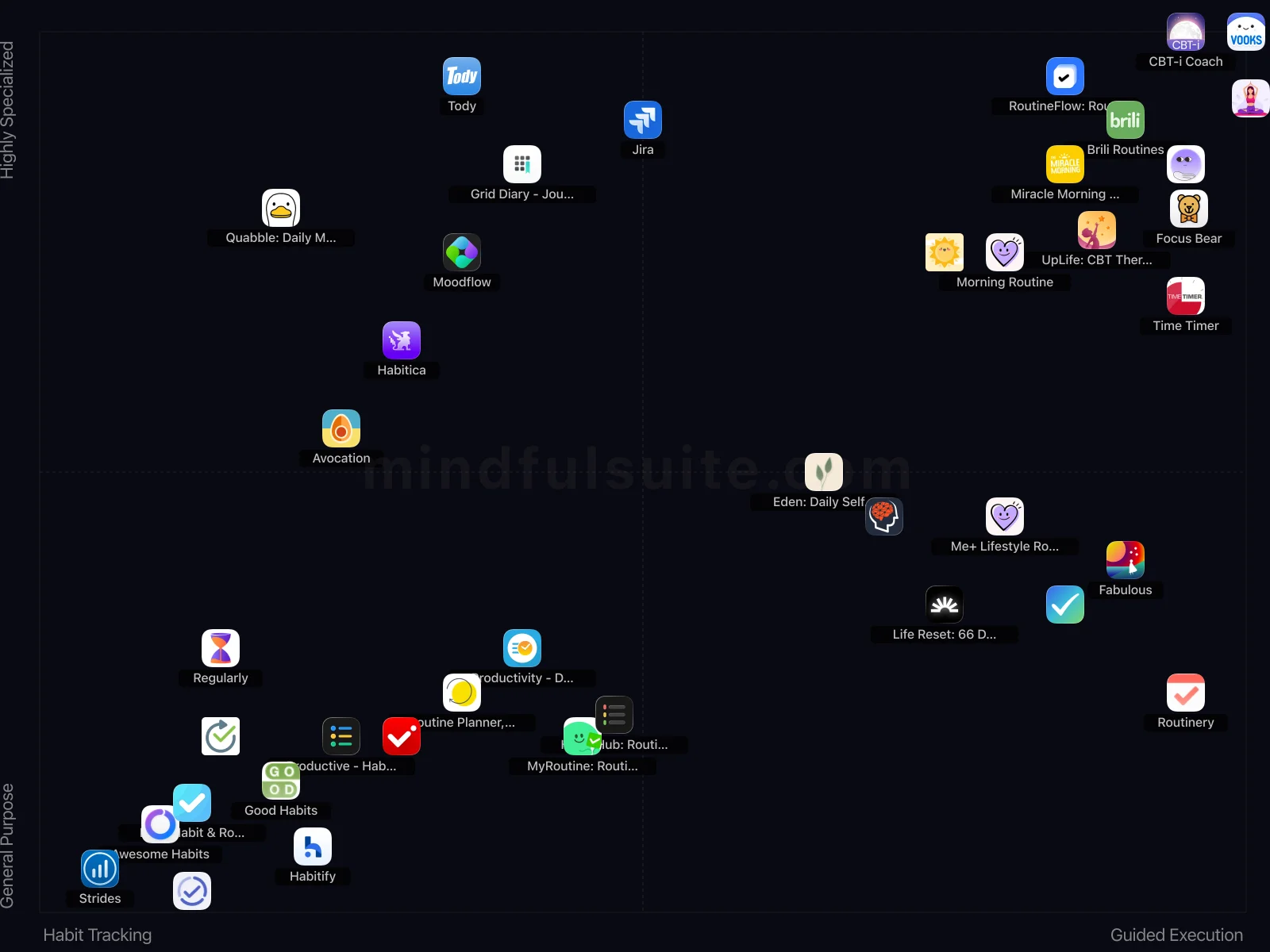
These 37 apps don't all solve the same problem. They cluster into 4 distinct groups, each built around a different philosophy. Understanding which group fits you is the fastest way to narrow your search.
Habit Tracking + Highly Specialized
6 apps in this group, led by  Tody,
Tody,  Habitica, and
  Avocation.
What defines this cluster: free with in-app purchases, gamified cleaning routines, gamified to-do list, tasks become role-playing game.
Avocation.
What defines this cluster: free with in-app purchases, gamified cleaning routines, gamified to-do list, tasks become role-playing game.
Guided Execution + Highly Specialized
11 apps in this group, led by  Jira,
Jira,  Tiimo: Daily To Do AI Planner, and
  Time Timer.
What defines this cluster: work management tool, bug tracking, agile project management, native time tracking features.
Time Timer.
What defines this cluster: work management tool, bug tracking, agile project management, native time tracking features.
Habit Tracking + General Purpose
14 apps in this group, led by  Routine Planner, Habit Tracker,
  Productive - Habit Tracker, and
  Strides.
What defines this cluster: habit tracker, routine planner, structured time management, free, iap available.
Strides.
What defines this cluster: habit tracker, routine planner, structured time management, free, iap available.
Guided Execution + General Purpose
6 apps in this group, led by  Fabulous,
  Life Reset: 66 Day Habit, and
  Me+ Lifestyle Routine.
What defines this cluster: free with in-app purchases, build healthy habits, guided journeys, science-based.
Me+ Lifestyle Routine.
What defines this cluster: free with in-app purchases, build healthy habits, guided journeys, science-based.
What makes them different
The core tension in this category runs along two axes. On one side, Habit Tracking apps prioritize simplicity and speed — you can be up and running in under a minute. On the other, Guided Execution apps offer depth and customization that rewards investment over time.
The second axis — Use Case Scope — captures an equally important difference. Apps closer to General Purpose take a fundamentally different approach than those near Highly Specialized. Neither is objectively better. The right choice depends on your personality, your experience level, and what you're trying to accomplish.
38 Apps Reviewed
We scored every app using a weighted composite of real App Store and Google Play ratings. Out of 38 apps: 10 Essential · 19 Hidden Gems. 23 cross-platform, 12 iOS-only, 3 Android-only.
Top picks: Me+ Lifestyle Routine and Productive - Habit Tracker scored highest overall. Routine Planner, Habit Tracker rounds out the top three. Switch to the Apps tab for the full list with ratings and download links.
How to Pick the Right One
Look at the cluster section above. If you already know whether you want Habit Tracking or Guided Execution, that eliminates half the options instantly. Same for General Purpose vs Highly Specialized.
Try one app for a full week before judging. Most routines apps reveal their value around day 5, not day 1.
Quick start: Me+ Lifestyle Routine and Productive - Habit Tracker represent two different approaches and both scored highest. Pick whichever resonates, switch if it doesn't click.
Making It Stick: Practical Advice
Downloading the app is the easy part. The hard part — the part that actually produces results — is what happens in weeks two, three, and beyond. These tips are drawn from behavioral research and from patterns we've observed across hundreds of thousands of user reviews. They're not revolutionary, but they work:
Design your morning routine first
Morning routines have the biggest impact because they set the tone for the entire day. Get your morning sequence right before tackling other time blocks.
Time each step realistically
A routine that's supposed to take 30 minutes but actually takes 45 will fail quickly. Time yourself through each step honestly and build the routine around real durations.
Frequently Asked Questions
These are the questions that come up most often — from our own testing, from user reviews, and from the broader conversation around routines apps. If your question isn't here, the Apps tab has detailed information on every app we reviewed.
How long does it take to establish a routine?
Most people need 2-3 weeks of conscious effort before a routine starts feeling automatic. After 6-8 weeks, it typically becomes the default behavior. Routines apps accelerate this by providing step-by-step guidance during the learning period.
Should routines be the same every day?
Core routines (morning, evening) benefit from daily consistency. But it's fine to have different routines for different days — a weekday work routine and a weekend routine, for example. Most routines apps support this.
Master Your Day: The Ultimate Guide to the Best Routine Apps of 2026
Remember that crisp, new paper journal you bought with the best of intentions? The one with two carefully filled pages for January 1st and 2nd, followed by a hundred empty ones? Or the sticky notes promising "Drink more water!" that ended up as colorful fossils on the edge of your monitor? We've all been there.
The desire to build better habits is universal, but the old tools often fail us because they're static and silent. They can't nudge you, cheer you on, or show you the beautiful chain of success you're building day by day. Big dreams have a funny way of fizzling out when they crash into the reality of a busy week.
That's where the magic of a great routine app comes in. These aren't just digital to-do lists. They're personal coaches, game masters, and data scientists living in your pocket. They transform the abstract goal of "being better" into a series of small, satisfying daily games you can actually win. Whether you want to finally nail a morning meditation habit, turn your messy apartment into a tidy sanctuary, or just remember to stand up and stretch, there's a perfect digital companion waiting to help.
The Dedicated Habit Trackers
These apps are laser-focused on one thing: helping you build and track your daily habits. They feature clean interfaces, detailed stats, and incredibly satisfying ways to cross a completed routine off your list.

Me+ Lifestyle Routine
Focuses on establishing good daily habits and healthy routines.
- Emphasizes deep habit formation with structured routines, crucial for establishing ADHD consistency.
- Vast library of pre-built routines and guided programs makes starting new habits genuinely accessible.

Awesome Habits
This habit tracker offers detailed statistics and customizable widgets to help users stay on track with routines. It's designed for users who want a visually appealing and data-rich habit tracking experience.
- Offers highly customizable widgets and a clean design, allowing users to track habits directly from their home screen efficiently.
- The detailed statistics and progress visualization are excellent for providing clear insights into long-term routine consistency.

MyRoutine: Routine Habit Goal
This helps build good habits and structure your day with routine tracking and goal setting.
- Excellent for building and maintaining consistent routines, offering clear visual progress and goal tracking.
- The focus on habit formation provides a structured approach to daily planning beyond just simple task lists.

Productive - Habit Tracker
Productive is a beautifully designed app that helps you build a routine of positive, life-changing habits. Its simple interface and useful statistics make it easy to get started and stay motivated.
- Its clean, intuitive interface makes tracking multiple daily habits straightforward and visually appealing.
- Customizable reminders and streaks genuinely motivate consistent progress on new routines.

Routine Planner, Habit Tracker
A routine and habit tracker aimed to instill structure for time management. Routinery is for users who wish to build and maintain consistent routines.

Habitify
Habitify is a sleek, cross-platform habit tracker that helps you stay organized and motivated. It provides detailed tracking, insightful charts, and timely reminders to keep you on track across all your devices.
- Organizing habits by "areas of life" provides a structured, holistic view beyond a flat task list.
- Detailed tracking and streaks across multiple platforms are genuinely motivating for building consistent daily routines.

HelloHabit - Habit Tracker
This is a simple habit tracker that helps you set goals and build habits.
- The extremely high 4.9-star iOS rating indicates a highly refined and satisfying user experience on Apple devices.
- Its promise of "simple habit tracking, made easy" truly delivers a streamlined, friction-free daily interaction.

Daily Habit & Routine Tracker
A habit tracker app that helps users create and maintain healthy habits for self-improvement and productive days.
- Its straightforward "habit tracker" functionality makes starting healthy routines genuinely accessible without overwhelming complexity.
- The consistent ratings across both iOS and Android suggest a reliably functional and well-maintained cross-platform experience.

Habit Tracker - Habit Diary
This customizable habit tracker helps users plan daily routines and track goals.
- Offers extensive customization options, allowing users to tailor habit tracking precisely to their unique needs.
- Its "Habit Diary" feature provides valuable context by letting you add notes to individual habit completions.

ClearFocus: Habit Tracker Plan
A habit tracker designed to build and maintain consistent routines without the complexity of traditional task managers.

Good Habits
Focuses on helping users establish consistent routines and develop positive habits. It is designed for anyone looking to improve their daily habits and lifestyle.
When You Need a Little Gamification
If traditional trackers feel like a chore, these apps turn habit-building into a game. Earn points, level up, and care for virtual characters just by sticking to your real-life routines.

Brili Routines
Brili turns the slog of daily routines into a game you can win. Originally designed for kids, it’s a secret weapon for adults with ADHD who struggle with time blindness. It visualizes your routine, breaking it down into timed, manageable steps, so "getting ready" becomes a clear path instead of a vague, overwhelming concept.
- Explicitly designed for ADHD, its visual timers and gamified reward system cater directly to neurodivergent needs.
- The ability to create custom routines with visual steps significantly aids in task sequencing and completion.

Habitica
Habitica gamifies your life by turning your tasks, habits, and goals into a retro-style role-playing game (RPG). As you complete tasks, your character levels up, earns gear, and can even battle monsters with friends.
- Gamification elements, like earning gold for task completion, uniquely transform mundane chores into an engaging quest.
- The social aspect, allowing users to team up and tackle challenges, provides an unparalleled layer of accountability and fun.

Tody
Tody gamifies your cleaning routine by turning chores into a game, helping you stay on top of household tasks in a fun and motivating way.
- Gamification of household chores makes cleaning routines genuinely engaging, transforming tedious tasks into a rewarding game.
- The "Tody Score" and "air quality" metrics provide a unique, motivating visual representation of home cleanliness.

Avocation
Avocation gamifies habit tracking by allowing users to grow a virtual baby plant. It's helpful for individuals seeking a fun and engaging way to build habits.
- The charming virtual plant growth gamification provides a delightful and unique motivation to maintain streaks.
- Integration with ADHD organizer features makes it particularly helpful for neurodivergent users needing structure.
Built for Specific Brains and Goals
Sometimes you need an app that understands exactly how your mind works. This group is designed around specific philosophies, behavioral science, neurodivergent needs, or deep mental wellness.

Fabulous
Born in Duke University's Behavioral Economics Lab, Fabulous is a science-based app that helps you build healthy rituals into your life. It acts as a digital coach, guiding you through morning routines, exercise, and meditation.
- The "Journeys" feature effectively gamifies habit building, providing structured guidance and positive reinforcement for daily routines.
- Its unique focus on creating holistic morning and evening routines is genuinely effective for establishing consistent positive habits.

Moodflow
A mood and habit tracker that helps users understand their emotions and build positive routines. It is for individuals looking to track symptoms, moods, and habits to improve emotional awareness.
- Moodflow effectively combines mood tracking with habit formation, providing a holistic view of emotional well-being and routines.
- Its visual analytics and insights help users identify patterns between daily activities and emotional states.

Focus Bear
Focus Bear acts as a friendly but firm guide for your day. Designed for neurodiverse minds, it helps you build powerful morning and evening routines and then stands guard during your focus blocks, blocking the distracting websites and apps that lure you off-task.
- Specifically designed "Focus Sessions" with guided routines provide structured support for AuDHD brains.
- Comprehensive cross-device blocking and routine enforcement makes it harder to bypass distractions.

RoutineFlow: Routine for ADHD
Helps users with ADHD design and stick to ideal daily routines. It's built to help those with attention deficits maintain structure.
- Designed specifically for "ADHD," offering tailored routine design and adherence strategies for neurodivergent users.
- Its focus on helping users "Finally Stick To Routines" addresses a critical pain point for its target audience.

Life Reset: 66 Day Habit
This appears to be a habit tracker designed to facilitate change over a 66-day period.
- The explicit "66-Day Path" structure provides a clear, finite goal, ideal for short-term habit challenges and focus.
- Its focused approach helps users commit to a defined period, fostering intense initial motivation effectively.

Quabble: Daily Mental Health
This app focuses on daily mental health support, providing wellness and self-care tools.
- Its focus on daily mental health check-ins encourages consistent self-reflection and habit formation.
- The app likely offers a streamlined, unintimidating approach to tracking wellness, appealing to users new to mental health apps.

Tiimo: Daily To Do AI Planner
A visual daily planner that helps neurodivergent individuals organize their lives and build routines.
- Visual and auditory cues are specifically designed for neurodivergent individuals, making routine adherence achievable.
- The "AI Planner" helps structure days with personalized activity suggestions, reducing ADHD decision fatigue.

Miracle Morning Routine
Acts as a companion to the Miracle Morning routine. It's for people who want to be guided through the Miracle Morning steps.
- Directly integrates "The Miracle Morning Routine" framework, appealing strongly to fans of the popular book.
- Functions as a dedicated "Morning Routine Companion," providing structure for consistent daily habits.

Ultiself | Self-Improvement
An app focused on self-improvement through small, impactful changes to your daily routine. It's a biohacker routine planner.
- Its unique "Biohacker Routine Planner" approach offers a distinctive, data-driven methodology for self-improvement.
- Focuses on making "the RIGHT small changes," providing curated recommendations rather than just tracking.

UpLife: CBT Therapy, Self-Care
UpLife offers tools to support emotional balance and personal growth, including guided journeys and mood tracking. The app is meant to be a personal wellbeing companion.
- Offers a diverse "collection of tools" including AI-based mood tracking and guided journeys for comprehensive self-care.
- Integrates "CBT Therapy" principles and habit-forming rituals, providing a structured approach to emotional balance.

CBT-i Coach
Developed by the U.S. Department of Veterans Affairs, this app is a focused and powerful tool for anyone struggling with insomnia. It uses the principles of Cognitive Behavioral Therapy for Insomnia to help you build better sleep habits, quiet a racing mind, and create a restful environment.
- It specifically supports users undergoing professional CBT-i with a health provider, enhancing therapy outcomes.
- Being completely free without IAP means full access to all CBT-i tools and resources.

Eden: Daily Self Care Routine
A habit tracker and planner focused on building consistent routines for self-improvement.
- Its distinct focus on "Daily Self Care Routine" offers a refreshing and niche-specific approach to habit tracking.
- The massive Android rating volume indicates a very popular and widely adopted application, suggesting reliability.

Routinery
Routinery helps you build routines that run on autopilot. You create a sequence of habits (like for your morning or evening), and the app guides you through them one by one with a timer. It dramatically reduces the mental energy and decision-making required to get started.
- The guided timer with encouraging messages is highly effective for building momentum and focusing through multi-step routines.
- The visual routine builder allows for intuitive sequencing of tasks, making complex morning or evening routines easy to follow.

Morning Habits - Daily Routine
Aids users in developing healthy habits and increasing productivity through personalized routines. It's for anyone who wants to create a revitalizing daily routine and achieve their goals.

Morning Routine
Helps users build a consistent and productive morning routine. It is for Android users wanting to optimize their mornings.
- Dedicated focus on morning routines with customizable timers ensures a structured and consistent start to the day.
- Its specific niche provides a streamlined experience for users primarily concerned with their AM habits.

Yoga Studio: Mind & Body
Provides a variety of yoga classes and meditations, with the option to create custom routines. It is suited for users who want structured or personalized yoga practice.
- The "create your own custom classes" feature offers unmatched flexibility for personalized yoga routines.
- It differentiates itself by focusing on a "7 Day Weight loss Dare," appealing to a specific fitness goal.
All-in-One Planners and Productivity Systems
Ready to manage your entire life in one place? These powerful productivity suites go beyond simple habit tracking. They let you juggle tasks, time-block your day, log your journal entries, and maintain your routines from a single dashboard.

Time Timer
A visual time management app that helps users feel time move and stay on track. It helps reduce stress.
- Signature disappearing red disk provides an instantly understandable, stress-reducing visual representation of time passing.
- Exceptionally effective for managing focus blocks and transitions without constant clock-watching.

Grid Diary - Journal, Planner
Grid Diary masterfully solves the "what should I write about?" problem. It presents your journal as a grid of questions for the day, such as "What made me happy today?" or "What did I learn?" This templated approach makes it incredibly easy to build a rich record of your life, one thoughtful answer at a time.
- The unique grid layout with customizable prompts makes daily journaling structured yet flexible.
- Offers robust privacy features, including passcode lock and data backup options for peace of mind.

Strides
Strides is a powerful and flexible goal-tracking app that shines with its data visualization capabilities. It allows you to monitor anything you want with four unique tracker types: Target (reach a goal by a date), Habit (build a good or bad habit), Average (track averages over time), and Project (milestones on the way to a larger goal).
- The four distinct tracker types (Good/Bad Habit, Target, Average) provide unmatched flexibility for tracking diverse goals.
- Its detailed "Goal Pacing" charts offer excellent long-term visual progress toward achieving targets.

Habit Hub: Routine Tracker
Routine is a modern planner designed around the powerful trio of habits, notes, and time-blocking. It’s an elegant tool for designing your ideal week and then giving you the structure to actually execute it.
- Offers robust habit tracking with detailed statistics and streaks, providing strong motivation for consistent daily routines.
- The ADHD-friendly focus timer and integrated to-do list make it a comprehensive tool for building discipline.

Productivity - Daily Planner
A productivity day planner, it offers a structured task list manager for daily organization.
- Its structured task list manager offers a clear framework for daily and weekly planning.
- The robust free tier covers core planning features, avoiding immediate IAP pressure for basic use.

Regularly
Tracks habits and tasks that don't need a fixed daily schedule. It's for users who need a flexible way to manage routines.
- Excels at tracking non-daily or irregular habits, a crucial feature often overlooked by other habit trackers.
- The interface is refreshingly straightforward, prioritizing functionality over unnecessary visual clutter.

Regularly Repeating Tasks
Keeps track of repeating tasks that don't need to happen on an exact day, such as washing sheets or replacing a toothbrush. This is for users who want to be reminded of flexible recurring tasks without strict calendar reminders.