
Wellness Coaching Apps: What You Need to Know in 2026
You know you should eat better, move more, sleep consistently, and manage stress. But knowing and doing are different planets. Wellness coaching apps bridge this gap by providing personalized guidance, accountability, and structure — like having a health coach in your pocket who adapts to your life, not the other way around.
We evaluated 28 wellness coaching apps across iOS and Android, scoring each on real user ratings, feature depth, and long-term value. This guide covers what we found.
Coaching vs Therapy vs Self-Help: Where Wellness Apps Actually Fit
The wellness app market is plagued by a category confusion that costs users time, money, and — in some cases — genuine well-being. Understanding where coaching apps sit in the broader landscape of personal support is not a semantic exercise. It is the difference between using the right tool and using the wrong one while a real problem goes unaddressed.
Therapy treats clinical conditions. Depression, PTSD, generalized anxiety disorder, eating disorders, substance abuse, bipolar disorder — these are diagnosable conditions with evidence-based treatments (CBT, EMDR, DBT, medication) that require professional training to deliver safely. A wellness coaching app is not therapy. It cannot diagnose. It cannot treat clinical conditions. It should not try.
Self-help provides information without personalization. A book about nutrition gives you principles. A YouTube video about meditation teaches a technique. The information may be excellent, but it is the same for everyone. There is no feedback loop, no adjustment based on your response, no accountability when you stop following the advice on page 47.
Coaching occupies the space between: personalized guidance for people who are fundamentally functioning but want to function better. You are not clinically depressed, but your energy is low and your habits are scattered. You do not have an eating disorder, but your nutrition is inconsistent and you know it affects your performance. You are not in crisis, but you are not thriving. This is the coaching zone — and it is where wellness apps legitimately deliver value.
The danger arises when the categories blur. Using a coaching app for clinical depression is like using a fitness app to treat a torn ACL — the tool is not designed for the problem, and the delay in seeking appropriate help can cause real harm. Responsible wellness apps acknowledge their boundaries explicitly. They include disclaimers, suggest professional resources for clinical symptoms, and avoid language that implies therapeutic outcomes.
Before downloading a wellness coaching app, be honest about which category your needs fall into. If you are struggling to function — persistent sadness, panic attacks, disordered eating, trauma symptoms — start with a therapist. If you are functioning but want structured support for improvement, a coaching app is a strong fit. Knowing which lane you are in determines whether the tool helps or delays the help you actually need.
From Generic Plans to Adaptive AI: The Personalization Spectrum
Personalization is the most overused word in wellness app marketing. Nearly every app claims to offer a "personalized experience." In practice, personalization exists on a spectrum, and most apps occupy a much lower position on that spectrum than their marketing suggests.
Level 1 is quiz-based personalization. You answer questions about your goals, current habits, dietary preferences, and fitness level. The app uses your answers to select from a library of pre-built plans. You get a meal plan, a workout schedule, or a wellness routine that matches your stated profile. This is better than nothing — a plan for a sedentary 45-year-old should differ from one for an active 25-year-old. But the plan is static. It does not change unless you retake the quiz. If you follow it perfectly for three weeks and then travel for a week, it has no mechanism to adapt.
Level 2 is data-responsive personalization. The app tracks what you actually do — workouts completed, meals logged, weight changes, sleep patterns — and adjusts recommendations based on observed behavior. If you consistently skip evening workouts, a Level 2 app might suggest rescheduling them to mornings. If your weight loss has plateaued, it might adjust caloric targets. This level requires consistent user input and benefits from integration with wearables and health platforms.
Level 3 is proactive, pattern-recognizing AI. This is what the marketing promises and what very few apps actually deliver. A true Level 3 system would analyze correlations across your data streams, identify patterns you have not noticed, and proactively suggest changes. It would notice that your sleep quality drops on days you eat after 9 PM and suggest an earlier dinner window. It would recognize that your motivation dips every third week and preemptively offer encouragement or schedule adjustments.
The honest test: does the app actually change its recommendations based on your behavior over weeks and months? Or does it deliver the same content wrapped in your name and stated preferences? Open the app after three months and check whether the recommendations look different from month one. If they do not, you are using a Level 1 app regardless of what the marketing claims.
The Integration Problem: Why Wellness Requires Multiple Inputs
Sleep affects exercise performance. Exercise affects appetite. Appetite affects nutrition choices. Nutrition affects energy. Energy affects stress resilience. Stress affects sleep. The cycle is not a metaphor — it is a documented set of physiological interactions, each link supported by research, each one capable of creating either a virtuous or vicious spiral depending on which direction it turns.
This interconnection is the fundamental challenge that wellness coaching apps attempt to address, and it is also the reason that single-purpose apps — however excellent at their specific function — provide an incomplete picture. A sleep tracker that does not know you ran a half-marathon today cannot explain why your sleep architecture is different tonight. A nutrition app that does not track your stress levels cannot identify that your late-night snacking correlates with high-anxiety days rather than genuine hunger.
The integration problem is why wellness coaching apps exist as a distinct category. Their value proposition is not that they track sleep better than a dedicated sleep app or nutrition better than a dedicated food logger. They do not. Their value is in the connections — the correlations and interactions between dimensions that siloed apps cannot surface.
The most useful insight a wellness app can provide is a cross-dimensional correlation: "Your sleep quality drops 30 percent on days you skip exercise." Or: "Your reported stress is 40 percent higher on days following less than six hours of sleep." Or: "You log healthier meals on days when you meditate in the morning." These connections are invisible when each dimension lives in a separate app. They become visible — and actionable — when a single platform tracks multiple inputs and has the analytical tools to surface relationships.
The practical limitation is data entry burden. An app that asks you to log meals, workouts, sleep, mood, stress, and water intake every day demands significant commitment. The best wellness coaching apps manage this through automation (wearable integration for sleep and exercise), simplification (photo-based meal logging, one-tap mood check-ins), and selective tracking (suggesting you focus on two or three dimensions rather than attempting all of them simultaneously).
The connected view is what coaching apps can do that a collection of single-purpose apps cannot. Whether that connected view is worth the trade-off of less specialized tracking depends on what question you are trying to answer. If you want the most accurate sleep data possible, use a dedicated sleep tracker. If you want to understand how your sleep, exercise, nutrition, and stress interact as a system, a wellness coaching app is the only tool designed to show you.
4 Types of Wellness Coaching Apps — and How They Differ
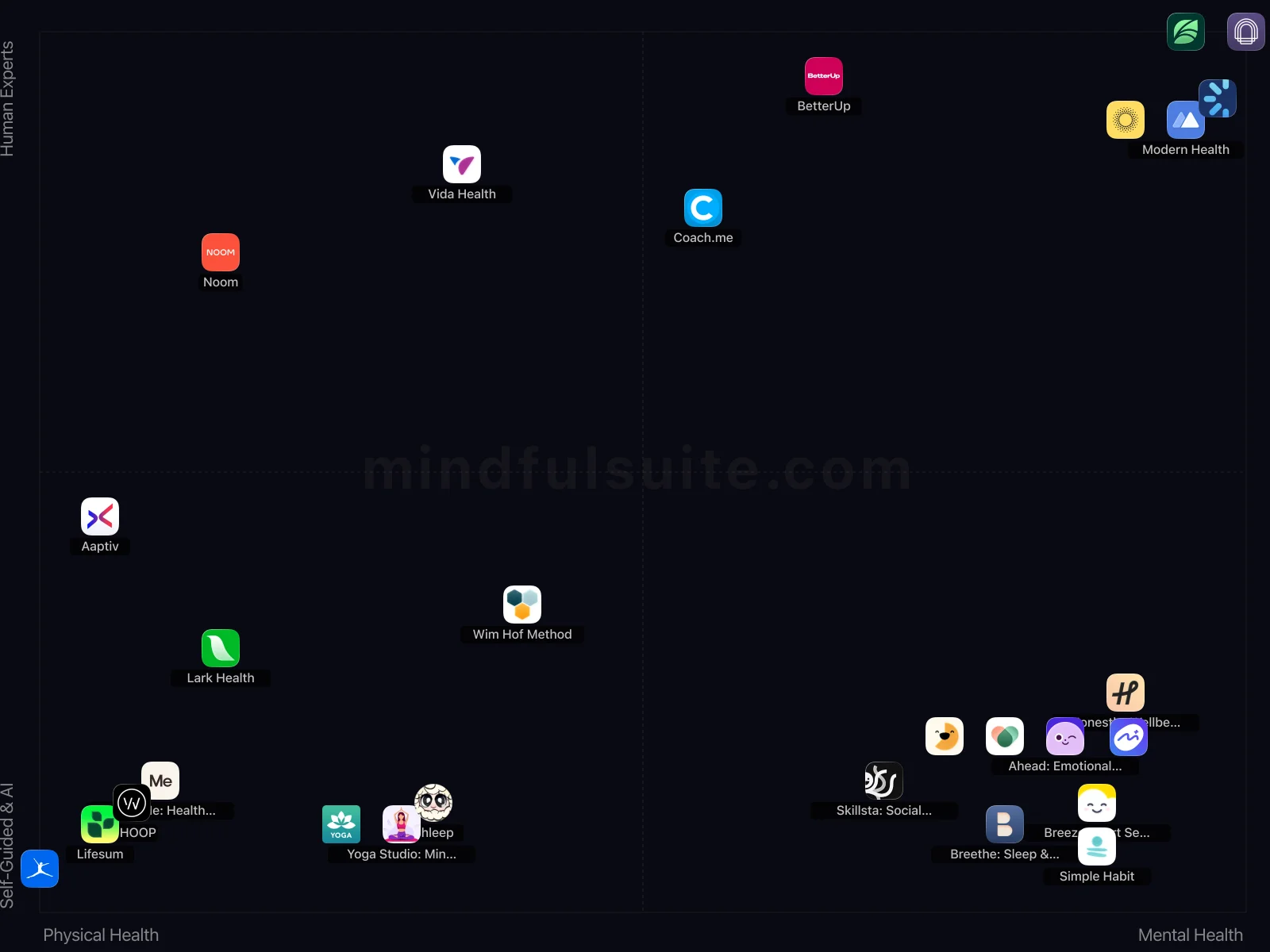
These 26 apps don't all solve the same problem. They cluster into 4 distinct groups, each built around a different philosophy. Understanding which group fits you is the fastest way to narrow your search.
Physical Health + Human Experts
2 apps in this group, led by  Vida Health and
  Noom.
What defines this cluster: virtual health clinic, free, weight loss app, psychology-based approach.
Noom.
What defines this cluster: virtual health clinic, free, weight loss app, psychology-based approach.
Mental Health + Human Experts
5 apps in this group, led by  Modern Health,
  Mindbloom, and
  BetterUp.
What defines this cluster: mental health platform, coaching access, therapy access, guided psychedelic experiences.
BetterUp.
What defines this cluster: mental health platform, coaching access, therapy access, guided psychedelic experiences.
Physical Health + Self-Guided & AI
10 apps in this group, led by  Aaptiv,
  BetterMe: Health Coaching, and
  Lifesum.
What defines this cluster: free with iap, audio fitness workouts, training programs, certified personal trainers.
Lifesum.
What defines this cluster: free with iap, audio fitness workouts, training programs, certified personal trainers.
Mental Health + Self-Guided & AI
9 apps in this group, led by  Ahead: Emotional Companion,
  Honestly: Wellbeing Coaching, and
  Breethe: Sleep & Meditation.
What defines this cluster: free with in-app purchases, for anxiety, stress, anger, mental health journaling, ai-guided prompts.
Breethe: Sleep & Meditation.
What defines this cluster: free with in-app purchases, for anxiety, stress, anger, mental health journaling, ai-guided prompts.
What makes them different
The core tension in this category runs along two axes. On one side, Physical Health apps prioritize simplicity and speed — you can be up and running in under a minute. On the other, Mental Health apps offer depth and customization that rewards investment over time.
The second axis — Coaching Approach — captures an equally important difference. Apps closer to Self-Guided & AI take a fundamentally different approach than those near Human Experts. Neither is objectively better. The right choice depends on your personality, your experience level, and what you're trying to accomplish.
28 Apps Reviewed
We scored every app using a weighted composite of real App Store and Google Play ratings. Out of 28 apps: 14 Essential · 6 Hidden Gems. 24 cross-platform, 2 iOS-only, 2 Android-only.
Top picks: Honestly: Wellbeing Coaching and Ahead: Emotional Companion scored highest overall. Breethe: Sleep & Meditation rounds out the top three. Switch to the Apps tab for the full list with ratings and download links.
How to Pick the Right One
Look at the cluster section above. If you already know whether you want Physical Health or Mental Health, that eliminates half the options instantly. Same for Self-Guided & AI vs Human Experts.
Try one app for a full week before judging. Most wellness coaching apps reveal their value around day 5, not day 1.
Quick start: Honestly: Wellbeing Coaching and Ahead: Emotional Companion represent two different approaches and both scored highest. Pick whichever resonates, switch if it doesn't click.
Making It Stick: Practical Advice
Downloading the app is the easy part. The hard part — the part that actually produces results — is what happens in weeks two, three, and beyond. These tips are drawn from behavioral research and from patterns we've observed across hundreds of thousands of user reviews. They're not revolutionary, but they work:
Be honest with your initial assessment
Coaching apps personalize based on what you tell them. Overstating your current fitness or understating your stress level leads to plans that don't fit.
Focus on one area first
Even though the app tracks multiple dimensions, pick one area for focused improvement. Once that stabilizes, expand to others. Trying to change everything at once leads to burnout.
Frequently Asked Questions
These are the questions that come up most often — from our own testing, from user reviews, and from the broader conversation around wellness coaching apps. If your question isn't here, the Apps tab has detailed information on every app we reviewed.
Can an app replace a human wellness coach?
AI-powered coaching apps provide solid personalization and accountability for most people's needs. Human coaches add deeper empathy, complex situation handling, and relationship-based motivation. If cost is a factor, an app is an excellent starting point.
How long before I see results from wellness coaching?
Most people notice subjective improvements in energy and mood within 1-2 weeks. Measurable changes in fitness, sleep quality, or weight typically emerge after 4-8 weeks of consistent engagement.
The Best Wellness Coaching Apps for a Healthier You (2026)
Remember scribbling a workout on a napkin, only to lose it by the time you got to the gym? Or trying to recall that one breathing exercise your friend mentioned, right when you needed it most? Our wellness goals have always been important, but the tools we used were scattered and, let's be honest, a bit flimsy. That crumpled diet plan and dusty self-help book have been replaced.
Today, the support you need lives right in your pocket. A wellness coach, a meditation guide, a nutritionist, and a therapist can all be on call, ready to help you build a healthier, more intentional life—one tap at a time. Let's explore the best digital companions for your journey.
For Your Mental Space: Meditation & Mindfulness
These apps are like a deep, calming breath for your mind. They use guided meditations, soothing sounds, and proven therapy techniques to help you quiet the noise, reflect on your emotions, and find your center during a chaotic day.

Honestly: Wellbeing Coaching
Honestly is an AI-powered mental health journal. The app guides users through writing or speaking prompts to release stress and understand their mood.
- Its AI-driven journaling transforms your thoughts into personalized mood insights, offering genuine self-reflection.
- Gentle, daily prompts prevent writer's block, making consistent self-reflection and habit building surprisingly effortless.

Ahead: Emotional Companion
Teaches emotion regulation skills, helping users manage anxiety, stress, and anger through behavior-change techniques.
- Its science-backed curriculum, developed by behavior-change scientists, focuses on skill-building.
- Provides structured lessons to understand and manage emotions, rather than just temporary distraction.

Breethe: Sleep & Meditation
Breethe is your all-in-one toolkit for unwinding. It goes beyond standard meditation, offering everything from hypnotherapy sessions to masterclasses on finding happiness. It’s for anyone who wants a broad spectrum of resources to de-stress and sleep like a champ.
- The personalized content recommendations genuinely tailor meditations and sleep stories to user needs.
- Offers a comprehensive library of guided meditations, music, and masterclasses for diverse relaxation.

Breeze: Start Self-Discovery
Breeze helps users explore self-discovery through routines, tests, insights, and calm exercises. It offers a step-by-step approach to feeling more like yourself.
- Breeze offers a comprehensive approach, combining routine building with self-discovery tests for deeper introspection.
- The app's focus on small, actionable steps makes self-improvement feel achievable and less daunting.

Simple Habit
As the name suggests, this app wants to make mindfulness an effortless part of your daily routine. It specializes in short, 5-minute meditations tailored to specific, everyday situations, making it incredibly easy to squeeze in a moment of calm.
- Its core strength lies in quick, accessible 5-minute meditations, making mindfulness genuinely achievable for busy individuals.
- The diverse library covers specific situations like "before a meeting" or "commuting," providing practical, immediate relief.

Mindfulness.com
This app aims to be your complete guide to living a more mindful life. It features a deep library of guided meditations, multi-day courses, and inspiring talks from leading teachers all over the world.
- Features exclusive content and courses from renowned mindfulness teachers, offering expert guidance not found elsewhere.
- Its structured "Mindfulness Courses" provide a clear progression for developing a deeper, more consistent practice.

VOS
VOS helps users find a balanced life through a mental health app and wellbeing plan. The app is aimed at wellbeing, and tracks ADHD and mood.
Your Digital Personal Trainer & Nutritionist
Think of these apps as a personal trainer and nutritionist who follow you everywhere. They help you track your food, plan your workouts, and cheer you on as you reach your physical health goals. Whether you're counting macros or mastering your downward dog, these tools do the heavy lifting of organization for you.

BetterMe: Health Coaching
If you want one app to rule them all, BetterMe is an all-in-one solution for fitness and nutrition. It creates personalized workout and meal plans tailored specifically to you and your goals.
- Its tailored workout plans adapt to user feedback and progress, offering a genuinely personalized fitness journey.
- The variety of bodyweight exercises and quick routines makes fitness accessible for users without gym equipment.

Lifesum
Lifesum is a nutrition app that helps you build healthy eating habits with meal plans, recipes, and a food diary.
- The app's personalized "diet plans" and "recipes" are excellent for users seeking structured guidance beyond basic calorie counting.
- Its visually appealing interface makes logging food and tracking progress far more engaging than many other nutrition apps.

MyFitnessPal
A leader in nutrition tracking, MyFitnessPal makes it easy to log your meals and track calories, macros, and nutrients. With a massive food database and barcode scanner, it's a powerful tool for achieving health and fitness goals.
- The extensive food database, often user-submitted, makes calorie and macro tracking incredibly comprehensive for diverse diets.
- Its AI-powered nutrition insights offer personalized guidance, beyond basic logging, helping users understand their dietary patterns.

Noom
Noom is a weight loss program that focuses on the psychology of eating. It combines food logging with daily lessons and personalized coaching to help you build healthier, sustainable habits for the long term.
- Noom's psychology-driven approach genuinely helps users understand and modify their eating behaviors, fostering sustainable changes.
- The color-coded food system simplifies nutritional choices, guiding users toward healthier options without restrictive counting.

Aaptiv
Offers audio-based fitness workouts led by certified personal trainers across various fitness categories.
- Its "audio-based fitness workouts" are perfect for hands-free training, focusing solely on the movement and trainer's voice.
- Led by "certified personal trainers," it provides expert guidance for diverse fitness goals, a key differentiator.

WHOOP
WHOOP is a favorite among athletes and anyone obsessed with optimizing their performance. The sleek WHOOP band tracks your body's strain, recovery, and sleep 24/7. The app then provides incredibly detailed analytics and coaching, helping you understand exactly how your lifestyle choices impact your sleep and how your sleep impacts your ability to perform the next day.
- Provides exceptionally granular data on sleep stages, recovery, and strain, offering deep physiological insights for athletes.
- The "Sleep Coach" feature gives specific bedtime recommendations to optimize recovery based on daily activity and goals.

Yoga Studio: Poses & Classes
Offers a comprehensive yoga and meditation experience with video classes and teacher commentary for all skill levels. Enables users to practice yoga at home with guidance.

Yoga Studio: Mind & Body
Provides a variety of yoga classes and meditations, with the option to create custom routines. It is suited for users who want structured or personalized yoga practice.
- The "create your own custom classes" feature offers unmatched flexibility for personalized yoga routines.
- It differentiates itself by focusing on a "7 Day Weight loss Dare," appealing to a specific fitness goal.
When You Need Professional Therapy & Coaching
Sometimes you need more than a meditation track—you need a real human in your corner. These platforms connect you directly with licensed therapists, credentialed doctors, and expert professional coaches. Many of these are even covered by progressive employers or insurance plans.

Modern Health
Provides access to mental health coaching, therapy, and resources. It's for employees and individuals who need personalized mental health support.
- Offers direct access to professional coaching and therapy, a significant advantage over self-help apps.
- Often provided as an employer benefit, making high-quality mental health support genuinely free.

Spring Health Mobile
Provides personalized mental healthcare through a provider network offering therapy and other care via an app.
- Provides direct access to actual mental health professionals and therapy appointments.
- Completely free for users whose employers offer it as a benefit, removing financial barriers.

BetterUp
It provides personalized coaching for professional and personal development. This app is useful for individuals looking for guidance and support in achieving their goals.
- It offers highly personalized human coaching for both professional and personal development, a significant differentiator.
- The "coaching at your fingertips" model provides convenient access to expert guidance for growth.

Vida Health
Vida Health is a virtual health clinic available to members of participating employers and health insurance plans.
- Offers access to personalized health coaching and clinical support, a significant advantage for users with specific needs;
- Its integration with employer and health plans makes it highly accessible for eligible individuals.

Cerebral - Mental Health
Provides personalized mental healthcare through licensed doctors and therapists, focusing on one-on-one care and medication management.
- Cerebral offers direct access to licensed human doctors and therapists, providing actual professional mental healthcare.
- It can facilitate online prescriptions, a critical service for those needing medication management alongside therapy.

Mindbloom
Facilitates at-home psychedelic therapy with clinician-prescribed, guided experiences for anxiety or depression. This is intended for users seeking alternative mental health treatments under professional supervision.
- Offers a unique, clinician-supervised psychedelic therapy approach for those resistant to traditional treatments.
- The app provides a structured, guided framework for at-home sessions, enhancing safety and accessibility.

Brightside Health
Brightside Health provides virtual mental health care, tailoring treatment plans to individual needs. It offers therapy, medication, or both, with progress tracking.
Smart Assistants for Habit Building & AI Coaching
This creative bunch of apps focuses on helping you achieve highly specific goals. Whether you want to manage a chronic health condition with AI insights, master complex social skills, or simply get a better night's rest, these targeted tools act as your specialized accountability partners.

Lark Health
Lark provides AI-powered coaching for chronic conditions like diabetes and hypertension, as well as overall wellness support.
- Specializes in AI-powered coaching for specific chronic conditions like diabetes and hypertension, offering targeted support.
- Provides data-driven insights and personalized feedback, making health management feel more informed and proactive.

Remente: Self Care & Wellbeing
Functions as a life coach providing self-help tools and a mental health tracker to help users with goal setting and personal growth. It offers a self-care journal for achieving self-improvement.
- Its focus on "mental health tracker" and "self care journal" gives it a distinct wellness-oriented edge.
- The "life coach" and "self help tools" offer guided paths for personal growth, a unique differentiator.

Wim Hof Method
This is the official app for the legendary Wim Hof Method, which combines specific breathing techniques, cold exposure, and mindset training. It's an intense, powerful practice aimed at boosting energy, reducing inflammation, and unlocking your inner resilience.
- Provides clear, guided instruction for the unique Wim Hof breathing technique, essential for safe practice.
- Integrates cold exposure and mindset challenges, offering a holistic physical and mental program.

Skillsta: Social skill trainer
This app teaches social skills through lessons, helping users improve communication. It's for anyone who wants to become more socially confident and articulate.
- Breaks down complex social concepts into "bite-sized practical lessons," making social skill development manageable.
- Its focus on "learning, doing, and succeeding" provides a structured, action-oriented approach to communication improvement.

Coach.me
Coach.me combines habit tracking with a supportive community and the option to hire professional coaches. If you need more than just a digital nudge, this app provides access to human support.
- Integrated community support offers a unique layer of public accountability and encouragement for routines.
- Option to hire a coach provides personalized guidance, a significant differentiator for serious habit changers.

Shleep
Shleep acts as a personal sleep coach to improve sleep quality and recovery through an immersive experience.