
Depression Management Apps: What You Need to Know in 2026
Depression lies to you. It tells you nothing will help, that you don't have the energy, that it's not worth trying. And the cruelest part is that the illness itself makes it harder to do the things that would actually make you feel better. Depression management apps work within these constraints — offering small, achievable steps that meet you where you are, not where you think you should be.
We evaluated 21 depression management apps across iOS and Android, scoring each on real user ratings, feature depth, and long-term value. This guide covers what we found.
How Depression Distorts Thinking (and Why Apps Can Help)
Depression is not just sadness. It is a systematic distortion of perception that makes the world look darker than it is — and, crucially, makes you unable to see that the distortion is happening. This is the disease's most insidious feature: it alters the lens through which you evaluate everything, including whether you are getting better.
Neurologically, depression reduces activity in the prefrontal cortex (responsible for rational evaluation and future planning) while amplifying activity in the amygdala (threat detection and negative emotion). The practical result is a brain that is biased toward noticing threats, remembering failures, and discounting positive experiences. You genuinely cannot see the good days. When someone tells you that last week was actually pretty good, you are not being dramatic when you say you do not remember it that way. Your brain literally encoded the negative experiences more strongly than the positive ones.
This is where apps provide something that willpower and good intentions cannot: objective data. A mood log does not have depression. It records what you reported on Tuesday with the same weight it gives to what you reported on Thursday. When you look at a month of mood data and see that you rated seven days as "good" or "okay" despite your depressed conviction that the entire month was terrible, you are seeing evidence your brain has been actively hiding from you.
Behavioral activation features address another distortion: the belief that you need to feel motivated before you can act. Depression kills motivation and then uses the resulting inactivity as evidence that you are lazy or worthless. An app that schedules a small activity — walk to the mailbox, take a shower, text one friend — and then records that you did it creates a counter-narrative. You did something. The depression said you could not, and you did. The app becomes external evidence against the depression's internal story, and over time, that evidence accumulates into something the depressed mind cannot entirely dismiss.
Behavioral Activation: The Technique That Works Even Without Motivation
Traditional cognitive therapy follows an intuitive sequence: change your thoughts, and your feelings will change, and then your behavior will change. This works well for many conditions. It works poorly for depression, because depression specifically impairs the cognitive capacity needed to change thoughts. Asking a severely depressed person to challenge their negative thinking is like asking someone with a broken leg to run — the tool requires the very resource the condition has depleted.
Behavioral activation reverses the sequence entirely. Change your behavior first. The feelings follow. The thoughts adjust last. It sounds almost offensively simple, and the research suggests it is nearly as effective as full cognitive therapy for depression — and in some studies, more effective for severe depression specifically.
The mechanism is not mysterious. Depression creates a withdrawal cycle: you feel bad, so you stop doing things. Stopping doing things removes sources of pleasure and accomplishment from your life. The absence of pleasure and accomplishment makes you feel worse. Feeling worse makes you withdraw further. Behavioral activation breaks this cycle by inserting activity — any activity — back into the sequence, regardless of whether you feel like doing it.
The critical insight is that motivation follows action, not the other way around. You do not wait until you feel like going for a walk. You go for the walk, and somewhere during or after it, you feel slightly less terrible. That slight reduction in terribleness is the foothold. It is not dramatic. It is not a cure. But it is a direction — and depression's greatest weapon is the conviction that no direction exists.
This is the single most app-friendly intervention in depression treatment because apps excel at exactly what behavioral activation requires: scheduling activities in advance, sending reminders at the right time, recording completion, and tracking the relationship between activity and mood over time. The app removes the decision-making burden — what to do, when to do it, whether it is worth doing — that depression makes so paralyzing. The activity is already scheduled. The reminder has arrived. The only remaining step is to do the thing.
Why Design Matters More for Depression Apps Than Any Other Category
Depression kills energy, motivation, and decision-making capacity simultaneously. This trifecta creates a design challenge that is qualitatively different from every other app category. A meditation app can assume its user wants to meditate. A fitness app can assume its user has decided to exercise. A depression app must assume its user may not want to do anything at all, may not believe anything will help, and may not have the cognitive resources to navigate a complex interface.
Every tap is a barrier. Every screen transition is an opportunity to close the app. Every decision point — which exercise to do, which mood label to select, whether to write in the optional journal field — is a cognitive tax on a brain that has almost nothing left to tax. The design test for a depression app is stark: could someone use this on their worst day? Not their average day. Their worst day — the day they have not gotten out of bed, the day they have not eaten, the day the thought of opening any app at all feels like an unreasonable demand.
The apps that pass this test share specific design characteristics. One-tap mood logging, where a single press records your emotional state without requiring you to categorize, explain, or elaborate. Pre-written journal prompts rather than a blank page, because a blank page asks a depressed brain to generate content from nothing and a depressed brain has nothing to generate from. Automatic behavioral suggestions rather than menus of options, because choosing feels impossible when everything feels equally pointless.
Color matters. Typography matters. A bright, cheerful interface that works beautifully for a gratitude app can feel like a mockery to someone in a depressive episode. The most effective depression apps use calm, muted designs that do not demand emotional alignment with a mood you cannot feel.
Default settings matter enormously. If an app requires ten minutes of setup before it becomes useful, most depressed users will never complete the setup. The best apps work immediately with zero configuration, then allow customization later for users who have the energy and interest to personalize.
This is not merely a usability question. It is a clinical one. An app that is too complex to use during a depressive episode is an app that is available only when it is least needed. The design itself determines whether the tool reaches the people it is designed to help.
4 Types of Depression Management Apps — and How They Differ
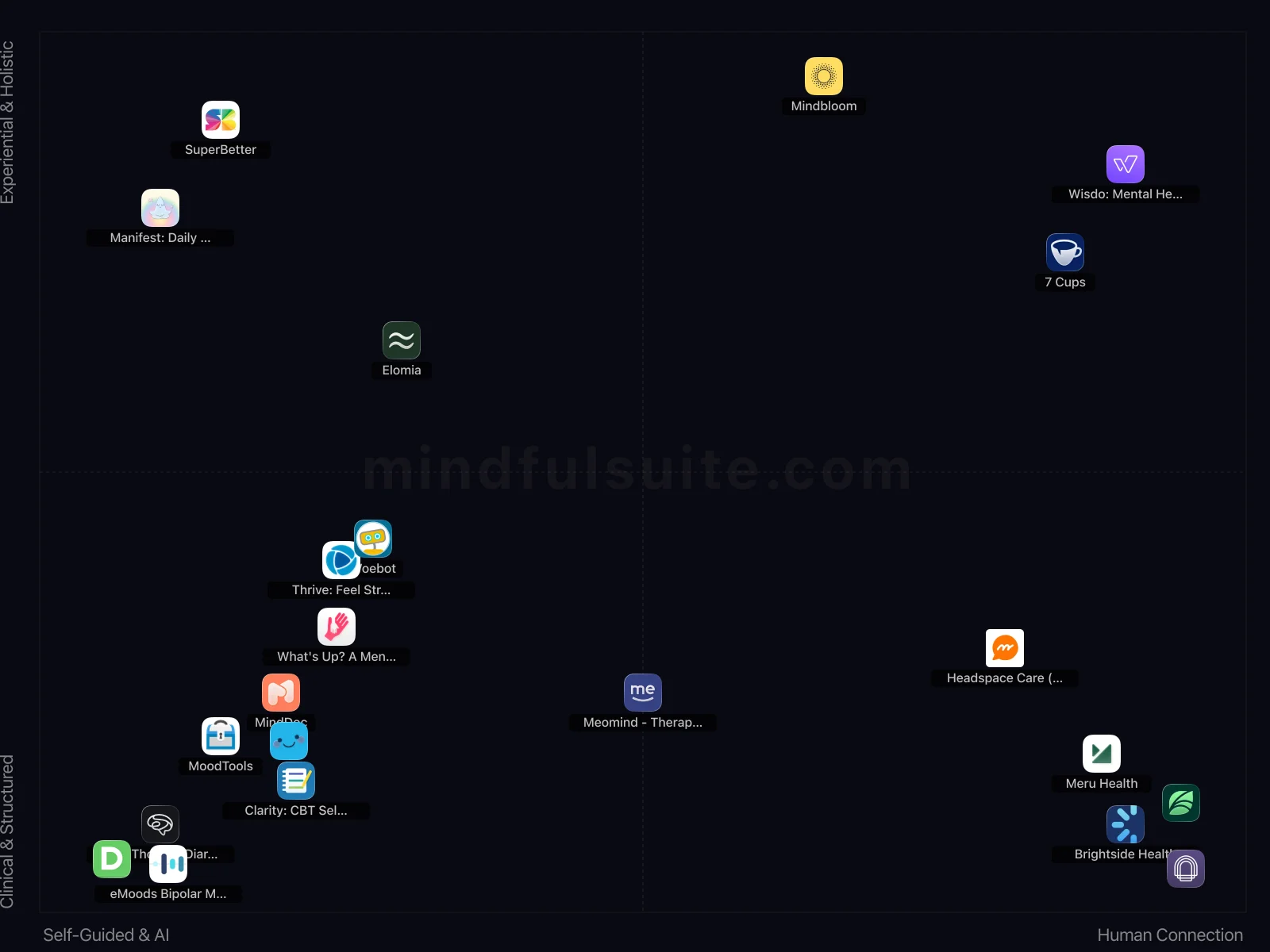
These 22 apps don't all solve the same problem. They cluster into 4 distinct groups, each built around a different philosophy. Understanding which group fits you is the fastest way to narrow your search.
Self-Guided & AI + Experiential & Holistic
3 apps in this group, led by  SuperBetter,
  Elomia, and
  Manifest: Daily Journal.
What defines this cluster: free (iap), build resilience, challenges and power-ups, ai chat companion.
Manifest: Daily Journal.
What defines this cluster: free (iap), build resilience, challenges and power-ups, ai chat companion.
Human Connection + Experiential & Holistic
3 apps in this group, led by  Mindbloom,
  Wisdo: Mental Health & Support, and
  7 Cups.
What defines this cluster: guided psychedelic experiences, clinician-prescribed, combat anxiety, combat depression.
7 Cups.
What defines this cluster: guided psychedelic experiences, clinician-prescribed, combat anxiety, combat depression.
Self-Guided & AI + Clinical & Structured
10 apps in this group, led by  MindDoc,
  Clarity: CBT Self Help Journal, and
  MoodTools.
What defines this cluster: mood tracking, cbt-based insights, mental health exercises, free (iap).
MoodTools.
What defines this cluster: mood tracking, cbt-based insights, mental health exercises, free (iap).
Human Connection + Clinical & Structured
6 apps in this group, led by  Cerebral - Mental Health,
  Spring Health Mobile, and
  Meomind - Therapy Anytime.
What defines this cluster: mental healthcare access, licensed therapists, personalized care, personalized mental healthcare.
Meomind - Therapy Anytime.
What defines this cluster: mental healthcare access, licensed therapists, personalized care, personalized mental healthcare.
What makes them different
The core tension in this category runs along two axes. On one side, Self-Guided & AI apps prioritize simplicity and speed — you can be up and running in under a minute. On the other, Human Connection apps offer depth and customization that rewards investment over time.
The second axis — Treatment Approach — captures an equally important difference. Apps closer to Clinical & Structured take a fundamentally different approach than those near Experiential & Holistic. Neither is objectively better. The right choice depends on your personality, your experience level, and what you're trying to accomplish.
21 Apps Reviewed
We scored every app using a weighted composite of real App Store and Google Play ratings. Out of 21 apps: 3 Essential · 14 Hidden Gems. 17 cross-platform, 3 iOS-only, 1 Android-only.
Top picks: MindDoc and Cerebral - Mental Health scored highest overall. MoodTools rounds out the top three. Switch to the Apps tab for the full list with ratings and download links.
How to Pick the Right One
Look at the cluster section above. If you already know whether you want Self-Guided & AI or Human Connection, that eliminates half the options instantly. Same for Clinical & Structured vs Experiential & Holistic.
Try one app for a full week before judging. Most depression management apps reveal their value around day 5, not day 1.
Quick start: MindDoc and Cerebral - Mental Health represent two different approaches and both scored highest. Pick whichever resonates, switch if it doesn't click.
Making It Stick: Practical Advice
Downloading the app is the easy part. The hard part — the part that actually produces results — is what happens in weeks two, three, and beyond. These tips are drawn from behavioral research and from patterns we've observed across hundreds of thousands of user reviews. They're not revolutionary, but they work:
Start with the smallest possible step
If full exercises feel like too much, just opening the app and logging your mood counts. On hard days, any engagement is a win.
Use behavioral activation before thought work
When depression is heavy, changing your thinking is extremely hard. Starting with simple activities (a short walk, a shower, a meal) often shifts mood enough to make cognitive exercises more accessible.
Share your tracking data with your care team
If you're working with a therapist or psychiatrist, mood tracking data from your app provides invaluable between-session information.
Frequently Asked Questions
These are the questions that come up most often — from our own testing, from user reviews, and from the broader conversation around depression management apps. If your question isn't here, the Apps tab has detailed information on every app we reviewed.
Can an app treat depression?
Apps are effective tools for managing mild to moderate depression, especially those based on CBT and behavioral activation. For moderate to severe depression, they work best alongside professional treatment (therapy and/or medication). If you're experiencing suicidal thoughts, please contact a crisis helpline immediately.
How do I use the app when I have no motivation?
The best depression apps are designed for this exact situation. Look for apps with tiny, achievable micro-actions rather than long exercises. Even logging your mood takes 10 seconds and starts building the tracking habit.
Finding Your Pocket of Peace: The Best Apps for Managing Depression (2026)
Remember trying to untangle heavy thoughts in a paper journal, only to close it and feel just as lost? Or maybe you've tried to "just think positive," sticking affirmations on a mirror that you eventually stop seeing. We've all been there. Managing depression can feel like a lonely, uphill battle fought with analog tools that just don't click when your energy is at absolute zero.
But what if the same phone that buzzes with stressful notifications could actually become a source of relief? Imagine a quiet guide living in your pocket—ready to help you breathe through a sudden wave of panic, map out the hidden patterns behind your moods, or connect you with a professional when things get too heavy.
That’s the magic of a great mental health app. They aren't magic cures, but they are powerful, modern tools for your wellness toolkit. They transform overwhelming therapeutic concepts into simple, bite-sized daily habits you can actually manage.
A quick but important note: These apps are here to support your journey. They are meant to complement, not replace, professional care. If you are in crisis, please contact a local crisis hotline or a healthcare professional immediately.
When You Need to Breathe: Meditation & Mindfulness
Sometimes, the best thing you can do is just step out of the noise. These apps are like a quiet room you can enter anytime. They guide you through grounding meditations, gentle breathing exercises, and calming soundscapes to help you find your center when everything else feels chaotic.

Thrive: Feel Stress Free
This health and fitness app helps users manage stress, anxiety, and depression. It uses evidence-based techniques to address these issues.
- Offers a wide array of evidence-based techniques, including CBT and mindfulness, all completely free without hidden paywalls.
- The app includes immersive "Escape" environments for quick relaxation, providing a unique visual and auditory de-stressing experience.

Manifest: Daily Journal
A personal companion for motivation and mental wellness offering daily affirmations.
- Combines daily affirmations with a journaling component, providing a structured space for reflecting on and reinforcing goal intentions.
- The "personal companion" aspect creates a consistent routine for mental wellness, supporting an optimistic approach to goals.
The Mind Detectives: CBT & Mood Tracking
These apps act like a personal investigator for your brain. Using proven techniques like Cognitive Behavioral Therapy (CBT), they help you recognize, understand, and gently rewrite the negative thought loops that weigh you down.

MoodTools
MoodTools is a thoughtful companion designed specifically for those navigating depression. It offers a suite of CBT-based tools, including a thought diary for challenging negativity and an activity tracker to encourage mood-boosting behaviors. Crucially, it also includes a suicide safety plan, providing a vital resource for those in crisis.
- Specifically designed to combat depression, offering targeted tools like thought diaries, safety plans, and activity schedulers.
- Provides accessible, evidence-based information and resources, empowering users to understand and manage their depression.

What's Up? A Mental Health App
What's Up? is a treasure trove of free mental health tools. It beautifully combines principles from both CBT and Acceptance Commitment Therapy (ACT), offering a wide range of features from a negative thought pattern tracker to a fun grounding game. It's a fantastic starting point for anyone wanting to explore different techniques without a subscription.
- It uniquely combines both CBT and ACT methods, offering a broader range of coping strategies for users.
- The app's "What's Up?" approach is designed to be a quick, accessible resource when immediate support is needed.

MindDoc
MindDoc acts like a thoughtful interviewer, asking you questions about your day to create a detailed emotional log and generate insightful reports on your mental health.
- Offers robust mood tracking combined with clinically-validated CBT exercises, providing structured mental health support.
- Generates personalized insights and progress reports, helping users understand their emotional patterns effectively.

Clarity: CBT Self Help Journal
A mental health app offering CBT techniques to manage stress, anxiety, and mood, with mood tracking features.
- Clarity's strong focus on CBT principles provides a structured, evidence-based approach to challenging negative thoughts.
- The comprehensive mood tracker helps users identify triggers and track progress in developing healthier thought patterns.

My Possible Self
An NHS-approved mental health app, it delivers CBT exercises and personalized activities.
- Being NHS-approved provides significant credibility, assuring users that the CBT exercises and techniques are evidence-based and safe.
- Offers genuinely personalized activity plans and mood tracking, helping users build resilience and manage anxiety long-term, all for free.

CBT Thought Diary: Depression
CBT Thought Diary uses cognitive behavioral therapy in a journal format to challenge negative thoughts. It is designed for self-help in managing depression and improving mental well-being.

eMoods Bipolar Mood Tracker
A mood tracker designed to help users monitor and report on their emotional states. It's privacy-focused, storing data locally without cloud connections.
A Safe Space to Vent: AI Chatbots & Companions
There are moments when you just need to talk, but you don't have the energy to explain yourself to a human. These AI companions offer a completely safe, anonymous, and always-awake space to process your feelings, vent without judgment, and learn new coping skills on the fly.

Woebot
Created by clinical psychologists from Stanford, Woebot is an AI chatbot that checks in with you daily, using CBT to help you reframe negative thoughts in a lighthearted way.
- Offers instant, 24/7 CBT-based mental health support through its AI chatbot, providing immediate coping strategies.
- It provides accessible mental health coaching without the immediate cost or scheduling of human therapy.

Elomia
Elomia is an AI chat companion that prioritizes creating a safe and anonymous space to talk. It's programmed to listen carefully and offer guidance based on established psychological practices, helping you gently navigate difficult emotions and tricky situations.
- Elomia offers a truly confidential and judgment-free space for users to vent and explore difficult emotions.
- The AI is designed to provide guidance rooted in established psychological practices, offering more than just a listening ear.
Connecting with the Pros: Online Therapy Platforms
When you're ready for professional support, finding a therapist shouldn't be another exhausting chore. These platforms remove the friction, making it easier than ever to match with licensed therapists, psychiatrists, and clinical programs directly from your couch.

Mindbloom
Facilitates at-home psychedelic therapy with clinician-prescribed, guided experiences for anxiety or depression. This is intended for users seeking alternative mental health treatments under professional supervision.
- Offers a unique, clinician-supervised psychedelic therapy approach for those resistant to traditional treatments.
- The app provides a structured, guided framework for at-home sessions, enhancing safety and accessibility.

Cerebral - Mental Health
Provides personalized mental healthcare through licensed doctors and therapists, focusing on one-on-one care and medication management.
- Cerebral offers direct access to licensed human doctors and therapists, providing actual professional mental healthcare.
- It can facilitate online prescriptions, a critical service for those needing medication management alongside therapy.

Spring Health Mobile
Provides personalized mental healthcare through a provider network offering therapy and other care via an app.
- Provides direct access to actual mental health professionals and therapy appointments.
- Completely free for users whose employers offer it as a benefit, removing financial barriers.

Meru Health
Delivers mental health care with continuous support from a licensed therapist through video calls and in-app chat. This is for people who need ongoing, accessible mental health support.

7 Cups
7 Cups is built on the power of connection. It offers free, anonymous emotional support by connecting you with trained volunteer listeners 24/7. For those seeking professional help, it also provides access to affordable online therapy.
- Connects users with real human listeners for immediate emotional support, offering a sense of connection during distress.
- Provides access to licensed therapists for more structured, professional counseling, a significant step beyond self-guided apps.

Meomind - Therapy Anytime
Provides personalized, on-demand therapy sessions for improved mental health in short timeframes. It is for individuals seeking quick and convenient access to therapeutic support.
- Offers "PERSONALIZED THERAPY" sessions on demand, providing flexible and accessible mental health support.
- The "Better mental health in 30 min" tagline suggests convenient, bite-sized therapeutic interventions.

Brightside Health
Brightside Health provides virtual mental health care, tailoring treatment plans to individual needs. It offers therapy, medication, or both, with progress tracking.
Playing Through the Pain: Gamified Support
Who says building mental resilience has to feel like homework? These apps cleverly disguise heavy emotional lifting as games and creative quests, making it surprisingly fun to tackle challenges and build healthier habits.

SuperBetter
SuperBetter turns your mental health journey into an epic adventure. You become the hero, taking on quests, activating power-ups, and battling "bad guys" (like self-criticism) to build real-life resilience and achieve your goals.
- The "Power-ups" and "Bad Guys" system offers a unique, engaging gamified approach to resilience building.
- Its focus on real-life challenges provides actionable steps rather than just passive tracking or journaling.
When You Need Immediate Help: Community & Crisis Support
Whether you need a quick baseline assessment of where your mental health currently stands, or you just need to know you aren't the only one feeling this way, these targeted apps provide immediate peer support and crucial crisis tools.

Wisdo: Mental Health & Support
Offers 24/7 live chats and support groups for mental health. Provides a community-based support system for users seeking help.
- The 24/7 live chats and themed help groups offer immediate, diverse peer support, fostering a strong community feeling.
- Completely free access to all core features, removing financial barriers for crucial mental health community support.

Depression Test
Depression Test uses the PHQ-9 questionnaire to help users evaluate the severity of their depression. It's designed to give a quick self-assessment of depressive symptoms.
Your Next Steps Toward Wellness
Finding the right app is a bit like finding a good pair of shoes—it might take a little trial and error, and that’s completely okay. The most important step is the one you’re taking right now: seeking out the support you deserve. Try downloading just one or two that caught your eye today. Celebrate simply opening them up, and remember to be gentle with yourself as you build your foundation of care.