
Calendar Apps: What You Need to Know in 2026
Your calendar is the most honest mirror of your priorities. Not what you say matters — what you schedule. The gap between a cluttered, reactive calendar and an intentionally designed one is the gap between surviving your week and actually directing it. The right calendar app doesn't just show you where to be; it helps you decide where your time should go.
We evaluated 38 calendar apps across iOS and Android, scoring each on real user ratings, feature depth, and long-term value. This guide covers what we found.
Your Calendar Is a Mirror of Your Priorities
Open your calendar right now and look at this week. What you see is not your schedule — it is a portrait of your values, rendered in colored blocks and time slots. The question is whether you painted it deliberately or let other people hold the brush.
Most calendars tell a story of reactivity. Meetings placed by colleagues. Appointments set by doctors, dentists, and mechanics. School events forwarded by a spouse. The calendar owner — the person whose time is actually being allocated — is often the least represented voice in their own schedule. The white space between commitments is not free time; it is undefended time, vulnerable to whatever demand arrives next.
Time blocking reverses this dynamic. The practice is simple: schedule your own priorities as calendar events, not just other people's requests. Block 90 minutes for deep work on your most important project. Block 30 minutes for exercise. Block an hour for reading. Block time for lunch — actual lunch, not eating at your desk while answering emails. These blocks are not aspirational; they are commitments to yourself with the same weight as a meeting with your boss.
The apps that support this well share certain characteristics. They make it fast to create and move blocks (drag-and-drop, not a four-field form). They offer visual distinction between meetings and personal blocks (so you can see at a glance how much of your week you actually control). They integrate with task managers so your to-do list feeds directly into your calendar. And they provide a weekly review view — because the value of time blocking is not in any single day but in the pattern across weeks.
Calendar apps that only handle events — that treat your schedule as a container for other people's needs — miss the fundamental point. Your calendar should be a tool for agency, not just a record of demands. The shift from passive scheduling to active time architecture is one of the highest-leverage changes you can make in how you work.
Calendar Overload: When Too Many Calendars Create Chaos
Work calendar. Personal calendar. Shared family calendar. Kids' school calendar. The side project calendar. Your partner's calendar, subscribed so you can coordinate. A holiday calendar for your country. A sports season calendar because you keep forgetting game days.
Individually, each calendar makes sense. Overlaid on top of each other, they produce a visual cacophony that is worse than no calendar at all. You cannot see your available time because every hour appears filled with colored blocks from six different sources. The tool designed to create clarity has become the source of confusion.
This is the calendar overload problem, and it is remarkably common among people who are otherwise well-organized. The issue is not that you have too many calendars — multiple calendars are a perfectly reasonable way to separate different life domains. The issue is that most calendar apps treat all calendars as equally important at all times. Your dentist appointment and your child's soccer practice and your quarterly business review all compete for visual attention on the same screen.
The solution is layered visibility, and the apps that handle this well offer several mechanisms. Calendar sets let you toggle groups of calendars on and off with a single tap — show only work calendars during work hours, only personal calendars on weekends. Focus mode integration (on iOS and Android) can automatically switch which calendars are visible based on your current Focus or Do Not Disturb setting. Color coding, when applied consistently, lets your brain filter visually even when all calendars are displayed — blue for work, green for personal, red for health, gray for informational subscriptions.
The best calendar apps also distinguish between calendars you need to act on (your own events) and calendars you need to be aware of (subscribed schedules, shared family calendars). A subscribed sports calendar should appear dimmer or in a sidebar — present but not competing with your actual commitments for visual priority.
If your calendar feels overwhelming, the fix is rarely fewer calendars. It is better tools for controlling which calendars you see, when you see them, and how prominently they appear.
AI Scheduling: What Works, What's Overhyped
The promise of AI scheduling is seductive: an intelligent assistant that manages your calendar, finds optimal meeting times, protects your focus blocks, and arranges your day for maximum productivity. Some of this is real. Much of it is marketing.
The genuinely useful AI scheduling feature — the one that delivers consistent, measurable value — is mutual availability detection. Finding a time that works for four people across two time zones used to require a volley of six emails. AI scheduling tools like Calendly, Reclaim, and the scheduling features built into modern calendar apps solve this problem cleanly. You share a link or let the AI scan participants' calendars, and available slots appear. This is not glamorous. It is enormously practical.
Natural language input is the second consistently valuable AI feature. Typing "lunch with Sarah Friday at noon at Cafe Roma" and having the app create a properly formatted event with the right time, duration, location, and invitee saves meaningful friction over filling in form fields. Most modern calendar apps now support this, and the accuracy has become reliable enough to trust.
The overhyped feature is autonomous schedule optimization — the claim that AI can arrange your entire day for peak productivity. The problem is fundamental, not technical: your priorities require human judgment. An algorithm cannot know that you need the morning slot for creative work because that is when your mind is sharpest, or that you prefer Tuesday meetings because Mondays are for catching up after the weekend. These are personal preferences shaped by self-knowledge that no amount of behavioral data can fully capture.
Where AI optimization does show promise is in the narrow domain of protecting existing intentions. If you have blocked time for deep work, a smart calendar can automatically decline or reschedule meeting requests that conflict, or suggest alternative times that preserve your focus blocks. This is AI as enforcer of your decisions, not AI as decision-maker — and that distinction matters.
The honest assessment: AI scheduling saves real time on coordination and data entry. It does not yet — and may never — replace the human judgment required to decide how your time should be spent. Use it for logistics. Keep strategy for yourself.
4 Types of Calendar Apps — and How They Differ
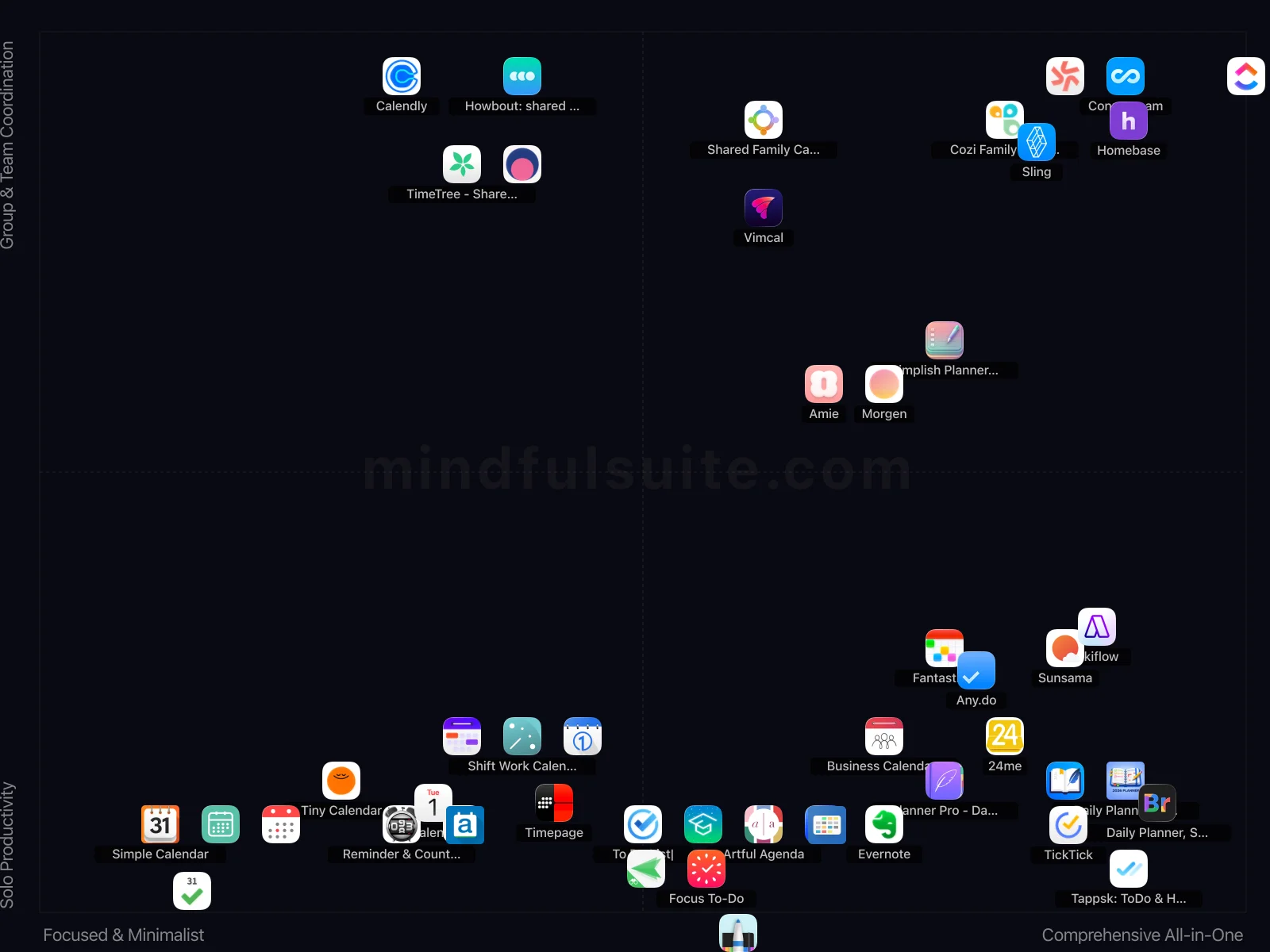
These 48 apps don't all solve the same problem. They cluster into 4 distinct groups, each built around a different philosophy. Understanding which group fits you is the fastest way to narrow your search.
Focused & Minimalist + Group & Team Coordination
4 apps in this group, led by  Calendly,
  TimeTree - Shared Calendar, and
  Howbout: shared calendar.
What defines this cluster: scheduling automation, meeting coordination, free with in-app purchases, shared calendars.
Howbout: shared calendar.
What defines this cluster: scheduling automation, meeting coordination, free with in-app purchases, shared calendars.
Comprehensive All-in-One + Group & Team Coordination
10 apps in this group, led by  Cozi Family Organizer,
  Shared Family Calendar: FamCal, and
  Connecteam.
What defines this cluster: shared calendar, free with iap, grocery lists, recipe management.
Connecteam.
What defines this cluster: shared calendar, free with iap, grocery lists, recipe management.
Focused & Minimalist + Solo Productivity
14 apps in this group, led by  Shift Work Calendar Planner,
  Simple Calendar, and
  Simple Calendar - SimpleCal.
What defines this cluster: offline calendar, customizable, monthly view, calendar app.
Simple Calendar - SimpleCal.
What defines this cluster: offline calendar, customizable, monthly view, calendar app.
Comprehensive All-in-One + Solo Productivity
20 apps in this group, led by  Business Calendar 2,
  Artful Agenda, and
  Planner Pro - Daily Planner.
What defines this cluster: customizable calendar app, various calendar views, event planning tools, free with in-app purchases.
Planner Pro - Daily Planner.
What defines this cluster: customizable calendar app, various calendar views, event planning tools, free with in-app purchases.
What makes them different
The core tension in this category runs along two axes. On one side, Focused & Minimalist apps prioritize simplicity and speed — you can be up and running in under a minute. On the other, Comprehensive All-in-One apps offer depth and customization that rewards investment over time.
The second axis — Target Audience — captures an equally important difference. Apps closer to Solo Productivity take a fundamentally different approach than those near Group & Team Coordination. Neither is objectively better. The right choice depends on your personality, your experience level, and what you're trying to accomplish.
38 Apps Reviewed
We scored every app using a weighted composite of real App Store and Google Play ratings. Out of 38 apps: 18 Essential · 12 Hidden Gems · 2 Mainstream. 19 cross-platform, 14 iOS-only, 5 Android-only.
Top picks:  One Calendar and Planner Pro - Daily Planner scored highest overall.
  TickTick rounds out the top three. Switch to the Apps tab for the full list with ratings and download links.
How to Pick the Right One
Look at the cluster section above. If you already know whether you want Focused & Minimalist or Comprehensive All-in-One, that eliminates half the options instantly. Same for Solo Productivity vs Group & Team Coordination.
Try one app for a full week before judging. Most calendar apps reveal their value around day 5, not day 1.
Quick start: One Calendar and Planner Pro - Daily Planner represent two different approaches and both scored highest. Pick whichever resonates, switch if it doesn't click.
Making It Stick: Practical Advice
Downloading the app is the easy part. The hard part — the part that actually produces results — is what happens in weeks two, three, and beyond. These tips are drawn from behavioral research and from patterns we've observed across hundreds of thousands of user reviews. They're not revolutionary, but they work:
Schedule everything, not just meetings
Block time for deep work, exercise, meals, and personal projects. If it's not on the calendar, it competes with everything else for your attention.
Use color coding consistently
Assign consistent colors to life areas (work = blue, personal = green, health = red). A glance at your calendar should immediately show how your time is distributed.
Review your week on Sunday evening
A 10-minute weekly review prevents surprises and lets you adjust before the week starts. Many calendar apps support weekly view for exactly this purpose.
Frequently Asked Questions
These are the questions that come up most often — from our own testing, from user reviews, and from the broader conversation around calendar apps. If your question isn't here, the Apps tab has detailed information on every app we reviewed.
Should I use my phone's default calendar or a third-party app?
Default calendars (Apple Calendar, Google Calendar) are solid for basic scheduling. Third-party apps add features like natural language input, advanced time blocking, AI scheduling, and better design. If your schedule is complex or you want more control, a dedicated app is worth it.
What's time blocking and should I use it?
Time blocking means scheduling specific tasks into calendar slots rather than just meetings. It's one of the most effective productivity techniques because it makes your plan for the day concrete and visible. If you struggle with getting important work done, time blocking helps.
The Best Calendar Apps for 2026
Remember the days of the family calendar hanging on the fridge? That chaotic collage of clashing pens, scribbled-out appointments, and sticky notes clinging to the edges. Or maybe you carried a pocket planner, its pages worn thin, holding the key to your entire life—until you accidentally left it on a coffee shop table. We’ve all felt that jolt of panic when a schedule falls apart.
Thankfully, we've moved on. A great calendar app isn't just a digital version of that paper mess; it's a smart, proactive assistant that lives in your pocket. It untangles the chaos of work deadlines, personal goals, and family commitments. It gives you a clear view of your day and the peace of mind that comes with knowing you’re in control. Let's find the one that will finally bring some beautiful order to your life.
The Ultimate All-Rounders
When you need a single dashboard to rule them all. These apps pull your disparate schedules—work, personal, side hustles—into one clean view, combining basic task management with broad calendar integration.

One Calendar
Integrates multiple calendars like Google, Outlook, and iCloud into a single, easy-to-read view.
- The exceptional ability to integrate virtually any calendar service (Google, Outlook, iCloud, Exchange) is its killer feature.
- Provides a unified, clean overview of all appointments from various sources without needing multiple apps.

Planner Pro - Daily Planner
An all-in-one planner, calendar, and to-do list app to help you manage your daily life.
- It offers a solid combination of calendar, tasks, and notes, serving as a comprehensive daily organization hub.
- The app allows for detailed event customization, including recurring tasks and multiple reminder options.

Morgen
A calendar and task manager that helps you schedule your time and get more done by unifying all your calendars and to-do apps.
- Offers a clean, unified interface for managing multiple calendars and task lists effectively in one place.
- The 'Schedule Assistant' feature simplifies finding available slots for meetings and tasks instantly.

Planmore - Schedule Planner
This is a professional planning app integrating calendars, events, tasks, reminders, and notes into a single place.
- Offers a truly comprehensive "all-in-one" solution, seamlessly integrating calendars, tasks, notes, and reminders.
- Its professional-grade feature set positions it as a robust hub for intricate personal and work schedule management.

Tappsk: ToDo & Habit Tracker
This productivity app combines a planner, habit tracker, reminder app, and calendar. It aims to streamline task management.
- Its explicit mission to replace multiple apps offers genuine all-in-one convenience for daily organization.
- The robust habit tracking combined with a strong task manager provides comprehensive daily organization.

Daily Planner, Schedule: Brite
An all-in-one productivity app that includes a planner, to-do lists, habit tracker, and notes.
- Brite aims for a "balanced and productive life," suggesting a holistic approach that integrates daily planning with well-being.
- Its combination of Habit Tracker, Routine, and Goals offers a versatile toolkit for managing various aspects of daily self-improvement.

Simplish Planner & To Do List
Simplish combines calendar, tasks, notes, and team messaging into a GTD-based day planner for structured daily life.
- Its "beautiful, thoughtfully designed" interface, combined with GTD, offers a polished and effective planning experience.
- Integration of "calendar, tasks, notes, team messaging" makes it a versatile hub for personal and collaborative productivity.
For Task-Focused Planners
If your schedule is driven by deadlines and to-do lists, a standalone calendar won't cut it. These apps marry your tasks with your time blocks. They force you to be realistic about what you can actually accomplish in a day, ensuring nothing slips through the cracks.

TickTick
TickTick is a comprehensive productivity app that masterfully combines a to-do list, calendar, and habit tracker. If you want to manage everything in one place, TickTick is a top contender.
- The built-in Pomodoro timer and Habit Tracker integration provide unique value, directly boosting productivity within the app.
- Its natural language input for task creation, including dates and times, is incredibly fast and efficient for daily use.

Any.do
Any.do is designed to bring calm and clarity to your day. It combines your to-do list, calendar, and reminders into a single, elegant interface, with a unique daily planning feature that encourages you to be intentional with your time.
- The "Plan My Day" feature effectively guides users through their daily tasks, preventing overwhelm with focused execution.
- Cross-platform sync and a clean, intuitive interface make managing personal tasks across devices surprisingly smooth.

Sunsama
Sunsama is a planner for busy professionals who want to reclaim their work-life balance. It guides you through a daily planning ritual, pulling tasks from all your other tools into a single view so you can build a calm, sustainable workflow.
- Its unique "daily intention" and time-boxing approach helps users establish a calm, focused routine by prioritizing critical tasks.
- Seamlessly integrates tasks from various tools like Slack, Jira, and email, creating a single source of truth for daily routines.

Akiflow
Akiflow is built for speed and for people who live and breathe by their calendar. It pulls all your tasks from different apps into a universal inbox, letting you drag, drop, and time-block your day in seconds.
- Excellent for consolidating tasks from numerous sources like Slack, Notion, and Gmail into one central inbox.
- The 'Command Bar' allows for incredibly fast task creation and scheduling using keyboard shortcuts.

To Do List|
A basic to-do list and calendar app. Use this to manage tasks.
- Direct integration with a calendar view offers crucial context for tasks, visualizing time commitments.
- Robust reminder system is excellent for ensuring important deadlines and appointments are never missed.
For Coordinating with Others
Trying to align schedules with a partner, family, or friend group can feel like a part-time job. These shared calendars stop the endless "are you free Tuesday?" texts and keep everyone beautifully in sync.

Cozi Family Organizer
Cozi is more than just a calendar; it's a digital command center for your entire family. It understands that managing a household involves more than just appointments—it's about grocery lists, recipes, and keeping track of everyone's needs. With its color-coded calendar and shared lists, it’s designed to bring a sense of calm to the wonderful chaos of family life.
- Its integrated recipe box and shopping list features are invaluable for comprehensive household management, not just scheduling.
- The robust, comprehensive suite genuinely centralizes all family logistics, making it an indispensable tool for parents.

TimeTree - Shared Calendar
A shared calendar app used by millions to coordinate schedules across families or other groups and avoid double-booking. Useful for errands, kids' pickups and family events.

Howbout: shared calendar
Howbout is a shared calendar app. It is designed for friends to coordinate schedules and events.
- Clearly focuses on social sharing for friends, making group event planning genuinely simpler than generic calendars.
- The "What's good?" feature for finding mutual availability among friends is a standout for social planning.

Shared Family Calendar: FamCal
Keeps families organized and connected through shared calendars and to-do lists. FamCal helps coordinate schedules and tasks among family members.
- Specifically designed for family coordination, its shared to-do lists and shopping lists are incredibly useful.
- The color-coded family member assignments make viewing everyone's schedule at a glance intuitive and clear.

Cupla
Cupla is a sleek shared calendar app designed specifically to help couples make more time for each other. It syncs with your existing calendars and intelligently finds shared free time for dates and quality time.
- Its "Date Night Planner" feature genuinely helps couples prioritize and schedule quality time together.
- The dedicated couple-centric interface avoids the clutter of general family organizers, keeping focus tight.
For the Power Schedulers
If you live and die by external meetings, time zones, and sharing availability links, you need a heavy-duty tool built for speed. These apps strip out the friction of booking calls and let you navigate your week with rapid-fire keyboard shortcuts.

Vimcal
Built for speed, Vimcal is the calendar for professionals who live by their schedule. Designed for remote workers and heavy meeting schedulers, it focuses on efficiency with powerful keyboard shortcuts, easy time zone conversions, and shareable booking links. It’s a sleek, modern tool that respects your time.
- Designed specifically for remote work, its quick meeting links and time zone conversions are incredibly useful.
- The fast keyboard shortcuts and command palette streamline navigation and event creation for power users.

Calendly
A scheduling automation platform that simplifies the process of finding a time to meet by eliminating back-and-forth emails.
- Simplifies meeting scheduling dramatically, eliminating back-and-forth emails for availability checks.
- Offers various event types and integrations, making it powerful for both personal and professional use.

Amie
Amie calls itself a "joyful productivity app," and it lives up to the name. It combines your calendar and to-dos into a colorful, friendly interface and adds unique social features that make planning feel less like a chore and more like connecting.
- Amie's "joyful productivity" design ethos results in a visually appealing and engaging interface that makes planning more pleasant.
- The unique integration of Spotify and meeting links directly within calendar events streamlines workflow for professionals.
For Android Customizers
Android users know the joy of a perfectly tailored home screen. These tools offer deep widget support, granular layout tweaks, and endless customization options so your schedule looks exactly how you want it to.

Business Calendar 2
For the Android user who wants complete control, Business Calendar 2 is a dream come true. It’s packed with an incredible number of views, widgets, and customization options, letting you build the exact calendar experience you want. Its heat map view is a genius touch, showing you your busiest days at a glance.
- Offers an unparalleled level of customization for views, widgets, and themes, catering to specific professional needs.
- The powerful drag-and-drop functionality for events across various views significantly streamlines scheduling adjustments.

DigiCal Calendar
DigiCal proves that a powerful calendar can also be beautiful. This Android-exclusive app blends a stylish, modern design with a great balance of features. With customizable widgets, multiple views, and a handy integrated weather forecast, it helps you plan your day while looking great on your home screen.
- Its clean Material Design aesthetic and various agenda views make navigating your schedule genuinely pleasant.
- Reliably syncs with Google Calendar, Outlook, and Exchange, ensuring all your commitments are centralized.

aCalendar
Fast, fluid, and focused. aCalendar is for the Android user who values intuitive navigation and core functionality done right. It strips away the clutter and delivers a smooth, user-friendly experience with fluid gestures for switching between views. It's a privacy-focused workhorse that just works.
- Fluid gesture navigation between different calendar views makes checking your schedule genuinely effortless.
- Offers highly customizable widgets that provide quick access to your agenda directly from the home screen.
For the Apple Ecosystem
If you're deeply entrenched in the iOS and Mac world, these gorgeous apps offer seamless integration, brilliant natural language parsing, and that premium, polished design Apple users love.

Fantastical
While it's primarily a calendar, Fantastical's task management features are so good it doubles as an excellent daily planner. Its claim to fame is its magical natural language parsing, which is the fastest way to get events and reminders out of your head and into your schedule.
- Its natural language parsing for event creation is unmatched, making scheduling incredibly fast and intuitive.
- The beautiful design and multiple customizable calendar views provide a superior visual experience on Apple devices.

Timepage
A beautifully designed calendar app by Moleskine that combines events, maps, contacts, and weather into one elegant application.
- Timepage features a sleek, minimalist design with a "heatmap" view that intuitively shows busy periods at a glance.
- Its unique "Moshi" natural language parsing for event creation makes adding entries incredibly fast and intuitive.
For Unique Schedules & Aesthetics
Standard 9-to-5 blocks don't work for everyone. Whether you work rotating shifts, juggle chaotic college classes, or just deeply miss the joy of a decorated, sticker-filled paper planner, these niche tools have you covered.

Artful Agenda
A digital planner that combines the look and feel of a paper planner with the convenience of a digital calendar.
- Artful Agenda's beautiful, customizable digital planner interface genuinely replicates the aesthetic joy of a paper planner.
- The ability to handwrite notes and decorate pages offers a creative and personalized planning experience.

Pencil Calendar: Daily Planner
Pencil Calendar is a daily planner app that combines calendar functionality with customizable templates. It focuses on creative daily, weekly, and monthly planning.
- Its unique focus on "cute templates" and creative planning differentiates it from utilitarian calendar apps.
- Combines visual appeal with functional task management, appealing to users who prefer a personalized planning aesthetic.

Shift Work Calendar Planner
This shift work calendar helps retail and hospital employees manage their schedules.
- Specifically designed for complex shift patterns, offering unparalleled clarity for unpredictable work schedules.
- Easily visualizes and manages complex rotating shifts, overtime, and time-off requests, unlike standard calendars.

Shift Day Work Calendar: Spoke
A shift work calendar, Spoke tracks hours and helps with schedule planning for those working shifts.
- Specifically tailored for shift workers, offering specialized tools for tracking irregular hours and rotations.
- The ability to track actual hours worked directly within the calendar is invaluable for accurate payroll.

MyStudyLife
An all-in-one student planner designed specifically for academic life. It helps you manage your classes, assignments, and exams with a built-in calendar, to-do list, and reminders.
- Comprehensive planner specifically designed for student schedules, easily managing classes, assignments, and exams in one place.
- Syncs across devices, ensuring your academic timetable and deadlines are always up-to-date and accessible.

Pocket Schedule Planner
Pocket Schedule Planner is designed for students who want help tracking when and where their next class will be.
- Specifically tailored for students, offering dedicated sections for class schedules, assignments, and exam tracking.
- The ability to easily manage multiple courses and their respective deadlines is invaluable for academic organization.
Smart Assistants & Simple Schedulers
Sometimes less really is more. If you just want a fast, reliable place to log appointments without drowning in complex features, or if you want an AI nudge telling you when traffic is bad, these are your best bets.

24me
Imagine a personal assistant that pulls everything together for you. That's 24me. It consolidates your calendar, tasks, and notes into a single timeline, and then adds a layer of intelligence with smart alerts that tell you when to leave for a meeting based on traffic. It’s designed to be proactive, helping you stay one step ahead.
- Successfully integrates calendar, tasks, and notes, creating a powerful all-in-one personal organization hub.
- The smart notifications for bills, upcoming events, and daily tasks act as a diligent personal assistant.

Simple Calendar: ToDo Planner
Simple Calendar is a basic and easy-to-use calendar for scheduling and organization.
- Delivers on its "simplicity" promise with a clean, uncluttered interface that makes event and task entry straightforward.
- Its direct approach to calendar and to-do integration avoids overwhelming users with unnecessary advanced features.

Tiny Calendar
Sometimes, you just need a simple, reliable calendar that works. Tiny Calendar is exactly that. It syncs with your existing calendars, offers a clean range of views, and—most importantly—works offline, so you can add or edit events even when you don't have a connection. It's a straightforward tool that nails the basics.
- Offers seamless synchronization with Google Calendar, Outlook, and Exchange, centralizing all your appointments effectively.
- The diverse range of calendar views, from agenda to year, provides flexibility for checking your schedule.

Simple Calendar - SimpleCal
SimpleCal is a basic calendar app designed for ease of use.
- Lives up to its name with a genuinely minimalist interface, prioritizing quick event creation and clear viewing.
- The integrated task and to-do list functionality within the simple calendar view is surprisingly effective.

Simple Calendar
Simple Calendar is a customizable offline monthly calendar app for basic scheduling and agenda planning.

Check Calendar - Habit Tracker
Enables users to track habits by ticking off days on a calendar.
- Its core "tick your calendar" mechanic is refreshingly simple and visually effective for tracking daily completion.
- The straightforward design ensures minimal friction when logging habits, focusing on pure consistency.

ZenDay: Organize Your Time
A 3D timeline that displays your tasks and events, helping you visualize your schedule and manage your time more effectively.
- The unique 3D timeline provides an interesting visual representation of your daily schedule and tasks.
- Its dynamic re-prioritization helps adapt your schedule when tasks run over or new ones arise.
Finding Your Perfect Calendar Match
Whether you’re meticulously color-coding every hour of your week or just trying to remember when your next dentist appointment is, there is a calendar app built specifically for your lifestyle. The best approach is to try out a few from this list. Test their home screen widgets, explore their unique features, and see which one seamlessly integrates into your daily flow. Here’s to a brilliantly organized and productive 2026!