
Vision Board Apps: What You Need to Know in 2026
A vision board is the simplest possible goal-setting tool: a collection of images and words representing the life you're building toward. Seeing it daily keeps your aspirations in your conscious awareness instead of fading into the background noise of daily life. Digital vision boards take this idea further — they're portable, updatable, and always in your pocket.
We evaluated 13 vision board apps across iOS and Android, scoring each on real user ratings, feature depth, and long-term value. This guide covers what we found.
Visualization Science: What Works, What's Wishful Thinking
The science of visualization is real, but it is substantially more nuanced than the vision board industry typically acknowledges. Understanding the distinction between what the research actually supports and what is wishful extrapolation is essential for using these tools effectively.
Mental imagery rehearsal — vividly imagining yourself performing a specific action — has genuine empirical support. Alvaro Pascual-Leone's landmark 1995 study at Harvard demonstrated that participants who mentally practiced piano sequences showed cortical changes similar to those who physically practiced. Athletes have used mental rehearsal for decades: a skier visualizing each gate, a basketball player mentally rehearsing free throws, a surgeon walking through a procedure before entering the operating room. The mechanism is real. Vivid mental simulation activates many of the same neural pathways as actual performance.
But here is where the research diverges sharply from popular vision board culture. Gabriele Oettingen's work at New York University has produced a finding that most manifestation advocates prefer to ignore: fantasizing about positive outcomes can actually reduce motivation and effort. In a series of studies, Oettingen found that people who vividly imagined achieving a desired outcome — getting a dream job, losing weight, recovering from surgery — subsequently showed lower energy, less effort, and worse results than control groups. The mechanism she identified is that positive fantasy provides a premature sense of satisfaction. Your brain experiences a taste of the reward without the work, which reduces the motivational tension that drives action.
The distinction is critical. Process visualization — imagining yourself doing the work, handling obstacles, executing the steps — improves performance. Outcome fantasy — imagining the result as already achieved, basking in the feelings of success — can undermine it. Oettingen developed a technique called WOOP (Wish, Outcome, Obstacle, Plan) that bridges this gap: you visualize the desired outcome, then immediately contrast it with the obstacles you expect to encounter, then form implementation intentions for handling those obstacles.
A vision board that shows you crossing a marathon finish line is outcome fantasy if it sits on your wall while you skip training runs. It becomes process visualization if it is paired with a training schedule, if the images include the early-morning runs and the foam rolling and the boring weekday miles. The science supports vision boards that inspire action, not vision boards that substitute for it.
Digital vs Physical: Why the Medium Matters Less Than the Practice
The vision board tradition predates apps by decades. Magazine clippings, photographs, printed quotes, arranged on a poster board or a cork wall — this was the original Pinterest, assembled with scissors and tape at kitchen tables. The question of whether digital vision boards are as effective as physical ones generates surprisingly strong opinions in wellness communities. The answer, once you strip away the nostalgia and the marketing, is that the medium is almost entirely beside the point.
Physical vision boards have real advantages. The act of cutting, arranging, and pinning is a tactile, meditative process that deepens engagement with the material. A large board in a prominent location in your home — above your desk, across from your bed — occupies physical space in your daily environment. You see it without choosing to look at it. It exists in your peripheral vision during phone calls and morning routines and late-night reading. This passive, ambient exposure has value.
Digital vision boards have different advantages. They are portable — your vision board is on the device you carry everywhere. They are easily updated — as goals evolve or are achieved, you swap images in seconds rather than re-creating the entire board. Most importantly, they can be set as your phone wallpaper, which means you see them not just when you walk past a wall at home, but dozens of times per day, every time you check your phone. Given that the average person unlocks their phone 80 to 100 times daily, a lock screen vision board gets more visual impressions in a week than a poster board gets in a month.
The variable that actually matters — and it is the same for both mediums — is frequency of exposure. A beautifully crafted physical vision board in a closet is worthless. A basic digital collage that appears every time you check the time is powerful. A gorgeous poster in your home office that you stopped noticing three weeks ago (the brain is remarkably efficient at tuning out static visual stimuli) is less effective than a digital board that rotates images and catches your attention anew.
The right answer for most people is simple: choose whichever medium you will actually look at. If you work from home and your desk faces a wall, a physical board in that sight line works beautifully. If you live on your phone and rarely sit at a desk, digital is obviously superior. Some people use both — a physical board for the creation ritual and deep engagement, a digital copy on their phone for daily repetition. The medium is a delivery mechanism. The practice is the payload.
From Dreaming to Doing: Boards That Drive Action
The uncomfortable truth about most vision board apps is that they are Pinterest with a different name. You collect beautiful images of the life you want — the beach house, the business, the body, the relationship — and you look at them, and you feel inspired, and then you close the app and do nothing different. Inspiration without action is entertainment.
The vision board apps that actually work are the ones that bridge the gap between the image and the effort. They connect each visual element to a specific, measurable goal and then connect that goal to concrete action steps. A picture of a marathon finish line means nothing in isolation. Attached to a 16-week training plan with weekly mileage targets, it becomes the emotional fuel for a real outcome. A photo of a kitchen you aspire to own is wallpaper. Linked to a savings goal tracking monthly deposits toward a down payment, it becomes a financial commitment device.
The best apps in this category understand that the vision board is the beginning of a funnel, not the end of one. The funnel works like this: vision (what do I want?) flows to goal (what specifically, by when?) flows to plan (what steps, in what order?) flows to action (what am I doing today?). Vision boards that stop at the first stage — collect pretty images, feel inspired — produce the premature satisfaction that Oettingen's research warns about. Vision boards that complete the funnel produce results.
When evaluating vision board apps, look for ones that let you tap an image and attach a goal to it — with a target date, milestones, and reminders. Look for apps that prompt you to define the gap between where you are and where the image represents. Look for weekly or daily prompts that ask: what action are you taking today toward this vision? The apps that ask these questions are the ones that understand the difference between dreaming and doing.
The ones that do not ask these questions — the ones that let you build a gorgeous collage and then leave you to stare at it — are tools for daydreaming. Daydreaming has its place. But if your goal is to actually build the life on your board, you need an app that treats the board as a starting point and asks you, persistently and specifically, what you are going to do about it.
4 Types of Vision Board Apps — and How They Differ
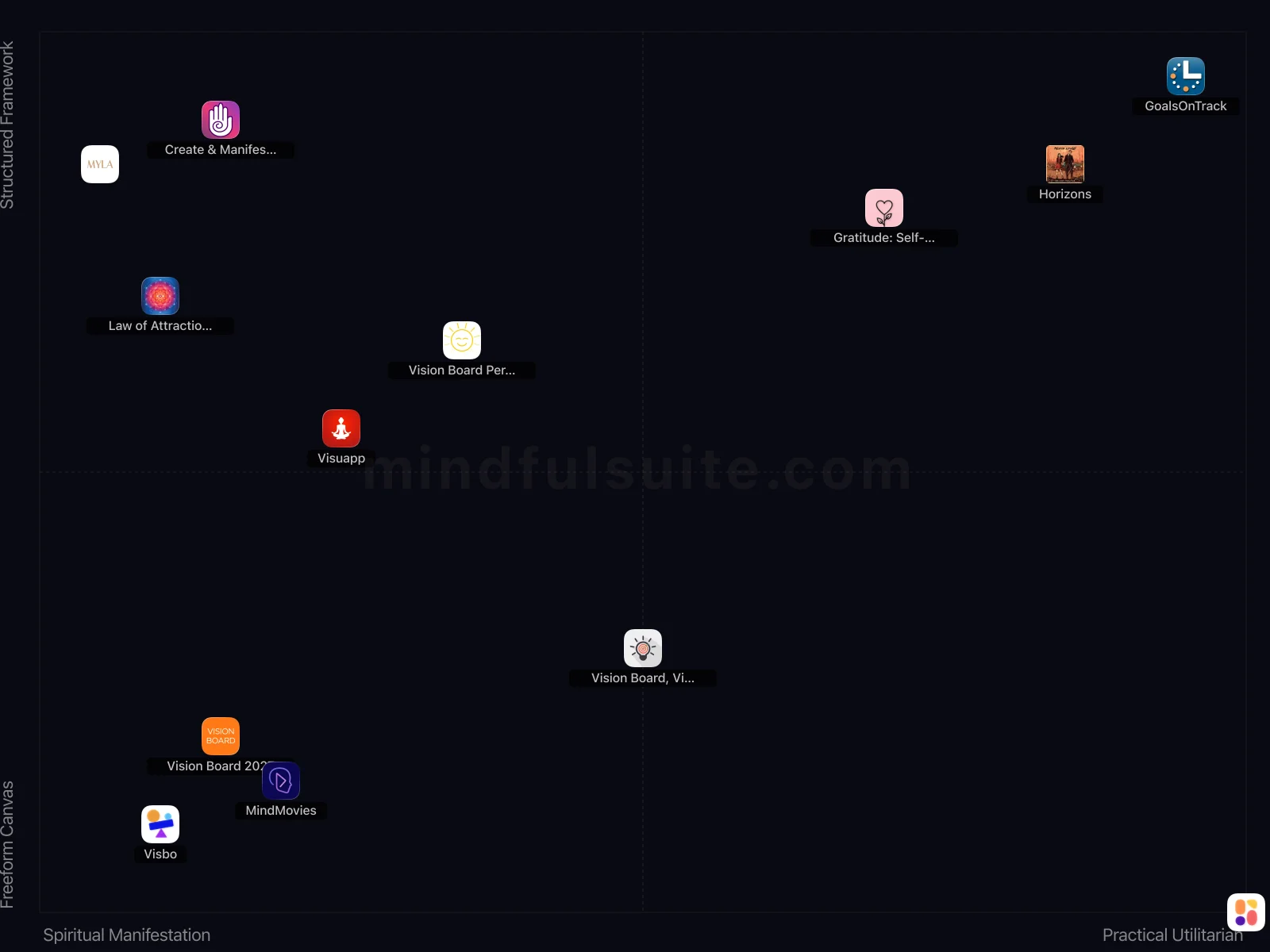
These 12 apps don't all solve the same problem. They cluster into 4 distinct groups, each built around a different philosophy. Understanding which group fits you is the fastest way to narrow your search.
Spiritual Manifestation + Structured Framework
5 apps in this group, led by  Manifest: Law of Attraction App,
  Vision Board Perfectly Happy, and
  Visuapp.
What defines this cluster: vision board, gratitude journal, guided meditations, affirmations.
Visuapp.
What defines this cluster: vision board, gratitude journal, guided meditations, affirmations.
Practical Utilitarian + Structured Framework
3 apps in this group, led by  Gratitude: Self-Care Journal,
  Horizons, and
  GoalsOnTrack.
What defines this cluster: daily gratitude prompts, affirmations, vision board, free with iap.
GoalsOnTrack.
What defines this cluster: daily gratitude prompts, affirmations, vision board, free with iap.
Spiritual Manifestation + Freeform Canvas
3 apps in this group, led by  Visbo,
  Vision Board 2027, and
  MindMovies.
What defines this cluster: vision board creation, inspiring imagery, music integration, free with in-app purchases.
MindMovies.
What defines this cluster: vision board creation, inspiring imagery, music integration, free with in-app purchases.
Practical Utilitarian + Freeform Canvas
1 apps in this group, led by  Vision Board, Visualize dreams.
What defines this cluster: goal setting, visualization, daily affirmations, productivity tools.
Vision Board, Visualize dreams.
What defines this cluster: goal setting, visualization, daily affirmations, productivity tools.
What makes them different
The core tension in this category runs along two axes. On one side, Spiritual Manifestation apps prioritize simplicity and speed — you can be up and running in under a minute. On the other, Practical Utilitarian apps offer depth and customization that rewards investment over time.
The second axis — Methodology — captures an equally important difference. Apps closer to Freeform Canvas take a fundamentally different approach than those near Structured Framework. Neither is objectively better. The right choice depends on your personality, your experience level, and what you're trying to accomplish.
13 Apps Reviewed
We scored every app using a weighted composite of real App Store and Google Play ratings. Out of 13 apps: 2 Essential · 9 Hidden Gems. 7 cross-platform, 5 iOS-only, 1 Android-only.
Top picks: Gratitude: Self-Care Journal and  Collect by WeTransfer scored highest overall. Vision Board Perfectly Happy rounds out the top three. Switch to the Apps tab for the full list with ratings and download links.
How to Pick the Right One
Look at the cluster section above. If you already know whether you want Spiritual Manifestation or Practical Utilitarian, that eliminates half the options instantly. Same for Freeform Canvas vs Structured Framework.
Try one app for a full week before judging. Most vision board apps reveal their value around day 5, not day 1.
Quick start: Gratitude: Self-Care Journal and Collect by WeTransfer represent two different approaches and both scored highest. Pick whichever resonates, switch if it doesn't click.
Making It Stick: Practical Advice
Downloading the app is the easy part. The hard part — the part that actually produces results — is what happens in weeks two, three, and beyond. These tips are drawn from behavioral research and from patterns we've observed across hundreds of thousands of user reviews. They're not revolutionary, but they work:
Update your board quarterly
Goals evolve. Review and refresh your vision board every few months to ensure it still reflects what you're actually working toward.
Include both outcomes and processes
Don't just add pictures of the destination — include images representing the daily habits and actions that get you there.
Set it as your phone wallpaper
The power of a vision board is in repeated exposure. If it's your lock screen, you'll see it 50+ times daily without any effort.
Frequently Asked Questions
These are the questions that come up most often — from our own testing, from user reviews, and from the broader conversation around vision board apps. If your question isn't here, the Apps tab has detailed information on every app we reviewed.
Do vision boards actually help achieve goals?
Vision boards help maintain goal awareness and motivation. They work best when combined with concrete action planning. The research supports that repeated visual exposure to goals increases the likelihood of pursuing them — but only if paired with effort.
Digital vs physical vision board — which is better?
Physical boards offer a tactile creation experience and constant visibility at home. Digital boards are portable, easily updated, and can serve as phone wallpapers. Many people use both — a physical board at home and a digital one on their phone.
The Best Vision Board Apps for 2026
Remember the satisfying snip of scissors through a glossy magazine page? The hunt for that perfect image of a sun-drenched beach or a corner office, followed by the careful arrangement of pushpins on a corkboard. It was a beautiful ritual, but your dreams usually ended up stuck on a wall in your bedroom, gathering dust.
What if you could carry that magic with you? Digital vision board apps transform the glowing screen in your pocket from a source of endless distraction into a powerful reminder of exactly where you’re headed. They are living, breathing canvases for your ambitions—easily updated, totally private, and ready to inspire you whether you're commuting on the bus or waiting for your morning coffee.
Let's explore the best tools to turn your phone into your biggest cheerleader.
Dedicated Vision Board & Manifestation Apps
Ready to dive deep into manifestation? These apps were built from the ground up to help you visualize your future. They're more than just collage makers; they're complete wellness toolkits designed to infuse your goal-setting with gratitude, daily affirmations, and mindful reminders.

Vision
A vision board app that keeps your goals always visible on your lock screen with custom widgets, backgrounds, and an extensive motto library.
- Always-visible vision board through iOS 26 widgets.
- Extensive motto library covering anxiety, ADHD, self-acceptance, and atomic habits.
- Beautiful custom background layouts and dynamic effects.

Gratitude: Self-Care Journal
This app is more than just a journal; it's a complete wellness toolkit. It wraps your gratitude practice in a warm hug of self-care, offering daily affirmations, a vision board for your dreams, and thought-provoking prompts to guide you.
- The combination of daily gratitude prompts, affirmations, and a vision board within one app offers a holistic manifestation approach.
- The "Gratitude Wall" feature, showcasing shared positive entries, provides a unique sense of community and inspiration.

Vision Board Perfectly Happy
An all-in-one wellness app that seamlessly integrates vision boards with tools like affirmations, a gratitude journal, and mood tracking to provide a holistic approach to manifestation.
- Offers a unique "vision board" feature, allowing visual goal setting alongside daily affirmations.
- Combines "visualization, daily affirmations, motivation" for a comprehensive manifestation approach to happiness.

Visuapp
A dedicated vision board app that uses Feng Shui principles to help structure your goals. It also includes a gratitude journal to enhance the visualization process.
- As a dedicated vision board app, it uniquely incorporates Feng Shui principles into board creation, adding a distinct spiritual dimension.
- The integrated gratitude journal and daily affirmations provide excellent support for mental well-being alongside goal visualization.

Law of Attraction Space
Offers tools and information for practicing the Law of Attraction, including affirmations, vision boards, and success stories.
- The inclusion of success stories from other users provides motivating social proof for the effectiveness of manifestation.
- It offers educational content and tools specifically designed to teach the principles of the Law of Attraction.

Visbo
Visbo is a dedicated Law of Attraction tool for creating vision boards. You can add inspiring imagery, text, and music to create a personalized manifestation tool.
- Visbo integrates music and inspiring imagery, directly catering to Law of Attraction principles for a more immersive manifestation experience.
- It's specifically designed for vision boards, providing a focused environment without unnecessary clutter.

Vision Board 2027
A highly customizable iOS app that lets you create not just static vision boards but also "vision board movies" with music and personal affirmations.
- Its unique focus on the "Bagua map" and visualization provides a distinct, spiritually aligned approach to goal setting and manifestation.
- The integration of "Affirmations" directly supports a positive mindset, which is crucial for staying motivated towards long-term goals.

Vision Board, Visualize dreams
This vision board app helps users visualize dreams and manifest goals through visualization and affirmations. Vision Board allows users to focus, plan, and track life goals.

Manifest: Law of Attraction App
This app aims to be your one-stop shop for manifestation. It neatly integrates the core pillars of the practice—meditation, gratitude, affirmations, and visualization—into a single, streamlined experience to keep you focused and inspired.
- Its all-in-one approach, combining meditations, journaling, affirmations, and vision boards, provides a comprehensive manifestation toolkit.
- Specific techniques like the 369 method are integrated, offering structured guidance for those familiar with Law of Attraction practices.

Create & Manifest Dream Goals
This app brings a dose of structured focus to your practice. It frames manifestation as a series of 30-day challenges, guiding you to pour intense energy into one specific desire at a time using a variety of Law of Attraction exercises.
- The structured 30-day challenges offer a clear, actionable roadmap for users new to consistent manifestation practices.
- It's genuinely free, without hidden subscription paywalls, which is a rare and refreshing find in this category.
Creative & Design Apps
For the inner artist who believes that beauty is part of the inspiration. If a static image isn't enough to get your heart racing, these tools let you add dynamic elements, music, and powerful pacing so your vision board feels less like a poster and more like a cinematic trailer for your life.

MindMovies
A unique take on the vision board, MindMovies allows you to create dynamic "video vision boards" by combining your images, powerful affirmations, and uplifting music.
- Creating dynamic "video vision boards" with music and affirmations offers a uniquely immersive and engaging visualization experience.
- The gamified personal development aspect provides a novel, interactive way to track and achieve goals.
Curation & Collage Apps
Sometimes you don't need bells, whistles, or guided meditations. You just need a place to quickly gather the sparks of inspiration you find scattered across the internet. These apps let you skip the fuss and focus on what matters most: collecting and combining your favorite ideas into a seamless digital scrapbook.

Collect by WeTransfer
Lets users save and organize visual inspiration into boards, ideal for creating vision boards and curating content.
- Seamlessly gather diverse content, including images, links, and notes, into visually intuitive boards.
- The "Pro" subscription unlocks unlimited boards and 200GB storage, crucial for extensive visual archiving.
Productivity & Goal-Tracking Apps
For the hyper-organized mind that loves connecting the dots. Staring at a picture of a sports car won't put the keys in your hand. These apps let you build a vision board directly alongside the actionable plans, mind maps, and daily tasks required to actually get you there.

Horizons
This app frames goal-setting as a journey. It combines a vision board with an action tracker and a progress journal to help you visualize and actively work towards your future.
- Uniquely combines mind mapping with affirmations, allowing for structured goal setting alongside visual inspiration.
- The daily affirmation feature provides consistent reinforcement for goals visualized on your board.