
Manifestation Apps: What You Need to Know in 2026
Manifestation is a loaded word. To some, it's wishful thinking. To others, it's a powerful visualization practice that aligns daily actions with long-term aspirations. Strip away the mysticism and you're left with something that psychology actually supports: vividly imagining your goals, affirming your capability, and taking daily intentional steps toward them.
We evaluated 14 manifestation apps across iOS and Android, scoring each on real user ratings, feature depth, and long-term value. This guide covers what we found.
Separating Neuroscience from Pseudoscience
Let's be direct: the claim that 'the universe will provide' if you think positive thoughts hard enough has zero scientific support. The law of attraction, as popularly understood — that like attracts like on a cosmic level, that your thoughts emit frequencies that draw corresponding realities — is not a finding of physics, neuroscience, or psychology. It's a belief system dressed in scientific-sounding language.
But here's what makes manifestation interesting rather than dismissible: buried under the mysticism are practices with genuine empirical backing. Mental rehearsal — vividly imagining yourself performing a task — activates motor cortex patterns similar to actual physical practice. Alvaro Pascual-Leone demonstrated this in a landmark 1995 study where subjects who mentally practiced piano exercises showed cortical reorganization comparable to those who physically practiced. Athletes, surgeons, and musicians have used this principle for decades.
Specific goal-setting works. Edwin Locke and Gary Latham's research, spanning thirty-five years, consistently found that specific and challenging goals produce higher performance than vague aspirations. Written self-affirmation of personal values buffers against stress and improves performance under pressure, as Claude Steele's self-affirmation theory demonstrated.
The challenge for consumers of manifestation apps is extraction. The evidence-based kernels — mental rehearsal, goal specificity, values affirmation, gratitude practice — are often buried in pseudoscientific packaging. The app that tells you to 'raise your vibration' might also guide you through a genuinely useful visualization exercise. The trick is knowing which part is doing the work. Look for apps that emphasize process over magic, that connect visualization to action, and that cite actual research rather than quantum physics metaphors. The good practices don't need the mystical framing. They stand on their own evidence.
Mental Rehearsal: The One Technique with Actual Evidence
Athletes don't visualize winning because it's motivational. They visualize because decades of research demonstrate that it works. A basketball player who mentally rehearses free throws — feeling the ball's texture, seeing the arc, experiencing the release — shows measurable improvement in actual performance. Surgeons who mentally walk through procedures before entering the operating room perform better than those who don't. Pianists who practice mentally show cortical changes that parallel physical practice.
The neuroscience is compelling. When you vividly imagine performing a task, your brain activates many of the same neural pathways it would use during actual performance. The motor cortex lights up. The supplementary motor area engages. The cerebellum participates. Your brain, to a meaningful degree, doesn't fully distinguish between vivid imagination and actual execution — at least at the level of pathway strengthening.
But there's a critical nuance that most manifestation apps get wrong. Visualizing the process works. Visualizing only the outcome can actually reduce motivation. Gabriele Oettingen, a psychology professor at NYU, has spent two decades studying this distinction. Her research consistently shows that people who vividly fantasize about achieving a goal — imagining the celebration, the congratulations, the feeling of success — subsequently exert less effort toward it. The fantasy provides premature emotional satisfaction. You feel good about the goal without doing anything about it.
Process visualization is different. Imagining yourself doing the work — sitting at the desk, writing the difficult chapter, having the uncomfortable conversation, running the miles — strengthens the neural pathways for execution, not just for enjoyment. The best manifestation apps get this distinction right: they guide you to visualize the doing, not just the having. Most apps don't. Most let you marinate in outcome fantasy and call it a practice.
The Action Gap Most Manifestation Apps Ignore
The most insidious danger of manifestation apps isn't that they waste your time. It's that they can actively undermine your goals by providing premature emotional satisfaction. You spend ten minutes visualizing your dream business, feeling the pride and excitement of success, and then you close the app and watch television. The visualization felt productive. It wasn't.
Gabriele Oettingen's research at NYU identified this trap precisely. In study after study, she found that positive fantasizing about a desired future — without confronting the obstacles between here and there — reduced effort, reduced persistence, and reduced achievement. The mechanism is almost perversely logical: your brain processes the vivid positive fantasy as a partial accomplishment. The emotional reward arrives before the work, draining the motivational fuel you needed to actually do something.
Oettingen's solution is a framework called WOOP: Wish, Outcome, Obstacle, Plan. You start with the wish (what you want). You imagine the best outcome (the visualization piece). Then — and this is where most manifestation apps stop — you identify the main internal obstacle standing in your way. Finally, you create an if-then plan: 'If [obstacle occurs], then I will [specific response].' The obstacle confrontation is what transforms dreaming into doing.
The best manifestation apps build this bridge between vision and action. They follow a visualization exercise with concrete planning: what is one step you will take today? What obstacle might you face? How will you respond? They treat visualization as the beginning of a process, not the end of one. The mediocre apps — and there are many — let you daydream in high definition and call it a practice. The difference between the two is the difference between an app that makes you feel good and an app that helps you change your life. Feeling good is easy. Changing your life requires the part that comes after the feeling.
4 Types of Manifestation Apps — and How They Differ
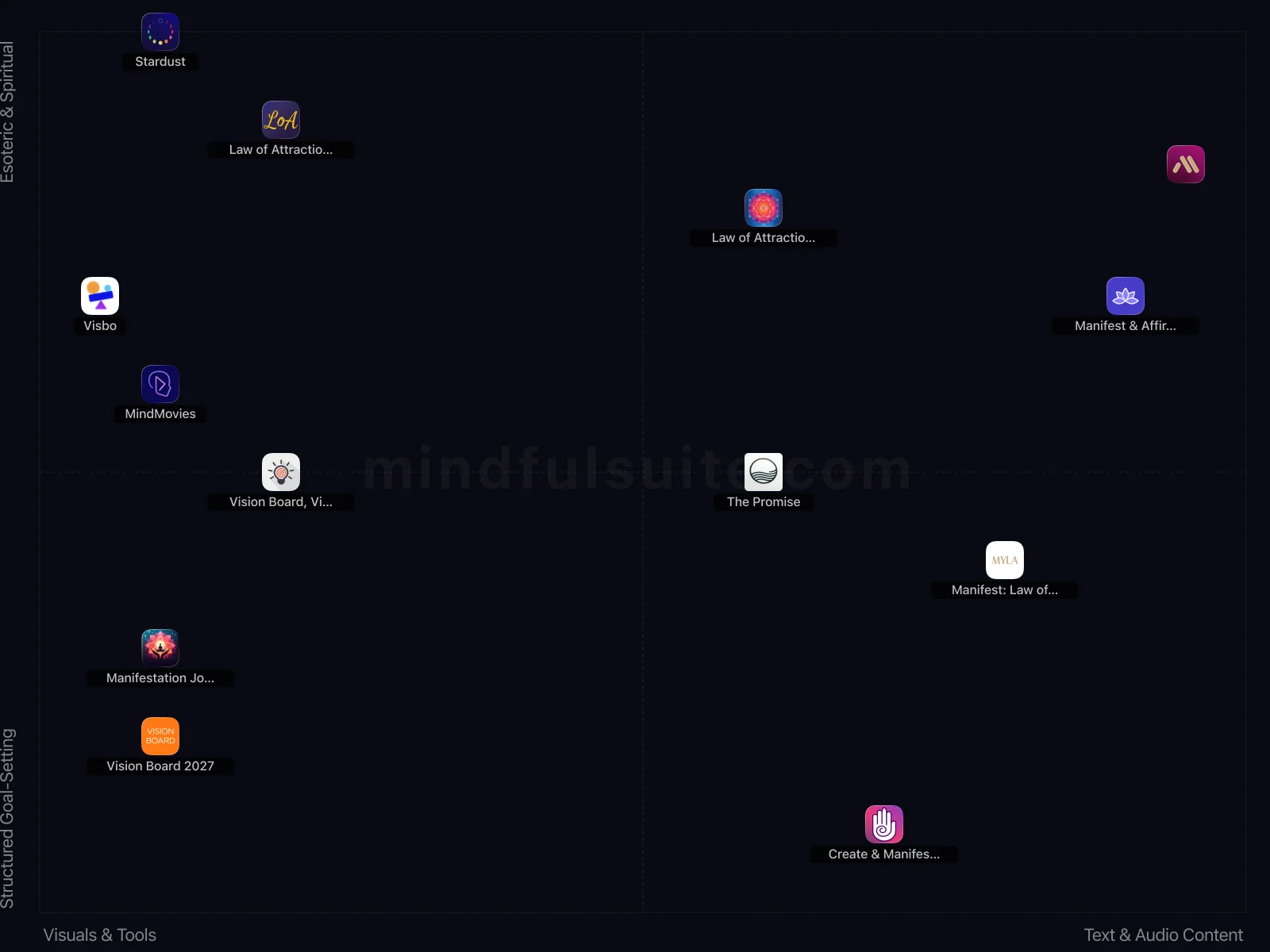
These 12 apps don't all solve the same problem. They cluster into 4 distinct groups, each built around a different philosophy. Understanding which group fits you is the fastest way to narrow your search.
Visuals & Tools + Esoteric & Spiritual
4 apps in this group, led by  Law of Attraction Toolbox,
  Visbo, and
  MindMovies.
What defines this cluster: law of attraction techniques, manifestation tools, free, in-app purchases, vision board creation.
MindMovies.
What defines this cluster: law of attraction techniques, manifestation tools, free, in-app purchases, vision board creation.
Text & Audio Content + Esoteric & Spiritual
4 apps in this group, led by  Law of Attraction Space,
  Manifest & Affirmations - Soul, and
  Manifest Affirmations.
What defines this cluster: law of attraction tools, affirmations and vision boards, success stories, free, in-app purchases.
Manifest Affirmations.
What defines this cluster: law of attraction tools, affirmations and vision boards, success stories, free, in-app purchases.
Visuals & Tools + Structured Goal-Setting
2 apps in this group, led by  Manifestation Journal and
  Vision Board 2027.
What defines this cluster: law of attraction, goal manifestation, dream visualization, goal planner.
Vision Board 2027.
What defines this cluster: law of attraction, goal manifestation, dream visualization, goal planner.
Text & Audio Content + Structured Goal-Setting
2 apps in this group, led by  Create & Manifest Dream Goals and
  Manifest: Law of Attraction App.
What defines this cluster: 30-day challenges, law of attraction tools, free, guided meditations.
Manifest: Law of Attraction App.
What defines this cluster: 30-day challenges, law of attraction tools, free, guided meditations.
What makes them different
The core tension in this category runs along two axes. On one side, Visuals & Tools apps prioritize simplicity and speed — you can be up and running in under a minute. On the other, Text & Audio Content apps offer depth and customization that rewards investment over time.
The second axis — Manifestation Approach — captures an equally important difference. Apps closer to Structured Goal-Setting take a fundamentally different approach than those near Esoteric & Spiritual. Neither is objectively better. The right choice depends on your personality, your experience level, and what you're trying to accomplish.
14 Apps Reviewed
We scored every app using a weighted composite of real App Store and Google Play ratings. Out of 14 apps: 1 Essential · 10 Hidden Gems. 7 cross-platform, 5 iOS-only, 2 Android-only.
Top picks:  Stardust and Manifestation Journal scored highest overall. Law of Attraction Toolbox rounds out the top three. Switch to the Apps tab for the full list with ratings and download links.
How to Pick the Right One
Look at the cluster section above. If you already know whether you want Visuals & Tools or Text & Audio Content, that eliminates half the options instantly. Same for Structured Goal-Setting vs Esoteric & Spiritual.
Try one app for a full week before judging. Most manifestation apps reveal their value around day 5, not day 1.
Quick start: Stardust and Manifestation Journal represent two different approaches and both scored highest. Pick whichever resonates, switch if it doesn't click.
Making It Stick: Practical Advice
Downloading the app is the easy part. The hard part — the part that actually produces results — is what happens in weeks two, three, and beyond. These tips are drawn from behavioral research and from patterns we've observed across hundreds of thousands of user reviews. They're not revolutionary, but they work:
Pair visualization with action steps
Visualization alone doesn't produce results. The magic happens when you vividly imagine the goal AND identify one concrete step you'll take today toward it.
Be specific in your visualizations
"I want to be successful" is too vague for effective visualization. "I'm presenting my project confidently to the leadership team" engages your brain much more effectively.
Frequently Asked Questions
These are the questions that come up most often — from our own testing, from user reviews, and from the broader conversation around manifestation apps. If your question isn't here, the Apps tab has detailed information on every app we reviewed.
Is manifestation scientifically supported?
The mystical framing of manifestation ('the universe provides') isn't scientifically supported. But the underlying practices — mental rehearsal, goal specificity, affirmation, gratitude — all have research backing. The most effective manifestation apps focus on these evidence-based elements.
How is manifestation different from goal setting?
Goal setting focuses on defining what you want and planning steps to get there. Manifestation adds an emotional and visualization component — not just knowing what you want, but feeling what achieving it would be like. When combined, they're more motivating than either alone.
The Best Manifestation Apps to Bring Your Dreams to Life (2026)
Remember scribbling an affirmation on a sticky note and slapping it on your bathroom mirror, only for it to lose its stick and fall behind the sink two days later? Or maybe you spent a whole Sunday afternoon cutting pictures from magazines for a vision board that eventually ended up collecting dust under your bed.
The intention was always there. But life gets busy, and those paper-and-glue dreams have a funny way of feeling a little flimsy when Monday morning rolls around.
What if your intentions could live where your attention already is—right on your phone?
Imagine a tool that doesn't just hold your goals, but actively reminds you of them. A companion that whispers encouragement during a chaotic commute or prompts a much-needed moment of gratitude when you're feeling overwhelmed. Manifestation apps take the pressure off. They transform a powerful practice from a "special occasion" ritual into a seamless daily habit, making your biggest goals as accessible as your favorite playlist.
The All-In-One Manifestation Toolkits
If you want a single place to log your gratitude, track the 369 method, and visualize your goals, these comprehensive apps do the heavy lifting. They bring together the core pillars of the Law of Attraction so you don't have to constantly bounce between five different tools.

Vision
A vision board app that keeps your goals always visible on your lock screen with custom widgets, backgrounds, and an extensive motto library.
- Always-visible vision board through iOS 26 widgets.
- Extensive motto library covering anxiety, ADHD, self-acceptance, and atomic habits.
- Beautiful custom background layouts and dynamic effects.

Manifestation Journal
A law of attraction journal app to help users turn their dreams into reality.

Manifest: Law of Attraction App
This app aims to be your one-stop shop for manifestation. It neatly integrates the core pillars of the practice—meditation, gratitude, affirmations, and visualization—into a single, streamlined experience to keep you focused and inspired.
- Its all-in-one approach, combining meditations, journaling, affirmations, and vision boards, provides a comprehensive manifestation toolkit.
- Specific techniques like the 369 method are integrated, offering structured guidance for those familiar with Law of Attraction practices.

Law of Attraction Toolbox
If you’re a fan of Abraham-Hicks, this app will feel like coming home. It’s a treasure chest of tools and exercises built around their teachings, designed to help you raise your vibration, find your alignment, and become a deliberate creator of your reality.
- The unique integration of 'games' makes manifestation principles more interactive and engaging than typical text-heavy apps.
- Its comprehensive suite of tools, from vision boards to gratitude journals, covers diverse manifestation techniques effectively.

Law of Attraction Space
Offers tools and information for practicing the Law of Attraction, including affirmations, vision boards, and success stories.
- The inclusion of success stories from other users provides motivating social proof for the effectiveness of manifestation.
- It offers educational content and tools specifically designed to teach the principles of the Law of Attraction.

Create & Manifest Dream Goals
This app brings a dose of structured focus to your practice. It frames manifestation as a series of 30-day challenges, guiding you to pour intense energy into one specific desire at a time using a variety of Law of Attraction exercises.
- The structured 30-day challenges offer a clear, actionable roadmap for users new to consistent manifestation practices.
- It's genuinely free, without hidden subscription paywalls, which is a rare and refreshing find in this category.
Rewiring Your Thoughts with Affirmations
Sometimes you just need a quick, targeted mindset shift to shake off a bad mood or imposter syndrome. These apps focus entirely on the power of spoken and written affirmations, helping you plant the seeds of self-belief and abundance throughout your day.

Manifest Affirmations
Provides affirmations and practices designed to attract abundance and radiate feminine energy.
- Caters to a specific "glow-up" and "feminine energy" niche, offering tailored empowering content.
- Focuses on attracting "unlimited abundance" through affirmations, appealing directly to manifestation enthusiasts.

Manifest & Affirmations - Soul
Generates personalized affirmations based on user-defined desires to help manifest goals using the law of attraction.
- Generates personalized daily affirmations, fostering a consistent positive mindset towards achieving specific desires and goals.
- The focused approach on manifestation and Law of Attraction appeals directly to users seeking mental reinforcement for their aspirations.

The Promise
This lifestyle app is a mindfulness and mental health tool. It promotes a positive mindset and enhances emotional wellness.
For the Visual Dreamers
If you're someone who needs to see it to believe it, dedicated vision board apps are exactly what you need. They let you seamlessly combine your own photos, inspiring quotes, and even customized soundtracks to create a pocket-sized reminder of exactly where you're headed.

Visbo
Visbo is a dedicated Law of Attraction tool for creating vision boards. You can add inspiring imagery, text, and music to create a personalized manifestation tool.
- Visbo integrates music and inspiring imagery, directly catering to Law of Attraction principles for a more immersive manifestation experience.
- It's specifically designed for vision boards, providing a focused environment without unnecessary clutter.

Vision Board 2027
A highly customizable iOS app that lets you create not just static vision boards but also "vision board movies" with music and personal affirmations.
- Its unique focus on the "Bagua map" and visualization provides a distinct, spiritually aligned approach to goal setting and manifestation.
- The integration of "Affirmations" directly supports a positive mindset, which is crucial for staying motivated towards long-term goals.

Vision Board, Visualize dreams
This vision board app helps users visualize dreams and manifest goals through visualization and affirmations. Vision Board allows users to focus, plan, and track life goals.

MindMovies
A unique take on the vision board, MindMovies allows you to create dynamic "video vision boards" by combining your images, powerful affirmations, and uplifting music.
- Creating dynamic "video vision boards" with music and affirmations offers a uniquely immersive and engaging visualization experience.
- The gamified personal development aspect provides a novel, interactive way to track and achieve goals.
When You Want a Cosmic Connection
Sometimes manifestation is less about pushing hard for a specific goal, and more about aligning with your natural rhythms. If you're interested in blending mystical wellness, moon phases, and the natural cycles of your body, this is where the magic happens.

Stardust
Ready for a cosmic twist? Stardust syncs your menstrual cycle with the phases of the moon and planets. It merges hormonal health with a dash of astrological insight, all wrapped in a beautifully designed, privacy-focused package.
- The unique 'moon phase syncing' feature offers a refreshing, mystical approach to cycle tracking and wellness.
- Its aesthetically pleasing, intuitive design stands out from the more clinical-looking period tracking applications.