
Habit Stacking Apps: What You Need to Know in 2026
You never forget to brush your teeth. You never forget to check your phone when you wake up. But meditation, journaling, and stretching? Those disappear within a week. The difference isn't discipline — it's neural pathways. Habit stacking works by piggybacking new behaviors onto old ones, borrowing the automation of existing habits to build new ones.
We evaluated 10 habit stacking apps across iOS and Android, scoring each on real user ratings, feature depth, and long-term value. This guide covers what we found.
Implementation Intentions: The Research Behind Habit Stacking
In 1999, Peter Gollwitzer published a meta-analysis that quietly transformed how psychologists think about behavior change. The finding was deceptively simple: people who formed "if-then" plans — "if situation X arises, then I will perform behavior Y" — were two to three times more likely to follow through on their intentions than people who relied on motivation alone. The effect size was large and remarkably consistent across domains: health behaviors, academic goals, interpersonal commitments, environmental actions.
The mechanism is not about wanting something more. It is about specifying when and where you will do it. "I want to meditate" is a goal. "After I pour my morning coffee, I will meditate for five minutes" is an implementation intention. The difference between these two statements is the difference between a wish and a plan. The first requires you to decide, in the moment, when to meditate — a decision that competes with every other demand on your morning attention. The second eliminates the decision entirely by linking the new behavior to an existing cue.
Habit stacking is the practical application of implementation intentions to daily routines. The "if" is an existing habit — pouring coffee, brushing teeth, sitting down at your desk — that already runs on autopilot. The "then" is the new behavior you want to install. By borrowing the cue reliability of the existing habit, you bypass the most common reason new habits fail: not that they are hard, but that you simply forget to do them.
This is why motivation-based approaches to habit formation have such poor track records. Motivation fluctuates. On a good day, you remember to meditate and you feel like doing it. On a bad day, the thought never crosses your mind, and even if it did, you wouldn't feel like acting on it. Implementation intentions work regardless of motivation because they operate at the level of cue-response, not desire. The coffee gets poured, the meditation begins — not because you feel inspired, but because the neural link between the two actions has been established through repetition.
The best habit stacking apps formalize this structure. They let you define the trigger (existing habit), the action (new habit), and the sequence (which comes first, second, third). They remind you at the trigger point rather than at an arbitrary clock time. And they track completion at the chain level, not just the individual habit level, because the chain is the unit that matters.
Designing Your Chain: Sequence, Friction, and the Weakest Link
A habit chain is only as strong as its weakest link, and the weakest link is almost always the one with the most friction. Understanding friction — and designing your chain to manage it — is the difference between a stack that survives the first week and one that becomes part of your daily life.
Friction, in this context, means anything that makes a habit harder to start: physical effort, equipment requirements, location dependencies, time demands, or cognitive complexity. Drinking a glass of water has almost zero friction. Going for a run has significant friction — you need shoes, clothes, a route, and twenty-plus minutes. Writing in a journal falls somewhere in between, depending on whether the journal is on your nightstand or buried in a drawer.
The principle for chain design is straightforward: place low-friction habits early in the sequence to build momentum, and place higher-friction habits after the most energizing step. If your morning stack is wake up, drink water, stretch for two minutes, journal for five minutes, meditate for five minutes, the first three steps are low-friction and quick. By the time you reach journaling and meditation, you have momentum — you have already completed three things, which makes completing two more feel natural rather than effortful.
Never place two high-friction habits back to back. If step three is a ten-minute workout and step four is a cold shower, the combined friction is enough to derail the entire chain. One difficult habit followed by one easy habit creates a rhythm: effort, relief, effort, relief. Two difficult habits in sequence create a wall.
The most valuable feature a habit stacking app can offer is chain completion analytics — showing you not just whether you completed your stack, but where you stopped when you didn't. If the data shows that you consistently complete steps one through four but drop off at step five, step five is your weak link. Maybe it's too hard. Maybe it's in the wrong position. Maybe it needs to be broken into smaller pieces. The data makes the diagnosis specific, and specific diagnoses lead to specific fixes.
Review your chain design every two weeks. A chain that worked when you started may need adjustment as habits become more automatic or as your schedule changes. The goal is a sequence that feels almost effortless to begin and natural to complete — not because the individual habits are easy, but because the sequence itself carries you through them.
When to Stack and When to Build a Routine From Scratch
Habit stacking requires something to stack onto. That sounds obvious, but it is the single most common reason stacking fails for certain people: they don't have reliable existing habits to serve as anchors. If your mornings are chaotic — no consistent wake time, no regular sequence of activities, every day different from the last — there is nothing sturdy enough to attach a new behavior to. You can't stack a meditation habit onto your morning coffee ritual if you don't have a morning coffee ritual.
In this situation, the right strategy is not stacking but routine construction. Build one anchor sequence first: a short, consistent morning routine of three to four actions that you do in the same order every day. It doesn't matter what the actions are, as long as they are easy enough to execute consistently. Wake up. Drink water. Brush teeth. Get dressed. That is a routine. It might seem too simple to matter, but its value is not in the individual actions — it is in the consistency of the sequence. After two to three weeks, that sequence becomes automatic. Now you have a foundation to stack onto.
The distinction between stacking and routine-building matters because they require different tools and different mindsets. Stacking is surgical: you identify one existing habit and attach one new behavior to it. Routine-building is architectural: you are constructing a sequence from the ground up, and the primary goal is consistency rather than adding new behaviors.
People with structured lives — regular work hours, consistent sleep schedules, established daily patterns — are natural candidates for stacking. They already have dozens of reliable anchors throughout their day. People with variable schedules — shift workers, freelancers, new parents, travelers — often need to build the anchor routine first.
Most habit stacking apps assume you have existing anchors. They let you create chains and set triggers, but they don't help you build the foundation. If you open a stacking app and feel lost because you don't have a stable routine to build on, that is a signal to step back and focus on establishing one consistent daily sequence before attempting to stack. Two to three weeks for the anchor, then begin adding. The patience required to build the foundation pays dividends in the durability of everything you stack on top of it.
4 Types of Habit Stacking Apps — and How They Differ
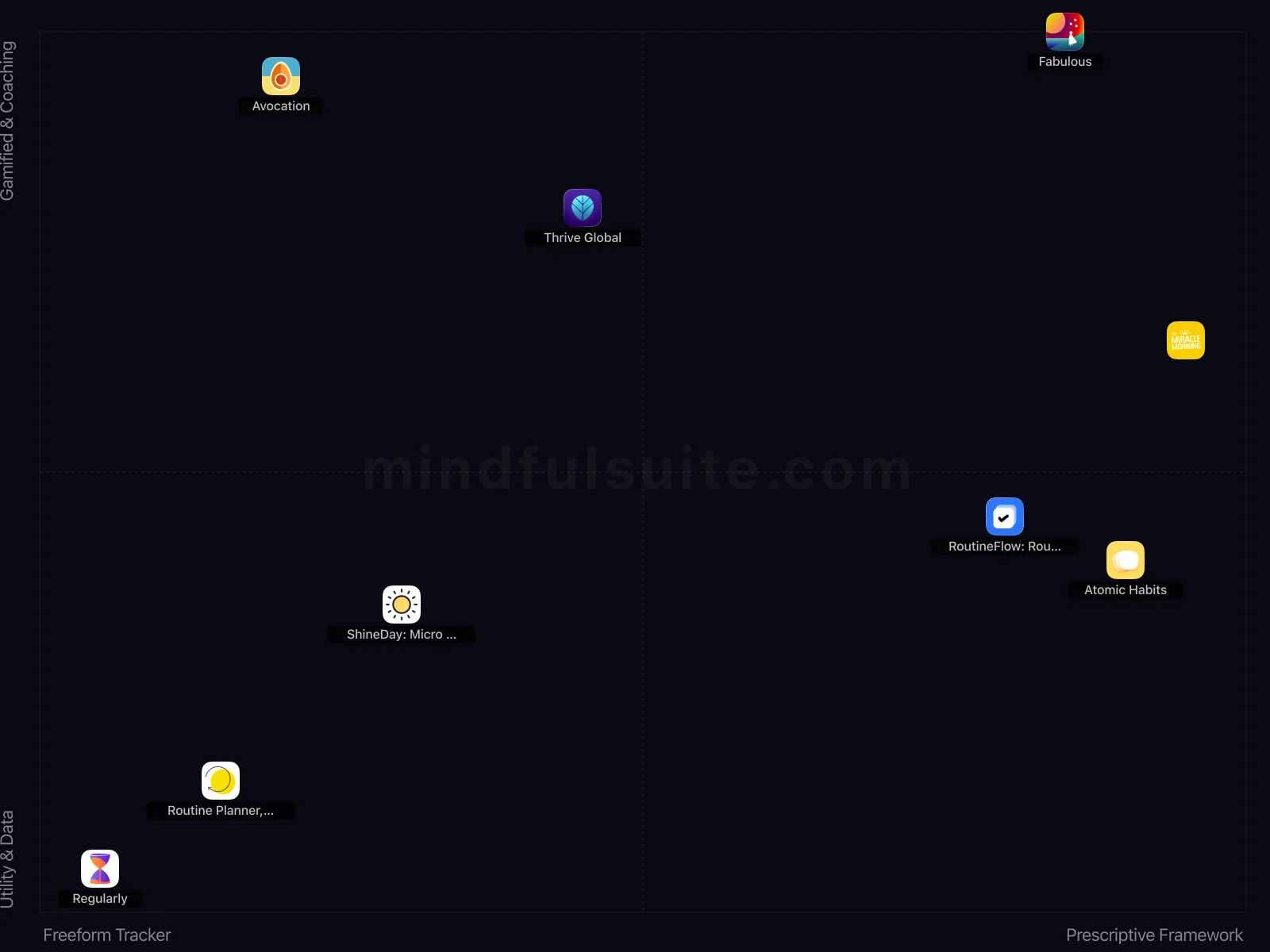
These 8 apps don't all solve the same problem. They cluster into 4 distinct groups, each built around a different philosophy. Understanding which group fits you is the fastest way to narrow your search.
Freeform Tracker + Gamified & Coaching
2 apps in this group, led by  Avocation and
  Thrive Global.
What defines this cluster: habit tracker, virtual baby plant game, daily planner, adhd organizer.
Thrive Global.
What defines this cluster: habit tracker, virtual baby plant game, daily planner, adhd organizer.
Prescriptive Framework + Gamified & Coaching
1 apps in this group, led by  Miracle Morning Routine.
What defines this cluster: morning routine companion, free with in-app purchases.
Miracle Morning Routine.
What defines this cluster: morning routine companion, free with in-app purchases.
Freeform Tracker + Utility & Data
3 apps in this group, led by  Routine Planner, Habit Tracker,
  ShineDay: Micro Habit Tracker, and
  Regularly.
What defines this cluster: routine planner, habit tracker, structured time management, free, iap available.
Regularly.
What defines this cluster: routine planner, habit tracker, structured time management, free, iap available.
Prescriptive Framework + Utility & Data
2 apps in this group, led by  Atomic Habits and
  RoutineFlow: Routine for ADHD.
What defines this cluster: official atomic habits app, habit building strategies, routine design, free, iap available.
RoutineFlow: Routine for ADHD.
What defines this cluster: official atomic habits app, habit building strategies, routine design, free, iap available.
What makes them different
The core tension in this category runs along two axes. On one side, Freeform Tracker apps prioritize simplicity and speed — you can be up and running in under a minute. On the other, Prescriptive Framework apps offer depth and customization that rewards investment over time.
The second axis — User Experience — captures an equally important difference. Apps closer to Utility & Data take a fundamentally different approach than those near Gamified & Coaching. Neither is objectively better. The right choice depends on your personality, your experience level, and what you're trying to accomplish.
10 Apps Reviewed
We scored every app using a weighted composite of real App Store and Google Play ratings. Out of 10 apps: 3 Essential · 4 Hidden Gems. 9 cross-platform, 1 iOS-only.
Top picks:  Fabulous and Routine Planner, Habit Tracker scored highest overall. Miracle Morning Routine rounds out the top three. Switch to the Apps tab for the full list with ratings and download links.
How to Pick the Right One
Look at the cluster section above. If you already know whether you want Freeform Tracker or Prescriptive Framework, that eliminates half the options instantly. Same for Utility & Data vs Gamified & Coaching.
Try one app for a full week before judging. Most habit stacking apps reveal their value around day 5, not day 1.
Quick start: Fabulous and Routine Planner, Habit Tracker represent two different approaches and both scored highest. Pick whichever resonates, switch if it doesn't click.
Making It Stick: Practical Advice
Downloading the app is the easy part. The hard part — the part that actually produces results — is what happens in weeks two, three, and beyond. These tips are drawn from behavioral research and from patterns we've observed across hundreds of thousands of user reviews. They're not revolutionary, but they work:
Start with a 2-habit stack
Don't build a 10-step chain on day one. Start by adding one new habit after one existing one. Once it's automatic (2-3 weeks), add the next link.
Choose strong anchor habits
The trigger habit should be something you do every day without thinking: brushing teeth, pouring coffee, sitting at your desk. The stronger the anchor, the more reliable the chain.
Frequently Asked Questions
These are the questions that come up most often — from our own testing, from user reviews, and from the broader conversation around habit stacking apps. If your question isn't here, the Apps tab has detailed information on every app we reviewed.
What's the difference between habit stacking and a routine?
A routine is a sequence of actions you do regularly. Habit stacking is a strategy for BUILDING that routine by intentionally linking new behaviors to existing ones. Once established, a habit stack becomes a routine — but the stacking framework is how you get there.
How many habits can I stack at once?
Start with 2-3 habits in a chain. Most people can build chains of 5-7 habits over time, but each link should be firmly established before adding the next.
The Best Habit Stacking Apps to Build a Better You (2026)
Remember that beautiful planner you bought in January? The one with the crisp, empty pages specifically dedicated to habit tracking? By March, it was probably gathering dust under a stack of mail, a silent monument to good intentions. We’ve all been there. The desire to be better—to meditate, to exercise, to read more—is easy. It’s the doing that’s hard, especially when life gets in the way of your best-laid plans.
But what if the secret wasn't about relying on raw willpower, but using a smarter strategy? That's the magic of habit stacking: linking a brand new goal to something you already do without thinking, like taking five deep breaths while your morning coffee brews. And your phone, instead of being a distraction, can actually become your most loyal accountability partner. These tools aren't just rigid checklists; they're pocket-sized coaches and behavior-change engines ready to help you turn tiny, stacked actions into life-changing routines.
Official Frameworks & Bestseller Companions
If you've read the blockbuster books on habit formation and morning routines, you know the methodologies work. These apps are the official digital companions to those popular frameworks, designed to take the theories off the page and integrate them directly into your daily life. They offer specialized features like habit scorecards and highly structured morning sequences you won't find anywhere else.

Goals
A comprehensive habit and goal tracker inspired by Atomic Habits, featuring AI coaching and visual progress tracking.
- Deep integration with Atomic Habits philosophy.
- Visual progress tracking keeps you motivated.
- Cross-platform support (iOS and Android).

Atomic Habits
The official companion app to "Atomic Habits" helps users implement strategies from the book. It's for readers seeking to build good habits using the book's framework.
- Directly implements James Clear's "Four Laws of Behavior Change," offering structured, science-backed habit guidance.
- The "Habit Scorecard" and "Habit Stacking" features are invaluable for users committed to the book's methodology.

Miracle Morning Routine
Acts as a companion to the Miracle Morning routine. It's for people who want to be guided through the Miracle Morning steps.
- Directly integrates "The Miracle Morning Routine" framework, appealing strongly to fans of the popular book.
- Functions as a dedicated "Morning Routine Companion," providing structure for consistent daily habits.
When You Need a Gamified Nudge
Sometimes building a routine feels like a chore, and we all need a little extra dopamine to keep going. These apps use behavioral science and playful gamification to make your habit journey genuinely fun. Whether you're embarking on structured personal growth journeys or growing a virtual garden with your daily wins, they turn self-improvement into a game you actually want to play.

Fabulous
Born in Duke University's Behavioral Economics Lab, Fabulous is a science-based app that helps you build healthy rituals into your life. It acts as a digital coach, guiding you through morning routines, exercise, and meditation.
- The "Journeys" feature effectively gamifies habit building, providing structured guidance and positive reinforcement for daily routines.
- Its unique focus on creating holistic morning and evening routines is genuinely effective for establishing consistent positive habits.

Avocation
Avocation gamifies habit tracking by allowing users to grow a virtual baby plant. It's helpful for individuals seeking a fun and engaging way to build habits.
- The charming virtual plant growth gamification provides a delightful and unique motivation to maintain streaks.
- Integration with ADHD organizer features makes it particularly helpful for neurodivergent users needing structure.
Built for Neurodivergent Minds & Micro-Habits
Traditional habit trackers can sometimes feel overwhelming, especially if you struggle with executive dysfunction, ADHD, or simply finding focus. These tools take a gentler, more targeted approach. By emphasizing micro-habits and visual routine flows, they break down intimidating goals into bite-sized, manageable steps that actually stick.

ShineDay: Micro Habit Tracker
ShineDay is a habit tracker for building routines, complete with reminders, progress charts, and note-taking.
- Explicitly targets "ADHD" and "micro habits," offering tailored features like specific focus tools for these users.
- The ability to "Build Micro Habits in Seconds" genuinely streamlines the process for quick habit setup.

RoutineFlow: Routine for ADHD
Helps users with ADHD design and stick to ideal daily routines. It's built to help those with attention deficits maintain structure.
- Designed specifically for "ADHD," offering tailored routine design and adherence strategies for neurodivergent users.
- Its focus on helping users "Finally Stick To Routines" addresses a critical pain point for its target audience.
Minimalist & Flexible Trackers
If you're a data purist who just wants a clean interface without the fluff, these trackers are for you. They skip the virtual pets and complex psychological journeys in favor of straightforward scheduling, clean charts, and the flexibility to track irregular habits that don't happen every single day.

Routine Planner, Habit Tracker
A routine and habit tracker aimed to instill structure for time management. Routinery is for users who wish to build and maintain consistent routines.

Regularly
Tracks habits and tasks that don't need a fixed daily schedule. It's for users who need a flexible way to manage routines.
- Excels at tracking non-daily or irregular habits, a crucial feature often overlooked by other habit trackers.
- The interface is refreshingly straightforward, prioritizing functionality over unnecessary visual clutter.
Holistic Wellness & Micro-Breaks
Sometimes the most important habit you can stack is learning when to stop. Rather than just pushing you to do more, this category focuses on routines that help you disconnect, recharge, and manage your overall well-being throughout a busy workday.

Thrive Global
A business app focused on well-being and productivity, to help users disconnect and recharge for better sleep.
- Its holistic approach links sleep directly to productivity, offering more than just bedtime sounds.
- The "Thrive Reset" micro-breaks are a unique feature for quick relaxation throughout the day.
Ready to Stack Your Habits?
Building better habits doesn't have to mean completely overhauling your life overnight. By choosing the right app to anchor your new behaviors to existing routines, you set yourself up for long-term success without the burnout. Whether you thrive on data, need a touch of gamified motivation, or want a specialized coach in your pocket, the perfect habit stacking companion is ready to help you build the routine you've always wanted. Pick your favorite, start small, and watch your daily wins compound!