
Habit Tracker Apps: What You Need to Know in 2026
You set the alarm for 6 AM. You laced up your running shoes exactly once. By Thursday, the shoes were back in the closet and the alarm was off. Sound familiar? Building habits is less about willpower and more about systems — and the right app can be the system that finally makes it stick.
We evaluated 75 habit tracker apps across iOS and Android, scoring each on real user ratings, feature depth, and long-term value. This guide covers what we found.
The Science Behind the Streak
The streak — that unbroken chain of green checkmarks marching across your screen — is not just a design choice. It is an exploitation of several well-documented cognitive biases, and understanding why it works so well makes you a more effective user of any habit tracker.
The foundation is the habit loop, described by Charles Duhigg in The Power of Habit: cue, routine, reward. The notification from your tracker is the cue. The habit itself is the routine. The satisfying act of checking it off — watching the streak grow — is the reward. This loop is the same basic architecture that drives every habit, good or bad. Trackers just make it visible and intentional.
Then there is the research on implementation intentions, pioneered by Peter Gollwitzer. His work demonstrates that people who specify when, where, and how they will perform a behavior are dramatically more likely to follow through than those who simply intend to do it. A habit tracker operationalizes this: the habit is defined, the schedule is set, and the reminder arrives at the right time. The vague intention "I should exercise more" becomes the specific commitment "Run at 7 AM, Monday-Wednesday-Friday," tracked and measured.
About that 66-day number you have probably seen cited as the time it takes to form a habit — it deserves more nuance. Phillippa Lally's 2009 study at University College London is the source, and the headline finding was a 66-day average. But the range was 18 to 254 days. Drinking a glass of water after breakfast became automatic in about three weeks. Doing 50 sit-ups before dinner took closer to eight months. Complexity, difficulty, and individual variation matter enormously. Anyone telling you a habit takes exactly 21 days or exactly 66 days is oversimplifying the research.
The streak itself works because of loss aversion — the psychological finding that losing something feels roughly twice as painful as gaining something of equivalent value. Once you have a 15-day streak, breaking it feels like a genuine loss, not just a missed day. The endowment effect compounds this: you value the streak more because you built it, the same way you value your own possessions more than identical items you do not own. Habit trackers weaponize these biases for your benefit. The streak becomes something you own, something you have invested in, something you are reluctant to abandon.
Two Philosophies: Minimalist Counters vs All-in-One Systems
The habit tracker market has split into two distinct philosophies, and which one works for you has less to do with the apps and more to do with your personality.
The minimalist camp believes that friction is the enemy of consistency. Apps like Streaks epitomize this approach: a handful of habits displayed as simple circles. Tap to complete. That is the entire interaction. No stats page to browse. No achievement system to chase. No settings to tweak for 30 minutes when you should be actually doing the habit. The minimalist philosophy is rooted in a practical insight — the best habit tracker is the one that takes less time to use than the habit itself takes to perform. If logging your two-minute meditation takes 45 seconds of navigating menus, something has gone wrong.
The comprehensive camp takes the opposite view. Apps like Habitica, Habitify, and Streaks (the other one — confusing, yes) offer detailed statistics, streak analysis, completion rate graphs, category organization, notes, integrations with Apple Health or Google Fit, and exportable data. Habitica goes furthest, wrapping the entire experience in an RPG framework where your habits level up a character, your misses damage it, and you can join parties with other users to fight monsters through collective accountability.
The personality split is fairly predictable. Detail-oriented people who enjoy data analysis, who keep spreadsheets for fun, who find satisfaction in a comprehensive dashboard — they gravitate toward full-featured trackers and use them well. People who feel overwhelmed by options, who open a settings page and feel paralyzed, who want to spend mental energy on the habit rather than the system — they thrive with minimalist tools.
Here is the paradox worth naming: feature-rich habit trackers can become a form of productive procrastination. You spend 20 minutes analyzing your completion rate trends when you could have been doing the habits. The app becomes the hobby instead of the tool. If you notice yourself spending more time inside the tracker than doing the activities it tracks, that is a signal to downshift to something simpler.
The honest truth is that the best habit tracker is the one you do not abandon. The average user downloads a habit tracker, uses it enthusiastically for 11 days, and never opens it again. Whichever philosophy — minimalist or comprehensive — leads to you still using the app in month three is the right one.
Gamification and the Dopamine Question
Gamified habit trackers — the ones with experience points, level-ups, virtual pets that grow when you complete habits, leaderboards, and boss fights — are tapping into exactly the same dopamine reward pathways that social media uses to keep you scrolling. That is both their power and their ethical tension.
The mechanism is straightforward. Completing a habit in a gamified tracker triggers a small burst of dopamine: a level-up animation plays, your character gains strength, your virtual pet does a happy dance, you earn coins for a virtual reward. This is the same variable-ratio reinforcement schedule that makes slot machines, loot boxes, and Instagram likes so compelling. The difference — and it is a meaningful one — is the direction. Social media hijacks your dopamine system to keep you consuming content that serves the platform's business model. Gamified habit trackers hijack the same system to make you exercise, meditate, read, or drink water.
The research on gamification in behavior change is encouraging but comes with caveats. A 2019 meta-analysis in the International Journal of Information Management found that gamification had a statistically significant positive effect on behavior change outcomes. Gamified interventions outperformed non-gamified ones for habit initiation — getting people to start a new behavior. But the data on long-term maintenance is less clear.
This is where the dopamine question gets interesting. Extrinsic motivation — doing something for points, badges, or virtual rewards — is effective for initiating behaviors. But intrinsic motivation — doing something because it is inherently satisfying or meaningful — is what sustains behavior over months and years. The psychological concept is called the overjustification effect: when you provide external rewards for behavior that someone would eventually find intrinsically rewarding, the external reward can actually undermine the development of internal motivation. If you exercise solely for Habitica experience points, what happens when you stop playing Habitica?
The most effective approach may be to use gamification as a bridge. Let the points and the pet and the RPG elements carry you through the first uncomfortable weeks of a new habit — the period when the behavior is not yet rewarding on its own. Then, as the habit itself starts to feel good (and most worthwhile habits eventually do), let the gamification become secondary. The transition from "I exercise because my character levels up" to "I exercise because I feel better when I do" is the real achievement. No app awards a badge for it, but it is the one that matters.
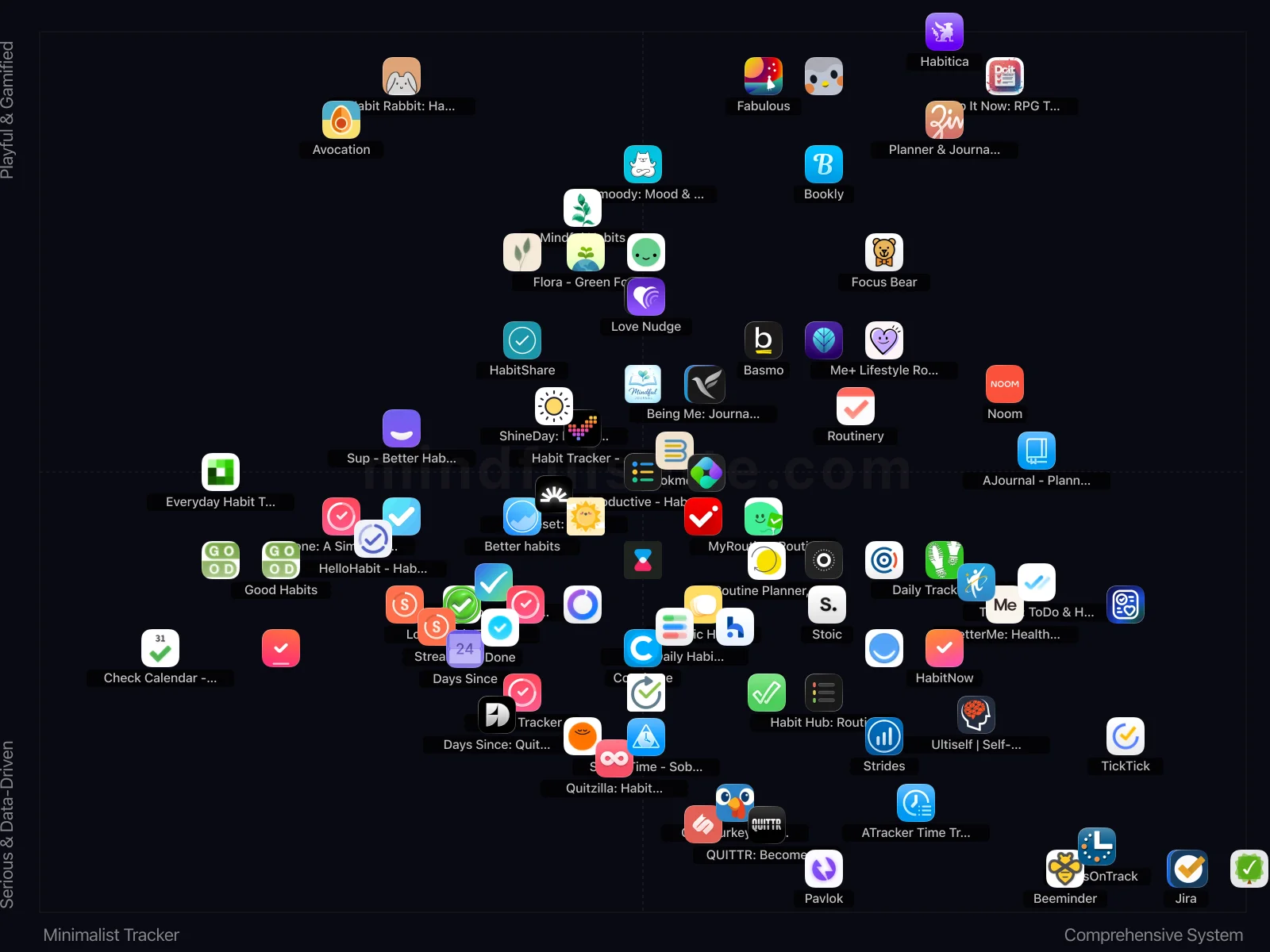
4 Types of Habit Tracker Apps — and How They Differ
These 89 apps don't all solve the same problem. They cluster into 4 distinct groups, each built around a different philosophy. Understanding which group fits you is the fastest way to narrow your search.
Minimalist Tracker + Playful & Gamified
14 apps in this group, led by  Life Reset: 66 Day Habit,
  Love Nudge, and
  Flora - Green Focus.
What defines this cluster: habit tracker, 66-day program, free, in-app purchases, based on love languages.
Flora - Green Focus.
What defines this cluster: habit tracker, 66-day program, free, in-app purchases, based on love languages.
Comprehensive System + Playful & Gamified
20 apps in this group, led by  Fabulous,
  Me+ Lifestyle Routine, and
  Noom.
What defines this cluster: free with in-app purchases, build healthy habits, guided journeys, science-based.
Noom.
What defines this cluster: free with in-app purchases, build healthy habits, guided journeys, science-based.
Minimalist Tracker + Serious & Data-Driven
22 apps in this group, led by  Loop Habit Tracker,
  Habit Tracker, and
  Streaks.
What defines this cluster: track measurable habits, show confetti animation, show streaks, supports android 15 and 16.
Streaks.
What defines this cluster: track measurable habits, show confetti animation, show streaks, supports android 15 and 16.
Comprehensive System + Serious & Data-Driven
33 apps in this group, led by  Atomic Habits,
  Grit: Daily Habit Tracker, and
  HabitNow.
What defines this cluster: habit tracker, official atomic habits app, habit building strategies, adhd planner.
HabitNow.
What defines this cluster: habit tracker, official atomic habits app, habit building strategies, adhd planner.
What makes them different
The core tension in this category runs along two axes. On one side, Minimalist Tracker apps prioritize simplicity and speed — you can be up and running in under a minute. On the other, Comprehensive System apps offer depth and customization that rewards investment over time.
The second axis — Approach — captures an equally important difference. Apps closer to Serious & Data-Driven take a fundamentally different approach than those near Playful & Gamified. Neither is objectively better. The right choice depends on your personality, your experience level, and what you're trying to accomplish.
75 Apps Reviewed
We scored every app using a weighted composite of real App Store and Google Play ratings. Out of 75 apps: 24 Essential · 33 Hidden Gems · 1 Mainstream · 1 to skip. 41 cross-platform, 25 iOS-only, 9 Android-only.
Top picks:  TickTick and
  Routine Planner, Habit Tracker scored highest overall.
  Habitica rounds out the top three. Switch to the Apps tab for the full list with ratings and download links.
How to Pick the Right One
Look at the cluster section above. If you already know whether you want Minimalist Tracker or Comprehensive System, that eliminates half the options instantly. Same for Serious & Data-Driven vs Playful & Gamified.
Try one app for a full week before judging. Most habit tracker apps reveal their value around day 5, not day 1.
Quick start: TickTick and Routine Planner, Habit Tracker represent two different approaches and both scored highest. Pick whichever resonates, switch if it doesn't click.
Making It Stick: Practical Advice
Downloading the app is the easy part. The hard part — the part that actually produces results — is what happens in weeks two, three, and beyond. These tips are drawn from behavioral research and from patterns we've observed across hundreds of thousands of user reviews. They're not revolutionary, but they work:
Start with just 2-3 habits
Tracking too many habits at once leads to overwhelm and abandonment. Start small, build momentum, then add more once your first habits feel automatic.
Anchor habits to existing routines
Pair new habits with things you already do. "After I pour my morning coffee, I meditate for 5 minutes" is far more effective than "meditate sometime today."
Don't break the chain — but forgive misses
Streaks are powerful motivators, but missing one day isn't failure. The most important thing is getting back on track the next day. Look for apps that let you add notes for missed days.
Review your data weekly
Set aside 5 minutes each week to look at your completion patterns. You might discover that certain days or times are consistently harder — and you can plan around them.
Frequently Asked Questions
These are the questions that come up most often — from our own testing, from user reviews, and from the broader conversation around habit tracker apps. If your question isn't here, the Apps tab has detailed information on every app we reviewed.
Are habit tracker apps actually effective?
Yes, when used consistently. The act of tracking itself is a proven behavior change technique called self-monitoring. Studies show it significantly increases the likelihood of maintaining a new behavior. The key is finding an app that fits your style and actually using it daily.
How many habits should I track at once?
Start with 2-3 habits maximum. Research on behavior change suggests that trying to change too many things simultaneously reduces your success rate for all of them. Once your initial habits feel automatic (usually 2-3 months), you can add more.
Free vs paid habit trackers — is it worth paying?
Many excellent habit trackers are completely free or have generous free tiers. Paid versions typically add features like unlimited habits, advanced statistics, cloud sync, or widget customization. If you're just starting out, a free app is perfectly fine. Upgrade when you hit a limitation that matters to you.
Should I use a simple or complex habit tracker?
It depends on your personality. If you love data and analytics, a feature-rich tracker will keep you engaged. If you find complexity overwhelming, a minimalist streak counter might be more effective. The best app is the one you'll actually open every day.
Can I track habits on both iPhone and Android?
Many habit trackers are available on both platforms, though some are exclusive to one. We note platform availability for every app in our reviews. If you switch between devices, look for apps with cloud sync.
The Best Habit Tracker Apps for Building a Better You (2026)
Remember that crumpled checklist on the fridge, the one meant to track your daily water intake? By Wednesday, it was probably decorated with a coffee ring and completely forgotten. Or the hopeful sticky notes for "morning jog" that lost their stick and fluttered away, taking your best intentions with them. We've all been there.
The desire to build good habits is strong, but daily follow-through can feel like a battle against our own forgetfulness and busy schedules. What if your cheerleader, scorekeeper, and accountability partner could live right in your pocket? That's the magic of a great habit tracker app. They transform vague goals into satisfying visual streaks, turning the chore of remembering into a daily game you actually want to win. Let's find the one that fits your personal style perfectly.
The Best All-In-One Productivity Trackers
If you hate juggling five different apps to organize your day, these powerhouses combine your to-do list, calendar, and habit tracking into one unified command center.

Goals
A comprehensive habit and goal tracker inspired by Atomic Habits, featuring AI coaching and visual progress tracking.
- Deep integration with Atomic Habits philosophy.
- Visual progress tracking keeps you motivated.
- Cross-platform support (iOS and Android).

TickTick
TickTick is a comprehensive productivity app that masterfully combines a to-do list, calendar, and habit tracker. If you want to manage everything in one place, TickTick is a top contender.
- The built-in Pomodoro timer and Habit Tracker integration provide unique value, directly boosting productivity within the app.
- Its natural language input for task creation, including dates and times, is incredibly fast and efficient for daily use.

HabitNow
A versatile Android app that functions as a habit tracker, reminder, and to-do list, offering detailed statistics and graphs to monitor progress.
- Comprehensive features combine habit tracking, reminders, and to-do lists into a cohesive Android experience.
- Detailed statistics and progress graphs provide excellent motivation and insights into routine consistency.

Routine Planner, Habit Tracker
A routine and habit tracker aimed to instill structure for time management. Routinery is for users who wish to build and maintain consistent routines.

Tappsk: ToDo & Habit Tracker
This productivity app combines a planner, habit tracker, reminder app, and calendar. It aims to streamline task management.
- Its explicit mission to replace multiple apps offers genuine all-in-one convenience for daily organization.
- The robust habit tracking combined with a strong task manager provides comprehensive daily organization.

Habit Hub: Routine Tracker
Routine is a modern planner designed around the powerful trio of habits, notes, and time-blocking. It’s an elegant tool for designing your ideal week and then giving you the structure to actually execute it.
- Offers robust habit tracking with detailed statistics and streaks, providing strong motivation for consistent daily routines.
- The ADHD-friendly focus timer and integrated to-do list make it a comprehensive tool for building discipline.

MyLifeOrganized (MLO)
A flexible task management system that helps you organize your goals, projects, and tasks into a hierarchical to-do list.
- Offers unmatched flexibility with its highly customizable hierarchical task structure for complex planning.
- The 'Outliner' view and 'Contexts' allow for powerful organization and filtering of tasks.

Habit Tracker - Habit Diary
This customizable habit tracker helps users plan daily routines and track goals.
- Offers extensive customization options, allowing users to tailor habit tracking precisely to their unique needs.
- Its "Habit Diary" feature provides valuable context by letting you add notes to individual habit completions.

Regularly Repeating Tasks
Keeps track of repeating tasks that don't need to happen on an exact day, such as washing sheets or replacing a toothbrush. This is for users who want to be reminded of flexible recurring tasks without strict calendar reminders.
For the Minimalists: Don't Break the Chain
Sometimes less is more. These beautiful, lightweight apps are built around one highly effective psychological trick: showing you an unbroken visual streak of colored squares or checkmarks that you won't want to ruin.

HelloHabit - Habit Tracker
This is a simple habit tracker that helps you set goals and build habits.
- The extremely high 4.9-star iOS rating indicates a highly refined and satisfying user experience on Apple devices.
- Its promise of "simple habit tracking, made easy" truly delivers a streamlined, friction-free daily interaction.

Streaks
As the name suggests, Streaks is built around the motivating power of not breaking the chain. This beautifully designed to-do list helps you form good habits by tracking consecutive day streaks.
- Its elegant, minimalist iOS-native design makes habit tracking visually appealing and incredibly intuitive with haptic feedback.
- Focuses specifically on building "streaks" for up to 12 habits, avoiding feature bloat for a streamlined experience.

Everyday Habit Tracker
With a simple and beautiful interface, this app focuses on the visual satisfaction of building a chain. Its board view shows your progress at a glance, motivating you to not leave any empty squares.
- The clean, visually appealing board-style progress visualization offers a satisfying and immediate sense of accomplishment.
- Its straightforward interface makes daily habit checking exceptionally quick and frictionless for casual users.

Check Calendar - Habit Tracker
Enables users to track habits by ticking off days on a calendar.
- Its core "tick your calendar" mechanic is refreshingly simple and visually effective for tracking daily completion.
- The straightforward design ensures minimal friction when logging habits, focusing on pure consistency.

Habit Tracker - Evoday
This habit tracker helps users build habits with progress tracking on grids, calendars, and widgets.
- The beautiful visual progress tracking through grids, calendars, and widgets makes monitoring streaks genuinely satisfying.
- High user engagement and excellent ratings across both platforms confirm its effectiveness and polished experience.

Done: A Simple Habit Tracker
An app that helps you create positive habits and track your progress with a simple, motivating interface.
- Its straightforward interface excels at tracking habits with clear streak visualizations, motivating consistent daily engagement.
- The ability to track both "build" and "quit" habits within one app is a surprisingly effective and versatile approach.

Habit Tracker - Daily Goals
This habit tracker provides motivation and accountability without ads or subscriptions.
- The explicit "no ads & no subscription" policy offers a rare, truly free, and complete habit tracking experience.
- Consistent high ratings across both platforms demonstrate its reliable and widely appreciated core functionality.

Good Habits
A habit tracker focused on simplicity, featuring a minimal and user-friendly interface. It's made for users who appreciate a clean and uncomplicated approach to habit formation.
- Its genuinely minimal interface makes tracking habits straightforward without unnecessary clutter.
- The "Don't break the chain" streak visualization is highly motivating for simple, consistent habit tracking.

Better habits
A habit tracker that promotes accountability by removing progress upon failure. It's for users who need a strong motivator to build and maintain healthy habits.
Streaks
A minimalist habit tracker that emphasizes privacy with a customizable interface and home screen widget.

Days Since
Days Since tracks elapsed time since events, creating reminders and widgets to monitor habits or important dates. It's useful for forming new habits or remembering recurring events like appointments.

Done
A to-do list app that features repeatable tasks, multiple color themes, habit tracking with snakes, and different icons for tasks.
Good Habits
Focuses on helping users establish consistent routines and develop positive habits. It is designed for anyone looking to improve their daily habits and lifestyle.
When You Need a Gentle, Gamified Nudge
Building discipline shouldn't always feel like punishment. If you are motivated by unlocking rewards, leveling up a character, or keeping a virtual pet happy, these apps turn your daily chores into a delightful quest.

Habitica
Habitica gamifies your life by turning your tasks, habits, and goals into a retro-style role-playing game (RPG). As you complete tasks, your character levels up, earns gear, and can even battle monsters with friends.
- Gamification elements, like earning gold for task completion, uniquely transform mundane chores into an engaging quest.
- The social aspect, allowing users to team up and tackle challenges, provides an unparalleled layer of accountability and fun.

Avocation
Avocation gamifies habit tracking by allowing users to grow a virtual baby plant. It's helpful for individuals seeking a fun and engaging way to build habits.
- The charming virtual plant growth gamification provides a delightful and unique motivation to maintain streaks.
- Integration with ADHD organizer features makes it particularly helpful for neurodivergent users needing structure.

Finch: Self Care Pet
Finch is a heartwarming self-care app that feels like a warm hug. It combines habit tracking and journaling with caring for a virtual pet. You nurture your pet by nurturing yourself. As you complete your daily goals—from tidying your room to practicing gratitude—your pet grows, goes on adventures, and shares its thoughts with you. It’s an incredibly positive and gentle approach to building a healthier you.
- Gamified pet care system genuinely motivates daily self-care habits like journaling and hydration.
- Customizing your adorable pet provides a tangible, delightful reward for consistent self-improvement.

Habit Rabbit: Habit Tracker
It's a habit tracker where a virtual pet motivates you to stick to your routines.
- The "productivity pet" gamification element uniquely motivates users, making habit tracking feel less like a chore and more engaging.
- Its focus on a positive, encouraging interface distinguishes it from generic, data-heavy habit trackers, appealing to a different user base.

Mindful Habits
Combines habit tracking with mindfulness exercises, using plants as a visual metaphor for growth. It's for people wanting to build habits with intention.
- Uniquely combines habit tracking with integrated mindfulness exercises, encouraging a more intentional and holistic approach to self-improvement.
- The plant-themed visual progress adds a delightful and calming aesthetic to daily check-ins.

Do It Now: RPG To-Do List
Transforms task management into a fantasy RPG by gamifying to-do lists and habit tracking.
- The unique RPG gamification, complete with stats, levels, and quests, uniquely motivates task completion for fantasy fans.
- It successfully merges a robust to-do list with habit tracking under an engaging, narrative-driven system.
Guided Routines & Behavioral Coaching
Starting from scratch is hard. These apps do the heavy lifting by offering structured blueprints for your morning or evening, bringing science-backed coaching right to your screen to help you build holistic lifestyle changes.

Me+ Lifestyle Routine
Focuses on establishing good daily habits and healthy routines.
- Emphasizes deep habit formation with structured routines, crucial for establishing ADHD consistency.
- Vast library of pre-built routines and guided programs makes starting new habits genuinely accessible.

Productive - Habit Tracker
Productive is a beautifully designed app that helps you build a routine of positive, life-changing habits. Its simple interface and useful statistics make it easy to get started and stay motivated.
- Its clean, intuitive interface makes tracking multiple daily habits straightforward and visually appealing.
- Customizable reminders and streaks genuinely motivate consistent progress on new routines.

Fabulous
Born in Duke University's Behavioral Economics Lab, Fabulous is a science-based app that helps you build healthy rituals into your life. It acts as a digital coach, guiding you through morning routines, exercise, and meditation.
- The "Journeys" feature effectively gamifies habit building, providing structured guidance and positive reinforcement for daily routines.
- Its unique focus on creating holistic morning and evening routines is genuinely effective for establishing consistent positive habits.

Success Life Coach Day Planner
A life coaching system with goal setting, habit tracking, and day planning features.
- The integrated "life coaching" aspect with guided goal setting uniquely differentiates it from basic task managers.
- Its habit journal directly supports long-term behavioral change, a distinct advantage over simple to-do lists.

Atomic Habits
The official companion app to "Atomic Habits" helps users implement strategies from the book. It's for readers seeking to build good habits using the book's framework.
- Directly implements James Clear's "Four Laws of Behavior Change," offering structured, science-backed habit guidance.
- The "Habit Scorecard" and "Habit Stacking" features are invaluable for users committed to the book's methodology.

MyRoutine: Routine Habit Goal
This helps build good habits and structure your day with routine tracking and goal setting.
- Excellent for building and maintaining consistent routines, offering clear visual progress and goal tracking.
- The focus on habit formation provides a structured approach to daily planning beyond just simple task lists.

Life Reset: 66 Day Habit
This appears to be a habit tracker designed to facilitate change over a 66-day period.
- The explicit "66-Day Path" structure provides a clear, finite goal, ideal for short-term habit challenges and focus.
- Its focused approach helps users commit to a defined period, fostering intense initial motivation effectively.

Ultiself | Self-Improvement
An app focused on self-improvement through small, impactful changes to your daily routine. It's a biohacker routine planner.
- Its unique "Biohacker Routine Planner" approach offers a distinctive, data-driven methodology for self-improvement.
- Focuses on making "the RIGHT small changes," providing curated recommendations rather than just tracking.

Morning Habits - Daily Routine
Aids users in developing healthy habits and increasing productivity through personalized routines. It's for anyone who wants to create a revitalizing daily routine and achieve their goals.
For the Data Nerds and Deep Analyzers
If you want granular control over your goals and love analyzing charts, averages, and long-term trends, these heavy-duty trackers will satisfy your inner statistician.

Strides
Strides is a powerful and flexible goal-tracking app that shines with its data visualization capabilities. It allows you to monitor anything you want with four unique tracker types: Target (reach a goal by a date), Habit (build a good or bad habit), Average (track averages over time), and Project (milestones on the way to a larger goal).
- The four distinct tracker types (Good/Bad Habit, Target, Average) provide unmatched flexibility for tracking diverse goals.
- Its detailed "Goal Pacing" charts offer excellent long-term visual progress toward achieving targets.

Habit Tracker
Strides is a powerful and flexible goal tracker exclusive to Apple devices. It allows you to track "Good" or "Bad" habits, set SMART goals, and provides beautiful charts to maintain motivation. Its key strength is its versatility.
- Straightforward interface makes daily tracking low-friction, ideal for avoiding ADHD decision fatigue.
- Its focus on simplicity ensures core habit building remains the priority without distracting bells and whistles.

Habitify
Habitify is a sleek, cross-platform habit tracker that helps you stay organized and motivated. It provides detailed tracking, insightful charts, and timely reminders to keep you on track across all your devices.
- Organizing habits by "areas of life" provides a structured, holistic view beyond a flat task list.
- Detailed tracking and streaks across multiple platforms are genuinely motivating for building consistent daily routines.

Way of Life: habit tracker
Tracks habits using a color-coding system and provides detailed charts and statistics to identify patterns.

ATracker Time Tracker
ATracker helps you understand where your time goes, which is the first step to building better habits. By tracking your daily activities, you can get a clear picture of your productivity and set goals for improvement.
- Provides incredibly granular data on how you spend your time, offering deep insights for optimizing your daily schedule.
- The ability to export data and generate custom reports is valuable for serious time analysis.

Loop Habit Tracker
A habit tracker that supports measurable habits and shows streaks, now with confetti animations and Android 15/16 support.

Awesome Habits
This habit tracker offers detailed statistics and customizable widgets to help users stay on track with routines. It's designed for users who want a visually appealing and data-rich habit tracking experience.
- Offers highly customizable widgets and a clean design, allowing users to track habits directly from their home screen efficiently.
- The detailed statistics and progress visualization are excellent for providing clear insights into long-term routine consistency.

Timelog
You can't manage what you don't measure. Timelog is a simple time-tracking app that helps you see where your time *actually* goes. By manually starting and stopping a timer for your activities, you build a powerful awareness of your habits, which is the first step toward changing them.
- Its clean, focused time-logging interface makes monitoring specific habit durations straightforward and effective.
- The app's calming aesthetic and focus on mindful tracking supports stress-free habit building.
When Your Habits Affect Your Mood (And Vice Versa)
Our daily routines and our emotional well-being are deeply connected. These apps brilliantly blend habit tracking with journaling and mood logging so you can finally see which habits actually make you happier.

Daylio Journal - Mood Tracker
Daylio is a massively popular micro-diary that brilliantly answers the question: "What if I could journal without typing?" You simply pick your mood and tap icons for the activities you did that day. Over time, it creates fascinating charts that reveal what habits and routines actually make you happy.
- Effortlessly track moods and activities with a quick tap-based interface, making daily logging consistent.
- Generates insightful statistics and charts to visualize mood patterns and activity correlations over time.

Shmoody: Mood & Habit Tracker
Shmoody is a wellness companion that helps track mood and habits for self-care and positive change.
- The app's quirky, non-clinical tone makes mood tracking feel less like a chore and more approachable.
- It effectively links mood tracking with actionable habit building, fostering positive change.

Moodflow
A mood and habit tracker that helps users understand their emotions and build positive routines. It is for individuals looking to track symptoms, moods, and habits to improve emotional awareness.
- Moodflow effectively combines mood tracking with habit formation, providing a holistic view of emotional well-being and routines.
- Its visual analytics and insights help users identify patterns between daily activities and emotional states.

Stoic
Stoic is more than a diary; it's a mental health companion grounded in philosophy and psychology. It uses the principles of Stoicism and Cognitive Behavioral Therapy (CBT) to help you not only record your feelings but understand them. Through guided exercises, meditations, and thoughtful prompts, it coaches you toward a more resilient and productive mindset.
- Offers a unique, philosophical approach to mental well-being with its "stoicism-based journaling" prompts.
- The "AI journaling" feature provides personalized reflections, making the self-improvement process more engaging.

Journal it!
A powerful, all-in-one app for those who want their journal to do everything. It combines a diary, planner, habit tracker, and note-taker into one highly organized system.
- Its comprehensive feature set, including "habit tracking" and "mood monitoring," makes it a powerful all-in-one productivity and journaling tool.
- "Traditional diary entries" combined with notes offer excellent flexibility for diverse writing needs.

Moodfit
Offers tools and exercises based on CBT and mindfulness to help users understand and improve their moods. It is for individuals seeking to enhance their mental well-being through mood tracking and targeted exercises.
- Integrates a robust mood tracker with CBT and mindfulness tools, providing a holistic mental wellness approach.
- Offers a wide variety of exercises and insights, giving users diverse strategies for improving mental well-being.

AJournal - Planner & Journal
Combines digital planning with handwriting, enabling users to plan, set goals, and journal using an Apple Pencil.
- The integration of Apple Pencil for handwriting offers a unique, mindful journaling experience, differentiating it from purely digital planners.
- Its "all-in-one planner" approach effectively centralizes daily schedules, long-term goals, and personal reflections into one cohesive space.

Planner & Journal - Zinnia
Zinnia is a digital journal and planner app with calendars, trackers, and stickers, and offers new content monthly.
- Creative freedom with stickers and custom layouts makes planning engaging and less tedious for ADHD users.
- Monthly new content provides fresh inspiration, actively preventing boredom often associated with routine planning.

Daily Tracker Journal & Diary
A versatile journal and diary app designed to track various aspects of daily life, such as food intake, expenses, and exercise routines.
- Its versatility in tracking diverse categories like food, money, and exercise makes it a comprehensive lifestyle logger.
- The app's recognition as an Apple "New Year, New You" Favorite speaks to its quality and effectiveness.

Being Me: Journal/Goals/Habits
Being Me provides a journal and planner to help you focus on goals and habits. Being Me is for users who want to prioritize self-care, cultivate positivity, and improve motivation.

Mindful Journal: Mood & Habits
A private daily journal, mood tracker, and habit tracker app. It is designed to improve mental well-being, build healthy habits, and develop emotional awareness.
ADHD-Friendly & Focus-First Trackers
If you struggle with executive dysfunction or get easily distracted halfway through your morning routine, these apps use strict timers and structured workflows to guide you step-by-step.

ShineDay: Micro Habit Tracker
ShineDay is a habit tracker for building routines, complete with reminders, progress charts, and note-taking.
- Explicitly targets "ADHD" and "micro habits," offering tailored features like specific focus tools for these users.
- The ability to "Build Micro Habits in Seconds" genuinely streamlines the process for quick habit setup.

Grit: Daily Habit Tracker
A habit tracker designed to empower users in building routines and achieving goals. It is for people who need a tool to plan and monitor their habits effectively.
- The "ADHD Planner" feature indicates specialized design choices, like minimal distractions or simplified interfaces, beneficial for focus.
- A perfect 5-star Android rating, though from limited reviews, suggests an exceptionally well-designed and stable experience on that platform.

Onrise: Habit Tracker & Focus
A habit tracker combined with a Pomodoro timer and journal to help users build positive habits and increase productivity.
- Integrates a "Pomodoro timer" and a "journal" directly, creating a holistic productivity and reflection hub.
- Its foundation in "behavior design" promises a thoughtfully structured and effective approach to habit formation.

Routinery
Routinery helps you build routines that run on autopilot. You create a sequence of habits (like for your morning or evening), and the app guides you through them one by one with a timer. It dramatically reduces the mental energy and decision-making required to get started.
- The guided timer with encouraging messages is highly effective for building momentum and focusing through multi-step routines.
- The visual routine builder allows for intuitive sequencing of tasks, making complex morning or evening routines easy to follow.

Focus Bear
Focus Bear acts as a friendly but firm guide for your day. Designed for neurodiverse minds, it helps you build powerful morning and evening routines and then stands guard during your focus blocks, blocking the distracting websites and apps that lure you off-task.
- Specifically designed "Focus Sessions" with guided routines provide structured support for AuDHD brains.
- Comprehensive cross-device blocking and routine enforcement makes it harder to bypass distractions.

ClearFocus: Habit Tracker Plan
A habit tracker designed to build and maintain consistent routines without the complexity of traditional task managers.
For Breaking Bad Habits & Raising the Stakes
Sometimes the goal isn't starting something new, but stopping something destructive. Whether you need a simple sobriety clock, social peer pressure, or an app that actually charges your credit card when you fail, these tools hold your feet to the fire.

Quitzilla: Habit Breaker
Most apps focus on building good habits, but Quitzilla is your ally in breaking bad ones. Designed specifically to help you overcome addictions, it tracks your sober time down to the second. Whether it's smoking, drinking, or excessive screen time, the app provides powerful motivation by calculating the money and time you've saved since you quit.
- Its dedicated focus on breaking bad habits, with features like "money saved" and "sober time," is incredibly effective for specific goals.
- The milestone achievements and personalized motivation messages provide strong encouragement during difficult times.

Days Since: Quit Habit Tracker
Days Since is a habit tracker that helps users break bad habits by counting sober days. It's for anyone trying to quit smoking or overcome other addictions.
- Versatile habit tracker that can be adapted to "break any bad habit," offering broad utility.
- The "Sober Time Clean Day Counter" tagline highlights its strong focus on streak-based motivation.

HabitShare
HabitShare is a social habit tracker built on the principle of accountability. You can track your habits privately or share them with friends, who can see your progress and send messages of encouragement.
- The integrated social sharing and friend accountability feature is genuinely unique and effective for motivation.
- Being entirely free with no hidden paywalls makes it an accessible option for everyone seeking shared progress.

Flora - Green Focus
Similar to Forest, Flora uses the idea of growing plants to keep you off your phone. But Flora adds a daring twist: you can set a real-money "price" for failure. If you kill your tree by getting distracted, the app can charge you, with the money being donated to plant real trees.
- The unique "grow trees with friends" feature provides a strong social accountability boost for group focus.
- Successfully gamifies focus by punishing phone usage with a withered virtual tree, enhancing discipline.

Beeminder
Beeminder is a goal-tracking app with a serious sting—in a good way! It works by having you pledge real money to stay on track. You set a goal and a 'yellow brick road' of progress you need to follow. If you fall off your path, Beeminder charges your credit card. This "commitment device" is a uniquely powerful motivator for anyone who needs high stakes to stay focused.
- The unique financial commitment mechanism, where you pay if you derail, is a potent motivator for sticking to challenging routines.
- Offers deep data integration with numerous third-party apps, automating progress tracking for a wide range of habits.

stickK
Ready to get serious? Created by behavioral economists, stickK raises the stakes by letting you put real money on the line. You create a "Commitment Contract" for your goal, and if you fail, your money goes to a friend, a charity, or even an "anti-charity" you passionately dislike.
- Leveraging financial contracts and real referees for accountability provides a truly potent deterrent against goal abandonment.
- Its commitment contracts with monetary stakes are a robust, no-excuses approach to behavior change.

Coach.me
Coach.me combines habit tracking with a supportive community and the option to hire professional coaches. If you need more than just a digital nudge, this app provides access to human support.
- Integrated community support offers a unique layer of public accountability and encouragement for routines.
- Option to hire a coach provides personalized guidance, a significant differentiator for serious habit changers.

Cold Turkey: Quit for Good
A recovery app to help users break free from addictions such as porn, fast food, gambling, and alcohol.

Sup - Better Habits
A habit reminder app.
- It focuses on creating "reminders that actually stick," suggesting a unique psychological approach to habit formation beyond simple notifications.
- Being entirely free, it offers its potentially innovative habit-building methodology without any financial barriers.
Trackers Specifically for Bookworms
Trying to read more this year? Instead of a generic tracker, try an app built specifically for logging pages, timing reading sessions, and organizing your digital library.

Bookmory
Bookmory allows you to track your reading progress, manage your books, and take notes. It is ideal for building a lasting reading habit with insightful stats.
- Clean, aesthetically pleasing interface makes tracking and managing books a joy.
- Offers a good balance of reading statistics and note-taking features for free users.

Bookly
Think of Bookly as a fitness tracker for your reading life. It gamifies your habits by encouraging you to start a timer every time you pick up a book, gathering data to generate detailed reports, cool infographics, and surprisingly accurate estimates on how long it'll take you to finish.
- Real-time reading timer and detailed session tracking provide excellent insights into reading habits.
- Offers robust, personalized statistics and progress reports to motivate reading goals.

Basmo
Basmo is another excellent habit-focused app that blends goal setting with powerful note-taking features. It’s designed not just to help you read more, but to help you *remember* more of what you read.
- Unique AI ChatBook Assistant feature offers interactive summaries and character analysis.
- Excellent for taking detailed notes and capturing memorable quotes directly within reading sessions.
Which Habit Tracker Will You Choose?
Building lasting habits isn't about being perfect; it's about being consistent. Whether you resonate with the playful gamification of raising a virtual pet, the deep insights of a mood and activity journal, or the satisfying simplicity of crossing off a daily visual streak, the right app can completely change your approach to self-improvement.
Don't try to change your entire life overnight. Pick one app that appeals to your personal style, start with just one or two small daily goals, and watch how those tiny ripples transform into massive waves of progress over time.