
Mindfulness Apps: What You Need to Know in 2026
You're in the middle of a conversation, but your mind is three conversations ahead. You're eating lunch, but you're also planning dinner, replying to emails, and worrying about a deadline. Mindfulness isn't about emptying your mind — it's about noticing when it wanders and gently bringing it back. These apps make that practice accessible, guided, and trackable.
We evaluated 59 mindfulness apps across iOS and Android, scoring each on real user ratings, feature depth, and long-term value. This guide covers what we found.
Mindfulness vs Meditation: The Distinction That Changes Everything
Most people use these words interchangeably, and most people are wrong. The confusion isn't semantic — it shapes which apps you choose, how you practice, and whether the practice actually transfers into daily life.
Meditation is a formal exercise. You sit down, close your eyes, set a timer, and direct your attention — to your breath, a mantra, a body scan, or some other anchor. It has a beginning and an end. You do it for ten minutes or twenty or forty, and then you're done. Mindfulness is something else entirely: a quality of attention you can bring to any moment. It's being fully present while chopping onions. It's noticing the tension in your shoulders during a difficult conversation. It's catching yourself ruminating about tomorrow's presentation and choosing to return to what's in front of you right now.
Here's what makes the distinction practical: you can meditate without being mindful — going through the motions of a guided session while your mind is elsewhere the entire time, checking the clock, performing the act of sitting still without actually paying attention. And you can be mindful without meditating — washing dishes with your full awareness engaged, feeling the water temperature, hearing the sounds, present in the activity rather than using it as background for mental planning.
Apps that understand this distinction offer both formal practices (guided meditations, timed sessions, progressive courses) and informal exercises (two-minute check-ins for daily activities, walking awareness prompts, mindful eating guides, transition rituals between tasks). The ones that only offer meditation — sit down, press play, follow the voice — are missing half the picture. The real transformation happens when mindfulness leaves the cushion and enters the kitchen, the commute, the meeting, and the argument. That's where the practice actually lives.
The Attention Crisis That Made Mindfulness Mainstream
Mindfulness didn't go mainstream because it became fashionable. It went mainstream because the attention crisis created genuine, urgent demand.
The numbers are well-documented at this point. Research from the University of California, Irvine found that the average knowledge worker is interrupted or context-switches roughly every three minutes. Smartphone users interact with their devices dozens of times per hour. The average American spends over seven hours a day consuming digital media. Our attentional environment has changed more in the past fifteen years than in the previous five hundred, and our brains — which evolved for sustained focus on one thing at a time — are struggling to adapt.
This context explains why mindfulness migrated from Buddhist monasteries to Google's campus to the Pentagon to public schools in a single generation. It wasn't marketing. Google didn't adopt its Search Inside Yourself program because meditation was trendy. The U.S. military didn't integrate mindfulness-based mind fitness training because wellness culture was appealing. Schools didn't implement mindful awareness practices because it was easy. They all adopted it because the evidence was strong and the need was real: attention was deteriorating, and mindfulness was one of the few interventions that reliably improved it.
This matters for how you think about mindfulness apps. They're not a wellness luxury, like aromatherapy or crystal healing. They're attention infrastructure — tools for maintaining a cognitive capacity that the modern information environment is actively degrading. The question isn't whether you need attention training. If you use a smartphone and work in an information-rich environment, you almost certainly do. The question is which form of training works for you.
Informal Practice: Mindfulness Without Sitting Still
Ask most people what mindfulness looks like and they'll describe someone sitting cross-legged with their eyes closed. That's meditation. The most transformative mindfulness practice happens with your eyes wide open, in the middle of ordinary life.
Informal practice means bringing full, deliberate attention to activities you already do. Mindful eating: tasting your food instead of inhaling it while reading your phone. Mindful walking: feeling your feet on the ground, noticing the temperature of the air, seeing the colors around you instead of rehearsing your to-do list. Mindful listening: actually hearing what someone is saying rather than formulating your response while they're still talking. Mindful transitions: pausing for three breaths between ending a meeting and opening your email, giving your mind a moment to shift gears rather than lurching from one context to the next.
The best mindfulness apps teach these practices explicitly. They offer thirty-second exercises you can do while waiting for your coffee to brew. Two-minute walking meditations for the hallway between your car and your office. Brief body-scan check-ins you can run while standing in line at the grocery store. These micro-practices are where mindfulness stops being 'something I do for ten minutes in the morning' and starts becoming 'how I experience my day.'
The compounding effect is significant. A formal ten-minute meditation gives you ten minutes of mindfulness. Informal practice — scattered across dozens of small moments throughout the day — can give you hours. And because informal practice happens in the context of real life, the skills transfer immediately. You don't have to figure out how to apply what you learned on the cushion. You're already applying it, in the moment where it matters.
4 Types of Mindfulness Apps — and How They Differ
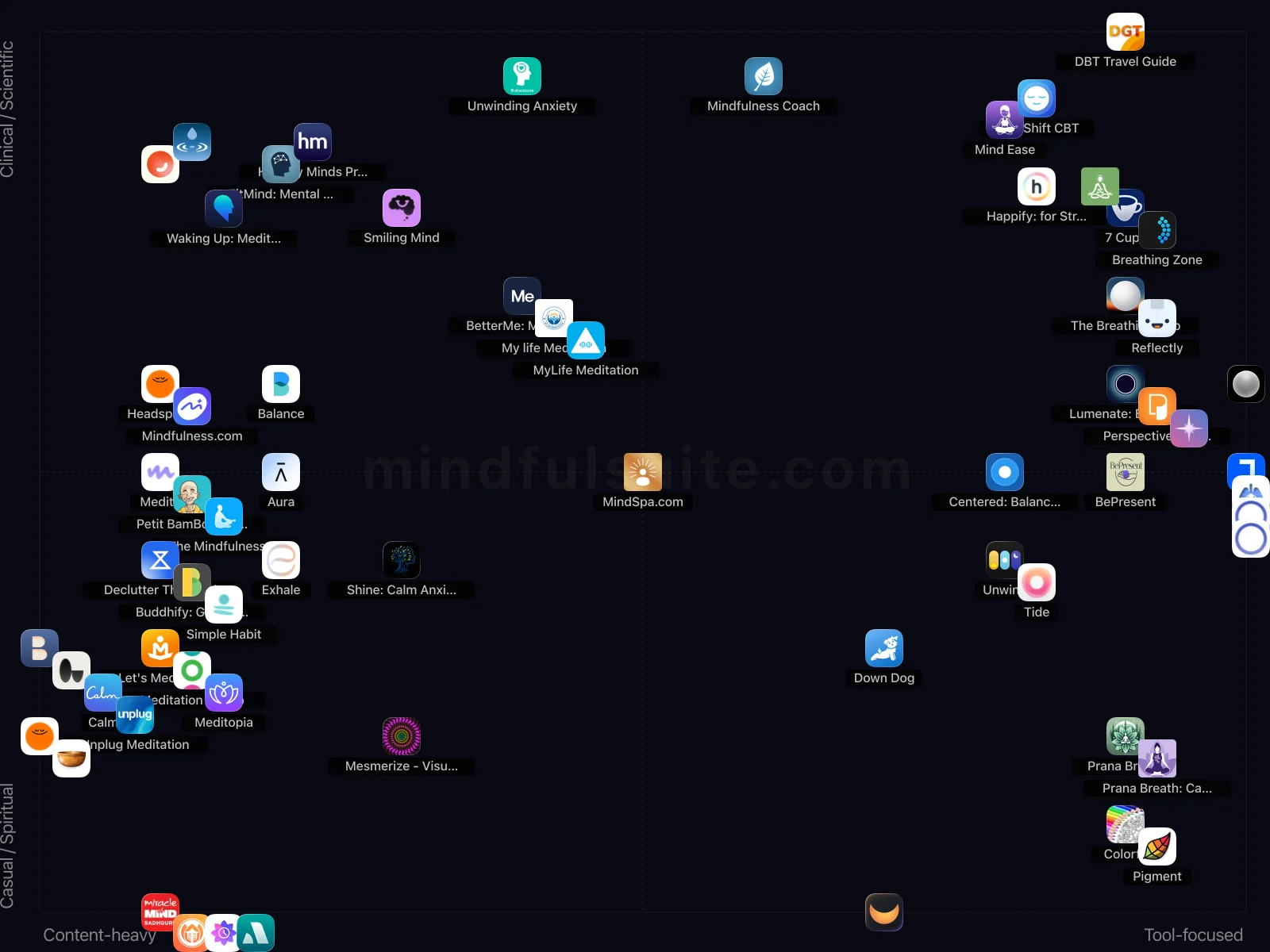
These 59 apps don't all solve the same problem. They cluster into 4 distinct groups, each built around a different philosophy. Understanding which group fits you is the fastest way to narrow your search.
Content-heavy + Clinical / Scientific
17 apps in this group, led by  BetterMe: Mental Health,
  FitMind: Mental Fitness, and
  Headspace.
What defines this cluster: guided meditations, meditations, mental health courses, self-care tools.
Headspace.
What defines this cluster: guided meditations, meditations, mental health courses, self-care tools.
Tool-focused + Clinical / Scientific
15 apps in this group, led by  Mindfulness Coach,
  Reflectly, and
  Centered: Balance & Focus.
What defines this cluster: va-developed mindfulness program, gradual, self-guided training, practice log, reminders, free, no iap or ads.
Centered: Balance & Focus.
What defines this cluster: va-developed mindfulness program, gradual, self-guided training, practice log, reminders, free, no iap or ads.
Content-heavy + Casual / Spiritual
19 apps in this group, led by  Glo | Yoga and Meditation App,
  Insight Timer, and
  Let's Meditate.
What defines this cluster: yoga classes, meditation classes, pilates classes, fitness classes.
Let's Meditate.
What defines this cluster: yoga classes, meditation classes, pilates classes, fitness classes.
Tool-focused + Casual / Spiritual
8 apps in this group, led by  Colorfy,
  Down Dog, and
  Pigment.
What defines this cluster: digital coloring book, variety of images, free core, iap options, new yoga practice daily.
Pigment.
What defines this cluster: digital coloring book, variety of images, free core, iap options, new yoga practice daily.
What makes them different
The core tension in this category runs along two axes. On one side, Content-heavy apps prioritize simplicity and speed — you can be up and running in under a minute. On the other, Tool-focused apps offer depth and customization that rewards investment over time.
The second axis — Methodology — captures an equally important difference. Apps closer to Casual / Spiritual take a fundamentally different approach than those near Clinical / Scientific. Neither is objectively better. The right choice depends on your personality, your experience level, and what you're trying to accomplish.
59 Apps Reviewed
We scored every app using a weighted composite of real App Store and Google Play ratings. Out of 59 apps: 27 Essential · 27 Hidden Gems. 44 cross-platform, 14 iOS-only, 1 Android-only.
Top picks: Headspace and  Calm scored highest overall.
  Balance rounds out the top three. Switch to the Apps tab for the full list with ratings and download links.
How to Pick the Right One
Look at the cluster section above. If you already know whether you want Content-heavy or Tool-focused, that eliminates half the options instantly. Same for Casual / Spiritual vs Clinical / Scientific.
Try one app for a full week before judging. Most mindfulness apps reveal their value around day 5, not day 1.
Quick start: Headspace and Calm represent two different approaches and both scored highest. Pick whichever resonates, switch if it doesn't click.
Making It Stick: Practical Advice
Downloading the app is the easy part. The hard part — the part that actually produces results — is what happens in weeks two, three, and beyond. These tips are drawn from behavioral research and from patterns we've observed across hundreds of thousands of user reviews. They're not revolutionary, but they work:
Start with informal practice
You don't have to sit on a cushion. Practice mindfulness while brushing your teeth, waiting in line, or drinking your morning coffee. Simply pay full attention to what you're doing without multitasking.
Expect your mind to wander constantly
A wandering mind isn't failure — it's the entire point. Every time you notice the wandering and return attention, you're strengthening the mindfulness muscle. That's the rep.
Use the app's shortest sessions first
1-3 minute exercises are far more sustainable than jumping into 20-minute sessions. Build the habit first, then gradually extend duration.
Frequently Asked Questions
These are the questions that come up most often — from our own testing, from user reviews, and from the broader conversation around mindfulness apps. If your question isn't here, the Apps tab has detailed information on every app we reviewed.
What's the difference between mindfulness and meditation?
Meditation is a formal practice (sitting, eyes closed, focused attention). Mindfulness is a broader quality of attention that can be applied to any moment. Meditation is one way to train mindfulness, but you can also practice mindfulness while walking, eating, or listening.
How long before mindfulness makes a difference?
Many people notice subtle shifts in awareness within the first week. Research typically shows measurable benefits after 4-8 weeks of regular practice. But even a single mindful minute can reduce acute stress in the moment.
Is mindfulness religious?
While mindfulness has roots in Buddhist contemplative traditions, modern mindfulness as taught in apps and clinical settings is entirely secular. It's a cognitive skill — training attention and awareness — with no religious requirements.
Finding Your Center: A Guide to the Best Mindfulness Apps (2026)
Remember when "clearing your head" meant pacing around the block or scribbling "JUST BREATHE" on a sticky note and slapping it on your monitor? Our minds have always been busy, chaotic places. Throw in a constant stream of notifications, an overflowing inbox, and the weight of a thousand tiny worries, and it can feel totally inescapable.
But what if you had a secret portal to a quiet garden, a peaceful library, or a cozy cabin, right in your pocket? That’s the magic of a great mindfulness app. They aren't going to magically fix your boss or pay your rent, but they act as gentle guides ready to help you turn a frantic commute or a sleepless night into a moment of genuine relief. Forget toughing it out. Let’s find a digital companion to help you navigate the beautiful, wild landscape of your own mind.
The Guided Getaways: For Beginners & Everyday Calm
These apps are like beautifully designed wellness studios. They offer a polished, welcoming path for anyone curious about meditation, loaded with soothing voices and beginner-friendly roadmaps.

Present
A beautiful meditation timer featuring 100+ soundscapes and 6 bell themes to help you find stillness anywhere.
- Over 100 high-quality nature and ASMR soundscapes.
- Minimalist design that stays out of your way.
- Available as a Chrome extension for working peacefully.

Headspace
Your friendly guide to meditation, Headspace makes mindfulness feel accessible and fun, with mood tracking integrated to help you see your progress.
- The playful, accessible animation style and beginner-friendly "Basics" course make mindfulness far less intimidating for newcomers.
- Its diverse collection of "mini-meditations" and "SOS" sessions offers quick relief for specific daily stresses or situations.

The Mindfulness App
One of the original players in the digital wellness space, this app offers a clean, straightforward path to mindfulness. It’s a wonderful resource for both guided practice with world-class teachers and silent, self-led meditation.
- Provides both guided and silent timed meditations with custom bells, offering flexibility for both beginners and experienced practitioners.
- Features a decent selection of respected teachers, ensuring high-quality instruction across its various meditation categories.

Mindfulness.com
This app aims to be your complete guide to living a more mindful life. It features a deep library of guided meditations, multi-day courses, and inspiring talks from leading teachers all over the world.
- Features exclusive content and courses from renowned mindfulness teachers, offering expert guidance not found elsewhere.
- Its structured "Mindfulness Courses" provide a clear progression for developing a deeper, more consistent practice.

Calm
Famous for its soothing meditations and sleep stories, Calm also includes a lovely mood check-in feature to weave mindfulness into your daily reflection.
- The vast library of high-quality Sleep Stories, narrated by soothing voices, genuinely helps users drift off to sleep.
- Its daily meditations, like the "Daily Calm," provide consistent, accessible guidance for mindfulness beginners and regulars.

Balance
Balance takes personalization to a whole new level. When you start, it asks you a series of questions about your meditation experience, goals, and challenges. From there, it crafts a custom daily meditation plan that evolves as you progress and provide feedback, so your practice grows with you.
- The adaptive daily meditations truly personalize the experience, adjusting based on your feedback and progress.
- Its clear, consistent instruction from a single narrator (Ofosu Jones-Quartey) provides a cohesive learning journey.

Meditopia
Offers guided meditations and sleep stories for stress reduction and improved sleep. It's for users seeking mindfulness practices and relaxation techniques.
- Offers a well-rounded collection of guided meditations, sleep stories, and soothing music at an accessible price point.
- The app provides a good balance between introductory and advanced content, catering to various user needs.

Breethe: Sleep & Meditation
Breethe is your all-in-one toolkit for unwinding. It goes beyond standard meditation, offering everything from hypnotherapy sessions to masterclasses on finding happiness. It’s for anyone who wants a broad spectrum of resources to de-stress and sleep like a champ.
- The personalized content recommendations genuinely tailor meditations and sleep stories to user needs.
- Offers a comprehensive library of guided meditations, music, and masterclasses for diverse relaxation.

BetterMe: Mental Health
This app provides tools for mental well-being, including meditations and courses. It's for those seeking to prioritize their self-care through guided practices.
- BetterMe offers a vast, all-encompassing library of meditations, courses, and tools catering to a broad range of mental well-being needs.
- It aims to be a single solution for various self-care practices, potentially reducing the need for multiple apps.

Meditation Studio
Offers a diverse collection of guided meditations from various teachers and traditions.
- The "diverse collection of guided meditations from various teachers" offers a rich array of perspectives and styles.
- It differentiates itself by featuring multiple traditions, allowing users to explore different meditative paths.

Declutter The Mind
Declutter The Mind provides guided mindfulness meditations covering topics like anxiety and sleep. It's good for beginners, offering accessible meditations on a range of issues.
- It offers structured courses, like the 30-day "Foundations of Mindfulness," which is excellent for building a consistent practice.
- The app's clear focus on specific goals like anxiety or sleep provides targeted support for common mental health challenges.

Unplug Meditation
Born from a real-world meditation studio in Los Angeles, Unplug brings the world’s best instructors right to your ears. It feels like dropping into a class with a seasoned teacher, offering a huge variety of styles and session lengths to fit any mood or schedule.
- The high-quality video meditations, filmed in a real studio, provide a more immersive and community-like experience.
- Its diverse roster of instructors brings a wide range of meditation styles and approaches directly to your screen.

Petit BamBou: Mindfulness
Petit BamBou is a meditation app designed to simplify mindfulness practices. It helps those looking to reduce stress and improve well-being.
The Free Sanctuaries: Generosity-Driven Mindfulness
Peace of mind shouldn't require a pricey monthly subscription. These apps are created by non-profits, universities, and government agencies who believe that quality mental health tools belong to everyone.

Mindfulness Coach
Offers a self-guided mindfulness training program developed by the U.S. Department of Veterans Affairs. It's designed to help individuals gradually learn and practice mindfulness techniques.
- Developed by the VA, it offers a credible, structured, and evidence-based curriculum for learning mindfulness from scratch.
- Being completely free with no ads or in-app purchases makes this high-quality program accessible to everyone.

Medito
Built on the beautiful principle that mindfulness should be accessible to all, Medito is a gift from the non-profit Medito Foundation. It's 100% free, forever, with no ads or hidden costs. It’s a pure, clean, and heartfelt resource for your mental well-being.
- Absolutely free with no premium tiers or ads, embodying a true non-profit mission to make mindfulness accessible to all.
- Offers a solid foundational course and diverse guided meditations, including sleep stories and breathing exercises, without paywalls.

Smiling Mind
Developed by psychologists and educators, Smiling Mind is a wonderful, not-for-profit app that’s entirely free. It has a special focus on youth, offering tailored programs for kids and teens, making it an incredible resource for families and schools.
- It is entirely free with no hidden paywalls, making quality mindfulness and mood-boosting exercises accessible to everyone.
- The app offers unique, age-specific programs, including dedicated modules for kids and teens, a rare find in this category.

UCLA Mindful
From the Mindful Awareness Research Center at UCLA, this app is a simple, credible, and no-frills tool for learning the basics. It’s a perfect, uncomplicated entry point from a trusted source.
- Backed by the "UCLA Mindful Awareness Research Center," it provides highly credible and expertly guided meditations.
- It’s completely free, offering high-quality, evidence-based mindfulness practices without any paywalls.

Healthy Minds Program
This app is a mindfulness course designed by the brilliant minds at the Center for Healthy Minds at the University of Wisconsin-Madison. It's a free, science-backed program that trains your mind in four key areas of well-being: awareness, connection, insight, and purpose.
- The Healthy Minds Program is entirely free, offering high-quality, science-backed meditation instruction without any paywalls.
- Its unique four-pillar framework (Awareness, Connection, Insight, Purpose) provides a robust, structured path to mental well-being.

Plum Village
This app is a direct portal to the gentle, profound teachings of the Zen Master Thich Nhat Hanh and his Plum Village community. It’s a completely free and peaceful offering, filled with dharma talks, guided meditations, and songs that embody a compassionate approach to mindfulness.
- Offers authentic Buddhist teachings and meditations directly from the revered Plum Village tradition, led by Thich Nhat Hanh's monastics.
- Completely free and ad-free, providing a pure, uncommercialized experience rooted in deep spiritual wisdom.

Let's Meditate
A free meditation app that provides various guided meditations without requiring ads or sign-ups.
- Its commitment to being entirely free, with no ads or required sign-ups, is genuinely refreshing and removes all friction.
- The simple, uncluttered interface focuses purely on meditation, making it incredibly accessible for quick, no-fuss sessions.
The Mindful Toolkits: Targeted Relief & Breathwork
Sometimes you don't want a 20-minute spiritual journey—you just need to stop a panic attack in its tracks or grab three minutes of sanity between meetings. These apps are built for specific situations, offering quick breathwork, CBT exercises, and on-the-go relief.

Buddhify: Guided Meditation
Buddhify's genius is its focus on "on-the-go" mindfulness. It offers guided meditations designed for whatever you're doing right now—whether you're on a work break, walking down the street, or trying to fall asleep. This approach is perfectly aligned with DBT's goal of weaving mindfulness into the fabric of your everyday life.
- Offers a uniquely diverse library of guided meditations tailored for specific situations and emotions, directly supporting DBT mindfulness.
- The "listen on the go" feature makes practicing mindfulness incredibly accessible throughout daily life, fostering consistent practice.

DBT Travel Guide
If you're already in a DBT program, the DBT Travel Guide is the perfect pocket companion. It's less of a teacher and more of a brilliant cheat sheet, giving you a quick reference to over 200 skills and mindfulness exercises. It's the tool you'll pull up when you need to recall a specific skill on the fly.
- Provides an impressive library of over 200 DBT skills with clear explanations, making it an excellent reference tool.
- The dedicated crisis section offers immediate, actionable guidance for managing intense emotional distress, a critical DBT component.

Prana Breath
Drawing from ancient yogic traditions (Pranayama), Prana Breath offers a variety of breathing techniques designed to promote deep relaxation and mindfulness. It's highly customizable and feels more like a training tool for your breath.
- Offers an impressive array of traditional yogic pranayama techniques, appealing to experienced practitioners.
- Highly customizable training sessions and detailed progress tracking empower users to tailor their practice.

Prana Breath: Calm & Meditate
This app offers breathing techniques and meditations to increase mindfulness.

MyLife Meditation
Formerly known as Stop, Breathe & Think, this app invites you to check in with yourself before you dive in. You tell it how you're feeling physically and mentally, and it recommends a short, guided activity—like meditation, yoga, or even acupressure—to help you find balance.
- Uniquely personalizes meditation recommendations based on your current emotional check-in, making it highly relevant.
- The "Stop, Breathe & Think" legacy ensures a solid foundation in accessible, science-backed mindfulness practices.

Simple Habit
As the name suggests, this app wants to make mindfulness an effortless part of your daily routine. It specializes in short, 5-minute meditations tailored to specific, everyday situations, making it incredibly easy to squeeze in a moment of calm.
- Its core strength lies in quick, accessible 5-minute meditations, making mindfulness genuinely achievable for busy individuals.
- The diverse library covers specific situations like "before a meeting" or "commuting," providing practical, immediate relief.

Aura
Aura acts like a personal wellness genie. Using AI, it learns your moods and goals, then serves up a daily, personalized 3-minute meditation, life coaching tip, or story. It’s a one-stop-shop for your emotional health.
- Excellent for quick stress relief, offering 3-minute personalized meditations perfect for busy schedules.
- The "life coaching" aspect provides a broader support system beyond just mindfulness exercises.

Unwinding Anxiety
This app-based program provides daily exercises and a community to help users understand and manage anxiety. Unwinding Anxiety is a program to help unwind your mind.
- The structured, daily 'bite-sized exercises' are designed to build habits, making the program feel manageable and progressive.
- Features a direct connection to a 'supportive community' and potentially live coaching, offering a social aspect missing in many apps.

Breath Ball
Breath Ball provides a simple, intuitive visual guide—a ball that expands and contracts—for various breathing exercises. It's perfect for visual learners who just want a clean, simple guide to follow.
- The simple visual guide of the expanding and contracting ball is incredibly intuitive for pacing breathing exercises.
- As a completely free app, it offers full access to its customizable sessions without any hidden costs or paywalls.

Breathing Zone
Breathing Zone offers clinically effective guided breathing exercises. Its unique feature is a Breath Analyzer that uses your phone's camera to measure your breathing rate and help you find your ideal pace for relaxation.
- The unique breath analyzer accurately detects and helps optimize your breathing rate for maximum benefit.
- It is genuinely free with no hidden paywalls, offering full functionality for stress reduction.

The Breathing App
Co-created by renowned yoga teacher Eddie Stern and author Deepak Chopra, this no-frills app focuses on one thing: resonant breathing. This technique involves breathing at a specific rate (around 5-6 breaths per minute) to instantly calm the nervous system.
- Focuses solely on resonant breathing, a scientifically-backed technique for nervous system calming.
- Its minimalist design, co-created by experts, ensures a distraction-free and effective experience.

Unwind
Unwind is another beautifully designed app with a focus on simplicity. It provides guided breathing exercises with calming animations and sounds to enhance the relaxation experience.
- The beautifully designed interface with calming animations and sounds genuinely elevates the breathing experience aesthetically.
- It offers specific guided exercises tailored for distinct goals like relaxation, focus, and sleep, which is helpful.

Just Breathe
This Android-only app offers a straightforward way to practice mindful breathing. It has a clean interface and customizable timers to help you focus purely on your breath without distractions.
- The simple and straightforward interface truly minimizes distractions, allowing complete focus on the breathing practice.
- Customizable timers provide essential flexibility for users to set their preferred session lengths and intervals.

Paced Breathing
Just like its name suggests, Paced Breathing helps you regulate your breath with simple cues. It's a minimalist app that uses visual, audio, and haptic feedback to guide your inhales and exhales.
- Offers effective haptic (vibration) feedback, making it possible to practice mindful breathing discreetly.
- Its straightforward approach focuses purely on paced breathing, avoiding distracting features or content.

MindShift CBT
Created by Anxiety Canada, MindShift CBT speaks directly to teens and young adults navigating the world of anxiety. It breaks down complex CBT concepts into practical, easy-to-use tools for tackling worry, panic, perfectionism, and phobias. It’s a friendly, no-nonsense guide to taking control of your thoughts.
- It provides free access to "scientifically proven strategies based on Cognitive Behavioral Therapy" for anxiety management.
- The focus on actionable CBT tools allows users to learn to relax and be mindful without subscription barriers.

Happify: for Stress & Worry
If the idea of journaling makes you yawn, Happify is here to change your mind. It turns mental wellness into a series of science-based games and fun activities designed to reduce stress and build resilience. Based on CBT and positive psychology, it transforms self-care into something you’ll actually look forward to doing.
- The "Tracks" system, based on specific psychological principles, provides a structured path for improvement.
- Interactive games, like "Uplift," make building positive habits genuinely engaging and less like a chore.

Mind Ease
Provides immediate relief from anxiety and panic using evidence-based exercises. This is for individuals who need quick and accessible tools to manage anxiety symptoms.
- It excels at providing instant, evidence-based exercises specifically tailored for acute anxiety and panic attack relief.
- The "SOS" button for immediate support is a crucial feature for those struggling with sudden, overwhelming anxiety.
The Thinker's Guides: For Skeptics & Deep Divers
If you roll your eyes at the word "chakras" but want the neurological benefits of meditation, or if you're looking for massive libraries of advanced philosophy, this is your section. These apps dive into the science, the ethics, and the raw mechanics of consciousness.

Open: Breathwork + Meditation
Presents a mindfulness studio promoting personal growth through breathwork and meditation practices.
- Features live and on-demand classes with expert instructors, fostering a strong community feel.
- High production value and engaging sessions make the breathwork and meditation experience premium.

Waking Up: Meditation & Wisdom
Created by neuroscientist and philosopher Sam Harris, Waking Up is not just a meditation app; it’s an operating system for your mind. It combines practical mindfulness instruction with deep, thought-provoking lessons on philosophy, ethics, and the nature of consciousness itself.
- Sam Harris's deep philosophical insights and rigorous approach to mindfulness differentiate it significantly from other apps.
- It offers a comprehensive curriculum, moving beyond basic breathing into advanced meditation theory and wisdom.

Ten Percent Happier Meditation
Built for the fidgety skeptic in all of us, this app makes meditation relatable and practical. It cuts through the fluff and gets straight to the point with guidance from world-renowned experts and scientists.
- The app features truly insightful, practical teachings from renowned meditation experts, making complex concepts digestible and applicable.
- Its clear, no-nonsense approach to mindfulness appeals to skeptics who prefer evidence-based instruction over spiritual fluff.

Insight Timer
Imagine a massive, free library for your soul. Insight Timer offers an incredible collection of meditations and talks, with a simple journal to capture your mood along the way.
- Its truly vast library of over 100,000 free guided meditations and talks makes it unbeatable for budget-conscious users.
- The community features, like "meditating with others," add a unique social dimension to personal practice.

FitMind: Mental Fitness
Offers guided meditations and breathing exercises, based on neuroscience and monastic practices, to enhance focus and well-being.
- Its neuroscientists and monks backed program offers a unique, structured approach to mental fitness, appealing to science-minded users.
- FitMind provides a progressive curriculum, moving beyond simple breathing to address focus, vitality, and joy systematically.

Sattva
Features authentic Vedic meditations, chants, and mantras from the Art of Living. It's for those seeking traditional meditation practices.
- It genuinely stands out by focusing on authentic Vedic traditions, offering a unique spiritual depth absent in many secular apps.
- The inclusion of traditional chants and mantras provides a distinct, resonant experience for those seeking a cultural connection.

Lumenate: Explore & Relax
Utilizes research-backed light sequences from your phone's flashlight to guide you into an altered state of consciousness for meditation and relaxation.
- Utilizes unique, research-backed light sequences for a genuinely novel meditative experience.
- Offers a powerful, non-ingestible way to explore altered states of consciousness for deep relaxation.

Miracle of Mind - Sadhguru
Provides a free 7-minute guided meditation session by Sadhguru. It is designed to help users take charge of their mental wellbeing and establish a daily meditation practice.
- The app is completely free, providing Sadhguru's 7-minute guided meditation and all features without any paywalls.
- Its engaging experience through milestones effectively motivates users to establish a consistent daily meditation practice.
Alternative Paths: Creativity, Faith & Culture
Mindfulness doesn't always look like sitting cross-legged with your eyes closed. For some, it's the rhythm of a coloring book, the connection of prayer, or tracking the moon. These apps cater to specific communities, creative outlets, and unique spiritual paths.

Moonly: Moon Phases & Calendar
For anyone who feels connected to the rhythms of nature, Moonly offers a magical twist. It provides daily affirmations, wisdom, and rituals that align with the current phase of the moon. It’s a beautiful guide to mindfulness that connects your inner world with the cosmos.
- Its unique alignment of daily affirmations with current Moon phases provides a distinct spiritual dimension.
- Includes a wealth of information on moon rituals, tarot, and birth charts, appealing to a specific audience.

Exhale
Created for and by Black, Indigenous, and Women of Color (BIWOC), Exhale is a well-being app that thoughtfully centers their lived experiences.
- Provides a critically important, culturally affirming space and resources specifically for Black, Indigenous, and Women of Color.
- Features a diverse range of meditations, breathwork, and coaching by BIWOC practitioners, ensuring relevant and understanding content.

Abide
A Christian meditation app with guided meditations and biblical stories, designed for relaxation and peace.
- It uniquely caters to Christians, integrating faith-based scriptures and biblical narratives into its guided meditations.
- The app offers specific Christian-themed content for sleep, anxiety, and daily reflection, aligning with spiritual needs.

Down Dog
Down Dog provides a new, studio-quality yoga practice every time you use it. Instead of pre-recorded videos, it generates a unique sequence based on your preferences, so you never get bored.
- Generates a completely new and personalized yoga practice every single session, ensuring incredible variety and preventing boredom.
- The sheer number of customizable configurations, from pace to voice, allows users to truly tailor their yoga experience.

Glo | Yoga and Meditation App
Offers yoga, Pilates, and fitness classes for users to practice at home or on the go. It is for individuals seeking guided wellness routines.
- Glo's strength lies in its expansive library of yoga, Pilates, and fitness classes, offering a holistic wellness approach.
- It excels as a comprehensive platform for physical and mental well-being, far beyond just breathing exercises.

Tide
Tide is a beautifully designed app that integrates sleep, meditation, and relaxation with nature sounds. It also features a Pomodoro timer and breathing exercises.
- Its beautiful, minimalist interface with elegant nature animations creates an immediately calming visual experience.
- Offers a free "Focus Timer" with built-in nature soundscapes, making it great for productivity and relaxation.

Reflectly
Billing itself as a personal mental health companion, Reflectly makes journaling feel like a conversation. This AI-powered app asks you questions about your day, helps you identify thought patterns, and provides personalized insights to help you understand yourself better. It’s like having a friendly, insightful robot in your pocket.
- The AI-powered prompts genuinely encourage deeper self-reflection, helping users process thoughts that might otherwise disrupt sleep.
- Journaling before bed is a proven method for mental decluttering, which Reflectly facilitates expertly.

Perspective, a mindful journal
Perspective is a mindful journaling app intended to provide a safe space for self-reflection. The app encourages users to be honest with themselves and to pause and allow their minds to catch up.
- Its dedicated "Mindful Moments" prompts genuinely facilitate deep, introspective self-reflection.
- The integrated mood tracker provides valuable visual insights into emotional patterns over time.

Spark - Gratitude Journal
This app helps cultivate gratitude through journaling, mood tracking, habit tracking, and affirmations. It is for anyone looking to improve their well-being through positive psychology practices.
- The integration of mood tracking, habit tracking, and affirmations offers a genuinely holistic self-care platform.
- Daily guided affirmations provide structured positive reinforcement, enhancing the gratitude practice.

Colorfy
Colorfy is a digital coloring book for adults filled with intricate designs like mandalas, florals, and animals. It's a simple and relaxing way to engage in a creative activity and reduce stress.
- The vast and diverse collection of coloring pages, from mandalas to intricate patterns, ensures endless creative relaxation for users.
- Its simple interface and focus on stress reduction make it an accessible and genuinely calming digital art experience for adults.

Pigment
A digital coloring book app, it offers a wide range of tools and a vast library of illustrations for a realistic coloring experience.
- Offers a genuinely realistic coloring experience with a wide array of brushes and tools, mimicking traditional art supplies digitally.
- The vast and continuously updated library of illustrations provides endless creative possibilities for a diverse user base.

Mesmerize - Visual Meditation
Offers a unique audio-visual meditation experience to promote relaxation and clear the mind. It's useful for users seeking a sensory approach to meditation and anxiety relief.
- The unique audio-visual meditations offer a genuinely hypnotic and immersive relaxation experience.
- High-quality visuals are a refreshing change from purely audio-based meditation apps.

7 Cups
7 Cups is built on the power of connection. It offers free, anonymous emotional support by connecting you with trained volunteer listeners 24/7. For those seeking professional help, it also provides access to affordable online therapy.
- Connects users with real human listeners for immediate emotional support, offering a sense of connection during distress.
- Provides access to licensed therapists for more structured, professional counseling, a significant step beyond self-guided apps.

Shine: Calm Anxiety & Stress
Shine is a self-care app that radiates inclusivity and community. It offers daily meditations, journaling prompts, and affirmations created with representation at the forefront. It’s more than an app—it’s a supportive space where you can feel seen while you manage stress and anxiety.
- The "Shine Together" community forum offers a unique space for shared support and accountability.
- Daily meditations are thoughtfully curated for specific anxiety and stress relief, not just generic well-being.