
Sleep Aid Apps: What You Need to Know in 2026
It's 2 AM. You've been staring at the ceiling for an hour, mentally rehearsing tomorrow's meeting and calculating how few hours of sleep you'll get if you fall asleep right now. The harder you try, the more awake you feel. Sleep aid apps break this cycle by giving your racing mind something constructive to focus on — replacing the anxiety spiral with sounds, stories, and guided relaxation that actually lead to sleep.
We evaluated 61 sleep aid apps across iOS and Android, scoring each on real user ratings, feature depth, and long-term value. This guide covers what we found.
Why Your Brain Won't Shut Off (and What Actually Helps)
You are tired. You know you are tired. Your body is tired. But the moment your head hits the pillow, your brain launches into a full production: replaying the awkward thing you said in a meeting, pre-writing tomorrow's email, calculating finances, remembering that you forgot to call the dentist. Welcome to sleep-onset insomnia, the most common form of sleeplessness, and it is almost always a hyperarousal problem.
The sympathetic nervous system — your fight-or-flight machinery — is not designed with an off switch. It is designed to wind down gradually when the environment signals safety. The problem is that modern life rarely sends that signal. You go from a stimulating screen to a dark room and expect your nervous system to make the transition instantly. It cannot. The cognitive activity that persists at bedtime is your brain doing what it does all day: solving problems, planning, evaluating. It has not received a convincing signal to stop.
This is where sleep aid apps enter, and understanding the mechanism explains why they work. The fundamental principle is attentional displacement. Your brain has limited cognitive bandwidth. If you give it a specific, low-stakes focus — a narrated story, a body scan, a counting exercise — it cannot simultaneously run the anxiety playlist. The rumination is not suppressed. It is displaced, crowded out by content that occupies the same neural real estate without generating arousal.
This is also why boring content works better than interesting content. A gripping podcast keeps you awake because it activates curiosity and engagement — arousal states incompatible with sleep. A gently narrated story about a train crossing the Scottish Highlands provides just enough structure to occupy your language-processing centers while being profoundly uninteresting enough that your arousal level drops. The sweet spot is content that is engaging enough to displace worries but not engaging enough to sustain wakefulness.
The research on pre-sleep cognitive activity supports this approach. Studies on cognitive distraction techniques for insomnia show that giving the mind a structured task — counting backward, imagining a peaceful scene in elaborate detail, following a guided relaxation script — significantly reduces sleep-onset latency compared to lying in silence and trying not to think. Trying not to think is, of course, a form of thinking. The brain needs somewhere to go, not an instruction to stay still.
Sleep Stories vs Soundscapes vs Guided Relaxation: Matching Content to Your Brain
Not all sleep content works the same way, and the differences map to genuine cognitive differences between people. Choosing the wrong type is a common reason people conclude that sleep apps do not work for them.
Sleep stories — the format Calm popularized and competitors have since adopted — work by engaging the brain's narrative processing capacity. When you listen to a story, your language centers activate to follow the plot, your imagination constructs the scene, and your predictive systems generate mild expectations about what happens next. This is precisely the cognitive machinery that, left unoccupied at bedtime, generates worry narratives. A sleep story is essentially a friendly hostile takeover of your internal storytelling system, redirecting it from "what if the project fails" to "the train rounded a bend and the valley opened before it." If you are a verbal thinker — someone whose anxious thoughts come primarily as inner speech and mental narratives — sleep stories are likely your best match.
Soundscapes work through a completely different mechanism. They do not engage narrative processing at all. Instead, they provide a consistent auditory baseline that serves two functions: masking environmental noise that might trigger alertness, and creating a monotonous sensory input that the brain can safely ignore. Rain is the most popular sleep soundscape because it hits this sweet spot perfectly — consistent enough to mask disruptions, variable enough to avoid the mechanical quality of synthetic white noise, and culturally associated with staying indoors and resting. If you find voices distracting at bedtime, or if your sleep problems are primarily driven by environmental noise rather than racing thoughts, soundscapes are the better choice.
Guided relaxation — body scans, progressive muscle relaxation, breathing exercises — targets the physiological dimension of sleeplessness. If your insomnia manifests physically — jaw clenching, shoulder tension, shallow breathing, restless legs — you need an intervention that addresses the body, not just the mind. Progressive muscle relaxation systematically tenses and releases each muscle group, teaching the nervous system what "relaxed" actually feels like. Body scans move attention slowly through the body, bringing awareness to tension you may not have consciously noticed. These techniques are the most clinically studied of the three formats, with strong evidence for reducing both sleep-onset latency and nighttime waking.
The honest recommendation is to try all three across your first week. One will click. When it does, the app you are using matters far less than the content type you have identified.
The Screen-Before-Bed Paradox: Using a Phone to Improve Sleep
The irony is hard to miss. Every sleep scientist will tell you to stop using screens before bed. Blue light suppresses melatonin production. Screen content stimulates cognitive arousal. The phone is the enemy of sleep. And yet the best tool many people have found for actually falling asleep lives on that same phone.
This tension is real, but it is more nuanced than the simple "screens bad" narrative suggests. The research on screen use and sleep conflates very different activities. Scrolling social media before bed is harmful not primarily because of the screen itself but because of what you are doing with it. Social media is engineered for engagement — variable rewards, social comparison, emotional content — all of which elevate arousal. The blue light is a secondary factor. The primary problem is that Instagram is the cognitive equivalent of espresso.
A sleep app used correctly is a fundamentally different interaction. The screen is face-down or in the dimmest possible mode. The content is audio, not visual. The app is the last thing you open, replacing the scrolling session that was actually damaging your sleep. In this configuration, the phone is functioning as a bedside speaker, not as a screen. The distinction matters.
That said, the blue light concern is not fabricated. Even brief screen exposure while setting up your sleep app suppresses melatonin to some degree. The practical mitigation is straightforward: enable the strongest possible blue light filter on your phone (Night Shift on iOS, Night Light on Android, or a third-party app that goes further than the built-in options). Set up your sleep content before you get into bed, not after. Use the sleep timer feature so the content fades naturally — most people fall asleep within 20 to 30 minutes, and leaving audio running all night can disrupt later sleep cycles.
The larger point is that the phone-in-bedroom debate is too binary. The question is not whether your phone is in the room. It is what your phone is doing. A phone playing a sleep story with the screen dark and a 30-minute timer is serving a genuinely different function than a phone showing you political arguments and celebrity gossip at midnight. Treating these as equivalent because they both involve a phone misses the point entirely.
4 Types of Sleep Aid Apps — and How They Differ
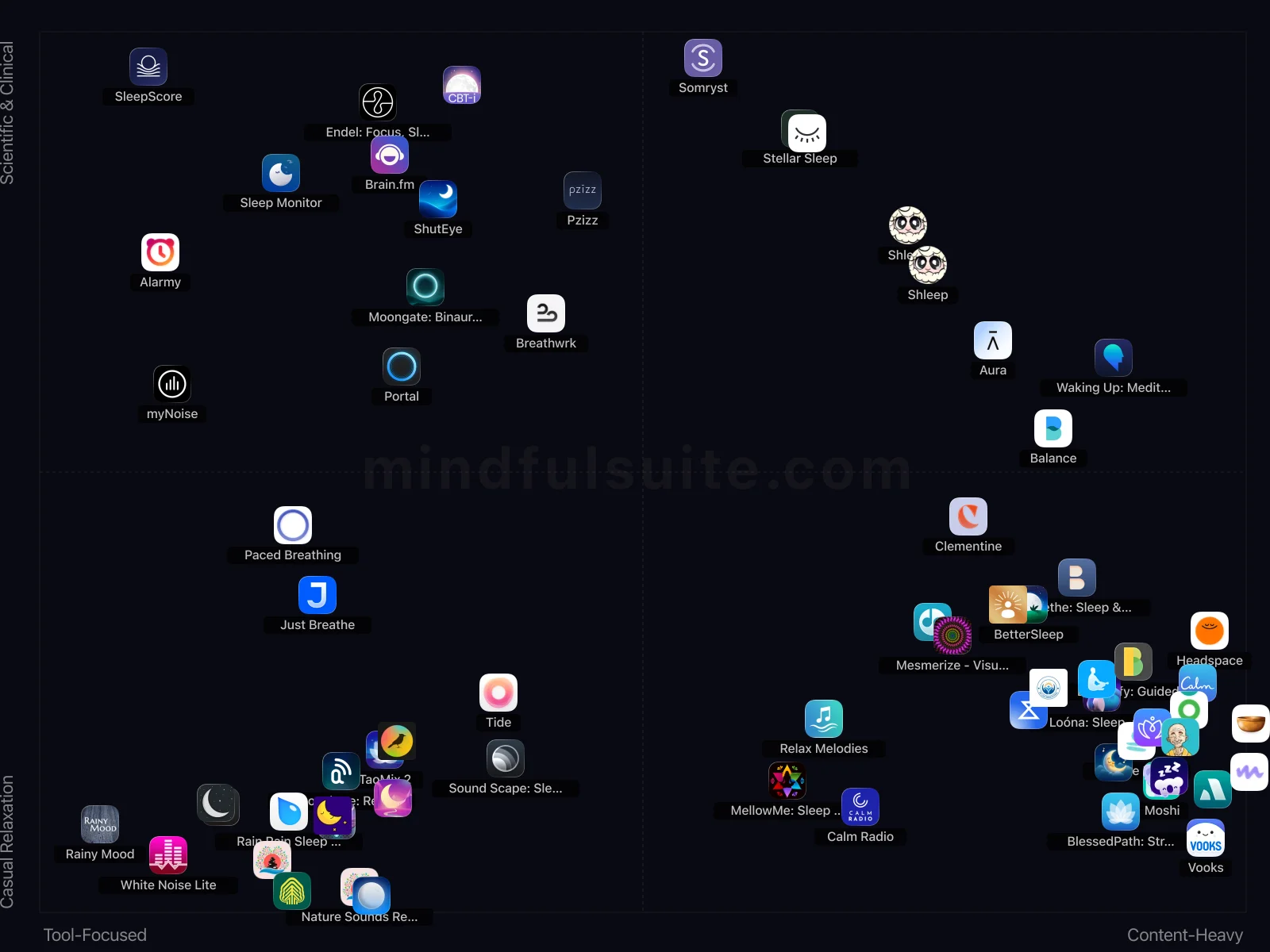
These 67 apps don't all solve the same problem. They cluster into 4 distinct groups, each built around a different philosophy. Understanding which group fits you is the fastest way to narrow your search.
Tool-Focused + Scientific & Clinical
12 apps in this group, led by  Alarmy,
  Endel: Focus, Sleep, Relax, and
  Moongate: Binaural Beats.
What defines this cluster: alarm clock with missions, for heavy sleepers, sleep tracker, ai-powered soundscapes.
Moongate: Binaural Beats.
What defines this cluster: alarm clock with missions, for heavy sleepers, sleep tracker, ai-powered soundscapes.
Content-Heavy + Scientific & Clinical
8 apps in this group, led by  Aura,
Aura,  Balance, and
  Waking Up: Meditation & Wisdom.
What defines this cluster: personalized meditations, life coaching, 3-minute sessions, personalized meditation program.
Waking Up: Meditation & Wisdom.
What defines this cluster: personalized meditations, life coaching, 3-minute sessions, personalized meditation program.
Tool-Focused + Casual Relaxation
19 apps in this group, led by  Rain Rain Sleep Sounds,
  White Noise Deep Sleep Sounds, and
  White Noise Lite.
What defines this cluster: rain sounds, nature sounds, sleep aid, relaxation aid.
White Noise Lite.
What defines this cluster: rain sounds, nature sounds, sleep aid, relaxation aid.
Content-Heavy + Casual Relaxation
28 apps in this group, led by  BetterSleep,
  Loóna: Sleep, reduce anxiety, and
  Moshi.
What defines this cluster: vast library of sleep sounds, celebrity-narrated bedtime stories, binaural beats for relaxation, sleep tracker, smart alarm.
Moshi.
What defines this cluster: vast library of sleep sounds, celebrity-narrated bedtime stories, binaural beats for relaxation, sleep tracker, smart alarm.
What makes them different
The core tension in this category runs along two axes. On one side, Tool-Focused apps prioritize simplicity and speed — you can be up and running in under a minute. On the other, Content-Heavy apps offer depth and customization that rewards investment over time.
The second axis — Methodology — captures an equally important difference. Apps closer to Casual Relaxation take a fundamentally different approach than those near Scientific & Clinical. Neither is objectively better. The right choice depends on your personality, your experience level, and what you're trying to accomplish.
61 Apps Reviewed
We scored every app using a weighted composite of real App Store and Google Play ratings. Out of 61 apps: 28 Essential · 27 Hidden Gems · 1 Mainstream. 42 cross-platform, 16 iOS-only, 3 Android-only.
Top picks:  Calm and BetterSleep scored highest overall.
  Headspace rounds out the top three. Switch to the Apps tab for the full list with ratings and download links.
How to Pick the Right One
Look at the cluster section above. If you already know whether you want Tool-Focused or Content-Heavy, that eliminates half the options instantly. Same for Casual Relaxation vs Scientific & Clinical.
Try one app for a full week before judging. Most sleep aid apps reveal their value around day 5, not day 1.
Quick start: Calm and BetterSleep represent two different approaches and both scored highest. Pick whichever resonates, switch if it doesn't click.
Making It Stick: Practical Advice
Downloading the app is the easy part. The hard part — the part that actually produces results — is what happens in weeks two, three, and beyond. These tips are drawn from behavioral research and from patterns we've observed across hundreds of thousands of user reviews. They're not revolutionary, but they work:
Start the app before you're desperate
Don't wait until you've been lying awake for an hour. Start your sleep aid as part of your bedtime routine, before frustration sets in.
Experiment with content types
Some people fall asleep best to stories, others to rain sounds, others to guided relaxation. Try different types over a week to find what works for your brain.
Keep your phone face-down
Use sleep aids with the screen off and the phone face-down. The audio is what helps — screen light works against you.
Frequently Asked Questions
These are the questions that come up most often — from our own testing, from user reviews, and from the broader conversation around sleep aid apps. If your question isn't here, the Apps tab has detailed information on every app we reviewed.
Is it healthy to need an app to fall asleep?
Using a sleep aid is no different from using a book, a fan for white noise, or any other sleep-promoting routine. If it helps you fall asleep consistently, it's a healthy habit. The goal is to replace harmful screen time with something that supports sleep.
Will I become dependent on sleep aids?
Audio-based sleep aids don't create chemical dependency like medications. Some people do develop a preference for sleeping with background audio. If this concerns you, gradually reduce volume over time as your sleep routine strengthens.
Sleep aid vs sleep tracker — what's the difference?
Sleep trackers monitor and analyze your sleep (when you slept, how well, sleep stages). Sleep aids actively help you fall asleep through audio content. Many people use both — an aid to fall asleep and a tracker to understand their patterns.
The Best Sleep Aid Apps for a Truly Restful Night (2026)
Remember when the best advice for a sleepless night was to count imaginary sheep? We’ve all been there, staring at the ceiling, our minds racing with tomorrow’s to-do list while the clock ticks louder and louder. It feels like a cruel joke that the very device often blamed for our restless nights—our glowing smartphone—might just hold the key to unlocking deep, restorative sleep.
Forget the frustrating glare of endless scrolling. When loaded with the right app, your phone can transform into a gentle guide, a soothing sound machine, or a brilliant sleep scientist right on your nightstand. These apps are designed to help you untangle the day's stress, block out the noise of the world, and understand your own unique sleep patterns. It's time to turn your screen from a source of stimulation into a portal to slumber.
All-in-One Sleep & Meditation Apps
Think of these apps as the swiss army knives of slumber. They are packed with everything from guided meditations and bedtime stories to calming music and breathing exercises, offering a complete toolkit for a better night's rest.

Present
A beautiful meditation timer featuring 100+ soundscapes and 6 bell themes to help you find stillness anywhere.
- Over 100 high-quality nature and ASMR soundscapes.
- Minimalist design that stays out of your way.
- Available as a Chrome extension for working peacefully.

Calm
Famous for its soothing meditations and sleep stories, Calm also includes a lovely mood check-in feature to weave mindfulness into your daily reflection.
- The vast library of high-quality Sleep Stories, narrated by soothing voices, genuinely helps users drift off to sleep.
- Its daily meditations, like the "Daily Calm," provide consistent, accessible guidance for mindfulness beginners and regulars.

BetterSleep
While it contains meditations, BetterSleep is, first and foremost, the ultimate sleep toolkit. It’s a paradise of sound, famous for its enormous library of high-quality sleep sounds and a magical mixer that lets you craft your own perfect ambient soundscape.
- Boasts an enormous library of ambient sounds, guided meditations, and sleep stories, ensuring diverse content.
- Allows users to mix multiple sounds and save their custom soundscapes, providing great personalization.

Headspace
Your friendly guide to meditation, Headspace makes mindfulness feel accessible and fun, with mood tracking integrated to help you see your progress.
- The playful, accessible animation style and beginner-friendly "Basics" course make mindfulness far less intimidating for newcomers.
- Its diverse collection of "mini-meditations" and "SOS" sessions offers quick relief for specific daily stresses or situations.

Meditopia
Offers guided meditations and sleep stories for stress reduction and improved sleep. It's for users seeking mindfulness practices and relaxation techniques.
- Offers a well-rounded collection of guided meditations, sleep stories, and soothing music at an accessible price point.
- The app provides a good balance between introductory and advanced content, catering to various user needs.

Breethe: Sleep & Meditation
Breethe is your all-in-one toolkit for unwinding. It goes beyond standard meditation, offering everything from hypnotherapy sessions to masterclasses on finding happiness. It’s for anyone who wants a broad spectrum of resources to de-stress and sleep like a champ.
- The personalized content recommendations genuinely tailor meditations and sleep stories to user needs.
- Offers a comprehensive library of guided meditations, music, and masterclasses for diverse relaxation.

Slumber
Slumber provides a collection of soothing stories, meditations, and soundscapes designed specifically to help you fall asleep.
- The app's unique "sleep fade" feature gradually reduces audio volume, preventing abrupt awakenings and promoting deeper rest.
- Its diverse library of immersive sleep stories and meditations effectively guides users into a relaxed state for falling asleep.

Sleepiest
Sleepiest offers a wide range of bedtime stories, sleep sounds, and meditations to help you drift off.
- Offers a truly broad selection of bedtime stories, meditations, and soundscapes for diverse sleep preferences.
- Its "Sleepiest Stories" provide a solid narrative alternative to traditional meditations for winding down.

Aura
Aura acts like a personal wellness genie. Using AI, it learns your moods and goals, then serves up a daily, personalized 3-minute meditation, life coaching tip, or story. It’s a one-stop-shop for your emotional health.
- Excellent for quick stress relief, offering 3-minute personalized meditations perfect for busy schedules.
- The "life coaching" aspect provides a broader support system beyond just mindfulness exercises.

Insight Timer
Imagine a massive, free library for your soul. Insight Timer offers an incredible collection of meditations and talks, with a simple journal to capture your mood along the way.
- Its truly vast library of over 100,000 free guided meditations and talks makes it unbeatable for budget-conscious users.
- The community features, like "meditating with others," add a unique social dimension to personal practice.

Balance
Balance takes personalization to a whole new level. When you start, it asks you a series of questions about your meditation experience, goals, and challenges. From there, it crafts a custom daily meditation plan that evolves as you progress and provide feedback, so your practice grows with you.
- The adaptive daily meditations truly personalize the experience, adjusting based on your feedback and progress.
- Its clear, consistent instruction from a single narrator (Ofosu Jones-Quartey) provides a cohesive learning journey.

Declutter The Mind
Declutter The Mind provides guided mindfulness meditations covering topics like anxiety and sleep. It's good for beginners, offering accessible meditations on a range of issues.
- It offers structured courses, like the 30-day "Foundations of Mindfulness," which is excellent for building a consistent practice.
- The app's clear focus on specific goals like anxiety or sleep provides targeted support for common mental health challenges.

Abide
A Christian meditation app with guided meditations and biblical stories, designed for relaxation and peace.
- It uniquely caters to Christians, integrating faith-based scriptures and biblical narratives into its guided meditations.
- The app offers specific Christian-themed content for sleep, anxiety, and daily reflection, aligning with spiritual needs.

Simple Habit
As the name suggests, this app wants to make mindfulness an effortless part of your daily routine. It specializes in short, 5-minute meditations tailored to specific, everyday situations, making it incredibly easy to squeeze in a moment of calm.
- Its core strength lies in quick, accessible 5-minute meditations, making mindfulness genuinely achievable for busy individuals.
- The diverse library covers specific situations like "before a meeting" or "commuting," providing practical, immediate relief.

The Mindfulness App
One of the original players in the digital wellness space, this app offers a clean, straightforward path to mindfulness. It’s a wonderful resource for both guided practice with world-class teachers and silent, self-led meditation.
- Provides both guided and silent timed meditations with custom bells, offering flexibility for both beginners and experienced practitioners.
- Features a decent selection of respected teachers, ensuring high-quality instruction across its various meditation categories.

Waking Up: Meditation & Wisdom
Created by neuroscientist and philosopher Sam Harris, Waking Up is not just a meditation app; it’s an operating system for your mind. It combines practical mindfulness instruction with deep, thought-provoking lessons on philosophy, ethics, and the nature of consciousness itself.
- Sam Harris's deep philosophical insights and rigorous approach to mindfulness differentiate it significantly from other apps.
- It offers a comprehensive curriculum, moving beyond basic breathing into advanced meditation theory and wisdom.

Medito
Built on the beautiful principle that mindfulness should be accessible to all, Medito is a gift from the non-profit Medito Foundation. It's 100% free, forever, with no ads or hidden costs. It’s a pure, clean, and heartfelt resource for your mental well-being.
- Absolutely free with no premium tiers or ads, embodying a true non-profit mission to make mindfulness accessible to all.
- Offers a solid foundational course and diverse guided meditations, including sleep stories and breathing exercises, without paywalls.

BlessedPath: Stress Relief
BlessedPath provides bedtime Bible stories and sleep stories to help users find inner peace. This app is ideal for users who seek stress relief through relaxation and spirituality.
- Its unique faith-based approach, with bedtime bible stories, provides spiritual comfort and guidance.
- Catifies specifically to users seeking solace and peace through religious and devotional content.

Meditation Studio
Offers a diverse collection of guided meditations from various teachers and traditions.
- The "diverse collection of guided meditations from various teachers" offers a rich array of perspectives and styles.
- It differentiates itself by featuring multiple traditions, allowing users to explore different meditative paths.

Buddhify: Guided Meditation
Buddhify's genius is its focus on "on-the-go" mindfulness. It offers guided meditations designed for whatever you're doing right now—whether you're on a work break, walking down the street, or trying to fall asleep. This approach is perfectly aligned with DBT's goal of weaving mindfulness into the fabric of your everyday life.
- Offers a uniquely diverse library of guided meditations tailored for specific situations and emotions, directly supporting DBT mindfulness.
- The "listen on the go" feature makes practicing mindfulness incredibly accessible throughout daily life, fostering consistent practice.

Petit BamBou: Mindfulness
Petit BamBou is a meditation app designed to simplify mindfulness practices. It helps those looking to reduce stress and improve well-being.
Sleep Tracking & Smart Alarm Apps
Tired of being jolted awake by a blaring alarm? These clever apps use your phone’s sensors to listen to your sleep patterns. They gently wake you during your lightest sleep phase, so you can start your day feeling refreshed instead of groggy.

ShutEye
ShutEye is the swiss army knife for your slumber. It's a comprehensive tracker that listens for snoring or teeth grinding, a sound machine with a library of relaxing audio, and a smart alarm to top it all off. It aims to give you a complete picture of your night, from the moment you drift off to the moment you wake.
- Its "Smart Cycle Alarm" wakes you gently within your lightest sleep phase for a better morning experience.
- The app provides detailed sleep reports, including snore and sleep talk recordings, for deep insights.

Sleep Monitor
Sleep Monitor is a straightforward and reliable choice for anyone wanting to track their sleep cycles, hear what they sound like at night, and drift off to calming music. It provides easy-to-read graphs and reports, making it simple to spot patterns in your sleep habits.
- Automatically records snoring and sleep talking, offering insightful audio playback of your nocturnal habits.
- Provides basic sleep cycle analysis and sleep quality scores without requiring a premium subscription immediately.

Alarmy
For anyone who loses the battle with the snooze button every morning, Alarmy is the solution. It's the "evil" alarm clock that forces you to complete a "mission" to turn it off. Missions include solving math problems, shaking your phone vigorously, or even taking a picture of your coffee machine. It's tough love for your morning routine.
- Its "missions" like photo, math, or shake challenges genuinely force you awake, preventing snooze button abuse.
- Offers a unique "Wake Up Check" feature to ensure you don't fall back asleep after dismissing the alarm.

SleepScore
Forget wearables or even putting your phone on the bed. SleepScore uses some seriously cool sonar technology to track your breathing and movement from your nightstand. Each morning, it gives you a simple "Sleep Score" out of 100 and offers science-backed advice to help you improve it.
- Utilizes unique sonar technology for contactless sleep tracking, avoiding the need for wearables or phone placement.
- Provides personalized recommendations based on your sleep data to genuinely improve sleep habits.
Soundscape & White Noise Apps
Sometimes, all you need to fall asleep is the right sound. Whether it’s the gentle pitter-patter of rain, the low hum of a fan, or the crackle of a campfire, these apps specialize in creating the perfect auditory environment to drown out distractions and lull you into a state of peace.

Rain Rain Sleep Sounds
As the name suggests, this app specializes in high-quality rain and other nature sounds to aid with sleep and relaxation.
- Specializes in an extensive, high-quality collection of rain and storm sounds, offering nuances like "Rain on Tent."
- The simple, focused interface makes it incredibly easy to find and play your preferred rain sound quickly.

White Noise Deep Sleep Sounds
This app offers a wide selection of calming sounds, including various types of white noise, to help you fall asleep and stay asleep.
- Offers a truly vast library of white noise and natural sounds, ensuring everyone finds their preferred sleep aid.
- The simple, uncluttered interface makes finding and playing desired sounds incredibly straightforward.

White Noise Lite
Sometimes, the simplest solution is the best one. White Noise Lite does one thing and does it brilliantly: it masks distracting noises. Whether it's city traffic or a noisy neighbor, you can drown it out with a library of calming sounds like a crackling fire, ocean waves, or a classic box fan.
- Offers a diverse selection of high-quality, looping ambient sounds, including unique options like "Oscillating Fan."
- The timer and alarm features are robust and free, allowing precise control over sound duration and waking.

Atmosphere: Relaxing Sounds
Atmosphere provides a wide variety of relaxing sounds that can be mixed to create personalized soundscapes for sleep, meditation, or focus.
- Allows extensive customization by mixing a wide range of ambient sounds to create truly personalized soundscapes.
- The high-quality sound library and intuitive mixing interface make it superior for creating perfect background noise.

Tide
Tide is a beautifully designed app that integrates sleep, meditation, and relaxation with nature sounds. It also features a Pomodoro timer and breathing exercises.
- Its beautiful, minimalist interface with elegant nature animations creates an immediately calming visual experience.
- Offers a free "Focus Timer" with built-in nature soundscapes, making it great for productivity and relaxation.

myNoise
MyNoise is for the true sound connoisseur. It's less of a sound library and more of a sound laboratory, offering an incredible level of customization. Each sound generator—from a calming temple bell to the rumble of a spaceship engine—comes with frequency sliders that let you shape the sound to perfectly match your hearing and preferences. It’s a uniquely powerful tool for creating a personal sonic sanctuary.
- Offers an unparalleled variety of highly customizable sound generators, from white noise to temple bells, with fine-tuned sliders.
- The unique "calibration" feature personalizes frequencies to your hearing, truly optimizing the sound experience.

Calm Radio
Calm Radio offers various calming music channels for sleep, meditation, and relaxation. It features a wide selection of nature sounds, sleep music, and meditation music.
- Provides a refreshing alternative with a curated selection of ambient music channels, not just basic white noise.
- The ability to blend multiple sound layers creates a unique, customizable audio experience.

Sleepa
Sleepa provides a great collection of HD sounds that can be mixed into the perfect relaxing ambiences for sleep or focus.
- The collection of HD sounds is impressive and can be effectively blended to create custom, relaxing ambiences.
- Its intuitive mixing interface makes combining multiple sounds and adjusting volumes incredibly simple for users.

Ambiance
A soundscape app with a diverse library of sounds to help you focus, relax, or sleep.
- Boasts an exceptionally diverse and extensive library of high-quality sounds available entirely for free.
- The ability to download and manage sound files locally is a huge benefit for offline use.

Portal
An iOS app that delivers immersive, spatial audio soundscapes from beautiful locations around the world, combined with smart lighting integration.
- Integrates dynamic soundscapes with stunning visuals, creating a truly immersive sensory experience.
- Features scientifically-backed sound frequencies and binaural beats specifically for focus and sleep.

TaoMix 2
TaoMix 2 allows you to create your own unique and evolving soundscapes for relaxation, meditation, or sleep by dropping sounds onto a board.
- Its innovative "evolving soundscapes" feature creates dynamic, non-repeating audio environments, truly unique.
- The visual mixing interface is incredibly intuitive, making custom soundscape creation genuinely engaging.

Sound Scape: Sleep & Calm
Sound Scape provides a variety of soothing sounds and music to help with sleep, meditation, and relaxation.
- The integrated "App blocker" feature is a standout, preventing distractions during focus or relaxation sessions.
- Provides a good variety of soothing sounds and music, effectively catering to different relaxation needs.

Nature Sounds - Relax & Sleep
This provides nature sounds to relax and improve sleep quality, useful for insomnia sufferers.

Sleep Sounds - relax melodies
This app provides a library of relaxing sounds, including nature sounds, white noise, and brainwave frequencies. It's for anyone who wants to create a custom soundscape to help them fall asleep.

Rainy Mood
The original rain sound generator, Rainy Mood provides the simple, calming sound of rain to help you sleep, study, or relax.
- Delivers a single, extremely high-quality rain sound that genuinely aids focus and relaxation effectively.
- It's completely free with no hidden costs or paywalls, offering its core feature without interruption.
Nature Sounds Relax & Sleep
It offers nature sounds for relaxation, meditation, and sleep to relieve stress and anxiety.
- Offers a truly vast library of nature soundscapes, making it easy to find specific calming environments like rain or ocean.
- The ability to mix and match different sounds creates personalized ambient noise perfect for focused relaxation or sleep.

MellowMe: Sleep & Relax
This Android-only app streams lo-fi hip hop radio, a genre known for its calming, ambient, and focus-enhancing qualities.
- Offers a diverse range of calming sounds and unique melodies, providing fresh options beyond typical white noise.
- The integration of mental health challenges alongside soundscapes adds a unique, goal-oriented dimension.

Sleepo: Sleep Sounds
This app offers sleep sounds and white noise to promote relaxation. It's for users who have trouble falling asleep or getting a good night's rest.

A Soft Murmur
A straightforward and elegant ambient sound app that lets you mix various sounds like rain, thunder, waves, and coffee shops to create a calming atmosphere.
- The minimalist interface makes mixing ambient sounds incredibly simple and frustration-free, a breath of fresh air.
- Its focus on a core set of quality ambient sounds prevents overwhelming choices, perfect for quick relaxation.

Relax Melodies
Much like a painter with a palette, Relax Melodies gives you the tools to create your own atmosphere for rest. Mix sounds, layer meditations, and add stories to craft a unique blend that speaks directly to you. It's a playground for your ears, designed to lead you gently into sleep.
- Allows unparalleled customization, letting users mix and match numerous sounds and melodies for unique soundscapes.
- The large library of sounds, meditations, and stories offers extensive variety for different moods.

Nature Sounds : Earth FM
This offers a variety of nature sounds to promote relaxation and improve sleep, marketed as 'Green Noise'.
Specialized & Unique Sleep Aids
Beyond meditations and soundscapes, this category features apps with a truly unique angle. From interactive bedtime rituals and AI-driven soundscapes to clinical-grade cognitive behavioral therapy programs, these tools offer innovative solutions for a better night's rest.

Endel: Focus, Sleep, Relax
Endel creates soundscapes that are alive. Using a patented AI, it generates personalized, adaptive audio that changes in real-time based on inputs like your heart rate, the weather, your location, and the time of day. This means the sound is never repetitive or boring. The "Sleep" mode is specifically designed to soothe your mind and body with scientifically engineered sound, making it a futuristic and fascinating way to rest.
- Its unique "adaptive soundscapes" truly personalize the auditory experience, dynamically adjusting to environmental and biometric data.
- The scientifically-backed approach and real-time adjustments feel genuinely innovative in the ambient sound category.

Breathwrk
Breathwrk is a powerhouse focused exclusively on science-backed breathing exercises. It guides you through powerful techniques to achieve specific states, whether you want to fall asleep in minutes, spark some energy, or instantly calm anxiety.
- The extensive library of goal-specific breathing exercises, like 'Energize' or 'De-Stress,' genuinely delivers targeted results.
- Breathwrk carves a distinct niche in crowded mindfulness with its exclusive, laser-focused breathwork approach.

Pzizz
Pzizz uses psychoacoustics to create dynamic 'dreamscapes'—a mix of music, voiceovers, and sound effects—that change each night to help you fall asleep. It has dedicated modules for sleep, naps, and focus.
- The unique "dreamscapes" system offers a dynamic, non-repetitive audio experience for sleep and naps.
- Its specific focus on insomnia and power naps provides targeted, effective relief for sleep issues.

Brain.fm
Brain.fm provides 'functional music' scientifically designed to help you focus, relax, meditate, or sleep. The AI-generated soundscapes are created to stimulate the brain and help you achieve your desired mental state.
- Scientifically designed "functional music" claims to directly impact brainwaves for focus, relaxation, or sleep.
- Offers distinct programs for various states like "Focus," "Meditate," and "Sleep," each with tailored audio.

Digipill
Offers guided meditations and hypnosis sessions, or "digital pills," tailored for needs like sleep and relaxation.
- Its "digital pill" concept with targeted hypnosis offers a unique, direct approach to specific sleep issues.
- The curated library includes sessions for various needs beyond sleep, like confidence and anxiety.

Stellar Sleep
Uses Cognitive Behavioral Therapy for Insomnia (CBT-I) to help users improve their sleep.
- Provides a structured, science-backed CBT-I program entirely for free, making evidence-based therapy accessible.
- Focuses purely on behavioral and cognitive changes for insomnia, offering a targeted solution.

Sleep Reset: CBT for Insomnia
This app delivers Cognitive Behavioral Therapy for Insomnia (CBT-I). It's for people struggling with sleep who want a natural solution.

Loóna: Sleep, reduce anxiety
Uses sleepscapes that alter your mood to help prepare you for sleep and reduce anxiety.
- Unique 'sleepscapes' combine interactive storytelling with calming visuals for profound unwinding.
- The app's exceptional aesthetic design and narrative structure create a truly immersive experience.

Moongate: Binaural Beats
Uses science-backed sound therapy to help users fall asleep, release anxiety, and stay focused. It's for individuals seeking help with sleep, anxiety, and focus through binaural beats and frequency healing sounds.
- Leverages "science-backed sound therapy" like binaural beats to specifically target focus, anxiety, and sleep improvement.
- The impressive 4.8★ Android rating from 23,000 users indicates its effectiveness and user satisfaction.

Clementine
Offers hypnotherapy sessions specifically for women, addressing sleep, confidence, and anxiety.
- Its specific focus on women's well-being and hypnotherapy offers a tailored, niche approach to sleep.
- The app provides structured hypnotherapy programs for various issues, giving a clear path to improvement.

Moshi
Designed especially for little ones, Moshi is a magical world of enchanting audio stories, meditations, and soothing sounds. The stories feature whimsical characters and are designed to capture a child's imagination while helping them relax and drift off to sleep. It’s a wonderful, screen-free way to establish a calm and consistent bedtime routine for kids.
- The enchanting "Moshi Monsters" universe provides truly unique, engaging audio stories for kids' bedtime.
- Offers a diverse library of audio-only stories and meditations perfect for winding down little ones.

Mesmerize - Visual Meditation
Offers a unique audio-visual meditation experience to promote relaxation and clear the mind. It's useful for users seeking a sensory approach to meditation and anxiety relief.
- The unique audio-visual meditations offer a genuinely hypnotic and immersive relaxation experience.
- High-quality visuals are a refreshing change from purely audio-based meditation apps.

CBT-i Coach
Developed by the U.S. Department of Veterans Affairs, this app is a focused and powerful tool for anyone struggling with insomnia. It uses the principles of Cognitive Behavioral Therapy for Insomnia to help you build better sleep habits, quiet a racing mind, and create a restful environment.
- It specifically supports users undergoing professional CBT-i with a health provider, enhancing therapy outcomes.
- Being completely free without IAP means full access to all CBT-i tools and resources.

Just Breathe
This Android-only app offers a straightforward way to practice mindful breathing. It has a clean interface and customizable timers to help you focus purely on your breath without distractions.
- The simple and straightforward interface truly minimizes distractions, allowing complete focus on the breathing practice.
- Customizable timers provide essential flexibility for users to set their preferred session lengths and intervals.

Paced Breathing
Guides users through paced breathing exercises using visual, audio, and haptic cues, as featured in James Nestor’s 'Breath'.