
Reading Tracker Apps: What You Need to Know in 2026
You bought 12 books last year. You finished 3. The stack on your nightstand keeps growing, and your annual reading goal feels increasingly fictional. Reading tracker apps bring visibility and accountability to your reading life — turning a vague aspiration to "read more" into a tracked, measured, and celebrated practice.
We evaluated 17 reading tracker apps across iOS and Android, scoring each on real user ratings, feature depth, and long-term value. This guide covers what we found.
The Reading Habit in the Age of Infinite Scrolling
The average American reads about twelve books a year. That number sounds reasonable until you look at the distribution. It's heavily skewed: a small group of voracious readers pulls the average up, while the median is far lower. Roughly a quarter of American adults report reading zero books in the past year. Among those who do read, many finish only one to four.
This isn't because people don't want to read. Surveys consistently show that most adults wish they read more. The problem is competition. Reading requires sustained attention to a single narrative or argument for hours — the cognitive equivalent of a long-distance run. It competes with infinite-scroll entertainment engineered to be easier, more immediately gratifying, and literally designed to prevent you from stopping. Instagram, TikTok, Twitter, YouTube — these platforms have entire teams optimizing for one metric: time spent. A book, sitting quietly on your nightstand, has no such advantage.
This is where tracking becomes genuinely useful, not as a productivity hack but as a counter-narrative. When you log your reading — pages, minutes, books completed — you create visible evidence of a practice you're building. The reading tracker transforms 'I should read more' from a vague aspiration into measurable progress. Twenty minutes today. Sixty-three pages this week. Four books this quarter. A library that grows alongside you, visible and concrete.
The psychological mechanism is straightforward: what gets measured gets attention. Not because measurement is magic, but because it makes invisible effort visible. You can't see the cumulative effect of reading twenty minutes a day — until your app shows you that those twenty minutes added up to twenty-eight books over the year. That reframe, from 'something I should do' to 'something I'm actively building,' is the tracker's real contribution.
What to Track: Books, Pages, or Minutes?
Every metric creates incentives, and every incentive has side effects. The choice of what to track in your reading life isn't neutral — it shapes what and how you read.
Counting books rewards finishing. Set a goal of fifty-two books in a year and you'll unconsciously gravitate toward shorter titles. That 180-page business book gets prioritized over the 700-page history because it moves the counter faster. This isn't necessarily bad — reading breadth has real value — but it can bias you against the deep, difficult books that often produce the most lasting insight.
Counting pages rewards volume and provides more granular progress feedback. You can see yourself advancing through a long book day by day, which prevents the discouragement that comes from a books-finished counter stuck on the same number for weeks while you're working through War and Peace. The downside: dense academic texts with fewer pages per hour of reading get undervalued relative to breezy novels.
Counting minutes rewards the actual practice regardless of the material's difficulty or your reading pace. Twenty minutes spent slowly processing a philosophy text counts the same as twenty minutes flying through a thriller. This metric is arguably the most honest because it measures the thing that actually matters: time invested in the act of reading. It's also the most forgiving for people who read slowly or who tackle challenging material.
The best approach depends on your goal. If you want to read more broadly and explore new genres, count books. If you want to build a daily reading habit without worrying about what you're reading, count minutes. If you want the most complete picture, track all three — some apps let you do this — and pay attention to whichever metric serves your current purpose.
The Goodreads Problem and Why Dedicated Trackers Exist
Goodreads has 150 million registered users, making it the largest platform for book tracking by an enormous margin. It is also, by nearly universal agreement among serious readers, a frustrating product that has barely evolved since Amazon acquired it in 2013.
The complaints are well-documented. The interface looks like it was designed in 2008 because it largely was. Search is unreliable. The mobile app is sluggish. The recommendation engine, despite Amazon's unmatched data on book purchases, serves suggestions that feel generic — pushing bestsellers and Amazon-published titles rather than surfacing genuinely relevant books based on your reading patterns.
But the deeper issue is structural. Goodreads is a social network for readers, and social networks create social incentives. Rating anxiety is real: should you give your friend's book four stars or five? Shelving becomes performative — curating a public-facing bookshelf that signals taste and identity rather than honestly reflecting what you're reading. The fear of judgment subtly discourages people from logging guilty pleasures, DNF-ing (did not finish) hyped books, or giving honest ratings to popular titles. Reading, which thrives as a private intellectual practice, becomes a social performance.
This is the gap that dedicated reading trackers fill. They trade the social network for focused personal tracking. No followers, no public shelves, no rating anxiety. Just you, your books, and your data. Reading as a private practice — measured, visible, and honest. What you lose in community (and Goodreads' community, despite the platform's flaws, is genuinely valuable for book discovery), you gain in unfiltered engagement with your actual reading life. For readers who want tracking without the audience, dedicated apps aren't a lesser alternative to Goodreads. They're a different tool for a different purpose.
4 Types of Reading Tracker Apps — and How They Differ
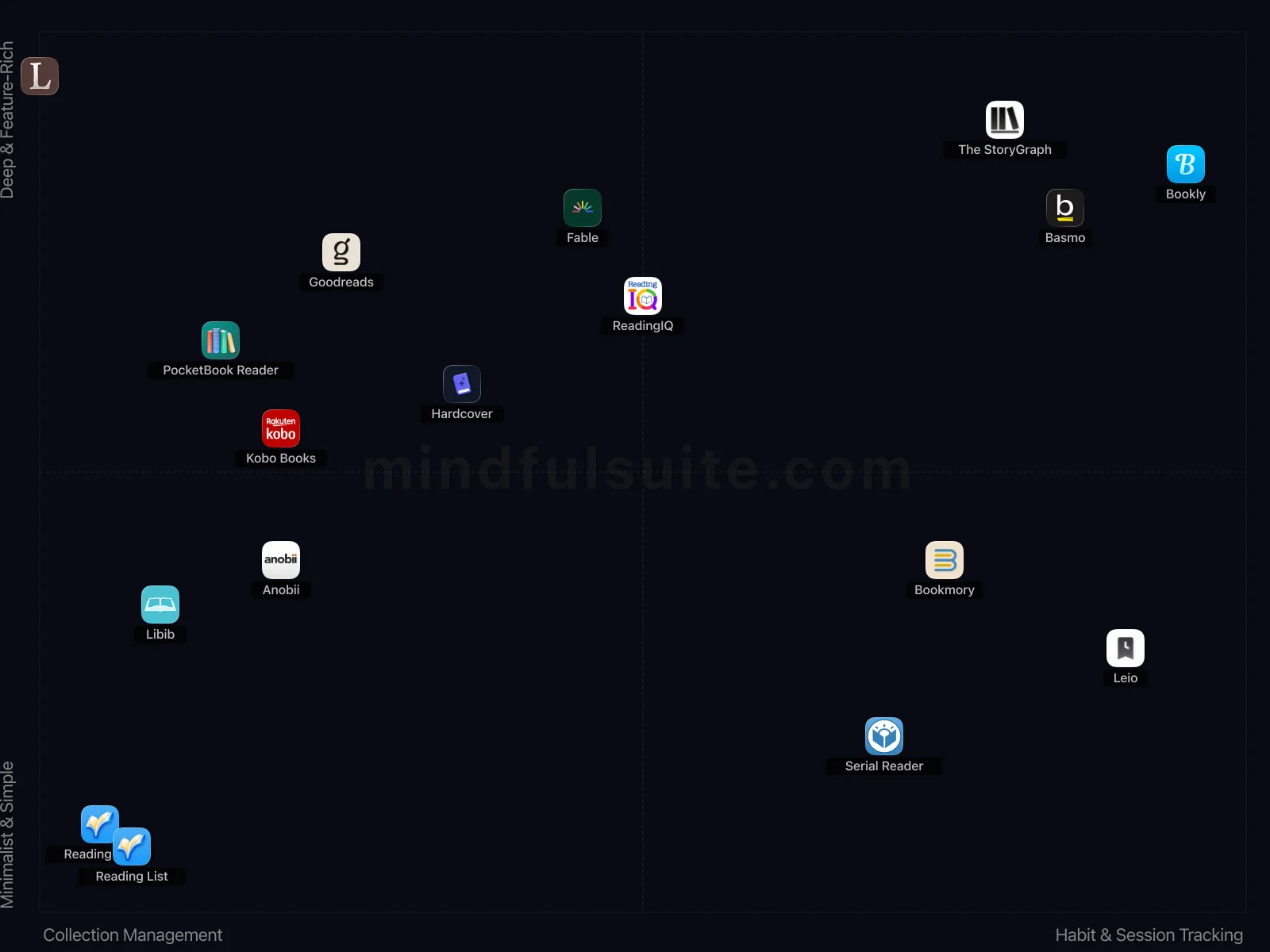
These 17 apps don't all solve the same problem. They cluster into 4 distinct groups, each built around a different philosophy. Understanding which group fits you is the fastest way to narrow your search.
Collection Management + Deep & Feature-Rich
6 apps in this group, led by  Kobo Books,
  Goodreads, and
  Fable.
What defines this cluster: free, e-reader app, large bookstore, customizable reading.
Fable.
What defines this cluster: free, e-reader app, large bookstore, customizable reading.
Habit & Session Tracking + Deep & Feature-Rich
4 apps in this group, led by  Bookly,
  ReadingIQ, and
  Basmo.
What defines this cluster: real-time reading tracking, personalized stats and reports, free with iap, digital library for kids.
Basmo.
What defines this cluster: real-time reading tracking, personalized stats and reports, free with iap, digital library for kids.
Collection Management + Minimalist & Simple
4 apps in this group, led by  Reading List,
  Libib, and Reading List.
What defines this cluster: track reading list, discover new books, simple and beautiful app, free with in-app purchases.
Libib, and Reading List.
What defines this cluster: track reading list, discover new books, simple and beautiful app, free with in-app purchases.
Habit & Session Tracking + Minimalist & Simple
3 apps in this group, led by  Bookmory,
  Leio, and
  Serial Reader.
What defines this cluster: track your reading, manage your books, insightful stats, note-taking.
Serial Reader.
What defines this cluster: track your reading, manage your books, insightful stats, note-taking.
What makes them different
The core tension in this category runs along two axes. On one side, Collection Management apps prioritize simplicity and speed — you can be up and running in under a minute. On the other, Habit & Session Tracking apps offer depth and customization that rewards investment over time.
The second axis — App Complexity — captures an equally important difference. Apps closer to Minimalist & Simple take a fundamentally different approach than those near Deep & Feature-Rich. Neither is objectively better. The right choice depends on your personality, your experience level, and what you're trying to accomplish.
17 Apps Reviewed
We scored every app using a weighted composite of real App Store and Google Play ratings. Out of 17 apps: 7 Essential · 3 Hidden Gems · 1 Mainstream. 12 cross-platform, 3 iOS-only, 2 Android-only.
Top picks: Goodreads and Bookly scored highest overall. Bookmory rounds out the top three. Switch to the Apps tab for the full list with ratings and download links.
How to Pick the Right One
Look at the cluster section above. If you already know whether you want Collection Management or Habit & Session Tracking, that eliminates half the options instantly. Same for Minimalist & Simple vs Deep & Feature-Rich.
Try one app for a full week before judging. Most reading tracker apps reveal their value around day 5, not day 1.
Quick start: Goodreads and Bookly represent two different approaches and both scored highest. Pick whichever resonates, switch if it doesn't click.
Making It Stick: Practical Advice
Downloading the app is the easy part. The hard part — the part that actually produces results — is what happens in weeks two, three, and beyond. These tips are drawn from behavioral research and from patterns we've observed across hundreds of thousands of user reviews. They're not revolutionary, but they work:
Set a daily minimum, not a daily target
"Read for at least 10 minutes" is more sustainable than "read 30 pages daily." A minimum ensures you read every day, and most days you'll exceed it.
Track reading time, not just books finished
Counting only finished books can discourage you from starting longer books. Tracking time invested gives credit for the reading you're actually doing.
Frequently Asked Questions
These are the questions that come up most often — from our own testing, from user reviews, and from the broader conversation around reading tracker apps. If your question isn't here, the Apps tab has detailed information on every app we reviewed.
How many books should I aim to read per year?
Any number more than zero is progress. 12 books a year (one per month) is a common and achievable starting goal. But don't let arbitrary targets discourage you — consistent daily reading matters more than annual book counts.
Does audiobook listening count as reading?
Absolutely. Comprehension and retention from audiobooks is comparable to traditional reading. Most reading tracker apps support logging audiobooks alongside physical and e-books.
Level Up Your Literary Life: The Best Reading Tracker Apps for Every Type of Reader (2026)
Remember that teetering "to-be-read" pile by your bedside, threatening to become a permanent piece of furniture? Or the frantic search through your camera roll for a screenshot of a book cover a friend recommended months ago? Our reading lives have always been a beautifully chaotic affair, managed with dog-eared notebooks, hopeful memory, and the occasional well-placed bookmark.
But what if you could have a personal librarian, a data-savvy stats guru, and a cozy book club, all living in your pocket? That’s the magic of a great reading tracker app. They transform the delightful mess of our literary habits into a streamlined, insightful, and even more joyful adventure. Get ready to discover your next favorite read, crush your reading goals, and connect with a world of fellow book lovers.
The Social Networks & Community Builders
These apps are the bustling town squares of the book-tracking world. They combine massive digital libraries with vibrant social networks where you can find your people, swap reviews, and snoop on what your friends are reading.

Goodreads
The original and largest social network for readers. As an Amazon company, Goodreads is the default hub for tracking, reviewing, and peeking at what your friends are reading. It houses a colossal database of books and an equally massive community.
- Massive community and extensive user-generated reviews provide diverse book recommendations.
- Excellent for tracking reading progress, setting goals, and managing your "To Be Read" list.

Hardcover
This is a reading tracker app focused on design and community.
- Its sleek, modern interface is refreshingly different from other cluttered reading trackers.
- The integrated community features truly make finding and discussing books a social experience.

Anobii
A social reading platform where users can catalog their books, follow other readers, and share their literary interests.
- Its strong international community provides diverse reading recommendations and cultural insights.
- The ability to catalog books and see friends' shelves offers a classic social library experience.

The StoryGraph
A modern, independent, and beautifully designed alternative to Goodreads that has quickly won the hearts of many readers. The StoryGraph's superpower is its incredibly detailed statistics that break down your reading habits by mood, pace, genre, page count, and more.
- Offers incredibly detailed reading statistics and charts, surpassing Goodreads' basic tracking.
- Unique "mood-based" recommendation system provides genuinely personalized book suggestions.
The Habit Builders: Stats & Goal Tracking
If your main mission is to read more consistently and understand your own patterns, these data-driven apps act like personal trainers for your brain. They use timers, streaks, and gorgeous charts to keep you turning pages.

Basmo
Basmo is another excellent habit-focused app that blends goal setting with powerful note-taking features. It’s designed not just to help you read more, but to help you *remember* more of what you read.
- Unique AI ChatBook Assistant feature offers interactive summaries and character analysis.
- Excellent for taking detailed notes and capturing memorable quotes directly within reading sessions.

Leio
Leio is a reading tracker that helps you log reading sessions, set goals, and view stats about your reading habits.
- Focuses purely on personal reading tracking with clean design and clear statistical breakdowns.
- Provides useful goal-setting tools and progress visualizations to encourage consistent reading.

Bookly
Think of Bookly as a fitness tracker for your reading life. It gamifies your habits by encouraging you to start a timer every time you pick up a book, gathering data to generate detailed reports, cool infographics, and surprisingly accurate estimates on how long it'll take you to finish.
- Real-time reading timer and detailed session tracking provide excellent insights into reading habits.
- Offers robust, personalized statistics and progress reports to motivate reading goals.

Bookmory
Bookmory allows you to track your reading progress, manage your books, and take notes. It is ideal for building a lasting reading habit with insightful stats.
- Clean, aesthetically pleasing interface makes tracking and managing books a joy.
- Offers a good balance of reading statistics and note-taking features for free users.
The Minimalist Organizers
Sometimes you just want a clean digital replacement for your notebook without the social pressure or the gamified charts. These simple, elegant lists do the trick beautifully.

Reading List
A simple app for book lovers to track their reading list and discover new books to read.
- Extremely clean and minimalist design focuses purely on managing your TBR and read lists.
- Offers a visually appealing way to organize books with custom lists and covers.
Reading List
This reading tracker helps users organize, track, and enjoy their reading journey with ease.
The All-in-One Ecosystems
Chances are, the platforms you already use to buy and read e-books have some impressive tracking features hiding in plain sight. These let you read and log in the exact same place.

Kobo Books
An e-reader with a built-in bookstore that lets users customize their reading experience and organize their digital libraries.
- Highly customizable reading experience with extensive font, margin, and line spacing options.
- Seamlessly integrates with Pocket, allowing you to read saved web articles alongside your ebooks.

PocketBook Reader
This e-reader app supports numerous formats and includes library management features.
- Its robust support for a huge array of ebook formats, including PDF and EPUB, is outstanding.
- Integrated library management features allow users to organize their digital collection efficiently.
The Heavy-Duty Catalogers
For the hardcore collectors with overflowing physical shelves. If your goal is scanning barcodes and managing a massive physical library like a true archivist, these are your power tools.

Libib
A library management app used for cataloging personal collections of books, movies, music, and video games.
- Managing multiple media types—books, movies, music, games—in one catalog is incredibly convenient.
- The barcode scanning for quick item entry simplifies the often tedious cataloging process.

LibraryThing
This app helps catalog your books and connects you with a community of other book lovers.
- The extensive community and detailed cataloging options are unparalleled for serious collectors.
- Its ability to import ISBNs and utilize various data sources makes large library organization efficient.
Niche Apps for Specific Needs
Sometimes you need an app that does one specific thing exceptionally well. Whether you're coordinating a digital book club, managing your child's literacy journey, or finally tackling Tolstoy, these specialists have you covered.

Fable
Fable is built entirely around the joy of social reading and digital book clubs. Here, you can join clubs hosted by authors, experts, and creators, or easily start your own with friends. The app is designed for shared reading schedules, lively discussions, and highlighting passages together.
- The "Fables" feature allows seamless, interactive book club experiences directly within the app.
- Its emphasis on communal reading truly differentiates it in a saturated tracking market.

ReadingIQ
It provides a digital library for kids aged 2-12, featuring thousands of books and reading progress tracking.
- Offers a massive, curated digital library specifically designed for children aged 2-12.
- Integrated reading levels and progress tracking help parents monitor their child's literacy development.

Serial Reader
Have you always wanted to tackle the great classics but felt intimidated by their size? Serial Reader has a brilliant solution. It breaks down massive novels like *War and Peace* or *Moby Dick* into small, manageable chunks delivered to you daily. You can conquer a classic in just 15-20 minutes a day.
- Breaks down daunting classic literature into manageable daily chunks, making them highly accessible.
- The unique delivery method encourages consistent engagement with challenging, longer works.
Which App Should You Choose?
Finding the right reading tracker is deeply personal. If you thrive on community and seeing what your friends are reading, lean into the social platforms. If you're highly motivated by streaks and data, a habit-building app will be your best friend. And if you just want to organize a massive physical collection, a dedicated cataloger is the way to go.
No matter which you choose, the goal is exactly the same: to make your reading life richer, easier, and a lot more fun. Happy reading!