
Motivational Quotes Apps: What You Need to Know in 2026
A well-timed quote can shift your entire perspective. Not because the words are magic, but because they articulate something you already felt but couldn't express — and that articulation gives you permission to believe it. Motivational quotes apps deliver that small daily spark of clarity.
We evaluated 20 motivational quotes apps across iOS and Android, scoring each on real user ratings, feature depth, and long-term value. This guide covers what we found.
Can Words Actually Change Behavior?
In the mid-1990s, psychologist John Bargh conducted an experiment that became one of the most cited — and debated — in social psychology. Subjects who unscrambled sentences containing words associated with old age subsequently walked more slowly down the hallway. The finding pointed to something called priming: exposure to certain words activates related concepts, attitudes, and even behaviors in ways we don't consciously register.
The implications for motivational quotes are provocative but require nuance. Priming effects, when they replicate, tend to be subtle and highly context-dependent. A quote about perseverance won't turn a quitter into a marathoner. What it can do is shift attention. When you read "the obstacle is the way" before tackling a difficult project, you haven't gained new information. You've redirected existing mental energy toward a frame that serves you better than the default frame, which is usually some version of "this is hard and I don't want to do it."
This is the honest mechanism behind motivational quotes: they function as attention directors, not motivation generators. They can't create drive that doesn't exist. But they can surface drive that's buried under fatigue, distraction, or self-doubt. The difference between a quote that makes you nod and one that makes you act usually comes down to relevance and timing. A quote about courage means nothing on a Tuesday when everything's fine. It means everything on a Wednesday morning when you're about to have a conversation you've been avoiding for three weeks.
The best quote apps understand this distinction implicitly. They don't just blast inspiration — they curate and time it. The mechanism isn't magic. It's attention, redirected at a moment when redirection matters.
The Micro-Intervention Effect: Why Timing Matters More Than the Quote
A quote delivered at 7 AM, just before you walk into a day you're dreading, hits differently than the same quote scrolled past at midnight while you're half-asleep on the couch. The words are identical. The impact isn't even close. This is the logic behind what positive psychology researchers call micro-interventions — brief, targeted psychological nudges delivered at moments of maximum receptivity.
The concept has roots in clinical work. Therapists have long known that a well-timed question can do more in five seconds than an hour of general discussion. The same principle scales down to a single sentence on your phone screen. One well-timed quote arriving during the transition between dropping your kids off and walking into a stressful office, or in the pause between finishing lunch and starting an afternoon of meetings, can reframe the next several hours. Not because the words are profound, but because they arrive at a decision point — a moment when your mind is choosing its orientation.
The best motivational quote apps have figured this out, even if they don't use the clinical language. They let you schedule delivery around your stress points: morning alarms, midday dips, pre-meeting jitters, the evening wind-down when self-doubt tends to creep in. This is meaningfully different from a passive library you browse when you're already feeling fine. The passive approach is entertainment. The timed approach is intervention.
Context is everything. A quote about patience is useless when you're already calm and devastating when you're about to send an email you'll regret. The apps that understand timing — that treat delivery as part of the design, not an afterthought — are the ones that actually change how your day unfolds. One sentence, at the right moment, aimed at the right vulnerability.
Beyond Passive Reading: Using Quotes as a Thinking Tool
Most people consume quotes the way they consume social media: read, nod, scroll. There's a small hit of recognition — yes, that's true — followed by nothing. The quote dissolves into the stream of content. This is the passive mode, and it's almost entirely useless for behavioral change. You might as well read a fortune cookie.
The practice becomes genuinely powerful when you shift from consumption to engagement. This means treating quotes not as finished thoughts to admire but as starting points for your own thinking. The simplest version: when a quote resonates, stop and ask yourself why. What specific situation in your life does it speak to? What would change if you actually applied it today — not abstractly, but concretely?
Journaling practitioners have known this for decades. A single quote used as a writing prompt can generate twenty minutes of self-examination that you never would have initiated on your own. "We suffer more in imagination than in reality" is a nice Seneca line to read. It becomes a different animal entirely when you sit with it and write down the three things you're currently suffering about in imagination — and then honestly assess how many of them are actually happening.
Quotes also function as decision frameworks. Facing a choice? Pick the quote that's been rattling around your head and use it as a lens. "What would 'done is better than perfect' mean for this project?" "If 'the obstacle is the way,' what does that suggest about the problem I'm avoiding?" This isn't inspirational fluff. It's applied philosophy — and it works because it forces specificity. The shift from passive reading to active reflection is where all the value lives. The quote is the match. Your thinking is the fire. Without the second step, you're just collecting matches.
4 Types of Motivational Quotes Apps — and How They Differ
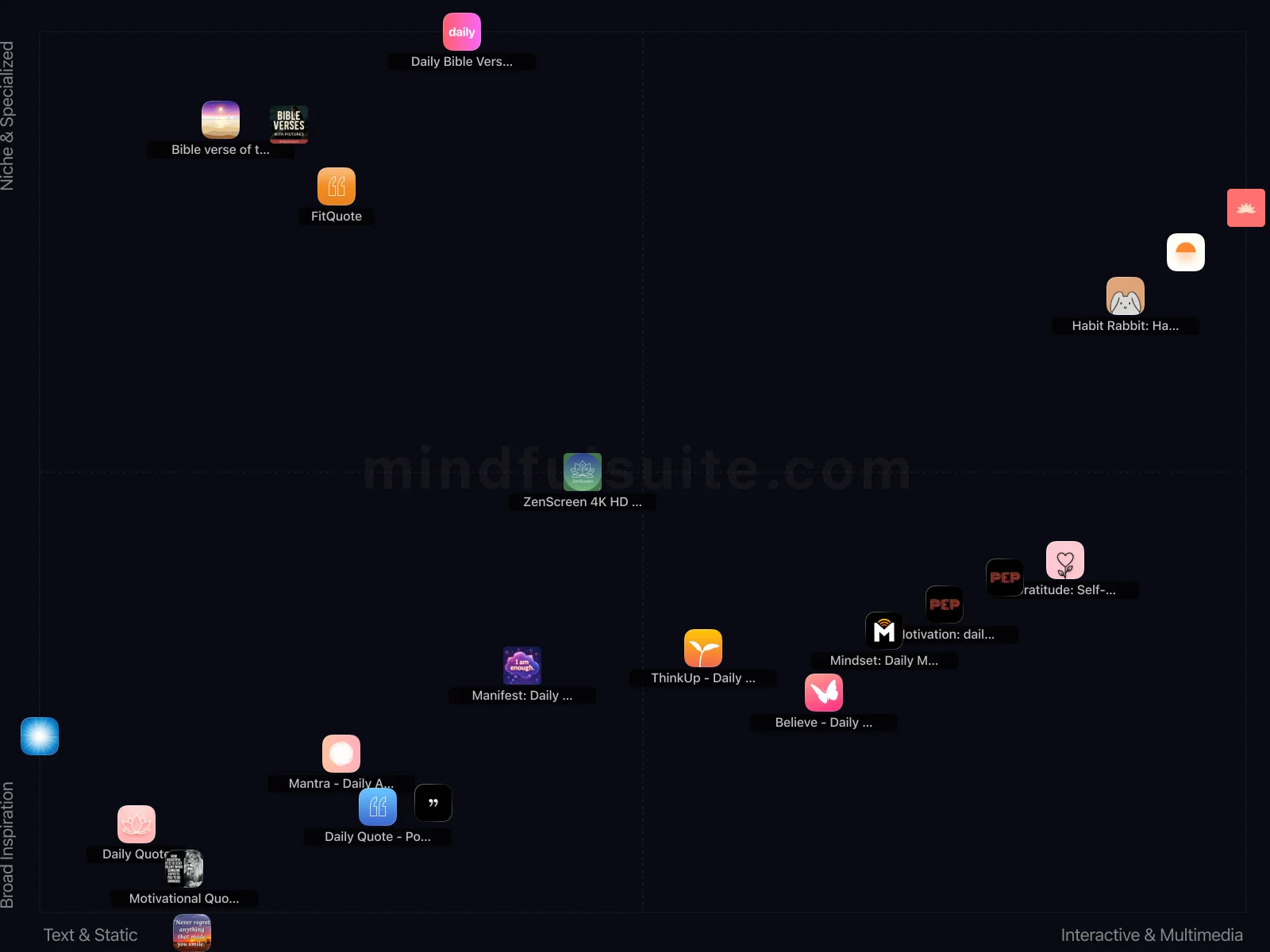
These 20 apps don't all solve the same problem. They cluster into 4 distinct groups, each built around a different philosophy. Understanding which group fits you is the fastest way to narrow your search.
Text & Static + Niche & Specialized
4 apps in this group, led by  Bible verse of the day,
  Daily Bible Verses, and
  FitQuote.
What defines this cluster: daily inspiring bible verse.
FitQuote.
What defines this cluster: daily inspiring bible verse.
Interactive & Multimedia + Niche & Specialized
2 apps in this group, led by  Mindful : Focus & Screen Time and
  Habit Rabbit: Habit Tracker.
What defines this cluster: simple, effective affirmations, uplifting daily messages, free with in-app purchases, habit tracker.
Habit Rabbit: Habit Tracker.
What defines this cluster: simple, effective affirmations, uplifting daily messages, free with in-app purchases, habit tracker.
Text & Static + Broad Inspiration
8 apps in this group, led by  Motivational Quotes Daily+,
  Unique Daily Affirmations, and
  Mantra - Daily Affirmations.
What defines this cluster: free with iap, motivational quotes, anxiety relief, self-improvement guide.
Mantra - Daily Affirmations.
What defines this cluster: free with iap, motivational quotes, anxiety relief, self-improvement guide.
Interactive & Multimedia + Broad Inspiration
6 apps in this group, led by  Motivation: daily Peptalk,
  Gratitude: Self-Care Journal, and
  ThinkUp - Daily Affirmations.
What defines this cluster: free with iap, motivational videos, motivational audio, daily quotes.
ThinkUp - Daily Affirmations.
What defines this cluster: free with iap, motivational videos, motivational audio, daily quotes.
What makes them different
The core tension in this category runs along two axes. On one side, Text & Static apps prioritize simplicity and speed — you can be up and running in under a minute. On the other, Interactive & Multimedia apps offer depth and customization that rewards investment over time.
The second axis — Focus Area — captures an equally important difference. Apps closer to Broad Inspiration take a fundamentally different approach than those near Niche & Specialized. Neither is objectively better. The right choice depends on your personality, your experience level, and what you're trying to accomplish.
20 Apps Reviewed
We scored every app using a weighted composite of real App Store and Google Play ratings. Out of 20 apps: 9 Essential · 11 Hidden Gems. 8 cross-platform, 8 iOS-only, 4 Android-only.
Top picks: Motivational Quotes Daily+ and  Motivation - Daily quotes scored highest overall. Unique Daily Affirmations rounds out the top three. Switch to the Apps tab for the full list with ratings and download links.
How to Pick the Right One
Look at the cluster section above. If you already know whether you want Text & Static or Interactive & Multimedia, that eliminates half the options instantly. Same for Broad Inspiration vs Niche & Specialized.
Try one app for a full week before judging. Most motivational quotes apps reveal their value around day 5, not day 1.
Quick start: Motivational Quotes Daily+ and Motivation - Daily quotes represent two different approaches and both scored highest. Pick whichever resonates, switch if it doesn't click.
Making It Stick: Practical Advice
Downloading the app is the easy part. The hard part — the part that actually produces results — is what happens in weeks two, three, and beyond. These tips are drawn from behavioral research and from patterns we've observed across hundreds of thousands of user reviews. They're not revolutionary, but they work:
Don't just read — reflect
When a quote resonates, pause and ask yourself why. The reflection is where the real insight happens, not the reading.
Set delivery for transition moments
Schedule quote notifications for times when you need them most: before starting work, during the post-lunch slump, or before bed.
Frequently Asked Questions
These are the questions that come up most often — from our own testing, from user reviews, and from the broader conversation around motivational quotes apps. If your question isn't here, the Apps tab has detailed information on every app we reviewed.
Can reading quotes actually improve my mindset?
Regular exposure to perspectives that align with your values can reinforce positive thought patterns. Quotes work best as part of a broader practice (journaling, affirmations, goal-setting) rather than as a standalone tool.
Unleash Your Potential with the Best Motivational Apps (2026)
Remember that crumpled sticky note on your monitor with a half-faded motivational quote? Or that burst of inspiration you had in the shower, only to forget it by the time you found a pen? We've all been there. Motivation can feel like a slippery thing—easy to find but incredibly hard to hold onto when a stressful Tuesday afternoon rolls around.
But what if you had a personal cheerleader, a wise mentor, and a source of boundless positivity living right in your pocket? That’s the magic of motivational apps. They transform your phone from a source of endless doomscrolling into a dedicated tool for inspiration. They're ready to deliver the perfect boost exactly when you need it, whether you're facing a tough workout, a creative block, or just the Monday morning blues.
Let's explore the best digital companions out there, ready to help you build a better mindset, one notification at a time.
Apps for Quick Inspiration
These apps are perfect for when you need a fast, powerful dose of positivity. Think of them as a shot of espresso for your soul, delivering daily quotes, visual affirmations, and gentle reminders to reframe your thinking in an instant.

Motivational Quotes Daily+
Provides daily motivational quotes and pep talks to help with stress and anxiety relief. It's for those looking for daily self-improvement and self-care guidance.
- Provides a constant stream of uplifting quotes, offering quick motivational boosts to maintain goal focus and resilience.
- Curated categories and daily reminders effectively inject positive reinforcement into your routine for consistent inspiration.

Daily Quote - Positive quotes
For those who believe a picture is worth a thousand words, Daily Quote pairs powerful inspiration with stunning visuals. The app offers a vast collection of curated quotes set against beautiful, high-quality background images, making each message a mini work of art.
- The "beautiful background imagery" truly elevates the visual experience of receiving daily inspirational quotes.
- Its focus on thoughtfully curated quotes ensures high-quality, impactful content over sheer volume.

Motivation - Daily quotes
This app is a titan in the motivation space for a reason. It's a straightforward and powerful engine for inspiration, delivering quotes and reminders on a huge range of topics to help you sprinkle positivity throughout your day.
- The customizable widgets deliver impactful quotes directly to your home screen, making daily inspiration effortless.
- You can browse quotes by specific categories like "self-esteem" or "relationships," ensuring relevant content.

Daily Affirmations & Quotes
Offers a large collection of over 10,000 quotes across 50+ categories for users seeking daily affirmations and inspiration.
- An enormous library of over 10,000 quotes provides endless inspiration and positive reinforcement on demand.
- The ability to easily share quotes across various platforms makes spreading positivity incredibly simple.

Unique Daily Affirmations
True to its name, this app embraces a "less is more" philosophy. It delivers a single, unique affirmation each day, helping you focus your energy on one positive thought without feeling overwhelmed. It's the perfect choice for anyone looking to build a simple, consistent habit without any bells or whistles.
- Its focus on a single, unique daily affirmation prevents overwhelm and encourages deeper reflection.
- The straightforward, minimalist design makes accessing your daily positive thought incredibly simple.

Believe - Daily Affirmations
Believe wants you to do more than just read—it wants you to interact. The app offers a large library of affirmations and includes engaging tools like an "affirmation mirror," which uses your phone's camera to make the practice more personal. It’s designed to help you actively challenge negative thoughts and reframe them in a positive light.
- Offers a massive collection of affirmations across diverse categories, catering to almost any need.
- The integrated "Affirmation Mirror" provides an engaging, personalized way to internalize positive statements.

Mantra - Daily Affirmations
Mantra is all about the aesthetic. This beautifully designed app focuses on delivering daily positive statements with a calm, clean, and visually pleasing interface. If you believe the experience of reading an affirmation should be as peaceful as the message itself, Mantra is your digital zen garden.
- The simple, elegant interface makes selecting and receiving daily affirmations incredibly straightforward and visually appealing.
- Its focus on core areas like self-love and confidence provides targeted motivation without overwhelming complexity.

ThinkUp - Daily Affirmations
A health and fitness app that uses positive affirmations to build motivation. It helps users develop a positive mindset.

FitQuote
Just as the name suggests, FitQuote is your no-nonsense workout buddy. It’s laser-focused on fitness motivation, delivering a fresh, inspirational quote each day to get you off the couch and into your sneakers.
- Its niche focus on "fitness motivation" provides highly relevant and targeted inspiration for workout enthusiasts.
- The clean, focused interface quickly delivers impactful quotes without unnecessary distractions.

Manifest: Daily Affirmations
Provides positive daily affirmations to instill positive thinking and self-worth.

Daily Quote
Provides a daily motivational quote as a mental stimulant to inspire and promote personal growth, displayed as a widget.
Apps for Your Ears
Sometimes, you need to hear it to believe it. These apps deliver motivation through audio and video, from epic speeches that give you goosebumps to guided pep talks that re-energize your perspective. They're perfect for your commute, your morning run, or whenever you need a literal voice to guide you.

Peptalk: Daily Motivation
Peptalk is your pocket-sized coach, combining videos, audios, and quotes to give you a multimedia boost. It’s a powerhouse of inspiration designed to give you the exact push you need, whether through a rousing speech or a thought-provoking clip.
- The blend of daily motivational videos, audios, and quotes offers a richer, more dynamic experience.
- The "Goals" feature allows you to personalize content around specific aspirations, making motivation highly relevant.

Mindset: Daily Motivation
Mindset serves up motivation from the greats. It offers an incredible library of speeches and audio clips from some of the world's most successful and inspiring figures. It’s designed to give you a powerful, thought-provoking start to your day.
- The core strength is its curated library of motivational speeches from well-known public figures, providing substantial content.
- Its focus on audio content makes it perfect for listening during commutes or morning routines without screen time.

Motivation: daily Peptalk
Provides motivational videos, audio, and quotes to help users stay focused and productive. It is for people who need a boost of motivation to perform at their best.
- Incorporates "Videos, audio, quotes & widget," offering a versatile multimedia approach to daily motivation.
- Functions as a "pocket-sized motivational companion," providing quick, accessible boosts whenever needed.
Apps for Building Better Habits
Inspiration is great, but action is where the real magic happens. These apps go beyond passive motivation, giving you the practical tools, gamified tracking, and daily structure required to actually build life-changing habits.

Habit Rabbit: Habit Tracker
It's a habit tracker where a virtual pet motivates you to stick to your routines.
- The "productivity pet" gamification element uniquely motivates users, making habit tracking feel less like a chore and more engaging.
- Its focus on a positive, encouraging interface distinguishes it from generic, data-heavy habit trackers, appealing to a different user base.

Mindful : Focus & Screen Time
Sends daily mindfulness affirmations as notifications to promote positivity. It's for anyone seeking simple, uplifting reminders throughout the day.
Faith-Based Inspiration
For many, true motivation and grounding come from spiritual roots. These apps combine daily scripture with community support, offering a quiet moment of reflection to center yourself before tackling the day.

Daily Bible Verse & Motivation
This app delivers daily Bible verses and fosters a supportive community for users seeking daily faith and prayer inspiration.
- Combines "God’s Word" with a "Supportive Community," fostering spiritual connection beyond solitary reflection.
- "Daily Faith Prayer Inspiration" provides structured religious content for consistent engagement.


Bible verse of the day
Delivers an inspiring Bible verse each day. This app is designed for anyone seeking daily spiritual reflection.
Apps for All-Around Wellness
True motivation rarely survives burnout. These apps understand that sustained drive comes from a place of holistic balance, offering tools for journaling, self-care, and daily gratitude to help you build a resilient foundation for your life.

Gratitude: Self-Care Journal
This app is more than just a journal; it's a complete wellness toolkit. It wraps your gratitude practice in a warm hug of self-care, offering daily affirmations, a vision board for your dreams, and thought-provoking prompts to guide you.
- The combination of daily gratitude prompts, affirmations, and a vision board within one app offers a holistic manifestation approach.
- The "Gratitude Wall" feature, showcasing shared positive entries, provides a unique sense of community and inspiration.