
Relationship Tracker Apps: What You Need to Know in 2026
When was the last time you had a meaningful conversation with your closest friend? Called your parents? Planned a real date night? Relationships are the single biggest predictor of life satisfaction, yet they're the first thing we neglect when life gets busy. Relationship tracker apps gently ensure that your most important connections don't slowly fade through inattention.
We evaluated 22 relationship tracker apps across iOS and Android, scoring each on real user ratings, feature depth, and long-term value. This guide covers what we found.
Dunbar's Numbers: The Science of How Many Relationships You Can Actually Maintain
Robin Dunbar, an evolutionary psychologist at Oxford, spent decades studying the relationship between primate brain size and social group size. His finding — now known as Dunbar's number — is that the human neocortex can support approximately 150 stable social relationships. But the number 150 is just the outer ring. The more practically useful finding is the layered structure underneath it.
Dunbar identified concentric circles of social connection, each with a characteristic size that appears remarkably consistent across cultures, historical periods, and communication technologies. The innermost circle — your support group, the people you would turn to in a genuine crisis — contains roughly 5 people. The next layer, close friends you see regularly and confide in, holds about 15. Casual friends — people you enjoy spending time with but don't share deep emotional bonds with — number around 50. And the full circle of meaningful acquaintances, people whose names and faces you know and whose company you recognize, reaches about 150.
These numbers are not arbitrary targets. They reflect cognitive limits on social bandwidth — the mental capacity required to track each person's history, personality, current circumstances, and your relationship dynamics with them. Maintaining a close friendship requires knowing what someone is going through, remembering what they told you last time, understanding their communication preferences, and investing regular emotional energy. There is a ceiling on how many people you can do this for simultaneously, and no amount of social media connections changes that ceiling.
This is where relationship tracker apps provide genuine value. They don't expand your cognitive capacity for relationships — nothing can. But they offload the logistical burden. Remembering that your friend Sarah mentioned a job interview last month, that your brother's anniversary is next week, that you haven't called your college roommate in three months — these are memory tasks, not emotional tasks. An app can handle the memory, freeing your cognitive resources for the emotional engagement that actually sustains relationships.
The strategic insight from Dunbar's research is this: be intentional about which 5 people get your deepest attention. Most people spread their social energy reactively — responding to whoever texts, whoever posts, whoever happens to be around. Relationship trackers let you be proactive, ensuring that the people who matter most to your wellbeing receive consistent, deliberate attention rather than whatever is left over after the squeaky wheels have been greased.
The Relationship Maintenance Problem: Why Good Intentions Aren't Enough
Relationships do not typically end in explosions. They end in silence. The friend you meant to call last week, then forgot. The cousin you haven't spoken to since the holidays. The college roommate who slowly faded from a weekly text to a monthly like on Instagram to an annual birthday message to nothing at all. No fight. No falling out. Just the quiet accumulation of days without contact until the gap becomes too wide to bridge casually.
This is the relationship maintenance problem, and it is fundamentally a systems failure, not a caring failure. The people whose friendships fade don't stop caring about their friends. They stop having a system that translates caring into action. Good intentions live in the mind. Relationships live in the world, sustained by phone calls placed, messages sent, plans made, and time spent. Without a mechanism that converts the intention to reach out into the act of reaching out, even the most valued relationships degrade.
The business world solved this problem decades ago with CRM software — Customer Relationship Management tools that track every interaction with every client, schedule follow-ups, and flag accounts that haven't received attention. The suggestion that personal relationships deserve the same systematic attention strikes many people as cold, clinical, even dehumanizing. But consider the alternative: letting the relationships that matter most to your happiness and health erode through sheer organizational failure.
Setting a reminder to call your closest ten people every two weeks sounds mechanical. It is mechanical. But the conversations that result from those reminders are not mechanical at all. You call, you ask how they're doing, you listen, you share something about your own life, you laugh, you make a plan to see each other. The reminder triggered the call. The call produced a genuine human connection that would not have happened otherwise, because you were busy and they were busy and no one was going to pick up the phone unprompted.
Relationship tracker apps formalize this insight. They let you set contact cadences for different people — weekly for your partner's parents, biweekly for close friends, monthly for extended family. They flag when someone is overdue. They store notes about what you discussed so you can follow up naturally next time. The mechanical system produces organic outcomes. And it does so far more reliably than the intention to "keep in touch" that lives, unfulfilled, in the back of everyone's mind.
Couples Apps: What Partners Can Track Together (Without It Getting Weird)
The couples app market occupies an awkward space between genuinely useful and uncomfortably surveillance-adjacent. The line between "tracking our relationship for mutual benefit" and "monitoring my partner's behavior" is not always clear, and apps that fail to navigate it carefully can introduce more tension than they resolve.
What works: shared gratitude logs. Both partners log one thing they appreciated about the other person that day. This sounds small, but the research on gratitude in relationships is substantial — couples who regularly express appreciation show higher relationship satisfaction, better conflict resolution, and greater long-term stability. The app provides a low-friction format for a practice that most couples agree is valuable but rarely sustain without structure.
Date night scheduling works because it solves a concrete logistical problem. Couples who have been together for years often stop dating each other — not because they don't want to, but because the planning friction increases as life gets busier. An app that suggests activities, tracks preferences, and puts date nights on the calendar addresses the planning barrier without making the experience feel forced.
Love language tracking — logging which types of affection and appreciation each partner responds to most — provides practical insight that reduces the common pattern of giving love in the way you prefer to receive it rather than the way your partner actually needs it. It translates Gary Chapman's framework from abstract understanding into specific, actionable behavior.
What gets weird: anything that tracks deficits rather than positives. An app that counts complaints, logs arguments, or scores household contributions creates a transactional frame that is toxic to intimacy. Relationships are not balance sheets. The moment one partner opens the app to prove that they did the dishes four more times this month, the app has become a weapon rather than a tool.
The most successful couples apps focus exclusively on positive reinforcement. They ask: what went well today? What did your partner do that you valued? What are you looking forward to doing together? They create a shared record of good moments that both partners can revisit during difficult times. And they work best — this point cannot be overstated — when both partners opt in voluntarily. An app that one partner downloads and the other resents is a relationship stressor disguised as a relationship tool.
4 Types of Relationship Tracker Apps — and How They Differ
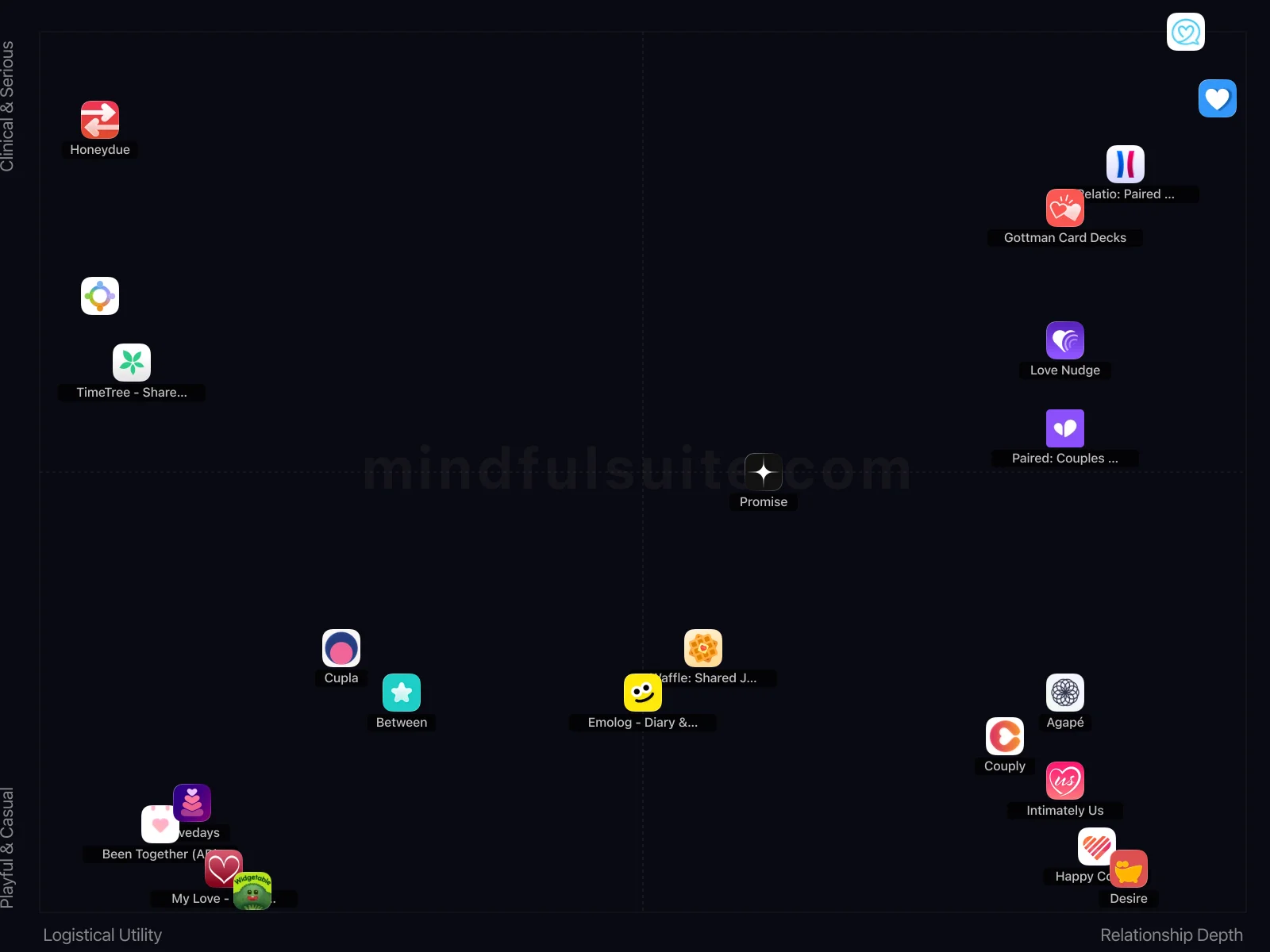
These 22 apps don't all solve the same problem. They cluster into 4 distinct groups, each built around a different philosophy. Understanding which group fits you is the fastest way to narrow your search.
Logistical Utility + Clinical & Serious
3 apps in this group, led by  Shared Family Calendar: FamCal,
  TimeTree - Shared Calendar, and
  Honeydue.
What defines this cluster: shared calendar, family organization, free with iap, shared calendars.
Honeydue.
What defines this cluster: shared calendar, family organization, free with iap, shared calendars.
Relationship Depth + Clinical & Serious
6 apps in this group, led by  Love Nudge,
  Paired: Couples & Relationship, and
  Lasting: Marriage & Couples.
What defines this cluster: based on love languages, set relationship goals, send affection "nudges", free (iap).
Lasting: Marriage & Couples.
What defines this cluster: based on love languages, set relationship goals, send affection "nudges", free (iap).
Logistical Utility + Playful & Casual
6 apps in this group, led by  My Love - Relationship Counter,
  Widgetable: Besties & Couples, and
  Lovedays.
What defines this cluster: relationship counter, free with iap, interactive sharing widgets, customizable lock/home screens.
Lovedays.
What defines this cluster: relationship counter, free with iap, interactive sharing widgets, customizable lock/home screens.
Relationship Depth + Playful & Casual
7 apps in this group, led by  Agapé,
  Desire, and
  Intimately Us.
What defines this cluster: free with iap, relationship wellness, meaningful conversations, daily questions.
Intimately Us.
What defines this cluster: free with iap, relationship wellness, meaningful conversations, daily questions.
What makes them different
The core tension in this category runs along two axes. On one side, Logistical Utility apps prioritize simplicity and speed — you can be up and running in under a minute. On the other, Relationship Depth apps offer depth and customization that rewards investment over time.
The second axis — Tone & Approach — captures an equally important difference. Apps closer to Playful & Casual take a fundamentally different approach than those near Clinical & Serious. Neither is objectively better. The right choice depends on your personality, your experience level, and what you're trying to accomplish.
22 Apps Reviewed
We scored every app using a weighted composite of real App Store and Google Play ratings. Out of 22 apps: 10 Essential · 10 Hidden Gems · 2 Mainstream. 18 cross-platform, 2 iOS-only, 2 Android-only.
Top picks: Agapé and Love Nudge scored highest overall.  ReGain - Couples Therapy rounds out the top three. Switch to the Apps tab for the full list with ratings and download links.
How to Pick the Right One
Look at the cluster section above. If you already know whether you want Logistical Utility or Relationship Depth, that eliminates half the options instantly. Same for Playful & Casual vs Clinical & Serious.
Try one app for a full week before judging. Most relationship tracker apps reveal their value around day 5, not day 1.
Quick start: Agapé and Love Nudge represent two different approaches and both scored highest. Pick whichever resonates, switch if it doesn't click.
Making It Stick: Practical Advice
Downloading the app is the easy part. The hard part — the part that actually produces results — is what happens in weeks two, three, and beyond. These tips are drawn from behavioral research and from patterns we've observed across hundreds of thousands of user reviews. They're not revolutionary, but they work:
Schedule your most important relationships
For your 5-10 closest relationships, set regular check-in reminders. It feels artificial at first, but it ensures the people who matter most don't get lost in the busyness.
Log interactions briefly after they happen
A quick note about what you discussed helps you pick up the thread naturally next time. People are touched when you remember what they shared weeks ago.
Frequently Asked Questions
These are the questions that come up most often — from our own testing, from user reviews, and from the broader conversation around relationship tracker apps. If your question isn't here, the Apps tab has detailed information on every app we reviewed.
Isn't tracking relationships kind of cold?
The alternative — letting important relationships fade because you're too busy to remember — is colder. Relationship tracking isn't about reducing people to data. It's about ensuring the people you care about receive the attention they deserve.
How many relationships should I actively track?
Research suggests we can maintain about 5 intimate relationships, 15 close friendships, and 50 casual friendships simultaneously (Dunbar's number). Focus your tracking on the relationships that matter most to your wellbeing.
The Best Relationship Tracker Apps for 2026
Before smartphones, relationship tracking was just the kitchen fridge door. It was plastered with grocery lists, appointment reminders, and that one funny magnet you bought on your first road trip. Connection happened in the gaps—the shared glance over dinner, the quick phone call during your lunch break.
But sometimes, those gaps widen. The logistics of life crowd out the magic, and suddenly you realize you’ve talked more about the electric bill this week than your actual feelings.
What if you had a dedicated space, right in your pocket, designed to close those gaps? Not to replace the real-world moments, but to nurture them. A digital treehouse where you can whisper a secret, plan a surprise date, or tackle that conversation about finances without the pressure of doing it at the end of a long day. These apps transform the hard work of relationships into a satisfying, daily habit of connection—even when you’re miles apart.
For Deepening Communication & Connection
These apps are designed to open up lines of communication, foster understanding, and provide expert guidance for a healthier relationship. Whether you need a daily conversation starter or structured advice from licensed therapists, these tools help you dig deeper.

Agapé
Agapé is built on the simple but powerful idea that a daily question can spark meaningful conversation and bring you closer. With its clean interface and focus on wellness, it encourages consistent, positive interaction, even when you're apart.
- Daily tailored questions consistently spark meaningful conversations, preventing communication plateaus.
- The app's elegant design makes daily check-ins a simple and pleasant part of a routine.

Love Nudge
Based on Dr. Gary Chapman's bestselling book, "The 5 Love Languages," this app helps you translate theory into action. Love Nudge allows you and your partner to discover and communicate in each other's primary love languages, filling up each other's "love tanks."
- Directly applying The 5 Love Languages framework offers a unique, structured approach to understanding needs.
- The goal-setting feature empowers couples to actively work on specific areas for relationship improvement.

ReGain - Couples Therapy
This app connects couples with licensed therapists specializing in relationship therapy for online counseling.
- Directly connects users with licensed relationship therapists, offering professional support for couples or individuals.
- The flexibility to engage individually or with a partner provides tailored relationship counseling options.

Lasting: Marriage & Couples
Powered by The Knot, Lasting is a marriage counseling app that brings therapist-led sessions right to your phone. It creates a personalized program to help you build a healthier, happier relationship by focusing on core areas like communication, conflict, and appreciation.
- Offers structured, guided sessions based on actual marriage counseling principles for real growth.
- Its specific focus on marriage provides tailored content that is genuinely relevant for long-term commitment.

Relatio: Paired Relationship
Provides expert-backed guidance and practical tools for couples to build deeper connections and improve their emotional health. It's designed to enhance relationship and intimate well-being.
- Exclusively focuses on couples' relationship and intimate well-being, offering tailored, expert-backed guidance uncommon in general therapy apps.
- Provides practical, easy-to-follow tools designed for real-world application, helping couples actively improve their dynamics.

Gottman Card Decks
From the world-renowned Gottman Institute, this app is a digital version of their popular card decks. It provides over 1,000 flashcards with questions, statements, and ideas to improve your relationship, based on decades of research.
- Backed by the reputable Gottman Institute, providing scientifically informed questions for connection.
- The variety of digital card decks ensures a consistent supply of fresh conversation starters and ideas.

Paired: Couples & Relationship
A relationship app that helps couples connect through daily questions, quizzes, and expert guidance.
For Sparking Fun, Quizzes & Date Nights
Keep the magic alive with apps focused on games, adventure, and spicing up your routine. If you're stuck in a Netflix-and-takeout rut, these apps offer a playful nudge to try something new, learn more about each other, and turn romance into a game you both win.

Couply
Couply uses personality quizzes, similar to the Love Languages or Myers-Briggs, to generate custom insights and ideas for your relationship. It provides personalized date ideas, conversation starters, and articles tailored to your specific couple dynamic.
- Personality quizzes genuinely customize date ideas and conversation starters, making interactions more relevant.
- It provides actionable insights into relationship dynamics, moving beyond superficial compatibility assessments.

Desire
Desire turns romance into a playful game. You and your partner dare each other to do things from hundreds of pre-loaded challenges, earning points as you complete them. It's a flirty and adventurous way to connect.
- Its gamified approach makes exploring fantasies and desires an exciting and interactive experience.
- Offers a wide variety of playful and intimate challenges, keeping the spark alive between partners.

Happy Couple
Turn learning about your partner into a fun game. Happy Couple uses daily quizzes and challenges to help you understand each other on a deeper level. The more you play, the more you learn, earning points along the way.
- Its gamified daily quizzes make learning about your partner genuinely fun and consistently engaging.
- The challenge feature encourages active participation, transforming communication into an enjoyable activity.

Intimately Us
A highly-rated app focused on improving intimacy in marriage in a fun, clean way. Intimately Us features bedroom games, daily challenges, and conversation starters to build a deeper, more passionate connection.
- Offers a "fun and clean" approach to intimacy, making it accessible for a wider range of couples.
- Daily challenges and games specifically target improving connection within marriage, fostering engagement.
For Organizing Your Life Together
Love is grand, but somebody still has to buy the milk and pay the Wi-Fi bill. For couples who want to sync their lives without the stress, these shared calendars and financial organizers help you tackle household logistics as a unified team.

TimeTree - Shared Calendar
A shared calendar app used by millions to coordinate schedules across families or other groups and avoid double-booking. Useful for errands, kids' pickups and family events.

Cupla
Cupla is a sleek shared calendar app designed specifically to help couples make more time for each other. It syncs with your existing calendars and intelligently finds shared free time for dates and quality time.
- Its "Date Night Planner" feature genuinely helps couples prioritize and schedule quality time together.
- The dedicated couple-centric interface avoids the clutter of general family organizers, keeping focus tight.

Honeydue
As the name suggests, Honeydue is designed specifically for couples. It allows you and your partner to sync your bank accounts, credit cards, and loans to a joint dashboard. The app helps you coordinate on bills, manage budgets together, and have transparent conversations about money without the stress.
- Its laser focus on joint financial tracking uniquely fosters transparency and collaboration for couples.
- The ability to see shared bills and bank balances in one place simplifies household money management.

Shared Family Calendar: FamCal
Keeps families organized and connected through shared calendars and to-do lists. FamCal helps coordinate schedules and tasks among family members.
- Specifically designed for family coordination, its shared to-do lists and shopping lists are incredibly useful.
- The color-coded family member assignments make viewing everyone's schedule at a glance intuitive and clear.
For Creating a Private Digital World
Step away from the noise of your regular group chats and social feeds. These apps offer a private digital scrapbook just for the two of you. From counting the days since your first kiss to shared widgets on your home screen, this is your exclusive space to share memories.

My Love - Relationship Counter
It simply counts the days you and your partner have been together, displaying the relationship length.
- Its singular focus on relationship duration makes it perfectly tailored for couples tracking their time together.
- The dedicated interface and features are much more intimate than a generic countdown app.

Emolog - Diary & Mood Tracker
Helps users care for themselves and others by tracking moods with dynamic emojis.
- The "Dynamic Emojis" provide a unique, visually expressive way to track and understand nuanced emotional states.
- Its "Hidden Gem" status suggests a refreshingly different approach to mood tracking compared to generic options.

Between
Between provides a private, exclusive space for you and your partner to share your life. It combines a messenger, photo album, and calendar into one beautifully designed app.
- Its secure private chat and shared calendar effectively centralize couple communication and important dates.
- Photo and video sharing within the app creates a dedicated, intimate digital scrapbook for memories.

Widgetable: Besties & Couples
Offers interactive widgets for home and lock screens so users can share moments with close friends and loved ones. It focuses on social connection through visual sharing.
- The unique interactive widgets like 'mood,' 'distance,' and 'status' genuinely foster connection with specific contacts.
- It transforms your lock screen into a dynamic, personalized canvas for shared memories and real-time updates.

Been Together (AD)
It is a simple D-day counter app for couples. This app tracks and displays the number of days a couple has been together with a customizable display.

Lovedays
Similar to Been Together, Lovedays is a D-Day counter for couples. It helps you keep track of anniversaries and other important dates with a visually appealing and customizable interface.
- The customizable D-Day counter and intuitive widgets make tracking anniversaries incredibly convenient.
- Its clean interface specifically focuses on commemorating important dates, keeping things simple and clear.

Waffle: Shared Journal
A shared journal for couples, families, or friends to connect and get to know each other better.
- Its core shared journaling mechanic is perfect for couples or families wanting to connect meaningfully.
- Prompts specifically designed for collaborative reflection foster deeper understanding and shared experiences.