
Breathing Exercise Apps: What You Need to Know in 2026
Your breath is the only autonomic function you can consciously control. Every other stress response — heart rate, blood pressure, cortisol levels — follows the breath. Master your breathing, and you have a direct line to your nervous system. These apps turn ancient breathwork practices into guided, accessible exercises you can use anywhere.
We evaluated 22 breathing exercise apps across iOS and Android, scoring each on real user ratings, feature depth, and long-term value. This guide covers what we found.
Your Nervous System Has a Manual Override
Your autonomic nervous system runs the show behind the scenes — heart rate, blood pressure, digestion, cortisol release, immune response. The word 'autonomic' means automatic, and for good reason: you can't consciously decide to lower your cortisol or slow your heart rate. These systems operate below the level of voluntary control, responding to perceived threats and environmental cues without asking your permission.
Except for one function. Breathing is the single autonomic process that also has a voluntary control pathway. Your diaphragm and intercostal muscles answer to both systems. You breathe automatically when you're asleep, but you can also choose to take a deep breath right now. This dual control is the manual override, and it's not a metaphor — it's anatomy.
When you deliberately extend your exhalation — making it longer than your inhalation — you activate the vagus nerve, the longest cranial nerve in your body, running from your brainstem to your abdomen. Vagal activation triggers the parasympathetic nervous system, which directly counteracts the fight-or-flight response. Heart rate slows. Blood pressure drops. Cortisol production decreases. Digestive function resumes. This cascade begins within seconds of the first extended exhale, not minutes, not after weeks of practice — seconds.
This is what separates breathwork from meditation, mindfulness, or any other stress-management technique. It's not cognitive. It's not about changing your thoughts, reframing your perspective, or cultivating a different relationship with your emotions. It's physiology. The vagus nerve doesn't care whether you believe in the practice, whether you're skeptical, or whether you're doing it reluctantly in a corporate wellness session you didn't sign up for. Extend the exhale, activate the nerve, trigger the response. It works whether you believe in it or not.
The Techniques: Box, 4-7-8, Wim Hof, and What Each Actually Does
Not all breathing techniques do the same thing, and using the wrong one for your goal is like taking a stimulant to fall asleep. Here's what the major techniques actually do and when to use each.
Box breathing (inhale 4 seconds, hold 4, exhale 4, hold 4) produces balanced calm. The equal ratios create nervous system equilibrium — not sedation, not activation, but steady regulation. It's used by Navy SEALs, first responders, and surgeons precisely because it calms without dulling. You want to be composed, not drowsy, when you're performing under pressure.
4-7-8 breathing (inhale 4, hold 7, exhale 8), popularized by Dr. Andrew Weil, is specifically designed for sleep onset. The extended exhale-to-inhale ratio strongly activates the parasympathetic response, and the long hold forces CO2 buildup that promotes drowsiness. This is not an all-purpose technique — it's a sleep tool.
Coherent breathing (inhale 5 seconds, exhale 5 seconds, no holds) optimizes heart rate variability, a key biomarker of autonomic flexibility. It's used in clinical settings for anxiety, depression, and PTSD treatment. The steady rhythm at approximately six breaths per minute synchronizes cardiac and respiratory cycles.
The Wim Hof method (thirty rapid breaths followed by a breath hold, repeated three rounds, often paired with cold exposure) is the outlier — it's deliberately activating rather than calming. The controlled hyperventilation increases blood alkalinity and triggers a stress response that, with repeated practice, may improve stress tolerance. Claims beyond that remain controversial.
Cyclic sighing (prolonged exhalation sighing) earned attention after Stanford research showed five minutes daily improved mood and reduced anxiety more effectively than mindfulness meditation. It's the simplest technique: a double inhale through the nose followed by a long exhale through the mouth. Each technique has a specific use case. Matching the technique to the need is where the skill lives.
16 Seconds to Calm: The Minimum Effective Dose
One cycle of box breathing — inhale four seconds, hold four, exhale four, hold four — takes sixteen seconds. In that time, measurable physiological changes begin. The vagus nerve activates. Heart rate begins to decelerate. The parasympathetic nervous system starts its counterbalance against whatever stress response was running. Sixteen seconds.
This matters because the number-one reason people don't use stress management techniques is time. They imagine they need twenty minutes. They picture a quiet room, a meditation cushion, a block of uninterrupted solitude. And since they don't have those things — not at 2 PM on a Wednesday between a difficult email and a team meeting — they do nothing. The stress continues unchecked.
The minimum effective dose framing dismantles that excuse entirely. You don't need twenty minutes. You don't need a quiet room. You don't need to close your eyes. You can do one cycle of box breathing while walking to the bathroom. While waiting for your computer to restart. While standing in line for coffee. While your phone rings and before you pick it up. The technique is invisible — nobody around you will know you're doing it.
This is where apps add genuine value, despite the irony that you don't technically need an app for something this simple. What apps provide is the scaffolding that turns occasional use into reliable practice. Visual pacing guides eliminate the need to count. Scheduled reminders solve the real problem — not 'I don't know how' but 'I forgot to do it.' Tracking creates accountability and reveals patterns: you might discover you consistently need breathwork at 3 PM or right before your weekly all-hands meeting.
The question was never whether you have sixteen seconds. You have sixteen seconds dozens of times a day. The question is whether you remember to use them — and whether, in the moment of stress, the technique is automatic enough to deploy without deliberation. That's what practice builds, and that's what apps facilitate.
4 Types of Breathing Exercise Apps — and How They Differ
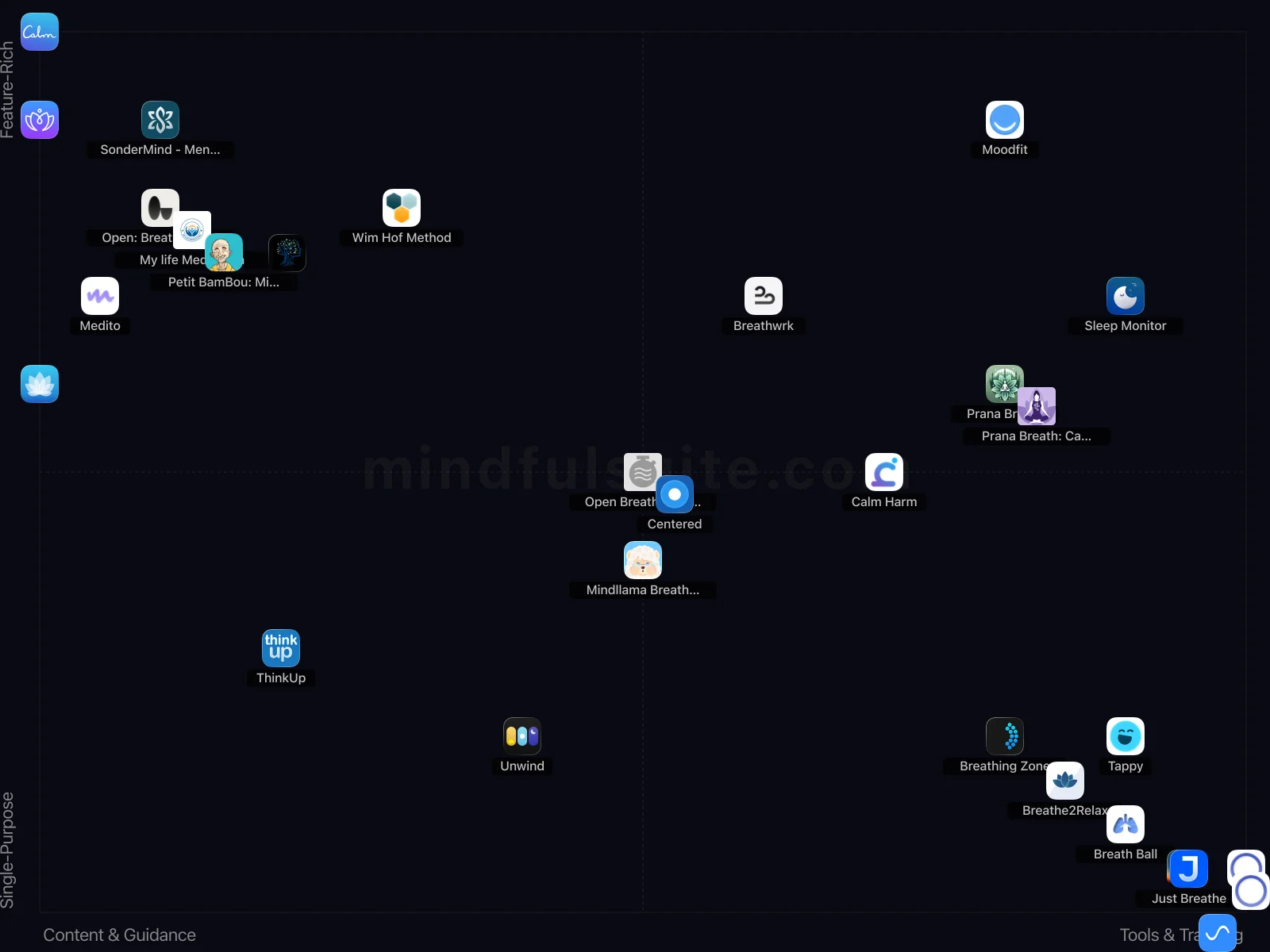
These 27 apps don't all solve the same problem. They cluster into 4 distinct groups, each built around a different philosophy. Understanding which group fits you is the fastest way to narrow your search.
Content & Guidance + Feature-Rich
9 apps in this group, led by  Open: Breathwork + Meditation,
  Wim Hof Method, and
  BlessedPath: Stress Relief.
What defines this cluster: free with iap, breathwork, meditation, mindfulness studio.
BlessedPath: Stress Relief.
What defines this cluster: free with iap, breathwork, meditation, mindfulness studio.
Tools & Tracking + Feature-Rich
8 apps in this group, led by  Breathwrk,
  Prana Breath: Calm & Meditate, and
  Sleep Monitor.
What defines this cluster: goal-specific breathing exercises, guided breathwork library, customizable breath pattern intervals, daily breathing reminders.
Sleep Monitor.
What defines this cluster: goal-specific breathing exercises, guided breathwork library, customizable breath pattern intervals, daily breathing reminders.
Content & Guidance + Single-Purpose
2 apps in this group, led by  Unwind and
  ThinkUp.
What defines this cluster: free with in-app purchases, guided breathing exercises, calming animations, calming sounds.
ThinkUp.
What defines this cluster: free with in-app purchases, guided breathing exercises, calming animations, calming sounds.
Tools & Tracking + Single-Purpose
8 apps in this group, led by  iBreathe,
  Tappy, and
  Breath Ball.
What defines this cluster: guided breathing exercises, reduce stress and anxiety, improve focus, free with in-app purchases.
Breath Ball.
What defines this cluster: guided breathing exercises, reduce stress and anxiety, improve focus, free with in-app purchases.
What makes them different
The core tension in this category runs along two axes. On one side, Content & Guidance apps prioritize simplicity and speed — you can be up and running in under a minute. On the other, Tools & Tracking apps offer depth and customization that rewards investment over time.
The second axis — App Scope — captures an equally important difference. Apps closer to Single-Purpose take a fundamentally different approach than those near Feature-Rich. Neither is objectively better. The right choice depends on your personality, your experience level, and what you're trying to accomplish.
22 Apps Reviewed
We scored every app using a weighted composite of real App Store and Google Play ratings. Out of 22 apps: 8 Essential · 11 Hidden Gems. 11 cross-platform, 8 iOS-only, 3 Android-only.
Top picks:  Medito and
  Calm scored highest overall.
  Meditopia rounds out the top three. Switch to the Apps tab for the full list with ratings and download links.
How to Pick the Right One
Look at the cluster section above. If you already know whether you want Content & Guidance or Tools & Tracking, that eliminates half the options instantly. Same for Single-Purpose vs Feature-Rich.
Try one app for a full week before judging. Most breathing exercise apps reveal their value around day 5, not day 1.
Quick start: Medito and Calm represent two different approaches and both scored highest. Pick whichever resonates, switch if it doesn't click.
Making It Stick: Practical Advice
Downloading the app is the easy part. The hard part — the part that actually produces results — is what happens in weeks two, three, and beyond. These tips are drawn from behavioral research and from patterns we've observed across hundreds of thousands of user reviews. They're not revolutionary, but they work:
Start with box breathing
Inhale 4 seconds, hold 4 seconds, exhale 4 seconds, hold 4 seconds. It's simple, effective, and used by Navy SEALs for stress management. Master this before exploring complex techniques.
Practice twice daily for a week
Like any skill, breathing techniques become more effective with practice. A 3-5 minute session morning and evening builds the neural pathways that make the technique automatic during stress.
Use before, not just during, stressful events
If you know a stressful meeting or situation is coming, do 2-3 minutes of calming breathwork beforehand. Pre-regulating is more effective than trying to calm down once you're already activated.
Frequently Asked Questions
These are the questions that come up most often — from our own testing, from user reviews, and from the broader conversation around breathing exercise apps. If your question isn't here, the Apps tab has detailed information on every app we reviewed.
Can breathing exercises really reduce anxiety?
Yes. This is one of the most well-supported interventions in psychophysiology. Controlled breathing directly activates the vagus nerve and parasympathetic nervous system, reducing heart rate, blood pressure, and cortisol within minutes.
How long should a breathing session be?
Even 1-2 minutes of controlled breathing produces measurable physiological changes. For sustained benefits, 5-10 minute sessions are ideal. Research on daily breathwork typically uses 5-minute protocols.
Which breathing technique is best for beginners?
Box breathing (4-4-4-4) or simple extended exhale breathing (inhale 4, exhale 6-8) are the easiest to learn. They're effective, hard to do wrong, and require no prior experience.
The 21 Best Breathing Exercise Apps for a Calmer You in 2026
Remember scribbling "just breathe" on a sticky note and slapping it on your monitor? Or maybe you’ve tried counting breaths in bed, only to lose track and start mentally drafting tomorrow's grocery list instead. We’ve all been there. Frantically searching for a moment of peace can easily feel like just one more task on an already endless to-do list.
But what if that little reminder could do more than just guilt-trip you? What if it could guide you with gentle sounds, visual cues, and structured pacing, turning a vague intention into a restorative practice? That’s the magic of a great breathing app. These digital guides transform the simple act of inhaling and exhaling into a deliberate tool to dial down stress, find focus, or drift off to sleep. Let's explore the best ones worth keeping in your pocket.
The All-in-One Wellness Hubs
These apps are the Swiss Army knives of mindfulness. They offer guided breathing exercises as part of a larger toolkit designed to tackle everything from everyday anxiety to sleep hygiene. If you want a complete mental wellness ecosystem, start here.

Present
A beautiful meditation timer featuring 100+ soundscapes and 6 bell themes to help you find stillness anywhere.
- Over 100 high-quality nature and ASMR soundscapes.
- Minimalist design that stays out of your way.
- Available as a Chrome extension for working peacefully.

Medito
Built on the beautiful principle that mindfulness should be accessible to all, Medito is a gift from the non-profit Medito Foundation. It's 100% free, forever, with no ads or hidden costs. It’s a pure, clean, and heartfelt resource for your mental well-being.
- Absolutely free with no premium tiers or ads, embodying a true non-profit mission to make mindfulness accessible to all.
- Offers a solid foundational course and diverse guided meditations, including sleep stories and breathing exercises, without paywalls.

Calm
Famous for its soothing meditations and sleep stories, Calm also includes a lovely mood check-in feature to weave mindfulness into your daily reflection.
- The vast library of high-quality Sleep Stories, narrated by soothing voices, genuinely helps users drift off to sleep.
- Its daily meditations, like the "Daily Calm," provide consistent, accessible guidance for mindfulness beginners and regulars.

Moodfit
Offers tools and exercises based on CBT and mindfulness to help users understand and improve their moods. It is for individuals seeking to enhance their mental well-being through mood tracking and targeted exercises.
- Integrates a robust mood tracker with CBT and mindfulness tools, providing a holistic mental wellness approach.
- Offers a wide variety of exercises and insights, giving users diverse strategies for improving mental well-being.

Meditopia
Offers guided meditations and sleep stories for stress reduction and improved sleep. It's for users seeking mindfulness practices and relaxation techniques.
- Offers a well-rounded collection of guided meditations, sleep stories, and soothing music at an accessible price point.
- The app provides a good balance between introductory and advanced content, catering to various user needs.

Petit BamBou: Mindfulness
Petit BamBou is a meditation app designed to simplify mindfulness practices. It helps those looking to reduce stress and improve well-being.
For the Dedicated Breathworkers
These apps are for the enthusiasts who want to go deep. They specialize in the art and science of breathing, offering specific techniques, intense guided sessions, and progress tracking designed to help you truly master your breath.

Breathwrk
Breathwrk is a powerhouse focused exclusively on science-backed breathing exercises. It guides you through powerful techniques to achieve specific states, whether you want to fall asleep in minutes, spark some energy, or instantly calm anxiety.
- The extensive library of goal-specific breathing exercises, like 'Energize' or 'De-Stress,' genuinely delivers targeted results.
- Breathwrk carves a distinct niche in crowded mindfulness with its exclusive, laser-focused breathwork approach.

Wim Hof Method
This is the official app for the legendary Wim Hof Method, which combines specific breathing techniques, cold exposure, and mindset training. It's an intense, powerful practice aimed at boosting energy, reducing inflammation, and unlocking your inner resilience.
- Provides clear, guided instruction for the unique Wim Hof breathing technique, essential for safe practice.
- Integrates cold exposure and mindset challenges, offering a holistic physical and mental program.

Open: Breathwork + Meditation
Presents a mindfulness studio promoting personal growth through breathwork and meditation practices.
- Features live and on-demand classes with expert instructors, fostering a strong community feel.
- High production value and engaging sessions make the breathwork and meditation experience premium.

Prana Breath
Drawing from ancient yogic traditions (Pranayama), Prana Breath offers a variety of breathing techniques designed to promote deep relaxation and mindfulness. It's highly customizable and feels more like a training tool for your breath.
- Offers an impressive array of traditional yogic pranayama techniques, appealing to experienced practitioners.
- Highly customizable training sessions and detailed progress tracking empower users to tailor their practice.

Prana Breath: Calm & Meditate
This app offers breathing techniques and meditations to increase mindfulness.

Open Breathwork Freely Breathe
A minimalist, customizable app for guided breathing exercises, deep breathing, and Pranayama.
Simple, Focused, and Distraction-Free
If you don't want a massive content library, ongoing subscriptions, or complex features, these apps are your best bet. They deliver straightforward, effective breathing exercises without any clutter, getting you right to the relief you need.

Breath Ball
Breath Ball provides a simple, intuitive visual guide—a ball that expands and contracts—for various breathing exercises. It's perfect for visual learners who just want a clean, simple guide to follow.
- The simple visual guide of the expanding and contracting ball is incredibly intuitive for pacing breathing exercises.
- As a completely free app, it offers full access to its customizable sessions without any hidden costs or paywalls.

Breathing Zone
Breathing Zone offers clinically effective guided breathing exercises. Its unique feature is a Breath Analyzer that uses your phone's camera to measure your breathing rate and help you find your ideal pace for relaxation.
- The unique breath analyzer accurately detects and helps optimize your breathing rate for maximum benefit.
- It is genuinely free with no hidden paywalls, offering full functionality for stress reduction.

iBreathe
This app is the definition of beautiful simplicity. It does one thing, and it does it perfectly: guide your breath. There are no meditations, no stories, no teachers—just a clean, elegant interface that helps you inhale, hold, and exhale your way to calm.
- Extremely minimalist design focuses purely on guided breathing, making it incredibly straightforward and distraction-free.
- Customizable breath hold times and session lengths allow for personalized relaxation routines.

Breathe2Relax
Sometimes the simplest solution is the best. Breathe2Relax is a straightforward app that teaches diaphragmatic breathing (belly breathing), a powerful stress management skill.
- Breathe2Relax excels at its core function, providing clear, customizable diaphragmatic breathing exercises for stress relief.
- The app is completely free, offering essential relaxation techniques without any hidden costs or subscriptions.

Unwind
Unwind is another beautifully designed app with a focus on simplicity. It provides guided breathing exercises with calming animations and sounds to enhance the relaxation experience.
- The beautifully designed interface with calming animations and sounds genuinely elevates the breathing experience aesthetically.
- It offers specific guided exercises tailored for distinct goals like relaxation, focus, and sleep, which is helpful.

The Breathing App
Co-created by renowned yoga teacher Eddie Stern and author Deepak Chopra, this no-frills app focuses on one thing: resonant breathing. This technique involves breathing at a specific rate (around 5-6 breaths per minute) to instantly calm the nervous system.
- Focuses solely on resonant breathing, a scientifically-backed technique for nervous system calming.
- Its minimalist design, co-created by experts, ensures a distraction-free and effective experience.

Just Breathe
This Android-only app offers a straightforward way to practice mindful breathing. It has a clean interface and customizable timers to help you focus purely on your breath without distractions.
- The simple and straightforward interface truly minimizes distractions, allowing complete focus on the breathing practice.
- Customizable timers provide essential flexibility for users to set their preferred session lengths and intervals.

Paced Breathing
Guides users through paced breathing exercises using visual, audio, and haptic cues, as featured in James Nestor’s 'Breath'.

Mindllama Breathe Sleep Focus
A breathing exercise companion. It's for users that need simple breathing exercises to help calm them down.
- Mindllama provides a diverse range of breathing exercises specifically categorized for sleep, focus, and relaxation.
- Its aesthetically pleasing animations and clean interface make the breathing practice visually engaging and calming.
Paced Breathing
Just like its name suggests, Paced Breathing helps you regulate your breath with simple cues. It's a minimalist app that uses visual, audio, and haptic feedback to guide your inhales and exhales.
- Offers effective haptic (vibration) feedback, making it possible to practice mindful breathing discreetly.
- Its straightforward approach focuses purely on paced breathing, avoiding distracting features or content.
Breathe Easier Today
Finding the right breathing app is a deeply personal process. Whether you're looking for an all-encompassing wellness space, a dedicated coach to push your physical limits, or just a simple visual pacer to clear your mind between chaotic meetings, the right tool exists. Take a deep breath, pick an app that fits your lifestyle, and start building a calmer, more resilient routine today.