
Goal Tracker Apps: What You Need to Know in 2026
"This year will be different." You've said it before — maybe about saving money, running a marathon, or learning a language. The intention was real. But somewhere between January's enthusiasm and March's reality, the goal faded into background noise. Goal tracker apps exist to bridge that gap between dreaming and doing.
We evaluated 33 goal tracker apps across iOS and Android, scoring each on real user ratings, feature depth, and long-term value. This guide covers what we found.
Why Most Goals Fail (and What the Research Says)
Edwin Locke and Gary Latham spent 35 years studying goal-setting, and their findings have been replicated so consistently that goal-setting theory is one of the most validated frameworks in organizational psychology. The core insight is deceptively simple: specific, challenging goals lead to higher performance 90 percent of the time compared to vague or easy goals. "Get in shape" fails. "Run a 5K in under 28 minutes by September 1" succeeds. Not because the second person wants it more, but because their brain has something concrete to plan around.
Goals fail for identifiable, predictable reasons. The first is vagueness. A goal you cannot measure is a goal you cannot track, and a goal you cannot track is a goal you will quietly abandon without ever making a conscious decision to quit. The second is the planning fallacy — our systematic tendency to underestimate how long things will take and overestimate what we can accomplish in a given period. Daniel Kahneman, who described this bias, observed that it persists even when people have direct experience with similar tasks taking longer than expected. You know your last project ran three months over schedule. You still estimate this project optimistically.
The third reason is particularly insidious in the social media era: comparison. Instagram and TikTok create a constant highlight reel of other people's accomplishments. Someone posts their marathon finish. Someone else posts their promotion. The cumulative effect is that your personal goals — which are calibrated to your actual life, your actual starting point, your actual constraints — start to feel inadequate. You set the goal of saving $5,000 this year, which would be genuinely transformative for your financial situation, and then feel foolish because someone on Twitter casually mentions their six-figure investment portfolio.
Goal tracker apps cannot fix a bad goal. No amount of progress bars or milestone notifications will rescue a goal that is vague, unrealistic, or chosen based on what impresses others rather than what matters to you. But they can make a good goal visible. They can put it in front of you daily. They can show you that the 12 percent progress you have made in six weeks is actually on pace for your timeline. The app is the infrastructure. The goal itself is the architecture, and that part is your job.
Process Goals vs Outcome Goals: A Critical Distinction
This is the single most useful distinction in goal-setting, and most people have never encountered it: the difference between outcome goals and process goals.
"Lose 20 pounds" is an outcome goal. You have defined the destination but not the vehicle. You control your behavior, but you do not control the result directly. Weight is influenced by hormones, sleep, stress, water retention, medication, genetics, and a dozen other variables that exist outside your effort. You can do everything right for two weeks and see the scale move in the wrong direction because of factors that have nothing to do with your commitment.
"Exercise four times per week and eat under 2,000 calories five days per week" is a process goal. You have defined the behaviors, and you have direct control over whether they happen. Every single day, you can objectively assess whether you followed through. No ambiguity. No external variables confounding the measurement.
The best goal tracking apps let you track both — and understanding why matters. Outcome goals provide direction and motivation. You need the lighthouse on the horizon. Process goals provide the daily checkboxes that sustain your effort when the outcome is not yet visible. The problem with tracking only outcomes is that plateaus destroy motivation. You work hard for a month, the number barely moves, and you conclude the effort is not working. The problem with tracking only process is that you can lose sight of why you are doing the work in the first place.
The sweet spot is tracking process goals daily and outcome goals weekly or monthly. Your daily question is: "Did I do the things I committed to doing?" Your weekly question is: "Is the outcome moving in the right direction?" When process is strong but outcome is stagnant, you adjust the process — not by working harder but by working differently. When process is inconsistent, you know exactly where the breakdown is.
This distinction alone changes how people use goal tracker apps. Instead of opening the app to stare at a number that has not moved, you open it to record that you showed up today. The showing up is the variable you control. The result will follow, but only if the process is sustained long enough for compounding to work.
The Accountability Gap Apps Can Actually Fill
The research on accountability and goal achievement is frequently cited but less straightforward than the popular summaries suggest. Yes, sharing your goals with others can increase the likelihood of achieving them. But the details matter enormously — and getting them wrong can actually make you less likely to follow through.
Peter Gollwitzer's 2009 research found that publicly announcing your goals can create a premature sense of accomplishment. Telling everyone "I am going to write a novel" gives you a taste of the social identity — "I am a writer" — without the work. Your brain gets a small hit of the reward that should come from finishing, which can reduce the motivation to actually start. The caveat is that this effect depends on who you tell and how. Announcing to a general audience (social media) has this deflating effect. Sharing with a specific accountability partner who will follow up and check on your progress has the opposite effect.
This is the gap that goal tracking apps can genuinely fill. They provide accountability without the social dynamics that complicate human relationships. You do not have to worry about burdening your friend with weekly check-ins about your savings goal. You do not have to perform progress for an audience. The app tracks your behavior with the objectivity and consistency that even the most well-intentioned friend cannot match. It does not forget. It does not get tired of asking. It does not judge.
The most effective app-based accountability features include progress photos (visual evidence of change that your brain processes differently than numbers), milestone sharing (celebrating specific achievements rather than announcing intentions), and commitment contracts (some apps let you stake money that you forfeit if you do not meet your goal — and the research on loss-aversion-based commitment devices is remarkably strong).
The ideal setup is often a hybrid: an app for daily tracking and honest data, combined with a single human accountability partner for the emotional support and social motivation that no app can replicate. The app handles the logistics — the reminders, the data, the streak tracking. The person handles the humanity — the encouragement when you are struggling, the celebration when you hit a milestone, the honest conversation when you need to recalibrate. Each fills a gap the other cannot.
4 Types of Goal Tracker Apps — and How They Differ
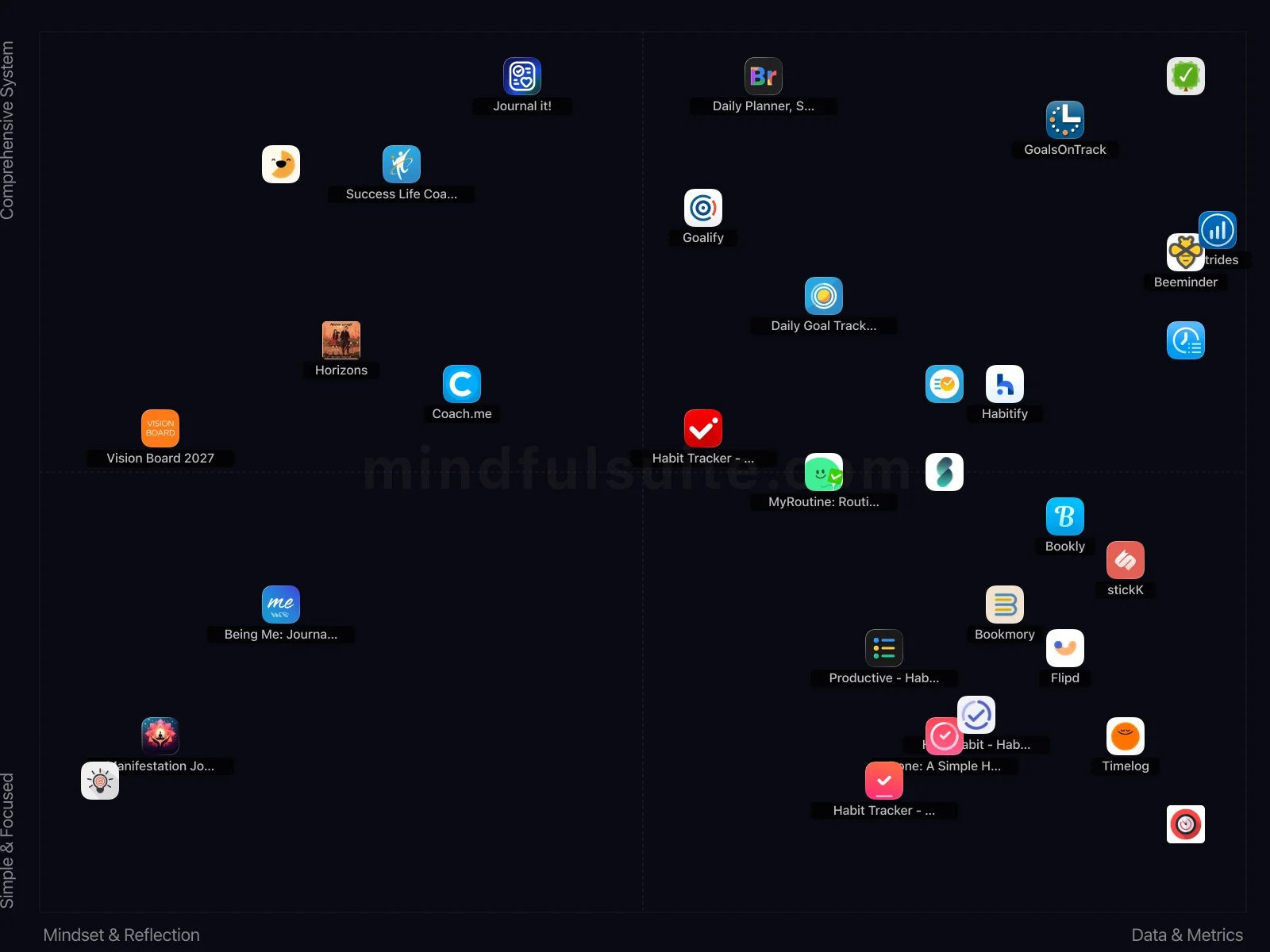
These 32 apps don't all solve the same problem. They cluster into 4 distinct groups, each built around a different philosophy. Understanding which group fits you is the fastest way to narrow your search.
Mindset & Reflection + Comprehensive System
6 apps in this group, led by  Horizons,
  Success Life Coach Day Planner, and
  Vision Board 2027.
What defines this cluster: life coaching system, goal setting, habit tracker, free with iap.
Vision Board 2027.
What defines this cluster: life coaching system, goal setting, habit tracker, free with iap.
Data & Metrics + Comprehensive System
13 apps in this group, led by  Strides,
  Daily Goal Tracker & Planner, and
  Goalify.
What defines this cluster: free with iap, goal and habit tracker, customizable trackers, charts for monitoring.
Goalify.
What defines this cluster: free with iap, goal and habit tracker, customizable trackers, charts for monitoring.
Mindset & Reflection + Simple & Focused
3 apps in this group, led by  Manifestation Journal,
  Being Me: Journal/Goals/Habits, and
  Vision Board, Visualize dreams.
What defines this cluster: goal setting, law of attraction, goal manifestation, dream visualization.
Vision Board, Visualize dreams.
What defines this cluster: goal setting, law of attraction, goal manifestation, dream visualization.
Data & Metrics + Simple & Focused
10 apps in this group, led by  Bookly,
  Bookmory, and
  Productive - Habit Tracker.
What defines this cluster: real-time reading tracking, personalized stats and reports, free with iap, track your reading.
Productive - Habit Tracker.
What defines this cluster: real-time reading tracking, personalized stats and reports, free with iap, track your reading.
What makes them different
The core tension in this category runs along two axes. On one side, Mindset & Reflection apps prioritize simplicity and speed — you can be up and running in under a minute. On the other, Data & Metrics apps offer depth and customization that rewards investment over time.
The second axis — Feature Scope — captures an equally important difference. Apps closer to Simple & Focused take a fundamentally different approach than those near Comprehensive System. Neither is objectively better. The right choice depends on your personality, your experience level, and what you're trying to accomplish.
33 Apps Reviewed
We scored every app using a weighted composite of real App Store and Google Play ratings. Out of 33 apps: 4 Essential · 20 Hidden Gems. 20 cross-platform, 11 iOS-only, 2 Android-only.
Top picks: Productive - Habit Tracker and Bookly scored highest overall. Bookmory rounds out the top three. Switch to the Apps tab for the full list with ratings and download links.
How to Pick the Right One
Look at the cluster section above. If you already know whether you want Mindset & Reflection or Data & Metrics, that eliminates half the options instantly. Same for Simple & Focused vs Comprehensive System.
Try one app for a full week before judging. Most goal tracker apps reveal their value around day 5, not day 1.
Quick start: Productive - Habit Tracker and Bookly represent two different approaches and both scored highest. Pick whichever resonates, switch if it doesn't click.
Making It Stick: Practical Advice
Downloading the app is the easy part. The hard part — the part that actually produces results — is what happens in weeks two, three, and beyond. These tips are drawn from behavioral research and from patterns we've observed across hundreds of thousands of user reviews. They're not revolutionary, but they work:
Make goals specific and measurable
"Get fit" is a wish. "Run 5K in under 30 minutes by June" is a goal. The more specific, the more your tracker can help you monitor real progress.
Focus on 3-5 active goals
Trying to pursue too many goals simultaneously dilutes your focus and energy. Prioritize the goals that matter most right now and defer the rest.
Schedule weekly reviews
Set a recurring 15-minute appointment with yourself to review goal progress. This is where you catch slippage early, celebrate wins, and adjust timelines.
Track lead indicators, not just outcomes
Instead of only tracking 'lose 10 pounds,' also track daily behaviors that lead there: workouts completed, calories logged, steps taken. These are the levers you actually control.
Frequently Asked Questions
These are the questions that come up most often — from our own testing, from user reviews, and from the broader conversation around goal tracker apps. If your question isn't here, the Apps tab has detailed information on every app we reviewed.
What's the difference between a goal tracker and a habit tracker?
Habit trackers focus on recurring daily behaviors (meditate, exercise, read). Goal trackers focus on specific outcomes with an endpoint (run a marathon, save $10,000, learn Spanish). Many apps combine both, since daily habits often serve larger goals.
How often should I check my goal tracker?
Daily for habit-related goals, weekly for milestone review. The key is making it part of your routine rather than something you check randomly. Most apps support customizable reminder schedules.
Can goal tracking apps replace a coach or accountability partner?
They complement human accountability rather than replacing it. Apps excel at data tracking, reminders, and visualization. But sharing your goals with another person adds social motivation that no app can fully replicate. Some goal apps include community or accountability partner features for this reason.
The Best Goal Tracker Apps for 2026
Remember that beautiful leather-bound journal you bought in January? The one with two pages of neatly written resolutions, followed by 200 empty ones? Or the sticky note on your monitor, now so faded you can barely read "learn Spanish"? We've all been there. Big dreams have a funny way of fizzling out when they crash into the reality of a busy week.
But what if your goals had a friendly coach living in your pocket? A companion that doesn't judge, but gently nudges you to practice for just 10 minutes, celebrates your 7-day streak, and shows you just how far you've come. That’s the magic of a great goal-tracking app. They transform vague ambitions into a simple, satisfying daily game you can actually win.
Dedicated Habit & Goal Trackers
These apps are built from the ground up with one primary purpose: helping you build good habits and break bad ones.

Priorities
A simple to-do list app employing a method used by investors, it helps users prioritize tasks.

Goals
A comprehensive habit and goal tracker inspired by Atomic Habits, featuring AI coaching and visual progress tracking.
- Deep integration with Atomic Habits philosophy.
- Visual progress tracking keeps you motivated.
- Cross-platform support (iOS and Android).

Remente: Self Care & Wellbeing
Functions as a life coach providing self-help tools and a mental health tracker to help users with goal setting and personal growth. It offers a self-care journal for achieving self-improvement.
- Its focus on "mental health tracker" and "self care journal" gives it a distinct wellness-oriented edge.
- The "life coach" and "self help tools" offer guided paths for personal growth, a unique differentiator.

HelloHabit - Habit Tracker
This is a simple habit tracker that helps you set goals and build habits.
- The extremely high 4.9-star iOS rating indicates a highly refined and satisfying user experience on Apple devices.
- Its promise of "simple habit tracking, made easy" truly delivers a streamlined, friction-free daily interaction.

Success Life Coach Day Planner
A life coaching system with goal setting, habit tracking, and day planning features.
- The integrated "life coaching" aspect with guided goal setting uniquely differentiates it from basic task managers.
- Its habit journal directly supports long-term behavioral change, a distinct advantage over simple to-do lists.

Strides
Strides is a powerful and flexible goal-tracking app that shines with its data visualization capabilities. It allows you to monitor anything you want with four unique tracker types: Target (reach a goal by a date), Habit (build a good or bad habit), Average (track averages over time), and Project (milestones on the way to a larger goal).
- The four distinct tracker types (Good/Bad Habit, Target, Average) provide unmatched flexibility for tracking diverse goals.
- Its detailed "Goal Pacing" charts offer excellent long-term visual progress toward achieving targets.

Daily Goal Tracker & Planner
A personal goal planner and tracker to assist users in setting, planning, and achieving their goals.
- As a dedicated "Goal PLANNER" and "Goal TRACKER," it provides focused tools specifically designed for comprehensive goal management.
- High ratings on both platforms from over 50,000 users signify a robust, trustworthy application for serious goal setters.

Habit Tracker - Daily Goals
This habit tracker provides motivation and accountability without ads or subscriptions.
- The explicit "no ads & no subscription" policy offers a rare, truly free, and complete habit tracking experience.
- Consistent high ratings across both platforms demonstrate its reliable and widely appreciated core functionality.

MyRoutine: Routine Habit Goal
This helps build good habits and structure your day with routine tracking and goal setting.
- Excellent for building and maintaining consistent routines, offering clear visual progress and goal tracking.
- The focus on habit formation provides a structured approach to daily planning beyond just simple task lists.

Productive - Habit Tracker
Productive is a beautifully designed app that helps you build a routine of positive, life-changing habits. Its simple interface and useful statistics make it easy to get started and stay motivated.
- Its clean, intuitive interface makes tracking multiple daily habits straightforward and visually appealing.
- Customizable reminders and streaks genuinely motivate consistent progress on new routines.

Done: A Simple Habit Tracker
An app that helps you create positive habits and track your progress with a simple, motivating interface.
- Its straightforward interface excels at tracking habits with clear streak visualizations, motivating consistent daily engagement.
- The ability to track both "build" and "quit" habits within one app is a surprisingly effective and versatile approach.

Goalify
A goal-setting and habit-tracking app with motivational challenges and coaching features. It is ideal for users seeking accountability and structure in achieving their goals.
- The integration of challenges and optional coaching provides structured motivation and personalized guidance for goal achievement.
- Its comprehensive approach to goal setting, beyond simple habits, offers a broader utility for users.

Habitify
Habitify is a sleek, cross-platform habit tracker that helps you stay organized and motivated. It provides detailed tracking, insightful charts, and timely reminders to keep you on track across all your devices.
- Organizing habits by "areas of life" provides a structured, holistic view beyond a flat task list.
- Detailed tracking and streaks across multiple platforms are genuinely motivating for building consistent daily routines.

Habit Tracker - Habit Diary
This customizable habit tracker helps users plan daily routines and track goals.
- Offers extensive customization options, allowing users to tailor habit tracking precisely to their unique needs.
- Its "Habit Diary" feature provides valuable context by letting you add notes to individual habit completions.
All-in-One Productivity Hubs
These apps are powerful productivity platforms where habit and goal tracking is one feature among many.

MyLifeOrganized (MLO)
A flexible task management system that helps you organize your goals, projects, and tasks into a hierarchical to-do list.
- Offers unmatched flexibility with its highly customizable hierarchical task structure for complex planning.
- The 'Outliner' view and 'Contexts' allow for powerful organization and filtering of tasks.

Being Me: Journal/Goals/Habits
Being Me provides a journal and planner to help you focus on goals and habits. Being Me is for users who want to prioritize self-care, cultivate positivity, and improve motivation.

Journal it!
A powerful, all-in-one app for those who want their journal to do everything. It combines a diary, planner, habit tracker, and note-taker into one highly organized system.
- Its comprehensive feature set, including "habit tracking" and "mood monitoring," makes it a powerful all-in-one productivity and journaling tool.
- "Traditional diary entries" combined with notes offer excellent flexibility for diverse writing needs.

Daily Planner, Schedule: Brite
An all-in-one productivity app that includes a planner, to-do lists, habit tracker, and notes.
- Brite aims for a "balanced and productive life," suggesting a holistic approach that integrates daily planning with well-being.
- Its combination of Habit Tracker, Routine, and Goals offers a versatile toolkit for managing various aspects of daily self-improvement.

Productivity - Daily Planner
A productivity day planner, it offers a structured task list manager for daily organization.
- Its structured task list manager offers a clear framework for daily and weekly planning.
- The robust free tier covers core planning features, avoiding immediate IAP pressure for basic use.
Specialty & Niche Trackers
These apps excel in a specific area, whether it's focus, social accountability, or time management.

ATracker Time Tracker
ATracker helps you understand where your time goes, which is the first step to building better habits. By tracking your daily activities, you can get a clear picture of your productivity and set goals for improvement.
- Provides incredibly granular data on how you spend your time, offering deep insights for optimizing your daily schedule.
- The ability to export data and generate custom reports is valuable for serious time analysis.

Bookly
Think of Bookly as a fitness tracker for your reading life. It gamifies your habits by encouraging you to start a timer every time you pick up a book, gathering data to generate detailed reports, cool infographics, and surprisingly accurate estimates on how long it'll take you to finish.
- Real-time reading timer and detailed session tracking provide excellent insights into reading habits.
- Offers robust, personalized statistics and progress reports to motivate reading goals.

Vision Board 2027
A highly customizable iOS app that lets you create not just static vision boards but also "vision board movies" with music and personal affirmations.
- Its unique focus on the "Bagua map" and visualization provides a distinct, spiritually aligned approach to goal setting and manifestation.
- The integration of "Affirmations" directly supports a positive mindset, which is crucial for staying motivated towards long-term goals.

Bookmory
Bookmory allows you to track your reading progress, manage your books, and take notes. It is ideal for building a lasting reading habit with insightful stats.
- Clean, aesthetically pleasing interface makes tracking and managing books a joy.
- Offers a good balance of reading statistics and note-taking features for free users.

Beeminder
Beeminder is a goal-tracking app with a serious sting—in a good way! It works by having you pledge real money to stay on track. You set a goal and a 'yellow brick road' of progress you need to follow. If you fall off your path, Beeminder charges your credit card. This "commitment device" is a uniquely powerful motivator for anyone who needs high stakes to stay focused.
- The unique financial commitment mechanism, where you pay if you derail, is a potent motivator for sticking to challenging routines.
- Offers deep data integration with numerous third-party apps, automating progress tracking for a wide range of habits.

Coach.me
Coach.me combines habit tracking with a supportive community and the option to hire professional coaches. If you need more than just a digital nudge, this app provides access to human support.
- Integrated community support offers a unique layer of public accountability and encouragement for routines.
- Option to hire a coach provides personalized guidance, a significant differentiator for serious habit changers.

Flipd
Flipd is a productivity app that locks you out of distracting apps for a set period, functioning as a focus and study timer.
- The "Full Lock" mode provides a truly unbreakable lockout from distracting apps, ideal for intense study or work periods.
- Its integration with a community and leaderboards can provide external motivation and accountability for focus.

Timelog
You can't manage what you don't measure. Timelog is a simple time-tracking app that helps you see where your time *actually* goes. By manually starting and stopping a timer for your activities, you build a powerful awareness of your habits, which is the first step toward changing them.
- Its clean, focused time-logging interface makes monitoring specific habit durations straightforward and effective.
- The app's calming aesthetic and focus on mindful tracking supports stress-free habit building.

Manifestation Journal
A law of attraction journal app to help users turn their dreams into reality.

Vision Board, Visualize dreams
This vision board app helps users visualize dreams and manifest goals through visualization and affirmations. Vision Board allows users to focus, plan, and track life goals.

Horizons
This app frames goal-setting as a journey. It combines a vision board with an action tracker and a progress journal to help you visualize and actively work towards your future.
- Uniquely combines mind mapping with affirmations, allowing for structured goal setting alongside visual inspiration.
- The daily affirmation feature provides consistent reinforcement for goals visualized on your board.

stickK
Ready to get serious? Created by behavioral economists, stickK raises the stakes by letting you put real money on the line. You create a "Commitment Contract" for your goal, and if you fail, your money goes to a friend, a charity, or even an "anti-charity" you passionately dislike.
- Leveraging financial contracts and real referees for accountability provides a truly potent deterrent against goal abandonment.
- Its commitment contracts with monetary stakes are a robust, no-excuses approach to behavior change.

ADHD Planner AI Task: Splitti
Uses AI to break down goals into actionable steps, created to aid users, especially those with ADHD, in overcoming procrastination.

Pomofocus - Productivity Timer
Pomofocus is a time-blocking app that breaks down work into manageable chunks with short breaks.
Whether you need the gentle encouragement of a beautiful visual interface, the tough love of a financial commitment, or the profound insights of a detailed time tracker, there is an app uniquely suited to your personality and goals. Pick the one that resonates most with you, start small, and let the momentum carry you forward. Here’s to crushing your goals in 2026!