
Focus Timer Apps: What You Need to Know in 2026
You sit down to work on that important project. Five minutes later, you've checked your phone, opened three browser tabs, and completely forgotten what you were doing. The modern attention economy is designed to fragment your focus. Focus timer apps fight back by giving your concentration a clear structure and making distraction-free time feel achievable.
We evaluated 55 focus timer apps across iOS and Android, scoring each on real user ratings, feature depth, and long-term value. This guide covers what we found.
The Science of Deep Work (and Why Your Brain Fights It)
Cal Newport's concept of deep work — professional activities performed in a state of distraction-free concentration that push your cognitive capabilities to their limit — is not just productivity advice. It is a description of a competitive reality. The ability to focus deeply is becoming rare at precisely the moment it is becoming valuable, and the scarcity is not accidental. It is engineered.
The modern knowledge worker operates in an environment specifically designed to fragment attention. Open offices generate constant ambient interruption. Slack and email create an expectation of immediate response that is incompatible with sustained concentration. The average knowledge worker checks email 77 times per day and touches their phone 2,617 times. Gloria Mark's research at UC Irvine found that the typical office worker gets only 11 minutes of uninterrupted focus before being interrupted — and that it takes an average of 23 minutes and 15 seconds to fully return to the original task afterward. The arithmetic is devastating: most people spend their entire workday in a state of partial attention.
Sophie Leroy's research on attention residue explains why this matters at a neurological level. When you switch from Task A to Task B, your attention does not switch cleanly. A residue of Task A remains, consuming cognitive resources and reducing performance on Task B. This residue is particularly strong when Task A was incomplete or had time pressure — which describes most tasks in a modern workday. The result is that people who frequently switch between tasks perform measurably worse on each of them than people who complete one task before starting another.
Focus timers address this by creating what Newport calls a "shutdown ritual" in reverse — a startup ritual that signals to the brain that a period of protected concentration has begun. The timer externalizes the commitment: you are not vaguely trying to focus, you are in a defined session with a visible countdown. The boundary between focus time and everything else becomes concrete rather than aspirational. For a brain that receives no structural support for depth from its environment, the timer provides what the open-plan office, the messaging app, and the notification badge have systematically removed.
Beyond Pomodoro: Finding Your Focus Rhythm
The Pomodoro Technique — 25 minutes of work, 5 minutes of rest, repeat — is the most widely known focus timing method, and it deserves credit for introducing millions of people to structured work intervals. But treating 25/5 as the optimal ratio for everyone is like prescribing the same eyeglass prescription to every patient. It is a useful starting point, not a universal solution.
The research on optimal focus duration suggests significant variation by person, task type, and experience level. Anders Ericsson's studies on deliberate practice found that elite performers across fields — musicians, athletes, chess players — sustain peak concentration for roughly 60 to 90 minutes before requiring substantial rest. But these are experts performing practiced skills. Novices working on unfamiliar material may sustain genuine focus for only 15 to 20 minutes.
Task type matters enormously. Analytical work — debugging code, processing spreadsheets, answering emails — often fits well into 25-minute sprints because each unit of work is relatively self-contained. Creative work operates differently. Writing, designing, composing, and strategic thinking require a warm-up period during which the mind loads context, makes associative connections, and reaches a state of flow. Mihaly Csikszentmihalyi's research on flow states suggests this loading period takes 15 to 25 minutes — meaning a 25-minute Pomodoro interrupts precisely when creative flow is beginning. For this work, 45- to 90-minute blocks are typically more productive.
Programming occupies a middle ground. Experienced developers often describe needing 30 to 45 minutes to fully load a complex codebase into working memory, after which they can sustain productive output for another 60 to 90 minutes. A 25-minute timer interrupts during the loading phase.
The practical approach is experimentation. Start with Pomodoro as a baseline, then adjust. The right interval is the longest period during which you can maintain genuine concentration — not the appearance of working, but the actual cognitive engagement. Good focus timer apps make this experimentation easy by allowing custom intervals and tracking which durations produce your best output.
Why Breaks Are Not Optional (The Neuroscience of Rest)
The instinct to skip breaks and push through is understandable and counterproductive. It feels like skipping the break saves time. The neuroscience shows it costs quality — and not by a small margin.
When you disengage from focused work, the brain does not go idle. It switches to the default mode network, a set of interconnected brain regions that become active specifically during rest and mind-wandering. The default mode network is not wasting time. It is performing essential cognitive maintenance: consolidating short-term memories into long-term storage, making associative connections between disparate pieces of information, and processing emotional experiences. The insight that arrives in the shower or on a walk — the sudden solution to a problem you had been grinding on — is the default mode network delivering the results of its background processing.
Research on ultradian rhythms provides a biological framework for understanding why continuous work degrades. The body operates on roughly 90-minute cycles of higher and lower alertness throughout the day, mirroring the sleep cycle structure. During the high phase, concentration comes relatively easily. During the low phase, the body signals a need for rest through decreased attention, increased restlessness, and a pull toward distraction. Working through the low phase does not demonstrate discipline. It produces work of measurably lower quality while depleting cognitive resources that would otherwise be available for the next high phase.
What you do during breaks matters as much as taking them. Movement is the highest-value break activity: even a five-minute walk increases blood flow to the brain, reduces cortisol, and improves subsequent cognitive performance. Exposure to nature, even briefly, has documented restorative effects on attention — a phenomenon researchers call attention restoration theory. Brief social interaction activates different neural networks than focused work, providing genuine cognitive rest.
What does not constitute a real break: checking email, scrolling social media, reading the news. These activities engage the same attentional and decision-making circuits you are trying to rest. They feel like breaks because they are less effortful than focused work, but they provide none of the restorative benefits. The brain does not distinguish between concentrating on a spreadsheet and concentrating on an Instagram feed. Both consume the same finite resource. A genuine break requires disengaging from screens and from goal-directed cognitive activity entirely.
4 Types of Focus Timer Apps — and How They Differ
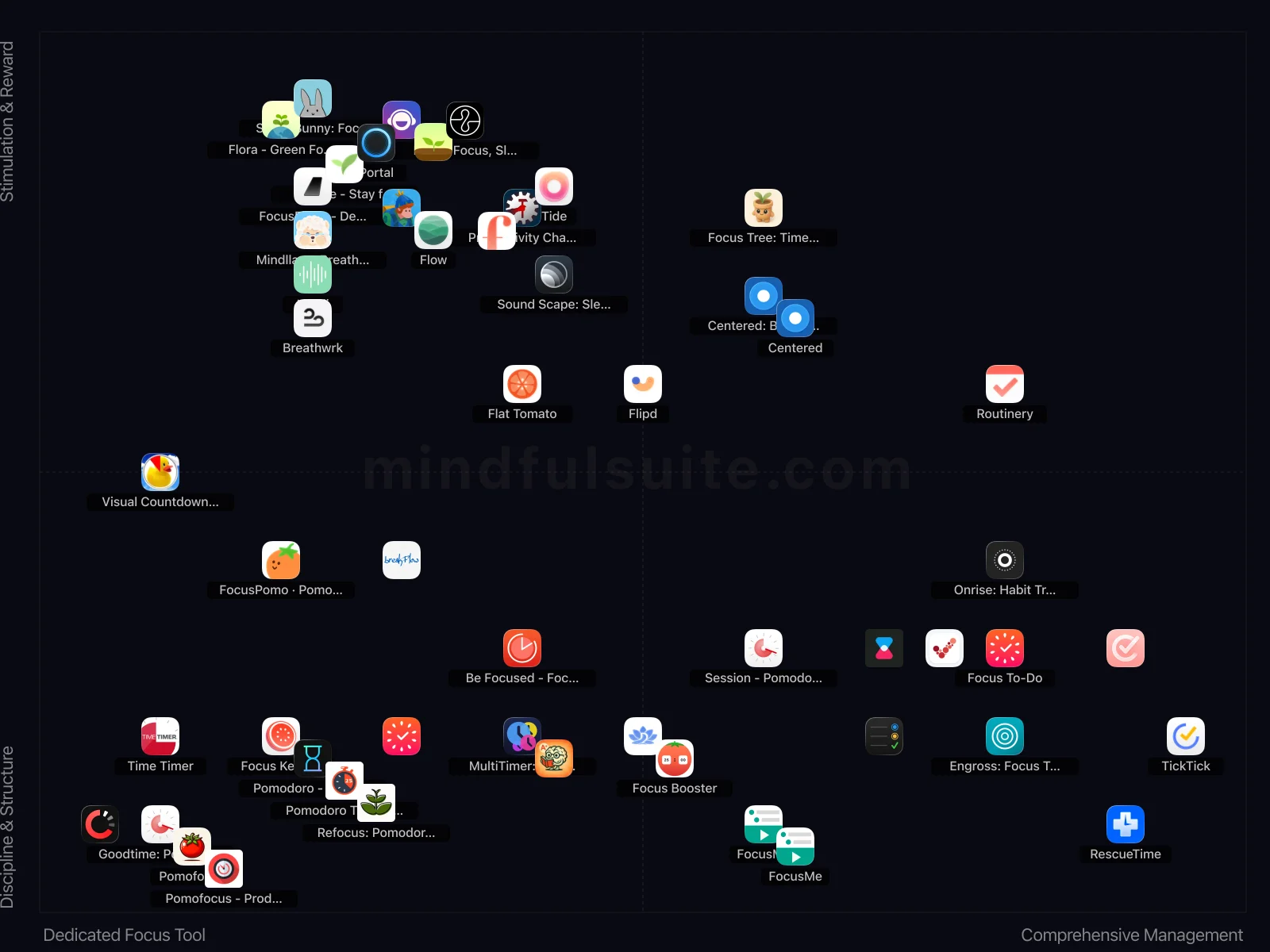
These 53 apps don't all solve the same problem. They cluster into 4 distinct groups, each built around a different philosophy. Understanding which group fits you is the fastest way to narrow your search.
Dedicated Focus Tool + Stimulation & Reward
19 apps in this group, led by  Flora - Green Focus,
  Productivity Challenge Timer, and
  Study Bunny: Focus Timer.
What defines this cluster: free with in-app purchases, grow virtual trees, gamified pomodoro timer, level up system.
Study Bunny: Focus Timer.
What defines this cluster: free with in-app purchases, grow virtual trees, gamified pomodoro timer, level up system.
Comprehensive Management + Stimulation & Reward
5 apps in this group, led by  Focus Tree: Timer & Flashcards,
  Flipd, and
  Centered: Balance & Focus.
What defines this cluster: focus app, flashcards, free with iap, free with in-app purchases.
Centered: Balance & Focus.
What defines this cluster: focus app, flashcards, free with iap, free with in-app purchases.
Dedicated Focus Tool + Discipline & Structure
15 apps in this group, led by  MultiTimer: Multiple timers,
  Time Timer, and
  Focus Keeper.
What defines this cluster: free with iap, visual countdown seconds timer, multiple timers, no ads.
Focus Keeper.
What defines this cluster: free with iap, visual countdown seconds timer, multiple timers, no ads.
Comprehensive Management + Discipline & Structure
14 apps in this group, led by  Focus To-Do,
  Digital Detox: Focus & Live, and
  Structured - Daily Planner.
What defines this cluster: pomodoro timer, task management, to-do list organizer, focus time tracking.
Structured - Daily Planner.
What defines this cluster: pomodoro timer, task management, to-do list organizer, focus time tracking.
What makes them different
The core tension in this category runs along two axes. On one side, Dedicated Focus Tool apps prioritize simplicity and speed — you can be up and running in under a minute. On the other, Comprehensive Management apps offer depth and customization that rewards investment over time.
The second axis — Motivation Strategy — captures an equally important difference. Apps closer to Discipline & Structure take a fundamentally different approach than those near Stimulation & Reward. Neither is objectively better. The right choice depends on your personality, your experience level, and what you're trying to accomplish.
55 Apps Reviewed
We scored every app using a weighted composite of real App Store and Google Play ratings. Out of 55 apps: 16 Essential · 25 Hidden Gems · 1 Mainstream. 24 cross-platform, 22 iOS-only, 9 Android-only.
Top picks: Focus Tree: Timer & Flashcards and Productivity Challenge Timer scored highest overall. Study Bunny: Focus Timer rounds out the top three. Switch to the Apps tab for the full list with ratings and download links.
How to Pick the Right One
Look at the cluster section above. If you already know whether you want Dedicated Focus Tool or Comprehensive Management, that eliminates half the options instantly. Same for Discipline & Structure vs Stimulation & Reward.
Try one app for a full week before judging. Most focus timer apps reveal their value around day 5, not day 1.
Quick start: Focus Tree: Timer & Flashcards and Productivity Challenge Timer represent two different approaches and both scored highest. Pick whichever resonates, switch if it doesn't click.
Making It Stick: Practical Advice
Downloading the app is the easy part. The hard part — the part that actually produces results — is what happens in weeks two, three, and beyond. These tips are drawn from behavioral research and from patterns we've observed across hundreds of thousands of user reviews. They're not revolutionary, but they work:
Match timer length to your natural attention span
If 25 minutes feels too long, start with 15. If it feels too short for your work, try 45 or 50 minutes. The right interval is the longest you can maintain genuine concentration.
Honor the breaks
Break time isn't optional — it's what makes sustained focus possible. Step away from your screen, move your body, and let your mind wander. Skipping breaks leads to diminishing returns.
Remove temptation before starting
Put your phone in another room, close unnecessary tabs, and tell people you're focusing. The timer works best when external distractions are already minimized.
Frequently Asked Questions
These are the questions that come up most often — from our own testing, from user reviews, and from the broader conversation around focus timer apps. If your question isn't here, the Apps tab has detailed information on every app we reviewed.
How is a focus timer different from a regular timer?
Focus timer apps add features specifically designed for productive work: automatic work/break cycling, session logging, ambient sounds, distraction blocking, and productivity statistics. A regular timer just counts down.
What's the ideal focus session length?
Research suggests most people can maintain peak focus for 25-50 minutes. The Pomodoro Technique's 25-minute sessions work well for many, but this is personal. Experiment with different lengths and track which produces your best work.
Should I use focus timers for creative work?
Yes, but you might want longer sessions. Creative work often needs a 'warm-up' period before you hit flow. Try 45-60 minute sessions for creative tasks and 25-minute sessions for more structured work.
The Ultimate Guide to the Best Focus Timer Apps for 2026
You sit down, ready to conquer your most important task. A notification buzzes. You'll just check it for a second. An hour later, you’ve journeyed through a dozen group chats, three social media feeds, and a rabbit hole of interesting-but-irrelevant articles. The task? Untouched. Your motivation? Gone.
This cycle of good intentions and digital derailment is exhausting. Before these apps, we had kitchen timers that screeched at us or relied on sheer, often-failing willpower. Now, we can transform the very device that distracts us into a powerful ally. Focus timer apps are the circuit breaker you need, creating deliberate, protected pockets of time to help you dive deep, beat procrastination, and finally get things done.
Here are the best apps to help you reclaim your attention and hit your flow state.
Best All-Around Focus Timers
These apps strike a perfect balance of powerful features and delightful design. They are the reliable daily drivers for anyone looking to master the Pomodoro technique and build a sustainable work rhythm.

Present
A beautiful meditation timer featuring 100+ soundscapes and 6 bell themes to help you find stillness anywhere.
- Over 100 high-quality nature and ASMR soundscapes.
- Minimalist design that stays out of your way.
- Available as a Chrome extension for working peacefully.

Pomodoro - Focus Timer
A straightforward Pomodoro Technique timer app for productivity.
- Its bold claim as "The Best Pomodoro Application" is backed by strong ratings and a massive Android user base.
- Offers a straightforward, effective Pomodoro timer experience, helping users implement focused work sessions easily.

Brain Focus Productivity Timer
Brain Focus Productivity Timer is a Pomodoro Technique timer for managing your time while working or studying. It helps you stay focused with timed work intervals and breaks.
- Effectively implements the Pomodoro Technique, providing structured work intervals for improved concentration.
- Specifically targets work and study, making it ideal for academic or professional focused tasks.

Be Focused - Focus Timer
For those deep in the Apple ecosystem, Be Focused is a dream. It's a clean, powerful timer that syncs flawlessly across all your Apple devices via iCloud. Start a timer on your Mac, check the remaining time on your Apple Watch, and mark the task complete on your iPhone. It just works.
- Offers a clean, native Apple-centric design, providing a polished and intuitive user experience.
- Allows breaking down tasks into distinct focus intervals, promoting structured and efficient work sessions.

FocusPomo · Pomodoro Timer
A minimalist Pomodoro timer designed to help users stay focused and productive while working or studying.
- Its "minimalist, beautiful" design provides a clean, professional interface for distraction-free Pomodoro sessions.
- The high 4.8★ iOS rating suggests a polished and highly satisfying experience for Apple users.

Session - Pomodoro Focus Timer
Helps users stay focused and track productivity using the Pomodoro Technique. Session provides detailed analytics of study and work time.
- Provides incredibly detailed productivity analytics and visual reports to track your focus trends over time.
- The "Goals" feature helps set and monitor specific focus targets, adding structure and accountability to your work.

Refocus: Pomodoro Timer
A minimalist Pomodoro timer app with dark and light themes, designed to help users focus on work.

Goodtime: Pomodoro Timer
A simple, ad-free Pomodoro timer with a minimalist design and customizable settings. It is best for students or professionals looking to improve their focus and time management.
- Its minimalist, ad-free design on Android provides an uncluttered, distraction-free environment for focus sessions.
- Highly customizable timer settings allow users to fine-tune Pomodoro intervals to suit individual preferences perfectly.

Pomodoro Timer - Pomo focus
This Pomodoro Technique app helps users stay focused, concentrated, and free from distractions.

Pomofocus - Productivity Timer
Pomofocus is a time-blocking app that breaks down work into manageable chunks with short breaks.

Focus Booster
Focus Booster is a simple timer that shines with its web-based dashboard. While the app itself is lightweight, it automatically tracks all your sessions and sends the data to a central dashboard where you can review your productivity, see your work patterns, and generate reports over time.
- The clean dashboard provides clear visual insights into your Pomodoro history and productivity trends.
- Its lightweight design ensures a fast, uncluttered experience focused purely on timing and tracking.

Flat Tomato
Breaking away from the typical timer aesthetic, Flat Tomato offers a bold, colorful, and unique interface. It’s more than just a pretty face, though—it integrates directly with your native Calendar and Reminders apps, turning your existing schedules and tasks into timed focus sessions.
- Offers a unique visual design for tracking Pomodoros, making the timing process feel more engaging on iOS.
- Provides useful statistics and reports to help users visualize and improve their focus patterns over time.
Best Gamified Focus Apps
For those of us who need a little extra sparkle to stay on track, these apps make productivity feel like a delightful game. You'll be amazed at what you can achieve just to keep a virtual plant alive, unlock a new badge, or earn coins for a cartoon bunny.

Focus Tree: Timer & Flashcards
A study app with timer features and flashcards that promotes studying with friends.
- The unique "Study with friends" feature fosters accountability and motivation through social interaction, ideal for students.
- Integrating flashcards alongside a focus timer provides a comprehensive study tool, enhancing learning efficiency.

Productivity Challenge Timer
A Pomodoro timer, it gamifies productivity by offering level-ups and achievements for focused work sessions.
- The robust leveling system and extensive achievement badges powerfully gamify focus, making productivity genuinely addictive.
- Earning "Karma" points to unlock new themes and sounds provides a strong incentive beyond just a timer.

Study Bunny: Focus Timer
Imagine a cute, cartoon bunny cheering you on while you work. That’s Study Bunny! Aimed at students but fun for everyone, this app rewards your focus sessions with coins. You can then use those coins to buy fun items for your virtual bunny, like furniture, accessories, or treats. It's a charmingly low-stakes way to make studying or working feel less like a chore.
- Its adorable virtual bunny companion provides unique, lighthearted motivation during study sessions.
- Users earn coins to customize their bunny and room, adding a fun, engaging gamification element.

FocusFlight - Deepfocus Timer
A focus timer app using a flight theme to help users maintain concentration and avoid distractions.
- Novel "flight theme" gamification provides a unique, engaging incentive to maintain focus during work sessions.
- Landing your "flight" successfully offers a clear visual reward, effectively reinforcing task completion.

Forest
Forest takes a unique approach to habit building. Instead of tracking a completed task, it helps you build the habit of *focus*. You plant a virtual tree that grows while you work on a task. If you leave the app, the tree withers.
- The gamified tree-planting mechanic effectively encourages deep, uninterrupted focus sessions with visual motivation.
- Offers unique social impact by planting real trees for virtual coins, providing powerful incentive beyond personal productivity.

Plantie - Stay focused
This focus timer uses the concept of growing virtual plants to motivate users to stay off their phones.
- The unique plant growth mechanic provides an engaging, visual reward for sustained focus sessions.
- The social "Grow Together" feature encourages cooperative productivity with friends for shared focus goals.

Flora - Green Focus
Similar to Forest, Flora uses the idea of growing plants to keep you off your phone. But Flora adds a daring twist: you can set a real-money "price" for failure. If you kill your tree by getting distracted, the app can charge you, with the money being donated to plant real trees.
- The unique "grow trees with friends" feature provides a strong social accountability boost for group focus.
- Successfully gamifies focus by punishing phone usage with a withered virtual tree, enhancing discipline.
Best Timers with Task Management & Integrations
These powerhouse apps are built to plug directly into your existing workflow. By connecting your focus time directly to your to-do lists and calendars, they eliminate the friction of switching between tools.

Focus To-Do
This app cleverly marries the Pomodoro Technique with a task manager. You can organize your tasks into different projects and then launch a focus timer for each one. It's a great way to break down your workday into manageable, focused sprints and see where your time is really going.
- The integrated task list means you can directly link Pomodoro sessions to specific tasks, enhancing accountability.
- Provides detailed statistics and reports on your focus time, allowing for robust productivity analysis.

Engross: Focus Timer & To-Do
Engross asks a simple question: where does your focus go when it wanders? It features a unique button to tap whenever you get distracted, helping you build a powerful awareness of your own work patterns. Paired with a planner and to-do list, it's a great tool for actively training your attention span.
- Seamlessly integrates a robust to-do list and day planner directly into the Pomodoro workflow for holistic task management.
- Detailed session history and productivity reports offer valuable insights into your focus patterns and work efficiency.

TickTick
TickTick is a comprehensive productivity app that masterfully combines a to-do list, calendar, and habit tracker. If you want to manage everything in one place, TickTick is a top contender.
- The built-in Pomodoro timer and Habit Tracker integration provide unique value, directly boosting productivity within the app.
- Its natural language input for task creation, including dates and times, is incredibly fast and efficient for daily use.

Onrise: Habit Tracker & Focus
A habit tracker combined with a Pomodoro timer and journal to help users build positive habits and increase productivity.
- Integrates a "Pomodoro timer" and a "journal" directly, creating a holistic productivity and reflection hub.
- Its foundation in "behavior design" promises a thoughtfully structured and effective approach to habit formation.

Structured - Daily Planner
Structured turns your day into a single, beautiful timeline. By merging your calendar and to-do list, it helps you visualize exactly how your day will flow, making it perfect for students, freelancers, and anyone who thrives on routine.
- Its unique timeline view provides an exceptionally clear visual representation of your daily schedule.
- Offers excellent integration with Apple Reminders and Calendar, making setup straightforward and efficient.

PomoDone - Pomodoro timer for tasks
Do you already live inside Trello, Asana, Todoist, or another project management tool? PomoDone is the missing piece of your productivity puzzle. Instead of forcing you to migrate your tasks, it acts as a Pomodoro layer on top of the services you already use. It pulls in your existing to-do lists and lets you track your focus time against them.
- Its standout feature is deep integration with popular task management tools like Trello and Asana.
- Allows users to pull tasks directly into the timer, ensuring focus on actual project work.

Pomotodo
This app combines the Pomodoro Technique with to-do lists to manage workflow and enhance productivity.
- Seamlessly integrates Pomodoro timers with task management, providing a unified workflow for focused productivity.
- The robust Android rating of 4.6★ from 275k users suggests a highly refined and reliable user experience.
Best Minimalist & Simple Timers
No games, no complex analytics, no setup required. These apps are for people who want a clean, straightforward countdown that gets out of the way and lets them work.

Focus Keeper
Focus Keeper is a tribute to the pure, simple power of the Pomodoro Technique. It’s an elegant timer designed to be incredibly easy to use, with a clean interface that helps you track your work and break intervals without any unnecessary fluff. It does one thing, and it does it beautifully.
- Its straightforward Pomodoro timer implementation is perfect for users seeking a no-frills, distraction-free focus tool.
- Customizable session lengths and break timers allow personalized productivity rhythms, great for ADHD management.

MultiTimer: Multiple timers
Allows users to run multiple timers simultaneously with visual countdowns. It is for individuals seeking to improve productivity and time management.
- Running multiple concurrent timers is invaluable for managing interleaved tasks and focus blocks.
- Its "NO ADS" policy ensures an uninterrupted, clean experience, critical for maintaining concentration.

Time Timer
A visual time management app that helps users feel time move and stay on track. It helps reduce stress.
- Signature disappearing red disk provides an instantly understandable, stress-reducing visual representation of time passing.
- Exceptionally effective for managing focus blocks and transitions without constant clock-watching.

Visual Countdown Timer
This visual timer helps children understand the concept of time and complete tasks quickly. The Visual Countdown Timer is a fun and effective way to motivate children.
- Explicit visual countdowns, like a disappearing pie chart, make abstract time tangible for ADHD brains.
- Its "fun" design and clear progression are excellent for managing transitions and time perception challenges.

ClearFocus: Pomodoro Timer
For Android users seeking minimalism, ClearFocus is a fantastic choice. It’s a lightweight and simple timer that does its job perfectly, but with one killer feature: it can block other distracting apps and even turn off your Wi-Fi during a focus session, adding a layer of gentle enforcement to keep you on track.
- Effectively blocks distracting apps during focus sessions, a critical feature for maintaining deep work on Android devices.
- Its clean, aesthetically pleasing interface makes the Pomodoro process visually enjoyable and straightforward.

TomatoTimer
A simple, web-based Pomodoro timer for productivity. Customize session and break lengths to fit your work style.
- Its extreme simplicity and web-based nature make it incredibly quick to set up and use for instant focus sessions.
- The customizable session and break lengths are easily adjusted on the fly without complex settings menus.

Pomofocus
Need a timer right now, with no downloads or sign-ups? Pomofocus is your answer. It’s a clean, simple, and effective Pomodoro timer that lives in your web browser. You can add a few simple tasks for your session and get right to work. It’s the perfect no-fuss solution for any device.
- Being entirely web-based means instant access on any device without installation, making it incredibly convenient.
- Its minimalist design and clear timer display ensure zero distractions while focusing on tasks.

Breakflow: Focus booster
Breakflow combines the Pomodoro technique with minimalist visual animations to boost focus. It uses visual cues to represent time passing during work and rest cycles.
Best Apps for Ambiance and Wellness
Sometimes, focus isn't just about managing time—it's about creating the right environment. These apps use scientifically backed soundscapes, nature audio, and even guided breathing to pull your brain into a state of deep flow.

Focus Traveller - Flow Timer
This Pomodoro timer helps users concentrate and track their study time.
- The "Flow Timer" combined with study tracking provides a focused environment for deep work and academic progress.
- An outstanding 4.9★ iOS rating suggests a highly refined and effective experience for Apple users seeking concentration.

Flow
Exclusive to iOS, Flowing offers immersive 3D soundscapes of streams and rivers for meditation, sleep, and focus.
- Its "beautifully designed" Mac-native interface provides a truly aesthetic and seamless user experience.
- Customizable Pomodoro sessions and intuitive controls make managing focus blocks genuinely straightforward.

Endel: Focus, Sleep, Relax
Endel creates soundscapes that are alive. Using a patented AI, it generates personalized, adaptive audio that changes in real-time based on inputs like your heart rate, the weather, your location, and the time of day. This means the sound is never repetitive or boring. The "Sleep" mode is specifically designed to soothe your mind and body with scientifically engineered sound, making it a futuristic and fascinating way to rest.
- Its unique "adaptive soundscapes" truly personalize the auditory experience, dynamically adjusting to environmental and biometric data.
- The scientifically-backed approach and real-time adjustments feel genuinely innovative in the ambient sound category.

Breathwrk
Breathwrk is a powerhouse focused exclusively on science-backed breathing exercises. It guides you through powerful techniques to achieve specific states, whether you want to fall asleep in minutes, spark some energy, or instantly calm anxiety.
- The extensive library of goal-specific breathing exercises, like 'Energize' or 'De-Stress,' genuinely delivers targeted results.
- Breathwrk carves a distinct niche in crowded mindfulness with its exclusive, laser-focused breathwork approach.

Brain.fm
Brain.fm provides 'functional music' scientifically designed to help you focus, relax, meditate, or sleep. The AI-generated soundscapes are created to stimulate the brain and help you achieve your desired mental state.
- Scientifically designed "functional music" claims to directly impact brainwaves for focus, relaxation, or sleep.
- Offers distinct programs for various states like "Focus," "Meditate," and "Sleep," each with tailored audio.

Focus@Will
It provides scientifically optimized music designed to enhance focus and improve productivity.
- Provides unique, scientifically-backed instrumental music channels specifically designed to enhance focus and reduce distractions.
- The diverse range of genre-specific focus channels caters to individual auditory preferences for optimal concentration.

Mindllama Breathe Sleep Focus
A breathing exercise companion. It's for users that need simple breathing exercises to help calm them down.
- Mindllama provides a diverse range of breathing exercises specifically categorized for sleep, focus, and relaxation.
- Its aesthetically pleasing animations and clean interface make the breathing practice visually engaging and calming.

Portal
An iOS app that delivers immersive, spatial audio soundscapes from beautiful locations around the world, combined with smart lighting integration.
- Integrates dynamic soundscapes with stunning visuals, creating a truly immersive sensory experience.
- Features scientifically-backed sound frequencies and binaural beats specifically for focus and sleep.

Tide
Tide is a beautifully designed app that integrates sleep, meditation, and relaxation with nature sounds. It also features a Pomodoro timer and breathing exercises.
- Its beautiful, minimalist interface with elegant nature animations creates an immediately calming visual experience.
- Offers a free "Focus Timer" with built-in nature soundscapes, making it great for productivity and relaxation.

Noisli
Noisli is your minimalist escape hatch for focus or relaxation. With a beautifully simple interface, you can mix high-quality sounds like a bustling coffee shop with gentle rain or crackling fire. It’s perfect for creating a distraction-free bubble to work in by day or a serene cocoon to sleep in by night.
- Empowers users to fully customize soundscapes by mixing multiple distinct sounds with individual volume controls.
- Features a clean, minimalist design that effectively highlights the sound-mixing functionality without distractions.

Sound Scape: Sleep & Calm
Sound Scape provides a variety of soothing sounds and music to help with sleep, meditation, and relaxation.
- The integrated "App blocker" feature is a standout, preventing distractions during focus or relaxation sessions.
- Provides a good variety of soothing sounds and music, effectively catering to different relaxation needs.
When You Need to Build a Routine (or Tame ADHD)
If your struggle is less about a single task and more about managing your momentum throughout the day, these apps act as guardrails. They help structure multi-step routines and build consistency with gentle, guided nudges.

Timecap care: ADHD Habit Timer
A time and habit tracker that helps users limit time on bad habits and build good ones with timers and stats. Perfect for kids with ADHD.

Centered: Balance & Focus
Centered: Balance & Focus is a minimalist Apple Watch app that challenges balance, focus, and reaction speed. It uses real-time motion from the watch to provide focus training on your wrist.

Routinery
Routinery helps you build routines that run on autopilot. You create a sequence of habits (like for your morning or evening), and the app guides you through them one by one with a timer. It dramatically reduces the mental energy and decision-making required to get started.
- The guided timer with encouraging messages is highly effective for building momentum and focusing through multi-step routines.
- The visual routine builder allows for intuitive sequencing of tasks, making complex morning or evening routines easy to follow.

Centered
Centered guides meditation sessions to improve mindfulness, reduce stress, and heighten focus. It handles the details of meditation, allowing users to relax and breathe.
Essential Distraction Blockers
When a simple timer isn’t enough to tame your wandering mind, you need to bring in the big guns. These apps actively lock you out of your digital vices so you have absolutely no choice but to get things done.

Flipd
Flipd is a productivity app that locks you out of distracting apps for a set period, functioning as a focus and study timer.
- The "Full Lock" mode provides a truly unbreakable lockout from distracting apps, ideal for intense study or work periods.
- Its integration with a community and leaderboards can provide external motivation and accountability for focus.

Digital Detox: Focus & Live
I am sorry, I do not have enough information about this app to provide a description.

FocusMe
For those who need the digital equivalent of a bank vault, there's FocusMe. It's a powerful, highly configurable blocker designed to be incredibly difficult to bypass. If you're the kind of person who always finds a workaround, this app is your worthy opponent.
- Its "hardcore mode" is truly difficult to bypass, making it an excellent choice for severe procrastination across platforms.
- The cross-platform support for Android, Windows, and macOS is a significant advantage for consistent blocking.
FocusMe
It helps users control their screen time and block distracting apps to improve focus and productivity.

RescueTime
RescueTime is like a fitness tracker for your digital life. It runs quietly in the background on your devices, automatically tracking where your time goes. It gives you a clear, honest picture of your digital habits and can even proactively block your personal time-wasting sites when you need to focus.
- Automatic background tracking provides incredibly honest insights into actual digital work habits without manual entry.
- Detailed productivity reports and distraction alerts help users identify and mitigate time-wasting activities effectively.