
Affirmations Apps: What You Need to Know in 2026
The conversations you have with yourself are the most important conversations you'll ever have. If your inner monologue is a constant stream of "I can't" and "I'm not enough," that voice shapes your confidence, decisions, and actions more than any external feedback. Affirmation apps help you consciously choose a different script.
We evaluated 28 affirmations apps across iOS and Android, scoring each on real user ratings, feature depth, and long-term value. This guide covers what we found.
The Science of Self-Talk: What Research Actually Shows
Self-affirmation theory did not emerge from the self-help aisle. It came from Claude Steele's laboratory at Stanford in the late 1980s, and it was originally about something quite specific: how people maintain their sense of self-integrity when confronted with threatening information. Steele's core finding was that when people affirm their values in one domain, they become less defensive and more open to challenging information in another. A smoker who reflects on being a good parent becomes more receptive to anti-smoking messages — not because the affirmation is about health, but because it shores up the overall sense of self enough to tolerate the threat.
This is a far cry from repeating "I am abundant" in the mirror. The research supports values-based affirmation — reflecting on what genuinely matters to you and connecting your actions to those values — rather than aspirational declarations about traits you wish you had. David Sherman and Geoffrey Cohen's work extended Steele's findings, showing that self-affirmation interventions improve academic performance among students facing stereotype threat. The mechanism is not magical thinking. It is threat reduction: when your core sense of self feels secure, you allocate fewer cognitive resources to defending it and more to actually performing.
The research also has a critical caveat that the affirmation industry tends to ignore. Joanne Wood's 2009 study at the University of Waterloo found that repeating positive self-statements like "I am a lovable person" made people with low self-esteem feel worse, not better. The affirmation clashed so violently with their existing self-concept that it triggered a rebound effect — essentially highlighting the gap between the statement and their belief. For people with already-high self-esteem, the same statements provided a modest boost.
What this means practically: affirmations work best when they are grounded in reality. Reflecting on a time you actually demonstrated resilience is more effective than declaring yourself resilient. Connecting today's small action to a value you genuinely hold outperforms generic positivity. The apps that get this right offer frameworks for creating evidence-based, personally meaningful affirmations rather than scrolling through someone else's inspirational quotes.
Why Generic Affirmations Don't Work (and What Does)
"I am amazing." "I attract success." "The universe supports my dreams." These statements share a common problem: they are so vague that your brain cannot find anything to do with them. They slide off cognition like water off glass. The affirmations that actually rewire thought patterns are specific, evidence-based, and connected to your lived experience.
The distinction is between aspirational affirmation and reflective affirmation. Aspirational affirmation declares something you want to be true: "I am confident." Reflective affirmation names something that already happened: "I spoke up in that meeting even though my voice shook, and my point was heard." The first asks your brain to accept a claim it may not believe. The second asks your brain to notice evidence it already has but is ignoring — which is a fundamentally different cognitive operation and one the brain is far more willing to perform.
Ethan Kross's research at the University of Michigan adds another dimension worth knowing. His studies on self-distancing show that people who talk to themselves in the third person — "You handled that well, Sarah" instead of "I handled that well" — experience less emotional reactivity and make better decisions under stress. The slight grammatical distance creates psychological distance, enabling a more objective perspective on your own experience. It feels odd at first. It works anyway.
Writing your own affirmations, rather than selecting from templates, is consistently more effective in the research. The act of articulation forces you to identify specific situations, specific strengths, and specific values. A template cannot know that your particular brand of courage shows up as sending the difficult email after drafting it four times, or that your patience manifests most clearly at bedtime with a three-year-old who needs one more story.
The best affirmation apps recognize this and provide structured prompts rather than finished products. They ask what challenge you faced, what you did, and what strength that demonstrates — then help you distill the answer into a statement worth repeating. The statement sticks because it is yours, it is true, and your brain has the receipts.
From Cringe to Habit: Building an Affirmation Practice That Sticks
Most people who try affirmations for the first time feel ridiculous. Standing in front of a mirror telling yourself you are worthy of love and success feels performative, embarrassing, and slightly unhinged — especially if you grew up in a culture that equates self-praise with narcissism. This discomfort is normal, nearly universal, and it fades. But it is also the primary reason people abandon the practice before it has time to work.
The fading follows a predictable curve. The first three to five days feel actively awkward. By week two, it feels neutral — mechanical, perhaps, but no longer embarrassing. By week four, if the affirmations are well-chosen and personally meaningful, most people report that the practice feels grounding rather than silly. The mistake is treating the initial cringe as a signal that the practice is wrong for you. It is not a signal. It is friction, and like all friction, it diminishes with repetition.
Anchoring the practice to an existing routine is the single most effective strategy for consistency. Behavioral science calls this habit stacking — attaching a new behavior to an established one so that the old behavior becomes the trigger. Morning bathroom time is the most common anchor: you are already there, the mirror is right in front of you, and the routine runs on autopilot. The commute works for audio affirmations. Bedtime works for written reflection. The specific anchor matters less than having one at all.
The format question — audio, written, or mental repetition — has no single correct answer, but the research leans toward active engagement over passive consumption. Writing an affirmation by hand or speaking it aloud produces stronger encoding than silently reading it on a screen. The motor involvement of writing or the auditory feedback of hearing your own voice creates additional neural pathways for the content. Scrolling through twenty affirmations on an app screen is the weakest format; deliberately practicing three to five with full attention is stronger.
The sweet spot most practitioners converge on is three to five affirmations, practiced once or twice daily, for a minimum of four weeks before evaluating whether the practice is working. Fewer than three lacks variety. More than ten becomes a list you rush through. The goal is depth of engagement with each statement, not breadth of coverage.
4 Types of Affirmations Apps — and How They Differ
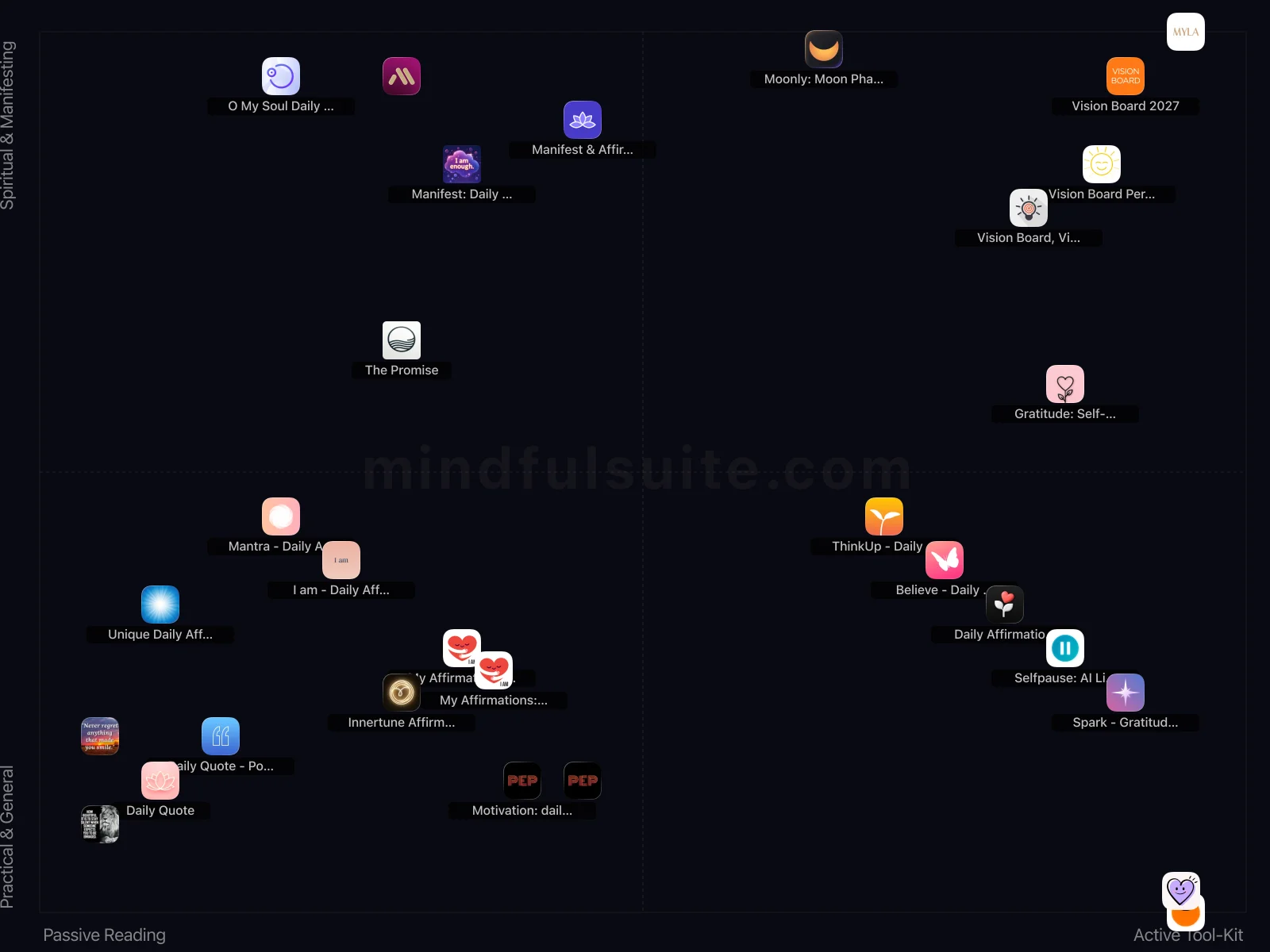
These 29 apps don't all solve the same problem. They cluster into 4 distinct groups, each built around a different philosophy. Understanding which group fits you is the fastest way to narrow your search.
Passive Reading + Spiritual & Manifesting
5 apps in this group, led by  Manifest: Daily Affirmations,
  O My Soul Daily Affirmations, and
  Manifest & Affirmations - Soul.
What defines this cluster: free with in-app purchases, daily positive affirmations, instills positive thinking, assists with self-worth.
Manifest & Affirmations - Soul.
What defines this cluster: free with in-app purchases, daily positive affirmations, instills positive thinking, assists with self-worth.
Active Tool-Kit + Spiritual & Manifesting
5 apps in this group, led by  Gratitude: Self-Care Journal,
  Moonly: Moon Phases & Calendar, and
  Vision Board Perfectly Happy.
What defines this cluster: vision board, daily affirmations, daily gratitude prompts, affirmations.
Vision Board Perfectly Happy.
What defines this cluster: vision board, daily affirmations, daily gratitude prompts, affirmations.
Passive Reading + Practical & General
12 apps in this group, led by  Motivational Quotes Daily+,
  I am - Daily Affirmations, and
  Unique Daily Affirmations.
What defines this cluster: free with iap, daily affirmations, motivational quotes, anxiety relief.
Unique Daily Affirmations.
What defines this cluster: free with iap, daily affirmations, motivational quotes, anxiety relief.
Active Tool-Kit + Practical & General
7 apps in this group, led by  Believe - Daily Affirmations,
  Daily Affirmations Mirror, and
  ThinkUp - Daily Affirmations.
What defines this cluster: free with iap, affirmations, affirmation mirror, positive thinking tools.
ThinkUp - Daily Affirmations.
What defines this cluster: free with iap, affirmations, affirmation mirror, positive thinking tools.
What makes them different
The core tension in this category runs along two axes. On one side, Passive Reading apps prioritize simplicity and speed — you can be up and running in under a minute. On the other, Active Tool-Kit apps offer depth and customization that rewards investment over time.
The second axis — App Focus — captures an equally important difference. Apps closer to Practical & General take a fundamentally different approach than those near Spiritual & Manifesting. Neither is objectively better. The right choice depends on your personality, your experience level, and what you're trying to accomplish.
28 Apps Reviewed
We scored every app using a weighted composite of real App Store and Google Play ratings. Out of 28 apps: 9 Essential · 18 Hidden Gems. 12 cross-platform, 12 iOS-only, 4 Android-only.
Top picks: I am - Daily Affirmations and Unique Daily Affirmations scored highest overall.  Innertune Affirmations rounds out the top three. Switch to the Apps tab for the full list with ratings and download links.
How to Pick the Right One
Look at the cluster section above. If you already know whether you want Passive Reading or Active Tool-Kit, that eliminates half the options instantly. Same for Practical & General vs Spiritual & Manifesting.
Try one app for a full week before judging. Most affirmations apps reveal their value around day 5, not day 1.
Quick start: I am - Daily Affirmations and Unique Daily Affirmations represent two different approaches and both scored highest. Pick whichever resonates, switch if it doesn't click.
Making It Stick: Practical Advice
Downloading the app is the easy part. The hard part — the part that actually produces results — is what happens in weeks two, three, and beyond. These tips are drawn from behavioral research and from patterns we've observed across hundreds of thousands of user reviews. They're not revolutionary, but they work:
Write your own affirmations
Generic affirmations work, but personalized ones are significantly more powerful. Address your specific self-doubt patterns: 'I am capable of handling difficult conversations' rather than generic 'I am great.'
Use present tense and first person
Phrase affirmations as current truths ('I am resilient') rather than future wishes ('I will be resilient'). This helps your brain process them as statements about who you are now.
Pair with a daily anchor
Read or listen to affirmations at the same time each day — morning bathroom mirror time, commute, or bedtime — to build the practice into your routine.
Frequently Asked Questions
These are the questions that come up most often — from our own testing, from user reviews, and from the broader conversation around affirmations apps. If your question isn't here, the Apps tab has detailed information on every app we reviewed.
Do affirmations actually work?
Self-affirmation has solid research support — particularly for buffering against stress, reducing defensiveness, and improving performance in challenging situations. They're most effective when personalized and practiced consistently, rather than generic positive statements.
How many affirmations should I practice daily?
Quality over quantity. 3-5 meaningful, personalized affirmations practiced deliberately are more effective than 20 generic ones scrolled through quickly.
Power Up Your Positivity: The Best Affirmations Apps (2026)
Remember scribbling "You are enough!" on a sticky note and slapping it onto your bathroom mirror? It was a great idea, until the shower steam made it curl up and fall behind the sink. Or maybe you tried a paper journal, but it ended up buried under a stack of mail. We’ve all been there. Trying to wrestle with a nagging inner critic is exhausting when you're relying on sheer willpower alone.
But what if your personal cheerleader lived right in your pocket? Affirmation apps are the modern answer to an age-old challenge. Instead of a forgotten post-it note, these tools bring gentle, consistent reminders straight to your screen. They help you build a powerful new habit, rewiring your brain one positive thought at a time.
Let's find the perfect companion to help you quiet that inner critic and turn up the volume on your own confidence.
The Daily Boosters
These apps master the art of the simple, straightforward nudge. If you just want a consistent dose of positivity to brighten your day without a steep learning curve, start here. They are straightforward, aesthetically pleasing, and designed to seamlessly blend into your daily routine.

Vision
A vision board app that keeps your goals always visible on your lock screen with custom widgets, backgrounds, and an extensive motto library.
- Always-visible vision board through iOS 26 widgets.
- Extensive motto library covering anxiety, ADHD, self-acceptance, and atomic habits.
- Beautiful custom background layouts and dynamic effects.

I am - Daily Affirmations
With over 10 million downloads, 'I am' is the undisputed rockstar of affirmation apps. It’s designed to be an incredibly simple yet effective tool for rewiring your brain and boosting your self-esteem. Its clean interface and endless customization options, from beautiful themes to handy home screen widgets, make it a favorite for beginners and affirmation veterans alike.
- The customizable affirmation reminders throughout the day genuinely help maintain a consistent positive mindset.
- The diverse categories of affirmations, from self-love to success, cater to specific personal growth areas.

Unique Daily Affirmations
True to its name, this app embraces a "less is more" philosophy. It delivers a single, unique affirmation each day, helping you focus your energy on one positive thought without feeling overwhelmed. It's the perfect choice for anyone looking to build a simple, consistent habit without any bells or whistles.
- Its focus on a single, unique daily affirmation prevents overwhelm and encourages deeper reflection.
- The straightforward, minimalist design makes accessing your daily positive thought incredibly simple.

Innertune Affirmations
Innertune Affirmations provides daily positive thoughts. It helps users stop negative thought spirals.
- Directly targets "stopping the negative thought spiral," offering clear purpose for users battling rumination.
- "Daily Positive Thoughts" provides consistent, actionable prompts to shift one's mindset.

Mantra - Daily Affirmations
Mantra is all about the aesthetic. This beautifully designed app focuses on delivering daily positive statements with a calm, clean, and visually pleasing interface. If you believe the experience of reading an affirmation should be as peaceful as the message itself, Mantra is your digital zen garden.
- The simple, elegant interface makes selecting and receiving daily affirmations incredibly straightforward and visually appealing.
- Its focus on core areas like self-love and confidence provides targeted motivation without overwhelming complexity.

My Affirmations: Live Positive
Provides daily affirmations to instill positive values and beliefs. It's for those wanting to change their mindset and create a new reality through positive affirmations.

Daily Affirmations & Quotes
Offers a large collection of over 10,000 quotes across 50+ categories for users seeking daily affirmations and inspiration.
- An enormous library of over 10,000 quotes provides endless inspiration and positive reinforcement on demand.
- The ability to easily share quotes across various platforms makes spreading positivity incredibly simple.

Motivational Quotes Daily+
Provides daily motivational quotes and pep talks to help with stress and anxiety relief. It's for those looking for daily self-improvement and self-care guidance.
- Provides a constant stream of uplifting quotes, offering quick motivational boosts to maintain goal focus and resilience.
- Curated categories and daily reminders effectively inject positive reinforcement into your routine for consistent inspiration.

Motivation: daily Peptalk
Provides motivational videos, audio, and quotes to help users stay focused and productive. It is for people who need a boost of motivation to perform at their best.
- Incorporates "Videos, audio, quotes & widget," offering a versatile multimedia approach to daily motivation.
- Functions as a "pocket-sized motivational companion," providing quick, accessible boosts whenever needed.

Peptalk: Daily Motivation
Peptalk is your pocket-sized coach, combining videos, audios, and quotes to give you a multimedia boost. It’s a powerhouse of inspiration designed to give you the exact push you need, whether through a rousing speech or a thought-provoking clip.
- The blend of daily motivational videos, audios, and quotes offers a richer, more dynamic experience.
- The "Goals" feature allows you to personalize content around specific aspirations, making motivation highly relevant.

Daily Quote - Positive quotes
For those who believe a picture is worth a thousand words, Daily Quote pairs powerful inspiration with stunning visuals. The app offers a vast collection of curated quotes set against beautiful, high-quality background images, making each message a mini work of art.
- The "beautiful background imagery" truly elevates the visual experience of receiving daily inspirational quotes.
- Its focus on thoughtfully curated quotes ensures high-quality, impactful content over sheer volume.

Daily Quote
Provides a daily motivational quote as a mental stimulant to inspire and promote personal growth, displayed as a widget.
Personalized & Interactive Apps
Ready to take your practice to the next level? These apps use creative features like AI coaching, customizable audio playlists, and even your phone’s front-facing camera to make the experience uniquely yours. Looking yourself in the eye or hearing a customized prompt while reading an affirmation is surprisingly powerful.

Believe - Daily Affirmations
Believe wants you to do more than just read—it wants you to interact. The app offers a large library of affirmations and includes engaging tools like an "affirmation mirror," which uses your phone's camera to make the practice more personal. It’s designed to help you actively challenge negative thoughts and reframe them in a positive light.
- Offers a massive collection of affirmations across diverse categories, catering to almost any need.
- The integrated "Affirmation Mirror" provides an engaging, personalized way to internalize positive statements.

Daily Affirmations Mirror
This Android-only app offers a uniquely powerful experience. It uses your phone's front-facing camera to create a mirror, overlaying positive affirmations on your own reflection. This simple but brilliant feature encourages you to look yourself in the eye while absorbing positive messages, which can dramatically deepen their impact.
- Overlaying affirmations onto your reflection using the camera creates a powerful, personal connection.
- The interactive "Mirror Mode" genuinely enhances engagement and makes affirmations feel more immediate.

ThinkUp - Daily Affirmations
A health and fitness app that uses positive affirmations to build motivation. It helps users develop a positive mindset.

Manifest & Affirmations - Soul
Generates personalized affirmations based on user-defined desires to help manifest goals using the law of attraction.
- Generates personalized daily affirmations, fostering a consistent positive mindset towards achieving specific desires and goals.
- The focused approach on manifestation and Law of Attraction appeals directly to users seeking mental reinforcement for their aspirations.
My Affirmations: Live Positive
This app is built for repetition, repetition, repetition. It’s designed to help positive thoughts take root in your subconscious mind by letting you set frequent reminders throughout the day. You can organize affirmations from a huge range of categories into personalized playlists and even add your own background sounds for a custom-tailored experience.
- Setting reminders at custom intervals throughout the day ensures consistent exposure to positive thoughts.
- The categorized affirmations make it easy to focus on specific areas of personal growth or challenge.

Selfpause: AI Life Coach
Imagine having an AI-powered life coach in your pocket. Selfpause uses artificial intelligence to offer a more personalized self-improvement journey. It provides guided affirmation tracks and support tailored to your specific goals, whether you're working to overcome anxiety or build unshakeable confidence.
- The AI life coach offers personalized guidance and conversational support, a unique differentiator in this category.
- Its library of affirmation tracks, often AI-generated or curated, provides a fresh take on positive messaging.
Holistic Wellness Hubs
Sometimes affirmations are just one piece of the puzzle. These apps combine daily positive statements with gratitude journaling, visual manifestation boards, and mood tracking to give you a complete mental wellness toolkit. If you want a centralized home for all your self-care rituals, these are heavy hitters.

Gratitude: Self-Care Journal
This app is more than just a journal; it's a complete wellness toolkit. It wraps your gratitude practice in a warm hug of self-care, offering daily affirmations, a vision board for your dreams, and thought-provoking prompts to guide you.
- The combination of daily gratitude prompts, affirmations, and a vision board within one app offers a holistic manifestation approach.
- The "Gratitude Wall" feature, showcasing shared positive entries, provides a unique sense of community and inspiration.

Vision Board Perfectly Happy
An all-in-one wellness app that seamlessly integrates vision boards with tools like affirmations, a gratitude journal, and mood tracking to provide a holistic approach to manifestation.
- Offers a unique "vision board" feature, allowing visual goal setting alongside daily affirmations.
- Combines "visualization, daily affirmations, motivation" for a comprehensive manifestation approach to happiness.

Spark - Gratitude Journal
This app helps cultivate gratitude through journaling, mood tracking, habit tracking, and affirmations. It is for anyone looking to improve their well-being through positive psychology practices.
- The integration of mood tracking, habit tracking, and affirmations offers a genuinely holistic self-care platform.
- Daily guided affirmations provide structured positive reinforcement, enhancing the gratitude practice.

Manifest: Law of Attraction App
This app aims to be your one-stop shop for manifestation. It neatly integrates the core pillars of the practice—meditation, gratitude, affirmations, and visualization—into a single, streamlined experience to keep you focused and inspired.
- Its all-in-one approach, combining meditations, journaling, affirmations, and vision boards, provides a comprehensive manifestation toolkit.
- Specific techniques like the 369 method are integrated, offering structured guidance for those familiar with Law of Attraction practices.

Vision Board 2027
A highly customizable iOS app that lets you create not just static vision boards but also "vision board movies" with music and personal affirmations.
- Its unique focus on the "Bagua map" and visualization provides a distinct, spiritually aligned approach to goal setting and manifestation.
- The integration of "Affirmations" directly supports a positive mindset, which is crucial for staying motivated towards long-term goals.

Vision Board, Visualize dreams
This vision board app helps users visualize dreams and manifest goals through visualization and affirmations. Vision Board allows users to focus, plan, and track life goals.
Spiritual & Niche Focus
If you want your positive messaging tied to your spiritual beliefs, the rhythms of the cosmos, or highly specific personal goals like tapping into feminine energy, these apps offer a beautifully tailored experience. They skip the generic advice in favor of deep, targeted resonance.

Moonly: Moon Phases & Calendar
For anyone who feels connected to the rhythms of nature, Moonly offers a magical twist. It provides daily affirmations, wisdom, and rituals that align with the current phase of the moon. It’s a beautiful guide to mindfulness that connects your inner world with the cosmos.
- Its unique alignment of daily affirmations with current Moon phases provides a distinct spiritual dimension.
- Includes a wealth of information on moon rituals, tarot, and birth charts, appealing to a specific audience.

Manifest Affirmations
Provides affirmations and practices designed to attract abundance and radiate feminine energy.
- Caters to a specific "glow-up" and "feminine energy" niche, offering tailored empowering content.
- Focuses on attracting "unlimited abundance" through affirmations, appealing directly to manifestation enthusiasts.

O My Soul Daily Affirmations
Offers twice-daily Christian prayers and meditations.
- Provides "unique Prayers Twice a Day," offering consistent spiritual nourishment and structured reflection.
- "Christian Meditation & Prayer" creates a distinct niche within the broader affirmations category.

Manifest: Daily Affirmations
Provides positive daily affirmations to instill positive thinking and self-worth.
Find Your Daily Voice
Ultimately, the most effective affirmation app is the one you actually use. Whether you prefer a clean, minimalist aesthetic, a deeply interactive digital mirror, or a spiritual guide synced with the moon, the perfect tool is the one that fits seamlessly into your morning routine. The key is simply getting started. Pick the app that resonates most, set up your first daily reminder, and take that powerful first step toward becoming your own biggest fan.