
Personal Finance Tracker Apps: What You Need to Know in 2026
You checked your bank account and the number was lower than expected. Not dramatically low — just that vague, unsettling 'where did it go?' feeling. Money leaks through small, invisible transactions: subscriptions you forgot about, coffee runs that add up, Amazon orders that seemed harmless one at a time. Finance trackers make the invisible visible.
We evaluated 15 personal finance tracker apps across iOS and Android, scoring each on real user ratings, feature depth, and long-term value. This guide covers what we found.
The Awareness Effect: Why Tracking Changes Spending Behavior
There is a phenomenon in behavioral economics that finance apps exploit brilliantly, whether they know it or not: the Hawthorne effect. The original finding, from a series of experiments at Western Electric's Hawthorne Works in the 1920s, showed that workers became more productive simply because they knew they were being observed. The observation itself, independent of any other intervention, changed behavior.
Applied to personal finance, the principle is the same. The simple act of measuring your spending changes your spending. Studies on financial tracking consistently show a 10 to 20 percent reduction in discretionary spending during the first month of consistent tracking, and the reduction persists as long as the tracking continues. No budget is required. No willpower is deployed. No purchases are explicitly forbidden. You just start watching where your money goes, and the watching itself produces restraint.
The mechanism is the aggregation of invisible costs. A four-dollar coffee feels insignificant. You do not think about it. You do not feel it. But a finance tracker shows you that you spent $120 on coffee last month, and that number produces a visceral reaction that the individual transactions never did. A $12 streaming service feels trivial — until you see that you are paying for five of them and using two. A $30 impulse purchase on Amazon feels harmless — until the monthly total reveals you made eleven of them.
This is why finance tracking is the single most powerful personal finance intervention that does not require willpower. Budgeting requires discipline. Investing requires knowledge. Negotiating a raise requires courage. But tracking requires only the mechanical act of recording what you already do — and the awareness it creates does the behavioral work for you.
The effect is strongest in the first month, when the gap between perceived and actual spending is widest. Most people underestimate their discretionary spending by 30 to 40 percent. The first monthly summary is frequently described as a shock. That shock is the point. It recalibrates your intuition about where your money goes, and once recalibrated, your intuition stays more accurate even on days when you do not check the app.
Manual Entry vs Bank Sync: The Hidden Tradeoff
The finance app market has split along a fault line that maps to a genuine tension in behavioral psychology: convenience versus engagement.
Bank sync — the feature where apps connect to your financial institutions through aggregators like Plaid or MX and automatically import transactions — is unquestionably more convenient. Every purchase, payment, and transfer appears in the app without any action on your part. Categorization is automatic or semi-automatic. Your financial picture is always current. The friction is essentially zero.
Manual entry — the old-fashioned approach where you type in each transaction yourself — is unquestionably more tedious. You have to remember to do it. You have to pull out your phone after every purchase. If you skip a few days, catching up feels like homework. Most people who start with manual entry apps eventually abandon them.
Here is the problem: the tedium is the feature. Research on expense tracking suggests that manual entry produces stronger behavior change than automatic import, precisely because of the friction. When you type "$4.50 — Starbucks" into your phone, you are forced into a moment of conscious engagement with that transaction. You feel the spending. The act of recording creates a brief pause — a micro-reflection — that automatic import eliminates entirely. With bank sync, you see your spending; with manual entry, you experience it.
This does not mean manual entry is universally better. If the friction causes you to abandon the app entirely — which it does for most people — then zero tracking is worse than passive tracking. A finance app you do not use helps no one.
The compromise that some financial advisors recommend captures both benefits: use bank sync for completeness and convenience, but conduct a manual categorization review once per week. Sit down for fifteen minutes every Sunday, look at each transaction, and confirm or correct its category. This weekly ritual provides the conscious engagement that drives behavior change without the daily friction that kills the habit. You get automatic data collection with manual awareness-building — the reliability of the machine combined with the behavioral impact of human attention.
Is It Safe to Connect Your Bank? What You Need to Know
The security question is the first one most people ask about finance apps, and the industry's standard answer — "we use bank-level encryption" — is technically true and practically insufficient. Here is a more complete picture.
The technology layer is genuinely robust. Aggregators like Plaid and MX, which power bank connectivity for most finance apps, use read-only API connections. They can view your transaction data but cannot initiate transfers, payments, or any movement of funds. Data in transit is encrypted with TLS 1.2 or higher — the same encryption your bank uses when you log in through a browser. Data at rest is encrypted with AES-256. These are not marketing claims; they are auditable standards verified through SOC 2 Type II compliance, which requires an independent audit of security controls over a sustained period.
The risk of someone hacking into Plaid or MX and accessing your bank account to steal money is, realistically, extremely low. These are billion-dollar infrastructure companies whose entire business model depends on security. A breach would be existentially threatening to them. They invest accordingly.
The more interesting risk — and the one the industry talks about less — is data. Your transaction history is an extraordinarily detailed portrait of your life: where you shop, what you eat, what medications you take, your income, your vices, your travel patterns. Some aggregators and some finance apps use this data in anonymized, aggregated form for market research, trend analysis, or advertising targeting. The terms of service allow this. Most users do not read the terms of service.
The questions worth asking before connecting your bank are not about encryption — they are about data practices. Does the app sell aggregated spending data to third parties? What happens to your data if the company is acquired or goes bankrupt? Can you fully and permanently delete your data if you close your account? Is the spending analysis performed on-device or on the company's servers? These questions matter more than the encryption specification because encryption protects against external attackers, while data policies govern what the company itself does with your information.
For people who remain uncomfortable with bank connectivity — and that is a legitimate position, not a paranoid one — manual-entry finance apps provide the same core functionality without any data-sharing. You lose the convenience of automatic import. You gain complete control over what information leaves your device. For some users, that tradeoff is worth making.
4 Types of Personal Finance Tracker Apps — and How They Differ
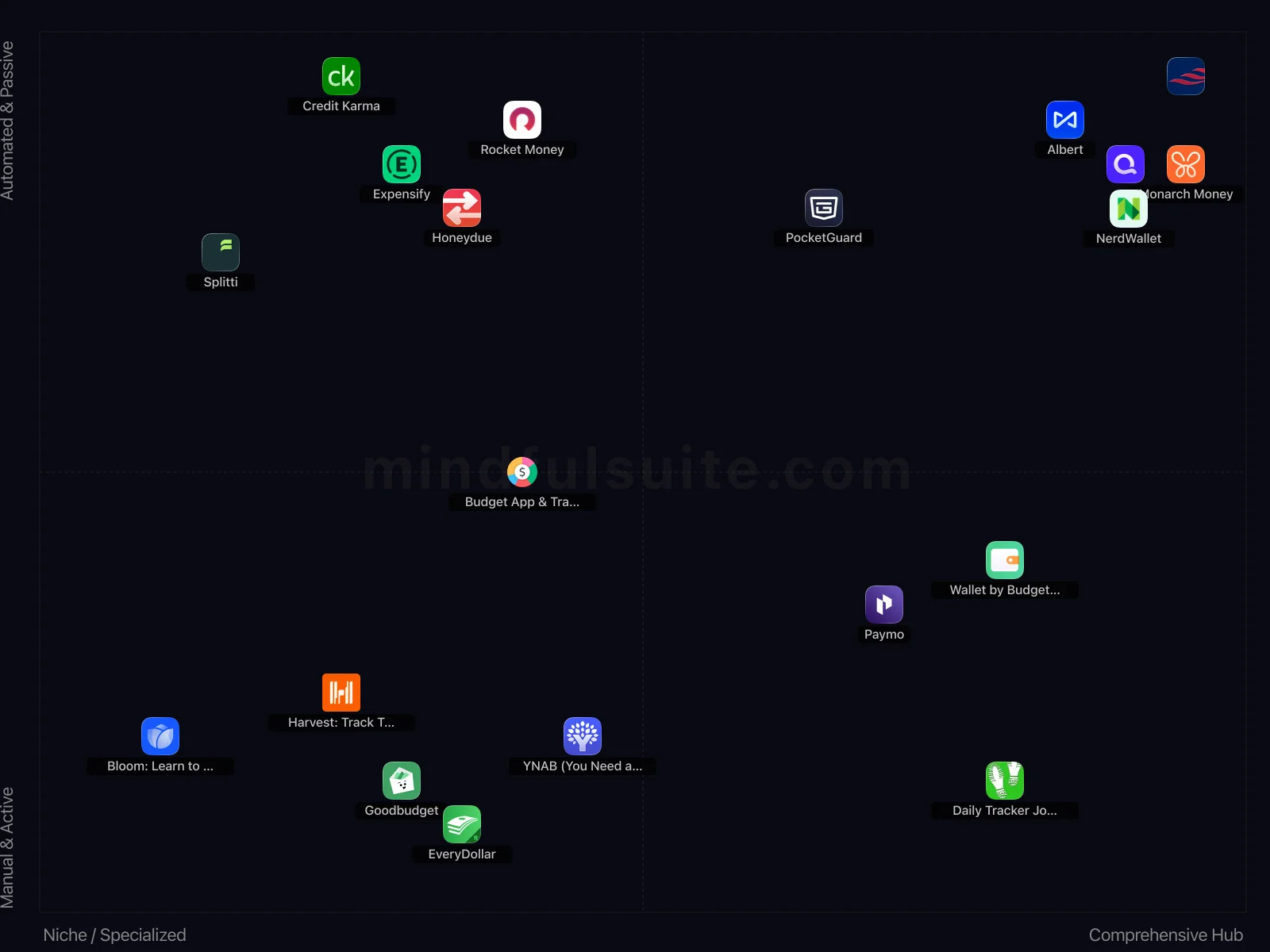
These 20 apps don't all solve the same problem. They cluster into 4 distinct groups, each built around a different philosophy. Understanding which group fits you is the fastest way to narrow your search.
Niche / Specialized + Automated & Passive
6 apps in this group, led by  Expensify,
  Credit Karma, and
  Rocket Money.
What defines this cluster: expense management system, track/submit expenses, track billable hours, free with in-app purchases.
Rocket Money.
What defines this cluster: expense management system, track/submit expenses, track billable hours, free with in-app purchases.
Comprehensive Hub + Automated & Passive
6 apps in this group, led by  Albert,
  Monarch Money, and
  Quicken Simplifi.
What defines this cluster: budgeting, saving, investing, automated savings.
Quicken Simplifi.
What defines this cluster: budgeting, saving, investing, automated savings.
Niche / Specialized + Manual & Active
5 apps in this group, led by  Bloom: Learn to Invest,
  EveryDollar, and
  YNAB (You Need a Budget).
What defines this cluster: free with in-app purchases, guided cbt exercises, self-care activities, zero-based budgeting app.
YNAB (You Need a Budget).
What defines this cluster: free with in-app purchases, guided cbt exercises, self-care activities, zero-based budgeting app.
Comprehensive Hub + Manual & Active
3 apps in this group, led by  Wallet by BudgetBakers,
  Paymo, and
  Daily Tracker Journal & Diary.
What defines this cluster: track spending, plan budgets, financial overviews, financial habit insights.
Daily Tracker Journal & Diary.
What defines this cluster: track spending, plan budgets, financial overviews, financial habit insights.
What makes them different
The core tension in this category runs along two axes. On one side, Niche / Specialized apps prioritize simplicity and speed — you can be up and running in under a minute. On the other, Comprehensive Hub apps offer depth and customization that rewards investment over time.
The second axis — Automation — captures an equally important difference. Apps closer to Manual & Active take a fundamentally different approach than those near Automated & Passive. Neither is objectively better. The right choice depends on your personality, your experience level, and what you're trying to accomplish.
15 Apps Reviewed
We scored every app using a weighted composite of real App Store and Google Play ratings. Out of 15 apps: 12 Essential · 2 Hidden Gems · 1 Mainstream. 14 cross-platform, 1 Android-only.
Top picks: YNAB (You Need a Budget) and EveryDollar scored highest overall. Quicken Simplifi rounds out the top three. Switch to the Apps tab for the full list with ratings and download links.
How to Pick the Right One
Look at the cluster section above. If you already know whether you want Niche / Specialized or Comprehensive Hub, that eliminates half the options instantly. Same for Manual & Active vs Automated & Passive.
Try one app for a full week before judging. Most personal finance tracker apps reveal their value around day 5, not day 1.
Quick start: YNAB (You Need a Budget) and EveryDollar represent two different approaches and both scored highest. Pick whichever resonates, switch if it doesn't click.
Making It Stick: Practical Advice
Downloading the app is the easy part. The hard part — the part that actually produces results — is what happens in weeks two, three, and beyond. These tips are drawn from behavioral research and from patterns we've observed across hundreds of thousands of user reviews. They're not revolutionary, but they work:
Track every transaction for one month
Complete tracking for even one month reveals spending patterns you didn't know you had. This awareness alone often changes behavior.
Use the 50/30/20 rule as a starting point
50% of income to needs, 30% to wants, 20% to savings and debt repayment. It's a simple framework that most finance apps can track.
Review weekly, not just monthly
Monthly reviews reveal what already happened. Weekly reviews let you course-correct before overspending in any category.
Frequently Asked Questions
These are the questions that come up most often — from our own testing, from user reviews, and from the broader conversation around personal finance tracker apps. If your question isn't here, the Apps tab has detailed information on every app we reviewed.
Is it safe to connect a finance app to my bank account?
Reputable finance apps use bank-level encryption and read-only access (they can see transactions but can't move money). Check for SOC 2 compliance and read the security documentation. If you're uncomfortable with bank linking, manual-entry apps are equally effective.
How long does it take to see financial improvement?
Most people notice meaningful changes within the first month of consistent tracking. The awareness effect is immediate. Building better financial habits typically takes 2-3 months.
Best Personal Finance Tracker Apps for Every Goal (2026)
Remember that shoebox stuffed with crumpled receipts? Or the kitchen drawer where paper bank statements and mysterious bills went to die? For a long time, figuring out where your money went involved a calculator, a fresh notebook, and a whole lot of guesswork. It was a financial puzzle where half the pieces were always missing. That nagging feeling of "Am I saving enough?" or "Where did my paycheck actually go?" was just a frustrating part of adult life.
Not anymore. The best personal finance apps act as your personal CFO, right in your pocket. They connect the dots between your spending and your goals, transforming that chaotic shoebox of receipts into clear, actionable insights. They turn financial anxiety into financial clarity, helping you finally build the future you want.
For Hands-On Budgeting
These apps are for those who want to be in the driver's seat. If you like actively telling your money where to go instead of wondering where it went, these trackers will help you break the paycheck-to-paycheck cycle and build real momentum.

YNAB (You Need a Budget)
YNAB is a highly popular budgeting app built on the philosophy of zero-based budgeting, or "giving every dollar a job." It's less of a passive tracker and more of an active financial management system designed to help you break the paycheck-to-paycheck cycle, demolish debt, and save more money than you thought possible.
- The "give every dollar a job" philosophy is incredibly effective for proactive budgeting and debt reduction.
- Offers robust features like transaction import, goal tracking, and detailed reporting for serious budgeters.

Goodbudget
Goodbudget is a brilliant digital twist on the classic envelope budgeting system your grandparents might have used. You portion your monthly income into digital "envelopes" for your spending categories (like groceries, gas, and fun). This method helps you stick to your budget by only spending what's in each envelope.
- The digital envelope system is an intuitive way to visualize and manage spending categories effectively.
- Its "Households" feature allows partners to share and manage the family budget collaboratively.

EveryDollar
Developed by Ramsey Solutions, EveryDollar is another champion of the zero-based budgeting method. It's designed to align with Dave Ramsey's "Baby Steps" financial plan, helping you track every single dollar of your income and expenses to make real progress on your financial goals.
- The zero-based budgeting method truly forces you to assign every dollar a job, promoting intentional spending.
- Seamlessly integrates with Ramsey's financial principles, appealing directly to his dedicated followers.

Budget App & Tracker: Spendee
Budget App & Tracker: Spendee is a money and expense tracker to help you manage your finances. It works as a budget planner to track spending.
For the Big Picture Overview
Sometimes you don't want to micromanage every single coffee purchase. If your goal is to see everything in one place—from your checking account to your 401(k) and mortgage—these apps provide a powerful, unified dashboard for your entire financial world.

Quicken Simplifi
From the makers of the legendary Quicken software, Simplifi is a modern, mobile-first app designed to give you a real-time, consolidated view of all your finances. It generates a personalized spending plan to help you stay on track without micromanaging every single transaction.
- Provides a clean, intuitive interface that simplifies expense tracking and spending plan creation.
- Offers strong connectivity with various financial institutions, ensuring a comprehensive financial overview.

Empower Personal Dashboard
Formerly Personal Capital, Empower Personal Dashboard is a powerhouse for tracking your net worth and managing your investments. While it has budgeting features, its real strength is providing a comprehensive overview of your entire financial portfolio, from checking accounts to complex retirement funds.
- Offers unparalleled free investment tracking and net worth aggregation across all your financial accounts.
- Provides detailed portfolio analysis and retirement planning tools, invaluable for long-term financial strategy.

NerdWallet
NerdWallet is a comprehensive personal finance app that helps you track your spending, net worth, and credit score all in one place. Beyond tracking, it provides personalized financial insights and recommendations for products like credit cards and loans to help you make smarter money moves.
- Aggregates credit scores, net worth, and spending for a broad financial overview, all completely free.
- Provides valuable, unbiased comparisons of financial products, helping users make informed decisions.

Monarch Money
Monarch Money is a modern, all-in-one financial platform that offers a beautiful, holistic view of your finances. It's designed for individuals and couples who want to track everything from daily spending and budgets to investments and long-term financial goals in a clean, customizable interface.
- Offers a truly comprehensive dashboard, integrating budgeting, investments, and net worth tracking seamlessly.
- Its collaboration features allow partners to manage finances together with robust customization options.
For Automated Savings & Bill Busting
We all have subscriptions we've forgotten about. These apps work like financial assistants in the background. They quietly analyze your spending to automatically save extra cash, identify unused services, and relentlessly slash your recurring bills.

Albert
Albert is an all-in-one finance app that works to automate your financial life. It analyzes your income and spending to find extra dollars to save automatically, offers guided investing, and provides access to human financial experts for personalized advice.
- The "Genius" feature offers personalized financial advice and automated savings, making money management effortless.
- Provides micro-investing options and cash advances, catering to a range of immediate and long-term financial needs.

Rocket Money
Formerly known as Truebill, Rocket Money excels at helping you take control of your recurring expenses. It provides a clear overview of your subscriptions and monthly bills, making it incredibly easy to cancel services you forgot about and even negotiating better rates on your behalf.
- Exceptional at identifying and helping cancel unwanted subscriptions, a significant money-saving feature.
- The bill negotiation service actively works to lower monthly recurring payments, potentially saving users hundreds.

PocketGuard
PocketGuard aims to simplify your financial life by answering one key question: "How much is in my pocket?" The app automatically calculates your truly spendable money after factoring in your income, bills, recurring expenses, and savings goals, giving you a clear, guilt-free spending limit.
- The "IN MY POCKET" feature provides an instant, clear view of spendable cash after bills and goals.
- Its automated bill negotiation and subscription finder actively help users identify and cut unnecessary expenses.
For Managing Money with Others
Combining finances can be notoriously tricky. These apps are built from the ground up to make managing money with a partner, family, or housemates a breeze. They foster transparency, share the load, and help cut out the money arguments.

Wallet by BudgetBakers
Wallet is a flexible and feature-rich personal finance planner that shines when managing shared finances. It allows you to automatically sync bank accounts or manually enter transactions, offering detailed charts and reports to help you understand your household's spending habits.
- Offers extensive customization for categories, accounts, and reporting, catering to detailed budgeting needs.
- Supports multiple currencies and manual transaction entry, ideal for international users or privacy-focused individuals.

Honeydue
As the name suggests, Honeydue is designed specifically for couples. It allows you and your partner to sync your bank accounts, credit cards, and loans to a joint dashboard. The app helps you coordinate on bills, manage budgets together, and have transparent conversations about money without the stress.
- Its laser focus on joint financial tracking uniquely fosters transparency and collaboration for couples.
- The ability to see shared bills and bank balances in one place simplifies household money management.
For Freelancers & Business Expenses
If your personal finances constantly bleed into your business expenses, you need a different kind of tool. This app simplifies tracking billable hours and turns a chaotic stack of business receipts into clean, scannable expense reports.

Expensify
It streamlines expense tracking and submission, allowing users to track billable hours alongside project costs.
- SmartScan receipt processing revolutionizes expense reporting, streamlining alongside billable hours for freelancers.
- "Money at the speed of chat" interface makes adding time entries quick and conversational, a unique approach.
For Your Credit Health
A budget is only one half of the financial equation. While not a daily expense tracker, keeping tabs on your credit score and protecting your financial identity is an absolutely essential piece of your wealth-building toolkit.

Credit Karma
Credit Karma is an essential tool for monitoring your overall financial health. It provides free access to your credit scores and reports from two major bureaus (TransUnion and Equifax) and offers valuable insights into what affects your score and how you can improve it.
- Provides genuinely free TransUnion and Equifax credit scores and reports without hidden fees.
- Offers valuable credit monitoring and alerts for suspicious activity, protecting your financial identity.