
Period Tracker Apps: What You Need to Know in 2026
Your body runs on cycles, but they don't always follow the textbook 28-day schedule. Period tracker apps bring predictability to the unpredictable — helping you anticipate your period, understand your symptoms, and recognize patterns that give you genuine insight into your health.
We evaluated 13 period tracker apps across iOS and Android, scoring each on real user ratings, feature depth, and long-term value. This guide covers what we found.
Cycle Literacy: Understanding the Four Phases (and Why It Matters)
The menstrual cycle is not a single event that happens once a month. It is a continuous hormonal rhythm with four distinct phases, each producing measurably different effects on energy, mood, cognition, and physical capacity. Understanding these phases transforms a period tracker from a countdown clock into a genuine health intelligence tool.
The menstrual phase (days 1-5, approximately) is when bleeding occurs. Hormone levels — both estrogen and progesterone — are at their lowest. Energy tends to be low. This is not the time to schedule your most demanding presentation or attempt a personal best at the gym. It is, however, often a time of heightened introspection and clarity about priorities, which some women use deliberately for planning and reflection.
The follicular phase (days 6-13) follows menstruation. Estrogen begins climbing, and with it, energy, mood, and cognitive sharpness. This is hormonally the most favorable phase for demanding work, creative projects, and intense physical training. Many women report feeling their most capable and confident during this phase — not because of some vague sense of well-being, but because of the measurable effects of rising estrogen on serotonin and dopamine production.
Ovulation (around day 14) is brief but hormonally significant. Estrogen peaks, testosterone surges briefly, and luteinizing hormone triggers egg release. Energy and sociability tend to peak. Communication skills are measurably sharper — studies have shown improved verbal fluency during the ovulatory phase.
The luteal phase (days 15-28) is the long back half. Progesterone rises and estrogen drops. Energy decreases. PMS symptoms, if they occur, emerge here. This phase favors detail-oriented work over creative ideation, and rest over intense exertion.
This is not pseudoscience — it is endocrinology. Tracker apps that educate users about these phases and help them plan accordingly provide dramatically more value than those that simply predict when bleeding will start. The most useful trackers overlay your logged symptoms onto phase data, revealing your personal pattern within the general framework. Your follicular energy boost might be moderate while your luteal dip is pronounced, or vice versa. The population averages are a starting point; your data tells your specific story.
Period Data Privacy: Why This Category Demands More Scrutiny Than Any Other
No other app category carries the legal and personal risk that period trackers do. This is not alarmism — it is a direct consequence of the post-Dobbs legal landscape in the United States and similar restrictions in other countries where reproductive rights are contested.
After the Supreme Court's 2022 Dobbs v. Jackson decision overturned Roe v. Wade, period tracking data acquired a new dimension of risk. In states with restrictive abortion laws, prosecutors can theoretically subpoena digital health records — including cycle data, missed period logs, and pregnancy-related symptom tracking — as evidence. This is not a hypothetical scenario. Law enforcement agencies have already sought digital evidence in reproductive health cases, and the data trail left by period trackers is precisely the kind of timestamped, detailed record that legal proceedings can exploit.
Several major apps responded quickly. Flo, one of the largest period trackers globally, introduced an Anonymous Mode that disconnects user data from identifying information. Clue, based in the EU, emphasized its GDPR compliance and European data storage. Smaller apps like Drip and Euki were built from the ground up with privacy-first architectures: local-only data storage, no cloud sync, no account creation required.
When evaluating any period tracker, ask these specific questions. Where is the data stored — on your device or on company servers? If in the cloud, in which country, and under which legal jurisdiction? Is the data encrypted end-to-end, or can the company access it? Does the app share data with third parties, including analytics providers, advertisers, or data brokers? Can you delete all your data permanently, and does the company retain backups? Does the app require an account with identifying information, or can you use it anonymously?
The privacy policy is the document that answers these questions, and reading it is not optional in this category. A period tracker with a beautiful interface and smart predictions is worthless if it stores your most sensitive health data on a server that can be accessed by parties you never intended to share it with.
Beyond Period Prediction: Using Cycle Data for Holistic Health Insight
The most common use of a period tracker is the most basic: predicting when the next period will start. That is useful. It is also a fraction of what cycle data can tell you about your health.
Cycle regularity is itself a vital sign — a concept that the American College of Obstetricians and Gynecologists has formally endorsed. A cycle that has been consistently 28-30 days for years and suddenly becomes 21 or 38 days is a signal. It could indicate stress (cortisol disrupts the hypothalamic-pituitary-ovarian axis), thyroid dysfunction (both hypo- and hyperthyroidism affect cycle length), polycystic ovary syndrome (PCOS), significant weight changes, or perimenopause. A period tracker that stores historical data makes these shifts visible in a way that memory alone cannot.
Symptom tracking across the full cycle — not just during menstruation — reveals patterns that are invisible on a monthly view. You might discover that your migraines consistently appear two days before your period, suggesting a hormonal trigger that your neurologist can address. You might find that your anxiety spikes during the luteal phase but resolves when menstruation begins, a pattern consistent with premenstrual dysphoric disorder (PMDD) that affects roughly 3-8% of menstruating people.
The most sophisticated trackers now integrate with wearable devices to capture basal body temperature (BBT) and heart rate variability (HRV) — two biometrics that shift predictably across the cycle. BBT rises approximately 0.3-0.5 degrees Celsius after ovulation and remains elevated through the luteal phase. HRV, a marker of autonomic nervous system balance, tends to decrease during the luteal phase as progesterone exerts its effects. These data streams, combined with symptom logs, create a rich picture that approaches what a reproductive endocrinologist would want to see.
The trajectory of this category is clear: the best period trackers are evolving from countdown timers into full-cycle health platforms. They are becoming tools not just for predicting periods but for understanding how your hormonal rhythm affects your entire body — energy, mood, cognition, pain, digestion, sleep. That understanding is not a luxury. It is basic health literacy that has been historically underserved by both medicine and technology.
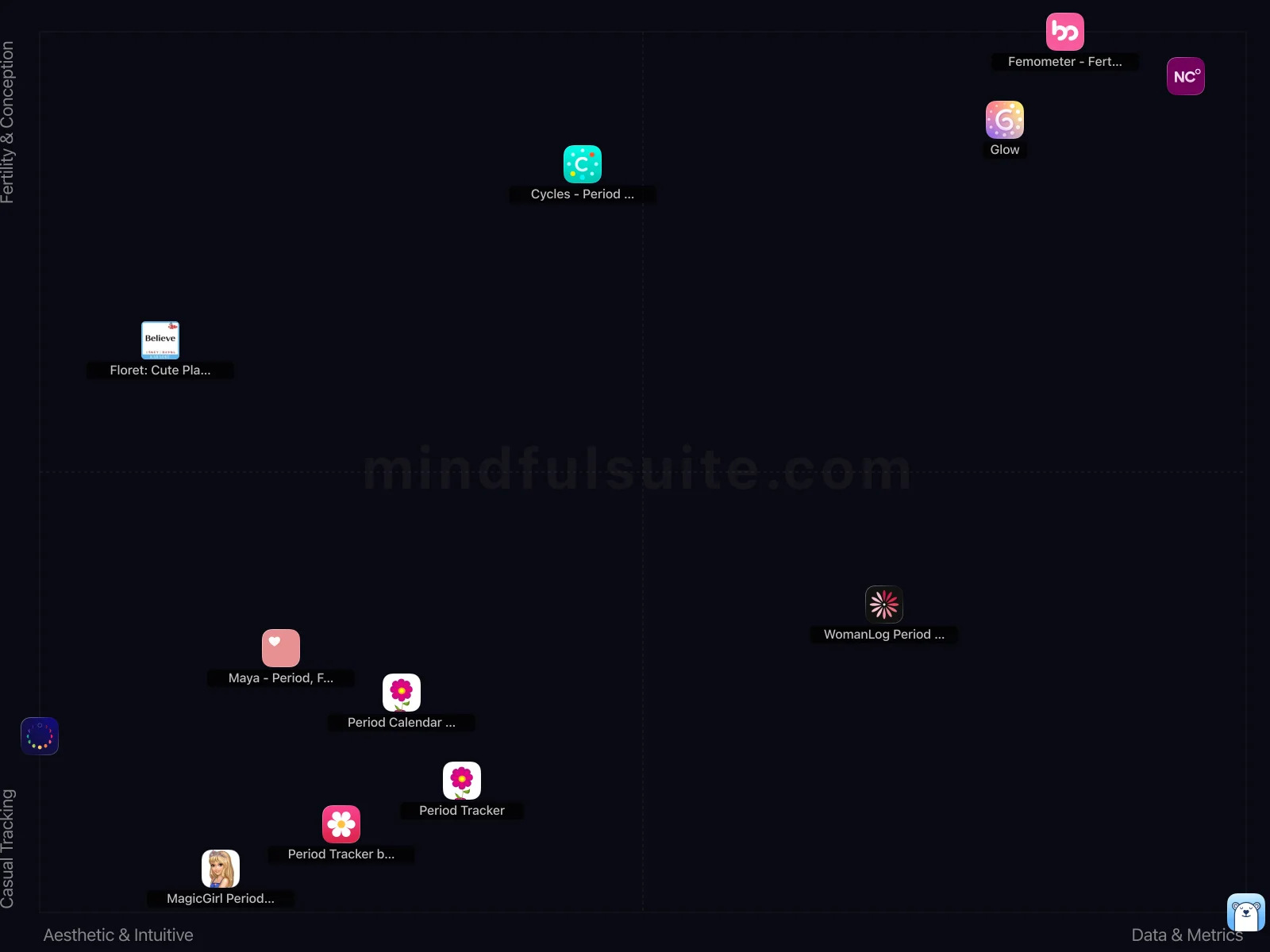
4 Types of Period Tracker Apps — and How They Differ
These 11 apps don't all solve the same problem. They cluster into 4 distinct groups, each built around a different philosophy. Understanding which group fits you is the fastest way to narrow your search.
Aesthetic & Intuitive + Fertility & Conception
2 apps in this group, led by  Floret: Cute Planner & Journal and
  Cycles - Period & Cycle Tracker.
Data & Metrics + Fertility & Conception
2 apps in this group, led by  Glow and
  Natural Cycles - Birth Control.
What defines this cluster: period tracker, ovulation tracker, fertility insights, community support.
Natural Cycles - Birth Control.
What defines this cluster: period tracker, ovulation tracker, fertility insights, community support.
Aesthetic & Intuitive + Casual Tracking
6 apps in this group, led by  Period Tracker,
  Stardust, and
  Period Calendar Period Tracker.
What defines this cluster: period tracker, period tracking, menstrual cycle prediction, logs period dates.
Period Calendar Period Tracker.
What defines this cluster: period tracker, period tracking, menstrual cycle prediction, logs period dates.
Data & Metrics + Casual Tracking
1 apps in this group, led by  WomanLog Period Tracker.
What defines this cluster: period and fertility calendar, various tracking options, free with in-app purchases.
WomanLog Period Tracker.
What defines this cluster: period and fertility calendar, various tracking options, free with in-app purchases.
What makes them different
The core tension in this category runs along two axes. On one side, Aesthetic & Intuitive apps prioritize simplicity and speed — you can be up and running in under a minute. On the other, Data & Metrics apps offer depth and customization that rewards investment over time.
The second axis — Primary Goal — captures an equally important difference. Apps closer to Casual Tracking take a fundamentally different approach than those near Fertility & Conception. Neither is objectively better. The right choice depends on your personality, your experience level, and what you're trying to accomplish.
13 Apps Reviewed
We scored every app using a weighted composite of real App Store and Google Play ratings. Out of 13 apps: 9 Essential · 2 Hidden Gems · 1 Mainstream. 7 cross-platform, 4 iOS-only, 2 Android-only.
Top picks:  Maya - Period, Fertility & Ovulation Tracker and Floret: Cute Planner & Journal scored highest overall. Period Tracker rounds out the top three. Switch to the Apps tab for the full list with ratings and download links.
How to Pick the Right One
Look at the cluster section above. If you already know whether you want Aesthetic & Intuitive or Data & Metrics, that eliminates half the options instantly. Same for Casual Tracking vs Fertility & Conception.
Try one app for a full week before judging. Most period tracker apps reveal their value around day 5, not day 1.
Quick start: Maya - Period, Fertility & Ovulation Tracker and Floret: Cute Planner & Journal represent two different approaches and both scored highest. Pick whichever resonates, switch if it doesn't click.
Making It Stick: Practical Advice
Downloading the app is the easy part. The hard part — the part that actually produces results — is what happens in weeks two, three, and beyond. These tips are drawn from behavioral research and from patterns we've observed across hundreds of thousands of user reviews. They're not revolutionary, but they work:
Log consistently, even when not on your period
Tracking symptoms throughout your entire cycle — not just during menstruation — reveals patterns in mood, energy, and physical symptoms that follow your hormonal cycle.
Prioritize privacy
Period data is sensitive health information. Choose apps with strong privacy policies, data encryption, and the option to store data locally rather than in the cloud.
Frequently Asked Questions
These are the questions that come up most often — from our own testing, from user reviews, and from the broader conversation around period tracker apps. If your question isn't here, the Apps tab has detailed information on every app we reviewed.
How accurate are period prediction apps?
After 3-6 months of consistent logging, most apps predict period start dates within 1-3 days. Accuracy improves with more data. Irregular cycles are harder to predict but tracking still provides valuable pattern information.
Are period tracker apps safe for my privacy?
Privacy varies significantly between apps. Some have faced criticism for sharing data with third parties. Look for apps that offer local-only storage, encryption, and transparent privacy policies. Read reviews focused on data handling before choosing.
The Best Period Tracker Apps of 2026
Remember that dog-eared paper calendar tucked away in a drawer, marked with a cryptic red 'X'? For generations, that was the peak of period tracking. You'd count the days, make a rough guess, and just hope for the best. Today, that guesswork is a relic of the past.
Imagine knowing your period was coming, not with a vague sense of dread, but with a friendly notification that lets you toss tampons in your bag, adjust your workout, or plan for a cozy night in. That's the power of a great period tracker. It's more than a calendar; it's a co-pilot for your body. The right app helps you navigate everything from mood swings and energy dips to your most fertile days, turning the mysteries of your cycle into clear, actionable insights.
The All-in-One Health Hubs
These apps are the powerhouses of period tracking. They offer deep insights, detailed symptom analysis, and a wealth of engaging health content to help you understand your body's unique rhythms.

Maya - Period, Fertility & Ovulation Tracker
Maya makes tracking your cycle a fun and colorful experience. With its bright, user-friendly interface and cute icons, logging your symptoms feels less like a chore. It also features a strong community forum for anonymous chats and support.
- The colorful and user-friendly interface makes daily logging a pleasant and intuitive experience.
- Its active in-app community forum provides a supportive space for sharing experiences and asking questions.

WomanLog Period Tracker
A true classic in the app world, WomanLog is a straightforward and dependable calendar. It offers a huge range of tracking options in a no-frills interface, making it a solid choice for those who love detailed logging without distractions.
- Offers extensive customization for symptom logging, allowing users to track almost anything related to their cycle.
- The straightforward calendar interface provides quick access to past and predicted cycle dates at a glance.

Floret: Cute Planner & Journal
A visually appealing planner and journal app designed to help you organize your life with a touch of creativity.
- The adorable floral interface and customizable widgets make cycle tracking surprisingly delightful and visually appealing.
- Its robust ovulation and pregnancy prediction algorithms are highly accurate, providing crucial insights for family planning.
For Lovers of Simplicity
If you want a no-fuss, reliable tracker that gets the job done beautifully without bombarding you with overwhelming data and charts, these apps are for you.

Period Calendar Period Tracker
This period tracker is an easy-to-use mobile application. Users give it a high rating on the Google Play Store.

Period Tracker
Period Tracker allows women to track their menstrual cycles by logging the start date of each period. It predicts future period start dates by calculating the average cycle length over the past 3 months.

Period Tracker by Leap Fitness Group
Boasting one of the highest ratings on the Google Play Store (an incredible 4.9!), this app is adored by its users for its accuracy, ease of use, and thoughtful features, all packed into a completely free experience.
- Its high Android rating and free price point make it an accessible, reliable choice for basic tracking.
- Provides clear, color-coded calendar views for quick understanding of cycle phases and future predictions.
Your Guides to Fertility & Conception
For those actively trying to conceive, a basic calendar won't cut it. These apps offer specialized tracking tools, advanced basal body temperature plotting, and highly supportive communities to guide you on your journey.

Glow
Glow is far more than a period tracker; it’s a bustling fertility-focused community. It’s an excellent choice if you’re actively trying to conceive and want a space to connect with others on the same path, all while getting detailed data on your cycle.
- Being an 'FDA Listed Fertility Tracker' implies a higher level of accuracy and reliability for conception planning.
- Its extensive community features and forums provide invaluable peer support during often challenging fertility journeys.

Femometer - Fertility Tracker
Femometer creates a powerful ecosystem for anyone trying to conceive. The app is designed to sync seamlessly with its own smart Basal Body Temperature (BBT) thermometers and ovulation test strips, taking the guesswork out of data entry and interpretation.
- Seamlessly integrates with Femometer's BBT thermometers, providing highly accurate, automated temperature logging.
- Offers detailed charting and analysis of basal body temperature data, crucial for precise fertility tracking.
Niche Trackers for Specific Needs
We all track for different reasons. Whether you're looking for FDA-cleared birth control, a safe space for teenagers, deep data logging for chronic illness, or just want to sync your cycle with the phases of the moon, these unique apps cater to highly specific goals.

Stardust
Ready for a cosmic twist? Stardust syncs your menstrual cycle with the phases of the moon and planets. It merges hormonal health with a dash of astrological insight, all wrapped in a beautifully designed, privacy-focused package.
- The unique 'moon phase syncing' feature offers a refreshing, mystical approach to cycle tracking and wellness.
- Its aesthetically pleasing, intuitive design stands out from the more clinical-looking period tracking applications.

Cycles - Period & Cycle Tracker
With a stunningly clean design, this iOS-exclusive app has a standout feature: you can invite your partner to sync with your cycle. This fosters amazing communication and helps your partner understand where you are in your cycle, from your fertile window to when PMS might be kicking in.
- Its clear focus on fertility and ovulation tracking makes it exceptionally precise for conception planning.
- The partner-sharing feature is brilliant for involving partners directly in fertility awareness and planning.

MagicGirl Period Tracker
Designed specifically with teenagers in mind, MagicGirl is a supportive and educational first period tracker. It provides helpful information about puberty and periods in a safe, friendly space, complete with an anonymous community chat for asking questions.
- The dedicated educational content on puberty and menstrual health is invaluable for its teen audience.
- Its 'expert app' approach provides clear, easy-to-understand explanations, reducing period anxiety for younger users.

Bearable
The ultimate data nerd's dream for health tracking. Bearable lets you customize and track literally everything—mood, pain, sleep, energy, medication—to find powerful correlations.
- Its unique focus on correlating habits, mood, and physical symptoms provides invaluable insights for managing chronic illnesses effectively.
- The detailed, customizable tracking options truly empower users to identify specific triggers and patterns affecting their well-being.

Natural Cycles - Birth Control
A true game-changer, Natural Cycles is the first app to be FDA-cleared for use as a contraceptive. It uses your basal body temperature to pinpoint your daily fertility status, offering a revolutionary, hormone-free method of birth control.
- It's the first and only FDA-cleared birth control app, offering a unique non-hormonal contraception method.
- The precise temperature-based algorithm provides highly accurate daily fertility status for informed decisions.