
Soundscape Apps: What You Need to Know in 2026
Close your eyes. You're sitting by a campfire in the mountains. Rain taps gently on the canopy above. A stream runs nearby. Your mind, which was cycling through tomorrow's worries, finally quiets. Soundscape apps create these immersive audio environments anywhere — your office, your commute, your bed at 2 AM.
We evaluated 44 soundscape apps across iOS and Android, scoring each on real user ratings, feature depth, and long-term value. This guide covers what we found.
How Sound Shapes Cognitive State (Whether You Notice or Not)
You probably do not think of your auditory environment as a productivity variable. You should. The sounds around you are affecting your cognitive performance right now, whether you are conscious of them or not, and the effects are more substantial than most people realize.
The baseline problem is silence — or rather, the impossibility of it. True silence does not exist in most environments. What people call "silence" is actually a low-level soundscape of refrigerator hums, HVAC systems, distant traffic, and the occasional unpredictable intrusion: a door closing, a neighbor's voice, a car horn. In this pseudo-silence, your brain's auditory processing system remains on high alert, evaluating each new sound for potential relevance. Every noise, no matter how minor, triggers a brief orienting response — an involuntary shift of attention to assess the source. You may not consciously register it, but your prefrontal cortex is spending resources on sound evaluation that could be directed toward your work.
Consistent ambient noise solves this by providing a stable auditory baseline that the brain can safely classify as "irrelevant" and stop monitoring. The orienting response diminishes because there is nothing new to evaluate. Sudden environmental sounds — a door slam, a phone ring — are partially masked by the ambient layer, reducing their disruptive impact.
Ravi Mehta's widely cited 2012 research at the University of Illinois added a surprising wrinkle: moderate ambient noise, around 70 decibels (roughly coffee shop volume), did not just reduce distraction — it actively enhanced creative thinking. The proposed mechanism is processing disfluency. A mild level of background noise forces the brain to work slightly harder to process information, and that extra effort pushes thinking toward more abstract, creative pathways. Too quiet, and the brain stays in concrete, analytical mode. Too loud, and the noise overwhelms processing capacity entirely.
Soundscape apps give you precise control over a variable that most people have never thought to manage. You can dial in the exact texture and volume of your auditory environment for any task. This is not a luxury. For knowledge workers whose output depends on sustained attention and creative thinking, it is infrastructure — as fundamental as good lighting or a comfortable chair, and considerably cheaper than either.
White, Pink, Brown, Green: A Guide to Noise Colors
The naming convention sounds arbitrary — as if someone assigned random colors to random sounds. It is not. Noise colors describe the frequency distribution of audio energy, and the differences between them are both measurable and perceptually significant.
White noise contains equal energy across all audible frequencies. If you visualize it as a graph, the line is flat. To human ears, this sounds like static — a bright, hissing quality that many people find harsh or fatiguing over extended periods. White noise is effective for sound masking because its broad frequency coverage blocks a wide range of environmental sounds, but it is not particularly pleasant. Think of it as functional rather than enjoyable.
Pink noise shifts energy toward lower frequencies. The graph slopes gently downward as frequency increases. This produces a warmer, more balanced sound — like steady rain, a distant waterfall, or wind through trees. Pink noise is what most academic sleep research actually uses, because it is effective without being irritating. A 2012 study in the Journal of Theoretical Biology found that pink noise during sleep enhanced memory consolidation, possibly by synchronizing with the brain's natural oscillation patterns during deep sleep.
Brown noise (named for Robert Brown and Brownian motion, not the color) concentrates energy even more heavily in low frequencies. The result is a deep, rumbling, almost thunderous quality — like standing beside a large waterfall or listening to a strong wind from inside a well-insulated building. Brown noise has become the internet's current obsession for focus and concentration, particularly among people with ADHD who report that its deep, enveloping quality quiets mental chatter more effectively than other noise colors. The scientific evidence for this specific claim is limited, but the anecdotal reports are extensive and consistent.
Green noise is the newest addition to the popular lexicon, emphasizing mid-range frequencies that produce a wind-like quality. It sits between pink and white noise in frequency distribution. Its main advantage is a naturalistic quality that some listeners find more organic and less synthetic than other noise colors.
The practical recommendation: try brown noise first for focus work, pink noise for sleep, and white noise only if you need to mask specific high-frequency sounds. But preferences are genuinely individual. What soothes one person's nervous system may irritate another's. The correct noise color is the one that makes you forget it is playing.
The Art of Sound Mixing: Creating Your Perfect Environment
A single sound — rain, wind, white noise — works. But it has a shelf life. Your brain is an adaptation machine, and after extended exposure to any consistent auditory stimulus, it begins to filter it out. This is called auditory habituation, and it is the same mechanism that lets you stop noticing the ticking of a clock after a few minutes. In the context of sound masking, habituation is a problem: once your brain filters out the masking sound, environmental noises become disruptive again.
Layered soundscapes resist habituation because they are more complex. When you combine rain with distant thunder and a fireplace, the resulting audio environment has enough internal variation to keep the auditory system mildly engaged — not enough to distract, but enough to prevent the brain from classifying the entire soundscape as a single, ignorable stimulus. The variation within the mix maintains the masking effect over longer periods.
Most soundscape apps let you mix multiple sources with individual volume controls, and there is a craft to doing it well. The principles are simple but make a significant difference.
First, limit yourself to two or three layers. More than three sources tends to create a muddy, overwhelming wall of sound that becomes fatiguing rather than calming. The goal is richness, not density.
Second, use one continuous base layer and one or two intermittent accent layers. The base — typically rain, wind, or a steady water flow — provides the consistent masking foundation. The accents — thunder, birdsong, distant chimes, crackling fire — provide the variation that prevents habituation. The base runs continuously. The accents come and go.
Third, keep the total volume moderate. A common mistake is setting each layer at a volume that would be appropriate if it were playing solo, then stacking them. The result is far too loud. Each layer should be quieter than you would set it alone, because the combined output of all layers is what matters. The ideal total volume is just loud enough that environmental noises feel blurred at the edges rather than eliminated.
Finally, save your mixes. The apps that let you store custom combinations as presets remove the daily friction of rebuilding your soundscape. Over time, you will develop distinct mixes for different contexts — a focus mix for deep work, a calming mix for wind-down, a sleep mix for bedtime — and being able to switch between them in one tap is the difference between a tool you use daily and one you abandon.
4 Types of Soundscape Apps — and How They Differ
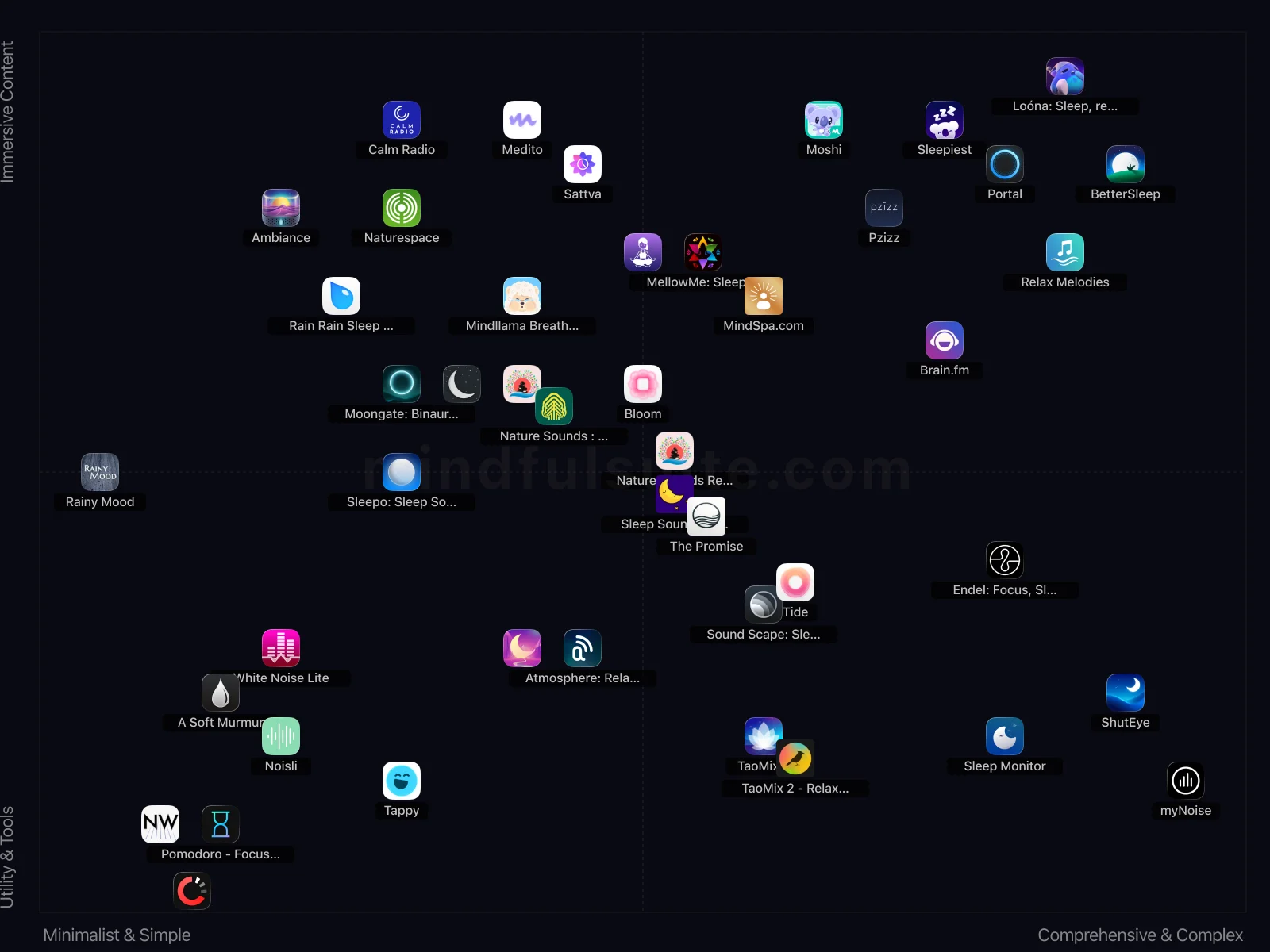
These 45 apps don't all solve the same problem. They cluster into 4 distinct groups, each built around a different philosophy. Understanding which group fits you is the fastest way to narrow your search.
Minimalist & Simple + Immersive Content
13 apps in this group, led by  Moongate: Binaural Beats,
  Rain Rain Sleep Sounds, and
  White Noise Deep Sleep Sounds.
What defines this cluster: free, binaural beats, sleep frequency sounds, in-app purchases.
White Noise Deep Sleep Sounds.
What defines this cluster: free, binaural beats, sleep frequency sounds, in-app purchases.
Comprehensive & Complex + Immersive Content
15 apps in this group, led by  Moshi,
  Sleepiest, and
  BetterSleep.
What defines this cluster: audio stories, meditations, soothing sounds, free with iap.
BetterSleep.
What defines this cluster: audio stories, meditations, soothing sounds, free with iap.
Minimalist & Simple + Utility & Tools
9 apps in this group, led by  Atmosphere: Relaxing Sounds,
  White Noise Lite, and
  Pomodoro - Focus Timer.
What defines this cluster: relaxing sounds, custom soundscape creation, for sleep and meditation, looping sounds.
Pomodoro - Focus Timer.
What defines this cluster: relaxing sounds, custom soundscape creation, for sleep and meditation, looping sounds.
Comprehensive & Complex + Utility & Tools
8 apps in this group, led by  Endel: Focus, Sleep, Relax,
  ShutEye, and
  Sleep Monitor.
What defines this cluster: free (iap), ai-powered soundscapes, personalized, adaptive audio, real-time adaptation.
Sleep Monitor.
What defines this cluster: free (iap), ai-powered soundscapes, personalized, adaptive audio, real-time adaptation.
What makes them different
The core tension in this category runs along two axes. On one side, Minimalist & Simple apps prioritize simplicity and speed — you can be up and running in under a minute. On the other, Comprehensive & Complex apps offer depth and customization that rewards investment over time.
The second axis — App Focus — captures an equally important difference. Apps closer to Utility & Tools take a fundamentally different approach than those near Immersive Content. Neither is objectively better. The right choice depends on your personality, your experience level, and what you're trying to accomplish.
44 Apps Reviewed
We scored every app using a weighted composite of real App Store and Google Play ratings. Out of 44 apps: 15 Essential · 20 Hidden Gems · 1 Mainstream. 22 cross-platform, 17 iOS-only, 5 Android-only.
Top picks: BetterSleep and Atmosphere: Relaxing Sounds scored highest overall. Endel: Focus, Sleep, Relax rounds out the top three. Switch to the Apps tab for the full list with ratings and download links.
How to Pick the Right One
Look at the cluster section above. If you already know whether you want Minimalist & Simple or Comprehensive & Complex, that eliminates half the options instantly. Same for Utility & Tools vs Immersive Content.
Try one app for a full week before judging. Most soundscape apps reveal their value around day 5, not day 1.
Quick start: BetterSleep and Atmosphere: Relaxing Sounds represent two different approaches and both scored highest. Pick whichever resonates, switch if it doesn't click.
Making It Stick: Practical Advice
Downloading the app is the easy part. The hard part — the part that actually produces results — is what happens in weeks two, three, and beyond. These tips are drawn from behavioral research and from patterns we've observed across hundreds of thousands of user reviews. They're not revolutionary, but they work:
Match sounds to your task
Rain and cafe sounds work well for focused work. Ocean waves and wind are better for relaxation and sleep. Experiment to find your ideal work and rest soundscapes.
Use for sleep transitions
Start a calming soundscape 15 minutes before bed as part of your wind-down routine. Set a 30-60 minute sleep timer so it fades after you're asleep.
Frequently Asked Questions
These are the questions that come up most often — from our own testing, from user reviews, and from the broader conversation around soundscape apps. If your question isn't here, the Apps tab has detailed information on every app we reviewed.
Can background sounds improve focus?
Yes. Research shows moderate ambient noise can improve focus and creativity compared to silence. The key is consistency — sudden or unpredictable sounds are distracting, while steady ambient noise creates a stable background for concentration.
Is it better than music for working?
For many people, yes. Music with lyrics activates language processing areas of the brain, which can compete with tasks that involve reading or writing. Instrumental soundscapes provide audio stimulation without this cognitive conflict.
The Best Soundscape Apps for Focus, Relaxation, and Sleep (2026)
Remember trying to fall asleep on a hot summer night by turning a clunky box fan to its highest setting, hoping the roar would drown out the world? Or maybe you’ve tried to work from home, only to be defeated by the sound of your neighbor’s suspiciously enthusiastic vacuuming. We’ve all been there—desperately seeking a pocket of peace in a world that never seems to turn the volume down.
Before our phones became our sound studios, we were at the mercy of our environment. But now, you can be the director of your own auditory scene. With the tap of a button, you can swap the distracting chatter of an open-plan office for the gentle hum of a Parisian café, or trade racing thoughts at 3 a.m. for the calming rhythm of a distant thunderstorm.
Whether you're trying to build a fortress of focus at your desk or a cozy cocoon of calm in your bed, these are the best soundscape apps to help you tune out the noise and tune into your day.
The Master Mixers
Sometimes, pre-made tracks just don't cut it. You want the exact sound of rain hitting a tin roof, layered with a distant train and a crackling fireplace. These apps are your personal soundboard, letting you play DJ for your own downtime.

Present
A beautiful meditation timer featuring 100+ soundscapes and 6 bell themes to help you find stillness anywhere.
- Over 100 high-quality nature and ASMR soundscapes.
- Minimalist design that stays out of your way.
- Available as a Chrome extension for working peacefully.

BetterSleep
While it contains meditations, BetterSleep is, first and foremost, the ultimate sleep toolkit. It’s a paradise of sound, famous for its enormous library of high-quality sleep sounds and a magical mixer that lets you craft your own perfect ambient soundscape.
- Boasts an enormous library of ambient sounds, guided meditations, and sleep stories, ensuring diverse content.
- Allows users to mix multiple sounds and save their custom soundscapes, providing great personalization.

Atmosphere: Relaxing Sounds
Atmosphere provides a wide variety of relaxing sounds that can be mixed to create personalized soundscapes for sleep, meditation, or focus.
- Allows extensive customization by mixing a wide range of ambient sounds to create truly personalized soundscapes.
- The high-quality sound library and intuitive mixing interface make it superior for creating perfect background noise.

myNoise
MyNoise is for the true sound connoisseur. It's less of a sound library and more of a sound laboratory, offering an incredible level of customization. Each sound generator—from a calming temple bell to the rumble of a spaceship engine—comes with frequency sliders that let you shape the sound to perfectly match your hearing and preferences. It’s a uniquely powerful tool for creating a personal sonic sanctuary.
- Offers an unparalleled variety of highly customizable sound generators, from white noise to temple bells, with fine-tuned sliders.
- The unique "calibration" feature personalizes frequencies to your hearing, truly optimizing the sound experience.

TaoMix 2
TaoMix 2 allows you to create your own unique and evolving soundscapes for relaxation, meditation, or sleep by dropping sounds onto a board.
- Its innovative "evolving soundscapes" feature creates dynamic, non-repeating audio environments, truly unique.
- The visual mixing interface is incredibly intuitive, making custom soundscape creation genuinely engaging.

TaoMix 2 - Relax with Nature S
A relaxation app that creates unique soundscapes using natural sounds. Users can create immersive experiences for meditation and sleep.

Noisli
Noisli is your minimalist escape hatch for focus or relaxation. With a beautifully simple interface, you can mix high-quality sounds like a bustling coffee shop with gentle rain or crackling fire. It’s perfect for creating a distraction-free bubble to work in by day or a serene cocoon to sleep in by night.
- Empowers users to fully customize soundscapes by mixing multiple distinct sounds with individual volume controls.
- Features a clean, minimalist design that effectively highlights the sound-mixing functionality without distractions.

A Soft Murmur
A straightforward and elegant ambient sound app that lets you mix various sounds like rain, thunder, waves, and coffee shops to create a calming atmosphere.
- The minimalist interface makes mixing ambient sounds incredibly simple and frustration-free, a breath of fresh air.
- Its focus on a core set of quality ambient sounds prevents overwhelming choices, perfect for quick relaxation.

Ambiance
A soundscape app with a diverse library of sounds to help you focus, relax, or sleep.
- Boasts an exceptionally diverse and extensive library of high-quality sounds available entirely for free.
- The ability to download and manage sound files locally is a huge benefit for offline use.

Sleepa
Sleepa provides a great collection of HD sounds that can be mixed into the perfect relaxing ambiences for sleep or focus.
- The collection of HD sounds is impressive and can be effectively blended to create custom, relaxing ambiences.
- Its intuitive mixing interface makes combining multiple sounds and adjusting volumes incredibly simple for users.

Relax Melodies
Much like a painter with a palette, Relax Melodies gives you the tools to create your own atmosphere for rest. Mix sounds, layer meditations, and add stories to craft a unique blend that speaks directly to you. It's a playground for your ears, designed to lead you gently into sleep.
- Allows unparalleled customization, letting users mix and match numerous sounds and melodies for unique soundscapes.
- The large library of sounds, meditations, and stories offers extensive variety for different moods.
AI & Science-Backed Audio
If you're looking for something a bit more futuristic, these apps use algorithmic generation and psychoacoustics. They adapt to your heart rate, time of day, and environment to create living soundscapes designed specifically to alter your brainwaves.

Endel: Focus, Sleep, Relax
Endel creates soundscapes that are alive. Using a patented AI, it generates personalized, adaptive audio that changes in real-time based on inputs like your heart rate, the weather, your location, and the time of day. This means the sound is never repetitive or boring. The "Sleep" mode is specifically designed to soothe your mind and body with scientifically engineered sound, making it a futuristic and fascinating way to rest.
- Its unique "adaptive soundscapes" truly personalize the auditory experience, dynamically adjusting to environmental and biometric data.
- The scientifically-backed approach and real-time adjustments feel genuinely innovative in the ambient sound category.

Brain.fm
Brain.fm provides 'functional music' scientifically designed to help you focus, relax, meditate, or sleep. The AI-generated soundscapes are created to stimulate the brain and help you achieve your desired mental state.
- Scientifically designed "functional music" claims to directly impact brainwaves for focus, relaxation, or sleep.
- Offers distinct programs for various states like "Focus," "Meditate," and "Sleep," each with tailored audio.

Pzizz
Pzizz uses psychoacoustics to create dynamic 'dreamscapes'—a mix of music, voiceovers, and sound effects—that change each night to help you fall asleep. It has dedicated modules for sleep, naps, and focus.
- The unique "dreamscapes" system offers a dynamic, non-repetitive audio experience for sleep and naps.
- Its specific focus on insomnia and power naps provides targeted, effective relief for sleep issues.

Portal
An iOS app that delivers immersive, spatial audio soundscapes from beautiful locations around the world, combined with smart lighting integration.
- Integrates dynamic soundscapes with stunning visuals, creating a truly immersive sensory experience.
- Features scientifically-backed sound frequencies and binaural beats specifically for focus and sleep.

Moongate: Binaural Beats
Uses science-backed sound therapy to help users fall asleep, release anxiety, and stay focused. It's for individuals seeking help with sleep, anxiety, and focus through binaural beats and frequency healing sounds.
- Leverages "science-backed sound therapy" like binaural beats to specifically target focus, anxiety, and sleep improvement.
- The impressive 4.8★ Android rating from 23,000 users indicates its effectiveness and user satisfaction.
Nature & The Elements
There's a reason we're hardwired to relax when we hear ocean waves or a gentle thunderstorm. These apps specialize in high-fidelity, highly realistic environmental recordings that transport you out of your stuffy bedroom and right into the wild.

Naturespace
Naturespace provides incredibly immersive 3D soundscapes recorded in natural environments, promoting deep relaxation and focus.
- Offers incredibly high-fidelity, true 3D binaural recordings, creating genuinely immersive and realistic nature soundscapes.
- Provides several free, full-length soundscapes that are exceptional quality, unlike many freemium alternatives.

Rain Rain Sleep Sounds
As the name suggests, this app specializes in high-quality rain and other nature sounds to aid with sleep and relaxation.
- Specializes in an extensive, high-quality collection of rain and storm sounds, offering nuances like "Rain on Tent."
- The simple, focused interface makes it incredibly easy to find and play your preferred rain sound quickly.

Rainy Mood
The original rain sound generator, Rainy Mood provides the simple, calming sound of rain to help you sleep, study, or relax.
- Delivers a single, extremely high-quality rain sound that genuinely aids focus and relaxation effectively.
- It's completely free with no hidden costs or paywalls, offering its core feature without interruption.

Nature Sounds Relax & Sleep
It offers nature sounds for relaxation, meditation, and sleep to relieve stress and anxiety.
- Offers a truly vast library of nature soundscapes, making it easy to find specific calming environments like rain or ocean.
- The ability to mix and match different sounds creates personalized ambient noise perfect for focused relaxation or sleep.
Nature Sounds - Relax & Sleep
This provides nature sounds to relax and improve sleep quality, useful for insomnia sufferers.

Nature Sounds : Earth FM
This offers a variety of nature sounds to promote relaxation and improve sleep, marketed as 'Green Noise'.

Bloom
Bloom is a music app exploring ambient soundscapes. The app, created by Brian Eno and Peter Chilvers, allows for generative music creation through simple interaction.
Sleep-Focused Soundscapes & White Noise
When the goal is strictly about knocking yourself out and drowning out the neighbor's barking dog, you need pure, unadulterated noise. These apps specialize in heavy-duty sleep aids, white noise generation, and even tracking how well you rested.

White Noise Deep Sleep Sounds
This app offers a wide selection of calming sounds, including various types of white noise, to help you fall asleep and stay asleep.
- Offers a truly vast library of white noise and natural sounds, ensuring everyone finds their preferred sleep aid.
- The simple, uncluttered interface makes finding and playing desired sounds incredibly straightforward.

White Noise Lite
Sometimes, the simplest solution is the best one. White Noise Lite does one thing and does it brilliantly: it masks distracting noises. Whether it's city traffic or a noisy neighbor, you can drown it out with a library of calming sounds like a crackling fire, ocean waves, or a classic box fan.
- Offers a diverse selection of high-quality, looping ambient sounds, including unique options like "Oscillating Fan."
- The timer and alarm features are robust and free, allowing precise control over sound duration and waking.

Noise Wall
It generates white, pink, and brown noise to mask background sounds for focus or sleep.
- Delivers pure, effective white, pink, and brown noise generation, ideal for straightforward background sound masking.
- The minimalist interface focuses solely on noise generation, providing a distraction-free experience for simple needs.

ShutEye
ShutEye is the swiss army knife for your slumber. It's a comprehensive tracker that listens for snoring or teeth grinding, a sound machine with a library of relaxing audio, and a smart alarm to top it all off. It aims to give you a complete picture of your night, from the moment you drift off to the moment you wake.
- Its "Smart Cycle Alarm" wakes you gently within your lightest sleep phase for a better morning experience.
- The app provides detailed sleep reports, including snore and sleep talk recordings, for deep insights.

Sleep Monitor
Sleep Monitor is a straightforward and reliable choice for anyone wanting to track their sleep cycles, hear what they sound like at night, and drift off to calming music. It provides easy-to-read graphs and reports, making it simple to spot patterns in your sleep habits.
- Automatically records snoring and sleep talking, offering insightful audio playback of your nocturnal habits.
- Provides basic sleep cycle analysis and sleep quality scores without requiring a premium subscription immediately.

Loóna: Sleep, reduce anxiety
Uses sleepscapes that alter your mood to help prepare you for sleep and reduce anxiety.
- Unique 'sleepscapes' combine interactive storytelling with calming visuals for profound unwinding.
- The app's exceptional aesthetic design and narrative structure create a truly immersive experience.

Sleepiest
Sleepiest offers a wide range of bedtime stories, sleep sounds, and meditations to help you drift off.
- Offers a truly broad selection of bedtime stories, meditations, and soundscapes for diverse sleep preferences.
- Its "Sleepiest Stories" provide a solid narrative alternative to traditional meditations for winding down.

Sleepo: Sleep Sounds
This app offers sleep sounds and white noise to promote relaxation. It's for users who have trouble falling asleep or getting a good night's rest.

Sleep Sounds - relax melodies
This app provides a library of relaxing sounds, including nature sounds, white noise, and brainwave frequencies. It's for anyone who wants to create a custom soundscape to help them fall asleep.
Focus Timers & Lo-Fi Beats
Need to crush a deadline without losing your mind? These apps blend the rhythmic, structured approach of productivity timers with lo-fi hip hop and gentle ambient sounds to keep you in the flow state.

Tide
Tide is a beautifully designed app that integrates sleep, meditation, and relaxation with nature sounds. It also features a Pomodoro timer and breathing exercises.
- Its beautiful, minimalist interface with elegant nature animations creates an immediately calming visual experience.
- Offers a free "Focus Timer" with built-in nature soundscapes, making it great for productivity and relaxation.

MellowMe: Sleep & Relax
This Android-only app streams lo-fi hip hop radio, a genre known for its calming, ambient, and focus-enhancing qualities.
- Offers a diverse range of calming sounds and unique melodies, providing fresh options beyond typical white noise.
- The integration of mental health challenges alongside soundscapes adds a unique, goal-oriented dimension.

Sound Scape: Sleep & Calm
Sound Scape provides a variety of soothing sounds and music to help with sleep, meditation, and relaxation.
- The integrated "App blocker" feature is a standout, preventing distractions during focus or relaxation sessions.
- Provides a good variety of soothing sounds and music, effectively catering to different relaxation needs.

Pomodoro - Focus Timer
A straightforward Pomodoro Technique timer app for productivity.
- Its bold claim as "The Best Pomodoro Application" is backed by strong ratings and a massive Android user base.
- Offers a straightforward, effective Pomodoro timer experience, helping users implement focused work sessions easily.

TomatoTimer
A simple, web-based Pomodoro timer for productivity. Customize session and break lengths to fit your work style.
- Its extreme simplicity and web-based nature make it incredibly quick to set up and use for instant focus sessions.
- The customizable session and break lengths are easily adjusted on the fly without complex settings menus.
Guided Mindfulness & Spiritual Sounds
For those moments when background noise isn't quite enough to quiet your racing thoughts. These apps pair traditional chants, frequencies, and guided meditations with their ambient soundscapes to actively bring your stress levels down.

Medito
Built on the beautiful principle that mindfulness should be accessible to all, Medito is a gift from the non-profit Medito Foundation. It's 100% free, forever, with no ads or hidden costs. It’s a pure, clean, and heartfelt resource for your mental well-being.
- Absolutely free with no premium tiers or ads, embodying a true non-profit mission to make mindfulness accessible to all.
- Offers a solid foundational course and diverse guided meditations, including sleep stories and breathing exercises, without paywalls.

Sattva
Features authentic Vedic meditations, chants, and mantras from the Art of Living. It's for those seeking traditional meditation practices.
- It genuinely stands out by focusing on authentic Vedic traditions, offering a unique spiritual depth absent in many secular apps.
- The inclusion of traditional chants and mantras provides a distinct, resonant experience for those seeking a cultural connection.

Mindllama Breathe Sleep Focus
A breathing exercise companion. It's for users that need simple breathing exercises to help calm them down.
- Mindllama provides a diverse range of breathing exercises specifically categorized for sleep, focus, and relaxation.
- Its aesthetically pleasing animations and clean interface make the breathing practice visually engaging and calming.

Calm Radio
Calm Radio offers various calming music channels for sleep, meditation, and relaxation. It features a wide selection of nature sounds, sleep music, and meditation music.
- Provides a refreshing alternative with a curated selection of ambient music channels, not just basic white noise.
- The ability to blend multiple sound layers creates a unique, customizable audio experience.

MindSpa.com
Claims to be a mental health super-app for relaxation, stress management, and improved sleep. It's for those seeking a comprehensive platform for mental well-being.

The Promise
This lifestyle app is a mindfulness and mental health tool. It promotes a positive mindset and enhances emotional wellness.
For the Little Ones
Because getting a toddler to wind down is half the battle. This app uses enchanting, screen-free audio environments to build a bedtime routine your kids will actually look forward to.

Moshi
Designed especially for little ones, Moshi is a magical world of enchanting audio stories, meditations, and soothing sounds. The stories feature whimsical characters and are designed to capture a child's imagination while helping them relax and drift off to sleep. It’s a wonderful, screen-free way to establish a calm and consistent bedtime routine for kids.
- The enchanting "Moshi Monsters" universe provides truly unique, engaging audio stories for kids' bedtime.
- Offers a diverse library of audio-only stories and meditations perfect for winding down little ones.