
Guided Journaling Apps: What You Need to Know in 2026
Staring at a blank page is the fastest way to not journal. Your brain freezes, you don't know what to write, and the notebook goes back on the shelf. Guided journaling solves this completely — every day, you get a specific question or prompt that gives your pen somewhere to go. The thinking happens naturally once you start writing.
We evaluated 34 guided journaling apps across iOS and Android, scoring each on real user ratings, feature depth, and long-term value. This guide covers what we found.
The Blank Page Problem (and Why Prompts Solve It)
The blank page is not a neutral starting point. It is an obstacle. For the majority of people who attempt journaling, staring at an empty screen or sheet of paper triggers a cascade of counterproductive mental processes: What should I write about? Is this worth writing? This feels stupid. I don't have anything interesting to say. The inner critic arrives before the first word does, and the journal gets closed.
This is not a failure of willpower or creativity. It is a well-documented cognitive phenomenon. Open-ended tasks with no constraints produce decision paralysis — the same mechanism that makes people stare at a restaurant menu with 200 options and order the same thing they always get. The paradox of choice applies to creative tasks just as powerfully as it applies to consumer ones. More freedom does not produce more output. It produces more anxiety.
Prompts solve this by imposing productive constraints. "What made you anxious today?" is dramatically easier to respond to than "Write about your day." The constraint narrows the field of attention, bypasses the "what should I write about" loop, and gives the pen a direction. The inner critic has less room to operate because you are not creating from scratch — you are responding to a question, which feels fundamentally less exposed.
There is an alternative philosophy worth noting. Julia Cameron's Morning Pages technique, from The Artist's Way, takes the opposite approach: write three pages of longhand stream-of-consciousness first thing in the morning. No prompts. No structure. Just volume. The theory is that quantity defeats the inner critic through exhaustion — if you commit to filling three pages regardless of quality, the editor in your head eventually gives up and lets the real thoughts through.
Both approaches work, but they work for different people at different stages. Prompts are better for building the initial habit, because they eliminate the startup cost that kills most journaling attempts in the first week. Stream-of-consciousness writing is better for people who already have the habit and want to go deeper. The best guided journaling apps understand this progression and offer both structured prompts for days when you need direction and open-ended space for days when the words are already flowing.
Therapeutic Writing vs Diary-Keeping: They're Not the Same Thing
Most people who say they journal are keeping a diary. They record events: what happened, where they went, who they saw. This is a perfectly valid activity. It creates a record of your life. It has almost no measurable psychological benefit.
Therapeutic writing — the kind that actually changes how you think and feel — is a fundamentally different activity. The distinction was established by James Pennebaker at the University of Texas at Austin in a series of experiments beginning in the 1980s that have since been replicated hundreds of times. His protocol is specific: write about an emotional experience for 15 to 20 minutes, exploring your deepest thoughts and feelings about it. Do this for three to four consecutive days.
The results are remarkably consistent. Participants who followed this protocol showed measurable improvements in immune function, reduced doctor visits, lower blood pressure, improved mood, and better academic or work performance — compared to control groups who wrote about neutral topics for the same duration. The effect sizes are modest but reliable, and they hold across cultures, ages, and clinical populations.
The mechanism is cognitive processing through language. When you write about an emotional experience — really write about it, exploring why it happened, how it made you feel, what it means — you are forced to organize chaotic emotional material into a coherent narrative. This organization is itself therapeutic. Unprocessed emotions exist as fragmented, intrusive sensations. Processed emotions — the ones you have put into words and examined from multiple angles — lose their disruptive charge and become integrated memories rather than active wounds.
This is where guided journaling apps either succeed or fail as therapeutic tools. Apps that offer prompts like "What are you grateful for?" and "What did you accomplish today?" are facilitating diary-keeping, not therapeutic writing. Apps that offer prompts like "Describe a situation that's been weighing on you — what happened, how you felt, and what you wish had gone differently" are facilitating genuine emotional processing. The difference in prompt design maps directly to the difference in psychological benefit.
The honest truth is that therapeutic writing is uncomfortable. Diary-keeping is pleasant. Writing about your deepest feelings regarding a conflict with your partner or anxiety about your career is not fun. But the discomfort is where the benefit lives. Good guided journaling apps push you gently into that discomfort rather than steering you around it.
AI-Powered Prompts: Smart Personalization or Privacy Nightmare?
A growing number of journaling apps are integrating artificial intelligence to personalize prompts based on your previous entries. The pitch is appealing: instead of receiving the same generic prompts as every other user, the AI reads what you have written, identifies recurring themes and emotional patterns, and generates prompts specifically relevant to your current psychological landscape. If you have been writing about work stress for two weeks, the AI might offer a prompt about boundaries or burnout rather than a generic question about your weekend.
The personalization is genuinely useful. Research on therapeutic writing shows that prompts targeting active emotional concerns produce greater benefit than generic prompts. An AI that can identify your active concerns and direct your attention toward them is, in theory, a more effective therapeutic tool than a static prompt library.
The cost is obvious but worth stating plainly: for the AI to personalize prompts, it must read your journal. Your journal — the place where you write your most private, unfiltered, vulnerable thoughts. The thoughts you would not share with your closest friend, let alone a technology company's servers.
The privacy implications depend entirely on implementation, and the range across apps is enormous. Some apps process your entries entirely on-device, meaning the AI analysis happens on your phone and your text never leaves it. This is the gold standard for privacy — the app can offer personalization without any data exposure. Other apps send your entries to cloud servers for processing, where they are analyzed by models running on the company's infrastructure. Your journal text exists, at least temporarily, on someone else's computer.
The questions you should ask before using AI-powered journaling features are specific and non-negotiable. First: is the analysis performed on-device or in the cloud? If cloud-based, who has access to the raw text? Second: is your journal data used to train the AI model? If so, fragments of your private writing could theoretically surface in responses to other users. Third: can you opt out of AI analysis while still using the app? Some apps make AI features mandatory; others make them optional. Fourth: what happens to your data if the company is acquired, goes bankrupt, or changes its privacy policy?
The apps that get this right are transparent about their architecture and offer genuine user control. The apps that get it wrong bury the details in a terms-of-service document that no one reads and treat your most private thoughts as training data. The difference matters more here than in almost any other app category, because the content at stake is not your browsing history or your purchase patterns. It is the unedited interior of your mind.
4 Types of Guided Journaling Apps — and How They Differ
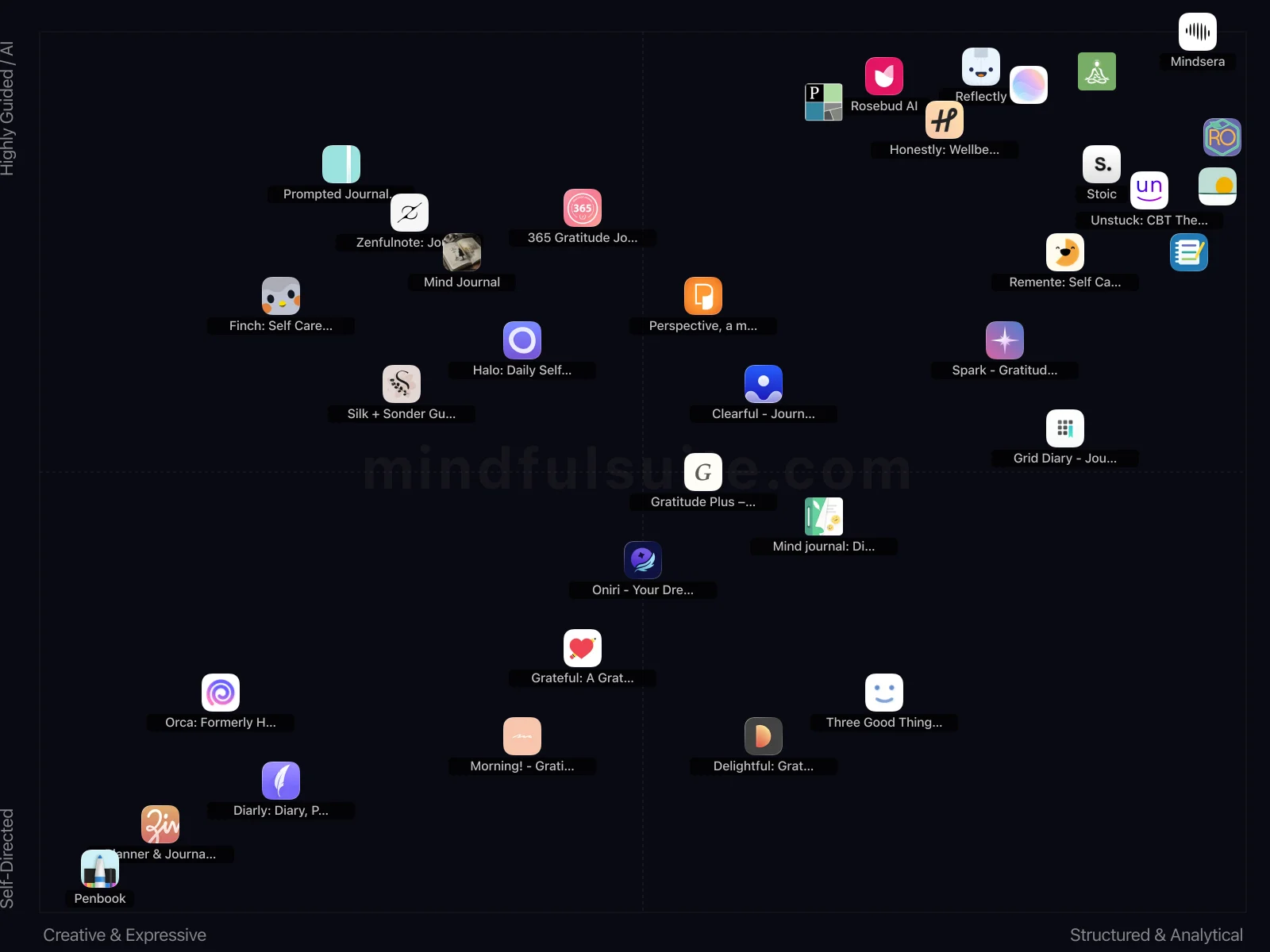
These 34 apps don't all solve the same problem. They cluster into 4 distinct groups, each built around a different philosophy. Understanding which group fits you is the fastest way to narrow your search.
Creative & Expressive + Highly Guided / AI
7 apps in this group, led by  Finch: Self Care Pet,
  Prompted Journal - Shadow Work, and
  Silk + Sonder Guided Self-Care.
What defines this cluster: free (iap), habit tracking, journaling, virtual pet care.
Silk + Sonder Guided Self-Care.
What defines this cluster: free (iap), habit tracking, journaling, virtual pet care.
Structured & Analytical + Highly Guided / AI
17 apps in this group, led by  Gratitude Plus – Journal,
  Honestly: Wellbeing Coaching, and
  Stoic.
What defines this cluster: social gratitude journal, science-based mental health tools, community support, free with in-app purchases.
Stoic.
What defines this cluster: social gratitude journal, science-based mental health tools, community support, free with in-app purchases.
Creative & Expressive + Self-Directed
6 apps in this group, led by  Planner & Journal - Zinnia,
  Penbook, and
  Diarly: Diary, Private Journal.
What defines this cluster: digital journal, creative planner, free version available, handwritten notes.
Diarly: Diary, Private Journal.
What defines this cluster: digital journal, creative planner, free version available, handwritten notes.
Structured & Analytical + Self-Directed
4 apps in this group, led by  Delightful: Gratitude Journal,
  Oniri - Your Dream Journal, and
  Three Good Things - A Happiness Journal.
What defines this cluster: free with iap, record three good things daily, clean and simple interface, dream journal.
Three Good Things - A Happiness Journal.
What defines this cluster: free with iap, record three good things daily, clean and simple interface, dream journal.
What makes them different
The core tension in this category runs along two axes. On one side, Creative & Expressive apps prioritize simplicity and speed — you can be up and running in under a minute. On the other, Structured & Analytical apps offer depth and customization that rewards investment over time.
The second axis — Level of Guidance — captures an equally important difference. Apps closer to Self-Directed take a fundamentally different approach than those near Highly Guided / AI. Neither is objectively better. The right choice depends on your personality, your experience level, and what you're trying to accomplish.
34 Apps Reviewed
We scored every app using a weighted composite of real App Store and Google Play ratings. Out of 34 apps: 8 Essential · 21 Hidden Gems · 1 to skip. 19 cross-platform, 12 iOS-only, 3 Android-only.
Top picks:  Reflectly and Honestly: Wellbeing Coaching scored highest overall. Stoic rounds out the top three. Switch to the Apps tab for the full list with ratings and download links.
How to Pick the Right One
Look at the cluster section above. If you already know whether you want Creative & Expressive or Structured & Analytical, that eliminates half the options instantly. Same for Self-Directed vs Highly Guided / AI.
Try one app for a full week before judging. Most guided journaling apps reveal their value around day 5, not day 1.
Quick start: Reflectly and Honestly: Wellbeing Coaching represent two different approaches and both scored highest. Pick whichever resonates, switch if it doesn't click.
Making It Stick: Practical Advice
Downloading the app is the easy part. The hard part — the part that actually produces results — is what happens in weeks two, three, and beyond. These tips are drawn from behavioral research and from patterns we've observed across hundreds of thousands of user reviews. They're not revolutionary, but they work:
Commit to just one prompt per day
You don't need to write pages. Answering one prompt in 3-5 sentences is enough to maintain the habit and gain reflection benefits.
Don't edit yourself
Guided journals aren't essays. Write quickly, honestly, and without self-censorship. The value is in the thinking process, not the quality of the writing.
Frequently Asked Questions
These are the questions that come up most often — from our own testing, from user reviews, and from the broader conversation around guided journaling apps. If your question isn't here, the Apps tab has detailed information on every app we reviewed.
Is guided journaling as effective as free-writing?
For building the habit, guided journaling is more effective because it eliminates blank-page paralysis. For depth of emotional processing, both approaches work. Many people use guided prompts to start and transition to free-writing once they're warmed up.
Can guided journals help with therapy?
Absolutely. Many therapists assign journaling as homework, and guided prompts can focus your between-session reflection on therapeutically relevant themes. Some apps even have prompt sets designed specifically to complement CBT, DBT, or ACT therapy.
The Best Guided Journaling Apps for Self-Reflection (2026)
Remember that dusty notebook you bought with the best of intentions? The one with three entries from January and a coffee stain from March? We’ve all been there. The desire to understand ourselves is timeless, but the classic pen-and-paper method can feel like a heavy chore when you're already exhausted from a long day.
Imagine, instead, if your journal could check in and ask how you're really doing. What if it could help you spot patterns in your mood, celebrate tiny victories, and untangle the mess of worries that keeps you up at night? That's the magic of guided journaling apps. They transform an intimidating blank page into a friendly conversation with yourself. By doing the heavy lifting of figuring out what to write about, they make self-reflection less of a task and more of a daily adventure. Let's find the perfect digital companion to help you write your story.
When You Want AI to Connect the Dots
Sometimes we vent into a journal and miss the bigger picture. These apps act like an insightful coach in your pocket, using artificial intelligence to analyze your entries, spot emotional patterns, and ask thoughtful follow-up questions you wouldn't have thought to ask yourself.

Reflection.app
An AI-powered journal that not only guides your reflections but also helps you uncover insights from what you've written. It's designed to be your personal coach for self-discovery.
- Its "AI-powered guided reflections" genuinely help users dig deeper into thoughts, moving beyond simple entry logging.
- The ability to "uncover insights" from entries provides valuable, personalized self-awareness that manual journaling often misses.

Rosebud AI
Rosebud AI offers a beautiful twist on mental wellness by focusing on AI-powered journaling. It acts as your personal guide for self-reflection, giving you intelligent prompts and analyzing your entries to reveal patterns in your emotional world. It’s perfect for anyone who finds clarity through writing.
- Focuses squarely on daily self-care and habit formation, providing structured routines to build positive mental health practices.
- As a "Hidden Gem," it likely offers a fresh, innovative approach to self-care tracking, differentiating from crowded markets.

Reflectly
Billing itself as a personal mental health companion, Reflectly makes journaling feel like a conversation. This AI-powered app asks you questions about your day, helps you identify thought patterns, and provides personalized insights to help you understand yourself better. It’s like having a friendly, insightful robot in your pocket.
- The AI-powered prompts genuinely encourage deeper self-reflection, helping users process thoughts that might otherwise disrupt sleep.
- Journaling before bed is a proven method for mental decluttering, which Reflectly facilitates expertly.

Mindsera
An AI journaling app that acts like a microscope for your mind. It analyzes your writing to provide deep insights into your mindset, emotions, and even hidden cognitive biases.
- The "AI journaling" that "analyzes your writing" to reveal cognitive biases is truly innovative for deep self-reflection.
- Its focus on "CBT & Self-Care Diary" provides a unique therapeutic angle distinct from typical journaling apps.

Honestly: Wellbeing Coaching
Honestly is an AI-powered mental health journal. The app guides users through writing or speaking prompts to release stress and understand their mood.
- Its AI-driven journaling transforms your thoughts into personalized mood insights, offering genuine self-reflection.
- Gentle, daily prompts prevent writer's block, making consistent self-reflection and habit building surprisingly effortless.

Perspective - AI Journal
Perspective is a modern, beautifully designed journal that uses on-device AI to help you discover who you are. As you write or speak your entries, it intelligently analyzes your words to uncover themes, track people and places, and ask thoughtful questions that guide you toward deeper self-understanding, all while keeping your data completely private on your phone.
- The "AI Journal" approach promises potentially unique insights and personalized prompts for deeper self-reflection.
- AI integration could automate organization or highlight emotional patterns, making journaling more insightful.

Mindease (AI mental health)
Provides AI chat support for empathetic, non-clinical conversations to improve mental wellness. It is for users seeking a supportive space for expressing themselves.
For Managing Anxiety and Mental Health
When you're caught in a spiral of negative thoughts, a blank page isn't always enough. These apps lean heavily on proven psychological frameworks, like Cognitive Behavioral Therapy (CBT) and Stoicism, to help you actively challenge your worries and build mental resilience.

Stoic
Stoic is more than a diary; it's a mental health companion grounded in philosophy and psychology. It uses the principles of Stoicism and Cognitive Behavioral Therapy (CBT) to help you not only record your feelings but understand them. Through guided exercises, meditations, and thoughtful prompts, it coaches you toward a more resilient and productive mindset.
- Offers a unique, philosophical approach to mental well-being with its "stoicism-based journaling" prompts.
- The "AI journaling" feature provides personalized reflections, making the self-improvement process more engaging.

Unstuck: CBT Therapy Journal
A simple and effective CBT-based journaling app designed to help you understand and change the thought patterns that impact your mental well-being.
- Offers a practical, guided approach to applying CBT principles for tangible improvements in mental well-being.
- The clean interface effectively breaks down complex thought patterns into manageable, actionable steps.

Clarity: CBT Self Help Journal
A mental health app offering CBT techniques to manage stress, anxiety, and mood, with mood tracking features.
- Clarity's strong focus on CBT principles provides a structured, evidence-based approach to challenging negative thoughts.
- The comprehensive mood tracker helps users identify triggers and track progress in developing healthier thought patterns.

WorryTree
A focused journaling app specifically designed to help you manage anxiety. It guides you through Cognitive Behavioral Therapy (CBT) techniques to catch, challenge, and let go of your worries.
- Its direct application of CBT techniques offers actionable steps for managing specific worries, not just tracking.
- Unlike general mood trackers, WorryTree provides a structured problem-solving framework, a true "Proven CBT Tool."

RO DBT Diary Card and Skills
For Radically Open Dialectical Behavior Therapy, it provides a diary card, skills help, safety toolkit, and self-enquiry journal.
- Uniquely caters to Radically Open DBT (RO DBT) principles, offering a specialized diary card and skills for overcontrolled individuals.
- The integrated "Safety Toolkit" and "Self-Enquiry Journal" provide specific, targeted tools that align perfectly with RO DBT practices.
Cultivating a Daily Gratitude Habit
Our brains are hardwired to notice the bad stuff. It takes practice to see the good. If you want to train yourself to look for the bright spots, these apps focus specifically on gratitude, prompting you to log just a few good things that happened each day to slowly rewire your mindset.

365 Gratitude Journal
Features daily gratitude prompts and affirmations, designed to encourage reflection and improve mood with a supportive community.
- Daily, varied prompts and affirmations provide consistent guidance, perfect for establishing a gratitude habit.
- The integrated community feature offers a unique, inspiring space for shared positive reflection.

Gratitude Plus – Journal
Combines science-backed mental health tools with community support to help users build a consistent gratitude practice. It is for individuals seeking a structured and social approach to gratitude journaling.
- The integrated social sharing feature uniquely fosters communal gratitude, distinguishing it from private journals.
- Connecting directly with friends and family within the app builds a supportive network for shared positivity.

Spark - Gratitude Journal
This app helps cultivate gratitude through journaling, mood tracking, habit tracking, and affirmations. It is for anyone looking to improve their well-being through positive psychology practices.
- The integration of mood tracking, habit tracking, and affirmations offers a genuinely holistic self-care platform.
- Daily guided affirmations provide structured positive reinforcement, enhancing the gratitude practice.

Orca: Formerly HappyFeed Diary
Happyfeed takes the classic "three good things" idea and gives it a delightful, visual spin. By encouraging you to add photos to each happy moment, it helps you create a vibrant, personal feed of memories that are a true joy to scroll through later.
- Integrating photo and video entries makes gratitude reflections vivid and more memorable than text alone.
- The optional sharing feature offers welcome flexibility for those who want community without being forced into it.

Three Good Things - A Happiness Journal
This app is a testament to the power of simplicity. It’s built entirely around the evidence-based practice of noting three good things that happened each day. With a minimalist design that removes every distraction, it lets you focus on one thing: finding the positive.
- Its hyper-focused "three good things" method is perfect for a simple, consistent daily gratitude practice.
- The gamification elements effectively encourage daily engagement and habit formation for long-term use.

Delightful: Gratitude Journal
Delightful: Gratitude Journal provides a simple interface for recording three good things each day. It's for users who want an easy way to cultivate gratitude through journaling.
- The elegant, uncluttered interface makes daily gratitude entries feel effortlessly simple and inviting.
- Focusing strictly on "three good things" maintains clarity and prevents overcomplication for beginners.

Grateful: A Gratitude Journal
A straightforward journal designed to help users focus on the positive aspects of their lives. It is for those who want to cultivate gratitude and mindfulness.
- Grateful's streamlined interface makes daily gratitude journaling incredibly simple and genuinely enjoyable to maintain.
- The app effectively cultivates a positive mindset by consistently prompting users to reflect on good things.

Morning! - Gratitude Journal
A simple journal to help make daily gratitude a habit. It's for individuals seeking to cultivate an attitude of gratitude through daily journaling.
- Its sleek, minimalist design provides a calming and focused environment specifically for morning gratitude.
- The clean interface prioritizes quick entry, making it easy to integrate into a busy morning routine.
Structured Prompts and Deep Reflection
"What should I write about?" If that question alone stops you from journaling, this group is for you. From simple grid-based questionnaires to gamified self-care pets and intense "shadow work," these apps provide rigid, engaging structures so you never have to face a blank screen.

Grid Diary - Journal, Planner
Grid Diary masterfully solves the "what should I write about?" problem. It presents your journal as a grid of questions for the day, such as "What made me happy today?" or "What did I learn?" This templated approach makes it incredibly easy to build a rich record of your life, one thoughtful answer at a time.
- The unique grid layout with customizable prompts makes daily journaling structured yet flexible.
- Offers robust privacy features, including passcode lock and data backup options for peace of mind.

Finch: Self Care Pet
Finch is a heartwarming self-care app that feels like a warm hug. It combines habit tracking and journaling with caring for a virtual pet. You nurture your pet by nurturing yourself. As you complete your daily goals—from tidying your room to practicing gratitude—your pet grows, goes on adventures, and shares its thoughts with you. It’s an incredibly positive and gentle approach to building a healthier you.
- Gamified pet care system genuinely motivates daily self-care habits like journaling and hydration.
- Customizing your adorable pet provides a tangible, delightful reward for consistent self-improvement.

Remente: Self Care & Wellbeing
Functions as a life coach providing self-help tools and a mental health tracker to help users with goal setting and personal growth. It offers a self-care journal for achieving self-improvement.
- Its focus on "mental health tracker" and "self care journal" gives it a distinct wellness-oriented edge.
- The "life coach" and "self help tools" offer guided paths for personal growth, a unique differentiator.

Zenfulnote: Journal & Heal
Serves as the official shadow work journaling app, guiding users through self-discovery. Based on the book, it helps users find their true self.
- As the "official shadow work journaling app," it provides structured, guided prompts directly from a bestselling author.
- Its specific focus on "shadow work" offers a unique, therapeutic niche within guided journaling.

Prompted Journal - Shadow Work
This private journal app uses daily prompts to foster self-reflection and personal growth through guided writing.
- The "Shadow Work" prompts offer a deep, structured approach to self-reflection beyond surface-level journaling.
- The app excels at maintaining privacy for sensitive entries, crucial for therapeutic journaling.
For the Visually Creative Soul
If text alone feels too restrictive, you need a canvas. These beautifully designed apps let you combine text with digital stickers, custom templates, and even handwritten notes to make your self-reflection feel like an art project.

Silk + Sonder Guided Self-Care
Silk + Sonder provides guided self-care through daily affirmations and community to improve mental health.

Planner & Journal - Zinnia
Zinnia is a digital journal and planner app with calendars, trackers, and stickers, and offers new content monthly.
- Creative freedom with stickers and custom layouts makes planning engaging and less tedious for ADHD users.
- Monthly new content provides fresh inspiration, actively preventing boredom often associated with routine planning.

Penbook
Penbook is a digital notebook app for handwritten notes using Apple Pencil. The app features "Live Paper" technology for a natural writing experience.
- Its "Live Paper" feature and Apple Pencil integration create an exceptional handwritten journaling experience, mimicking real paper.
- The vast array of paper types and templates allows for highly personalized and visually appealing notebook creation.
Keep It Simple and Secure
You don't always need AI analysis or community sharing. Sometimes you just want a quiet, beautiful, and highly secure digital diary to capture your thoughts before bed. These apps focus on privacy and clean design, letting you get in, write, and get out.

Clearful - Journal & Diary
A journaling app focused on personal growth and mental health, providing a secure space to explore thoughts and emotions.
- Its explicit focus on personal growth and mental health provides a structured framework for deeper self-reflection.
- Emphasizing secure and private journaling builds crucial trust for sensitive self-exploration and introspection.

Diarly: Diary, Private Journal
Diarly: Diary, Private Journal is a journaling app that offers a straightforward and appealing interface for writing daily entries. It's suitable for both new and experienced journalers.
- Diarly balances a clean, inviting interface with sufficient features, making daily journaling genuinely appealing.
- Password protection for entries offers essential peace of mind, ensuring your private thoughts remain secure.

Halo: Daily Self Care Journal
A private, safe space for daily journaling, helping users declutter their minds and build a consistent writing habit.
- Offers flexible writing durations, making it easy to integrate journaling into any busy schedule.
- Strong emphasis on self-care through its curated prompts fosters genuine emotional well-being.

Perspective, a mindful journal
Perspective is a mindful journaling app intended to provide a safe space for self-reflection. The app encourages users to be honest with themselves and to pause and allow their minds to catch up.
- Its dedicated "Mindful Moments" prompts genuinely facilitate deep, introspective self-reflection.
- The integrated mood tracker provides valuable visual insights into emotional patterns over time.

Mind journal: Diary, Mood trac
A CBT-guided diary app designed to provide immediate anxiety relief through journaling. It is for individuals seeking a structured approach to self-reflection and mental well-being.

Mind Journal
A guided journaling app designed to facilitate self-discovery. This is helpful for individuals on a journey of self-reflection and emotional exploration.
- The guided prompts are genuinely thoughtful, pushing deeper self-reflection than simple mood logging.
- Its "Boutique" feel offers a distinct, less gamified approach compared to mainstream trackers.
How to Choose Your Perfect Journaling Partner
With a universe of amazing apps at your fingertips, picking the right one can feel like the first big journal prompt. Don't worry! The best app for you is simply the one you'll actually open when you're lying in bed at night.
Think about the specific friction that stops you from journaling right now:
- If you get writer's block: Go for something highly structured like a grid diary or an AI app that interviews you about your day.
- If you struggle to stay consistent: Pick a gamified option that rewards you for showing up, or a simple "three good things" gratitude tracker that only takes 60 seconds.
- If you're wrestling with anxiety: Choose a dedicated CBT app that gives you actionable tools to dismantle your worries, rather than just venting about them.
Ultimately, the perfect app is just a starting line. The real adventure begins with that first entry. Happy journaling!