
Gratitude Journal Apps: What You Need to Know in 2026
It sounds almost too simple to work: write down three things you're grateful for each day. But the science behind gratitude journaling is surprisingly robust. It's one of the few practices that consistently shows up in positive psychology research as a reliable way to increase life satisfaction — and it takes less than five minutes.
We evaluated 17 gratitude journal apps across iOS and Android, scoring each on real user ratings, feature depth, and long-term value. This guide covers what we found.
How Gratitude Rewires Your Brain's Default Settings
Human beings come equipped with a cognitive feature that is both essential for survival and quietly corrosive to happiness: hedonic adaptation. You get the promotion, the new apartment, the relationship you wanted, and within weeks the thrill fades. The extraordinary becomes ordinary. Your brain recalibrates its baseline and starts scanning for the next problem to solve. This is not a character flaw. It is your default neural operating system, and it kept your ancestors alive by ensuring they never felt satisfied enough to stop striving.
Gratitude practice is, at its core, a systematic override of this default. Robert Emmons, the psychologist at UC Davis who has spent two decades studying gratitude, describes it as a deliberate retraining of the brain's attentional filter — the mechanism that decides what gets noticed and what gets ignored. Left alone, this filter prioritizes threats, problems, and unmet needs. Gratitude practice manually redirects it toward what is already present and good.
The neuroscience supports the claim. Functional MRI studies show that gratitude activates the medial prefrontal cortex, a region associated with learning and decision-making, and the anterior cingulate cortex, which plays a role in emotional regulation and empathy. Repeated activation of these circuits through daily gratitude practice appears to strengthen them — the same use-dependent neuroplasticity that makes any practiced skill easier over time.
This is why describing gratitude as simply "being thankful" misses the point. Thankfulness is a feeling. Gratitude practice is a discipline — a form of attention training with measurable neurological consequences. You are not just counting blessings. You are systematically reprogramming which inputs your brain treats as signal and which it treats as noise. The five minutes you spend each morning writing down what went well are not a sentimental exercise. They are cognitive infrastructure work, gradually shifting the ratio of what your brain notices without being asked.
Why 'I'm Grateful for My Family' Doesn't Work
There is a persistent misunderstanding about gratitude journaling that undermines the practice for millions of people: the belief that any expression of thankfulness counts equally. It does not. Writing "I'm grateful for my family" every day for a year will produce almost nothing. Writing "I'm grateful that my daughter spontaneously held my hand while we walked to the car this morning" will change how you experience your life.
The difference is specificity, and the research on this point is unambiguous. Generic gratitude entries — the broad, categorical kind ("I'm grateful for my health," "I'm grateful for my friends") — activate surface-level cognitive processing. They are true statements, but they do not engage the brain's emotional or memory systems in any meaningful way. You could write them on autopilot, and most people do.
Specific entries work differently. When you describe a particular moment — the exact words someone said, the quality of light in the room, the feeling in your chest — you force your brain to reconstruct that experience in vivid detail. This activates episodic memory, engages emotional processing centers, and creates a rich mental trace that strengthens the neural association between that type of experience and positive affect. You are not just acknowledging something good. You are reliving it, and the reliving is where the benefit occurs.
Emmons' research found that participants who wrote detailed, specific gratitude entries showed significantly greater increases in wellbeing than those who wrote generic ones. The novelty of entries matters too. Repeating the same items week after week produces diminishing returns. The brain habituates — the same hedonic adaptation that gratitude practice is supposed to counteract.
The best gratitude journal apps understand this. They use prompts designed to force specificity: "Describe a moment today that made you smile" rather than "What are you grateful for?" They encourage novelty by tracking what you have written before and nudging you toward fresh territory. The difference between a gratitude app that works and one that becomes another abandoned icon on your home screen often comes down to whether its prompts push you past the generic and into the particular.
When Gratitude Practice Can Backfire
The gratitude industry — and it is an industry, with apps, books, journals, and courses generating hundreds of millions in revenue — has a blind spot it rarely acknowledges: gratitude practice can cause harm.
The most obvious case is toxic positivity. When gratitude is wielded as a universal prescription — "just focus on what you have" — it can function as a tool to silence legitimate suffering. A person in an abusive relationship does not need to practice gratitude for the days their partner is kind. A person drowning in medical debt does not benefit from being told to appreciate the sunset. In these contexts, gratitude is not a lens that reveals overlooked good. It is a gag that minimizes real problems.
The research supports this concern. Studies on gratitude interventions show they are most effective for people operating from a baseline of psychological safety — individuals whose basic needs are met and who are not in active crisis. For people experiencing trauma, grief, or systemic oppression, forced gratitude can increase feelings of guilt ("I should be more thankful") and invalidation ("my problems must not be that bad").
There is an important distinction that the best practitioners draw: gratitude as a lens versus gratitude as an obligation. As a lens, gratitude is a choice to also notice what is working, alongside honest acknowledgment of what is not. It coexists with difficulty. As an obligation, gratitude becomes a demand to replace negative feelings with positive ones — a kind of emotional censorship that psychology has consistently shown to be counterproductive.
Some gratitude apps are beginning to build in this nuance. A few include prompts that acknowledge difficulty first ("What was hard today? Now, what was one small thing that helped?") rather than bypassing it entirely. This matters. The most psychologically sophisticated approach to gratitude is not relentless positivity but dual awareness — the capacity to hold both what hurts and what helps in the same frame without letting either one erase the other.
4 Types of Gratitude Journal Apps — and How They Differ
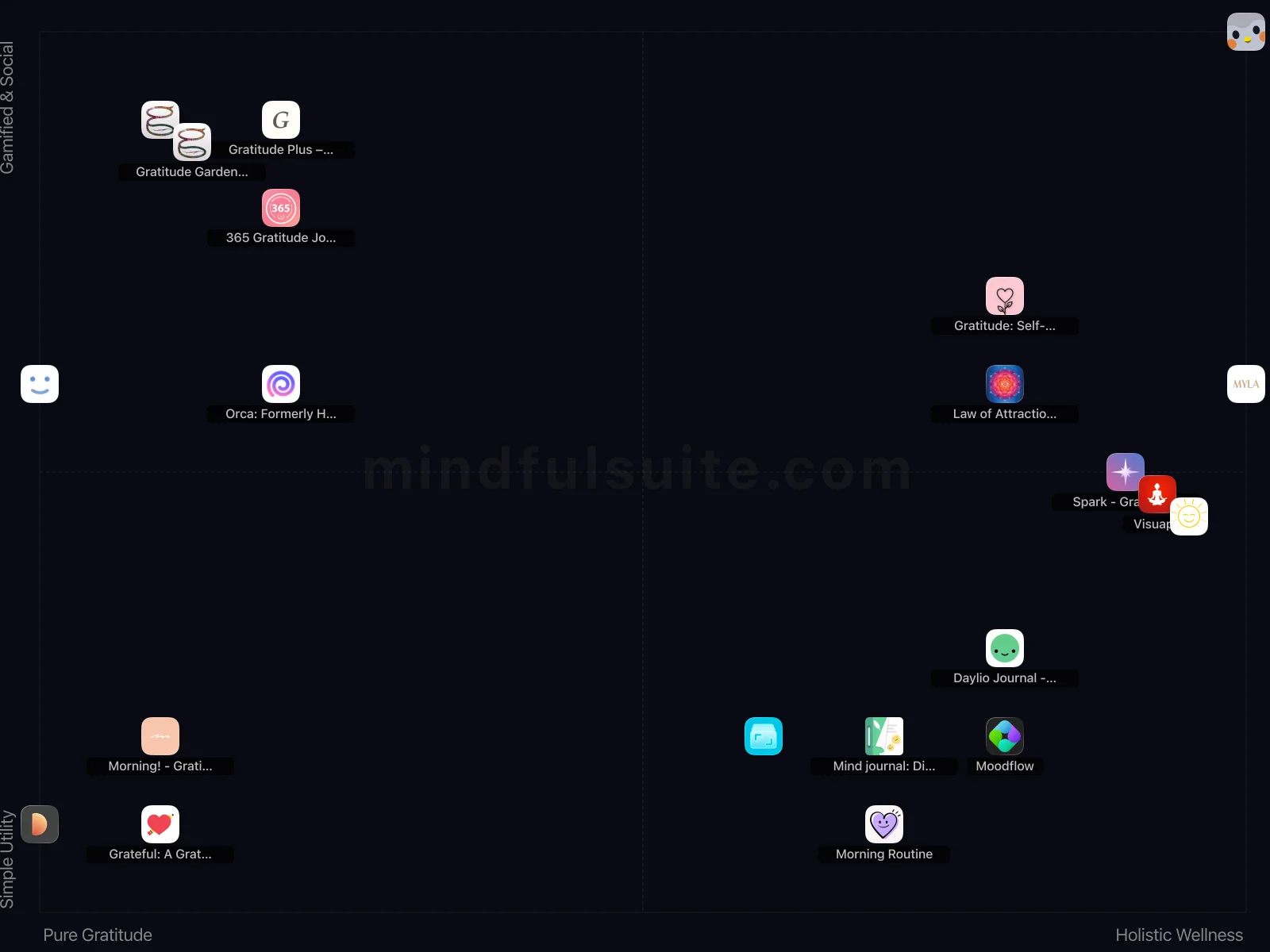
These 19 apps don't all solve the same problem. They cluster into 4 distinct groups, each built around a different philosophy. Understanding which group fits you is the fastest way to narrow your search.
Pure Gratitude + Gamified & Social
6 apps in this group, led by  Gratitude Plus – Journal,
  365 Gratitude Journal, and
  Orca: Formerly HappyFeed Diary.
What defines this cluster: social gratitude journal, science-based mental health tools, community support, free with in-app purchases.
Orca: Formerly HappyFeed Diary.
What defines this cluster: social gratitude journal, science-based mental health tools, community support, free with in-app purchases.
Holistic Wellness + Gamified & Social
5 apps in this group, led by  Gratitude: Self-Care Journal,
  Spark - Gratitude Journal, and
  Law of Attraction Space.
What defines this cluster: daily gratitude prompts, affirmations, vision board, free with iap.
Law of Attraction Space.
What defines this cluster: daily gratitude prompts, affirmations, vision board, free with iap.
Pure Gratitude + Simple Utility
3 apps in this group, led by  Delightful: Gratitude Journal,
  Grateful: A Gratitude Journal, and
  Morning! - Gratitude Journal.
What defines this cluster: free with iap, gratitude journal, record three good things daily, clean and simple interface.
Morning! - Gratitude Journal.
What defines this cluster: free with iap, gratitude journal, record three good things daily, clean and simple interface.
Holistic Wellness + Simple Utility
5 apps in this group, led by  Daylio Journal - Mood Tracker,
  Morning Routine, and
  Mind journal: Diary, Mood trac.
What defines this cluster: free with iap, micro-diary, mood tracker, track habits.
Mind journal: Diary, Mood trac.
What defines this cluster: free with iap, micro-diary, mood tracker, track habits.
What makes them different
The core tension in this category runs along two axes. On one side, Pure Gratitude apps prioritize simplicity and speed — you can be up and running in under a minute. On the other, Holistic Wellness apps offer depth and customization that rewards investment over time.
The second axis — Experience Style — captures an equally important difference. Apps closer to Simple Utility take a fundamentally different approach than those near Gamified & Social. Neither is objectively better. The right choice depends on your personality, your experience level, and what you're trying to accomplish.
17 Apps Reviewed
We scored every app using a weighted composite of real App Store and Google Play ratings. Out of 17 apps: 4 Essential · 12 Hidden Gems · 1 Mainstream. 10 cross-platform, 5 iOS-only, 2 Android-only.
Top picks: Gratitude: Self-Care Journal and Gratitude Plus – Journal scored highest overall. Daylio Journal - Mood Tracker rounds out the top three. Switch to the Apps tab for the full list with ratings and download links.
How to Pick the Right One
Look at the cluster section above. If you already know whether you want Pure Gratitude or Holistic Wellness, that eliminates half the options instantly. Same for Simple Utility vs Gamified & Social.
Try one app for a full week before judging. Most gratitude journal apps reveal their value around day 5, not day 1.
Quick start: Gratitude: Self-Care Journal and Gratitude Plus – Journal represent two different approaches and both scored highest. Pick whichever resonates, switch if it doesn't click.
Making It Stick: Practical Advice
Downloading the app is the easy part. The hard part — the part that actually produces results — is what happens in weeks two, three, and beyond. These tips are drawn from behavioral research and from patterns we've observed across hundreds of thousands of user reviews. They're not revolutionary, but they work:
Be specific, not generic
"I'm grateful for my family" is fine, but "I'm grateful my daughter made me laugh at breakfast with her silly dinosaur impression" is far more impactful. Specificity deepens the emotional effect.
Set a consistent daily time
Evening works well for most people — reflecting on the day before sleep. But morning gratitude can set a positive tone for the day ahead. Pick one and protect it.
Include small and large things
Big events (a promotion, a wedding) are obvious gratitude targets. But the practice is most powerful when you also notice small, everyday moments: a good cup of coffee, a stranger's smile, sunshine through a window.
Frequently Asked Questions
These are the questions that come up most often — from our own testing, from user reviews, and from the broader conversation around gratitude journal apps. If your question isn't here, the Apps tab has detailed information on every app we reviewed.
Does gratitude journaling really improve mental health?
Multiple peer-reviewed studies show that regular gratitude practice is associated with increased positive affect, life satisfaction, and reduced depressive symptoms. It's not a cure for clinical conditions, but it's one of the most well-supported positive psychology interventions.
How many things should I write each day?
Three is the most commonly recommended number, and it's what most research studies used. Some people prefer just one deeply detailed entry. The important thing is that each entry is genuine, not forced.
What if I can't think of anything to be grateful for?
Start with the absolute basics: you're breathing, you have shelter, you ate today. On difficult days, gratitude for small things is even more powerful. This is exactly when the practice matters most — it gently redirects attention from what's overwhelming to what's still stable.
Cultivating Joy: The Best Gratitude Journal Apps to Boost Your Well-Being in 2026
Remember that half-empty notebook on your nightstand? The one with “Gratitude Journal” hopefully scribbled on the first page, followed by exactly three entries from last January? We’ve all been there.
The desire to notice the good in our lives is strong. But when life gets chaotic, finding a pen and a quiet moment can feel like just one more chore on an endless to-do list. On days when the coffee spills, the Wi-Fi drops, and deadlines loom, it’s far too easy to get buried under a pile of small frustrations.
A gratitude practice isn’t about ignoring the tough stuff. It’s about creating a deliberate pause to find the glimmers of light that are always there. The perfect song on the radio. A surprise text from a friend. The simple, quiet comfort of a warm cup of tea.
This is where a great app transforms the entire experience. It puts a moment of reflection right in your pocket. With gentle reminders, inspiring prompts, and a private space to capture your thoughts, these digital journals make cultivating joy feel like a delightful secret you carry with you all day long.
Here are the best gratitude journal apps of 2026, categorized by what makes them shine.
The All-In-One Wellness Companions
If you want your gratitude practice wrapped in a warm hug of overall self-care, these apps are for you. They go beyond simple text entries, offering daily affirmations, guided prompts, and even vision boards to help you cultivate a deeply positive mindset.

Gratitude: Self-Care Journal
This app is more than just a journal; it's a complete wellness toolkit. It wraps your gratitude practice in a warm hug of self-care, offering daily affirmations, a vision board for your dreams, and thought-provoking prompts to guide you.
- The combination of daily gratitude prompts, affirmations, and a vision board within one app offers a holistic manifestation approach.
- The "Gratitude Wall" feature, showcasing shared positive entries, provides a unique sense of community and inspiration.

365 Gratitude Journal
Features daily gratitude prompts and affirmations, designed to encourage reflection and improve mood with a supportive community.
- Daily, varied prompts and affirmations provide consistent guidance, perfect for establishing a gratitude habit.
- The integrated community feature offers a unique, inspiring space for shared positive reflection.

Spark - Gratitude Journal
This app helps cultivate gratitude through journaling, mood tracking, habit tracking, and affirmations. It is for anyone looking to improve their well-being through positive psychology practices.
- The integration of mood tracking, habit tracking, and affirmations offers a genuinely holistic self-care platform.
- Daily guided affirmations provide structured positive reinforcement, enhancing the gratitude practice.
For the Minimalists
Sometimes, less really is more. These apps strip away the clutter, the community feeds, and the complex charts. They give you a clean, beautiful space to log a few good things and get on with your day. Perfect for anyone who gets overwhelmed by too many features.

Three Good Things - A Happiness Journal
This app is a testament to the power of simplicity. It’s built entirely around the evidence-based practice of noting three good things that happened each day. With a minimalist design that removes every distraction, it lets you focus on one thing: finding the positive.
- Its hyper-focused "three good things" method is perfect for a simple, consistent daily gratitude practice.
- The gamification elements effectively encourage daily engagement and habit formation for long-term use.

Delightful: Gratitude Journal
Delightful: Gratitude Journal provides a simple interface for recording three good things each day. It's for users who want an easy way to cultivate gratitude through journaling.
- The elegant, uncluttered interface makes daily gratitude entries feel effortlessly simple and inviting.
- Focusing strictly on "three good things" maintains clarity and prevents overcomplication for beginners.

Grateful: A Gratitude Journal
A straightforward journal designed to help users focus on the positive aspects of their lives. It is for those who want to cultivate gratitude and mindfulness.
- Grateful's streamlined interface makes daily gratitude journaling incredibly simple and genuinely enjoyable to maintain.
- The app effectively cultivates a positive mindset by consistently prompting users to reflect on good things.

Morning! - Gratitude Journal
A simple journal to help make daily gratitude a habit. It's for individuals seeking to cultivate an attitude of gratitude through daily journaling.
- Its sleek, minimalist design provides a calming and focused environment specifically for morning gratitude.
- The clean interface prioritizes quick entry, making it easy to integrate into a busy morning routine.
When You Want Community & Connection
Gratitude can be contagious. If journaling alone in a quiet room feels isolating to you, a social approach might be the missing ingredient. This app lets you share your bright spots with friends and family, creating a private feed of shared positivity.

Gratitude Plus – Journal
Combines science-backed mental health tools with community support to help users build a consistent gratitude practice. It is for individuals seeking a structured and social approach to gratitude journaling.
- The integrated social sharing feature uniquely fosters communal gratitude, distinguishing it from private journals.
- Connecting directly with friends and family within the app builds a supportive network for shared positivity.
For the Visual Storytellers & Dreamers
A picture is worth a thousand thankful words. If you're a visual thinker, text-only journals might leave you uninspired. These apps let you attach photos to your happy moments or build rich vision boards, turning your gratitude practice into a vibrant, scrollable highlight reel of your life.

Orca: Formerly HappyFeed Diary
Happyfeed takes the classic "three good things" idea and gives it a delightful, visual spin. By encouraging you to add photos to each happy moment, it helps you create a vibrant, personal feed of memories that are a true joy to scroll through later.
- Integrating photo and video entries makes gratitude reflections vivid and more memorable than text alone.
- The optional sharing feature offers welcome flexibility for those who want community without being forced into it.

Visuapp
A dedicated vision board app that uses Feng Shui principles to help structure your goals. It also includes a gratitude journal to enhance the visualization process.
- As a dedicated vision board app, it uniquely incorporates Feng Shui principles into board creation, adding a distinct spiritual dimension.
- The integrated gratitude journal and daily affirmations provide excellent support for mental well-being alongside goal visualization.

Manifest: Law of Attraction App
This app aims to be your one-stop shop for manifestation. It neatly integrates the core pillars of the practice—meditation, gratitude, affirmations, and visualization—into a single, streamlined experience to keep you focused and inspired.
- Its all-in-one approach, combining meditations, journaling, affirmations, and vision boards, provides a comprehensive manifestation toolkit.
- Specific techniques like the 369 method are integrated, offering structured guidance for those familiar with Law of Attraction practices.

Journey: Diary, Journal
Journey is a digital diary and journal app. It encourages gratitude, health, and calmness through journaling.
For the Data Nerds & Gamers
Do you love seeing a 30-day streak light up on your screen? Do you want to know exactly how a morning walk correlates to a better evening mood? These apps use gamification, mood charts, and even adorable digital pets to make showing up for your daily gratitude an absolute no-brainer.

Daylio Journal - Mood Tracker
Daylio is a massively popular micro-diary that brilliantly answers the question: "What if I could journal without typing?" You simply pick your mood and tap icons for the activities you did that day. Over time, it creates fascinating charts that reveal what habits and routines actually make you happy.
- Effortlessly track moods and activities with a quick tap-based interface, making daily logging consistent.
- Generates insightful statistics and charts to visualize mood patterns and activity correlations over time.

Finch: Self Care Pet
Finch is a heartwarming self-care app that feels like a warm hug. It combines habit tracking and journaling with caring for a virtual pet. You nurture your pet by nurturing yourself. As you complete your daily goals—from tidying your room to practicing gratitude—your pet grows, goes on adventures, and shares its thoughts with you. It’s an incredibly positive and gentle approach to building a healthier you.
- Gamified pet care system genuinely motivates daily self-care habits like journaling and hydration.
- Customizing your adorable pet provides a tangible, delightful reward for consistent self-improvement.

Gratitude Garden: Journal
Takes a gamified approach to gratitude journaling, allowing users to grow a virtual garden as they log things they're thankful for. It is targeted towards people who enjoy a playful, visual way to cultivate gratitude.

Mind journal: Diary, Mood trac
A CBT-guided diary app designed to provide immediate anxiety relief through journaling. It is for individuals seeking a structured approach to self-reflection and mental well-being.
So, Which Pocketful of Joy is Yours?
The best gratitude journal app is, quite simply, the one you'll actually look forward to opening. Your perfect match depends entirely on what makes you tick.
If you thrive on structure, an all-in-one wellness companion will keep you grounded. If you're easily distracted, a minimalist app will ensure you actually build the habit. And if you need a little extra motivation, tending to a digital garden or a virtual pet might be the exact nudge you need.
No matter which route you choose, the simple act of pausing to acknowledge the good has a profound ripple effect. Pick the app that sparks your curiosity, and start collecting a little more joy today.