
Stress Relief Apps: What You Need to Know in 2026
Stress isn't just mental — it lives in your clenched jaw, your shallow breath, your tight shoulders, your disrupted sleep. Your body keeps the score, and it's been running up the tab. Stress relief apps provide the tools to address stress where it lives: in your body, your breathing, your thought patterns, and your daily habits.
We evaluated 32 stress relief apps across iOS and Android, scoring each on real user ratings, feature depth, and long-term value. This guide covers what we found.
Not All Stress Is Created Equal: Acute, Chronic, and Traumatic
The word "stress" has become so overused that it has lost its diagnostic precision. Your colleague saying "I'm so stressed" about a deadline and a combat veteran saying the same words about a fireworks display are describing fundamentally different neurobiological states. Treating them with the same app feature is like prescribing aspirin for both a headache and a broken femur — one will help, the other is a category error.
Acute stress is the immediate, time-limited response to a specific threat or challenge. A presentation in 30 minutes. A difficult conversation you are about to have. A near-miss in traffic. Your sympathetic nervous system activates, cortisol and adrenaline surge, your heart rate rises, and your attention narrows. This is the stress response working as designed — a short-term performance enhancer that evolved to help you outrun predators. Breathing exercises, grounding techniques, and brief guided meditations are genuinely effective for acute stress because they directly counteract the sympathetic activation. A 4-7-8 breathing pattern can measurably lower heart rate within 90 seconds.
Chronic stress is categorically different. Months of overwork. An unresolved relationship conflict. Financial insecurity that never fully resolves. Caregiving without respite. The cortisol system, designed for sprints, is running a marathon — and it was not built for that. Chronic stress produces systemic inflammation, suppresses immune function, disrupts sleep architecture, and literally shrinks the hippocampus (the brain structure responsible for memory and emotional regulation). A breathing exercise during chronic stress provides temporary symptomatic relief the way a bandaid temporarily covers a wound that needs stitches. The real intervention for chronic stress is structural: boundaries, workload reduction, relationship repair, financial planning, or professional help.
Traumatic stress — the aftermath of events that overwhelm the nervous system's capacity to process — requires professional treatment. PTSD, complex trauma, and acute stress disorder are clinical conditions. Apps can supplement therapy (some therapists recommend specific apps between sessions), but they cannot replace it. Any app that implies otherwise is being irresponsible.
The practical implication: before choosing a stress relief app, honestly assess which type of stress you are addressing. The right tool depends entirely on the right diagnosis.
Why Body-Based Techniques Work Faster Than Thinking-Based Ones
When stress reaches a certain threshold, a peculiar thing happens in the brain. The prefrontal cortex — the region responsible for rational thought, planning, and the ability to talk yourself through a difficult moment — goes partially offline. Blood flow and neural resources shift toward the amygdala and the brainstem, the ancient survival hardware that processes threats faster than conscious thought can form. This is why telling an anxious person to "just think positive" is not merely unhelpful — it is asking them to use a tool that is temporarily unavailable.
Cognitive techniques like CBT-based thought reframing are powerful tools for stress management. They work by examining the thoughts that amplify stress ("This presentation will be a disaster" becomes "I have prepared thoroughly and presentations usually go better than I expect"). But they work best when the prefrontal cortex is online — during moderate stress, in reflective moments, or as a preventive daily practice. During acute high stress, the hardware for rational reappraisal is running at reduced capacity.
Body-based interventions bypass this limitation entirely. They do not require thinking. They work directly on the autonomic nervous system through peripheral pathways that do not route through the cortex. Slow diaphragmatic breathing stimulates the vagus nerve, which activates the parasympathetic (rest-and-digest) nervous system, directly counteracting the sympathetic (fight-or-flight) activation. The effect is measurable within minutes: heart rate decreases, blood pressure drops, heart rate variability improves.
Progressive muscle relaxation works through a different mechanism — the deliberate tensing and releasing of muscle groups interrupts the physical tension pattern that both results from and perpetuates the stress response. Cold exposure (splashing cold water on the face, holding ice cubes) triggers the mammalian dive reflex, a hardwired autonomic response that slows heart rate and redirects blood flow.
The practical principle for stress relief apps: when stress is high, start with the body. Breathing exercises first. Muscle relaxation second. Movement if possible. Save the cognitive reframing, the journaling, the thought records for after the physiological storm has passed. Think later. Breathe first. The apps that sequence their interventions in this order — body before mind — are the ones aligned with how stress neuroscience actually works.
The Stress Audit: Using App Data to Identify Your Actual Stressors
Ask most people what stresses them and they will name the obvious culprits: work deadlines, financial pressure, a difficult relationship. These answers are not wrong, but they are usually incomplete — and sometimes misleading. The human brain is surprisingly poor at identifying the actual sources of its own stress, for a simple reason: we notice acute stressors (a sudden deadline, an argument) while chronic low-level stressors (a 45-minute commute, poor sleep quality, a cluttered living space) operate below the threshold of conscious attention.
This is where stress tracking features in apps become genuinely valuable — not as a self-help novelty but as a diagnostic tool. The premise is straightforward: log your stress level several times a day along with contextual information (what you are doing, where you are, who you are with, how you slept, what you ate). After 30 days, the data tells a story that your memory cannot.
The surprises are remarkably consistent across users. The meeting you dread every Tuesday is stressful, yes — but the data shows that your baseline stress is already elevated by 10 AM on Tuesdays, before the meeting even starts. Anticipatory stress, it turns out, often exceeds the stress of the event itself. Your commute does not feel stressful because you have normalized it, but your stress logs are consistently higher on days you drive to the office than on days you work from home. You blame your workload for your evening tension, but the correlation is actually stronger with sleep duration the previous night — on nights you sleep less than six hours, the following day's stress is elevated regardless of what happens at work.
These patterns are actionable in a way that vague feelings of stress are not. "I'm stressed" has no clear solution. "My stress is 40% higher on days following poor sleep" has a very clear solution: prioritize sleep hygiene. "My afternoon stress spikes are correlated with skipping lunch" is solvable by eating lunch. The data transforms an amorphous feeling into a set of identifiable triggers with specific interventions.
The apps that do this well offer three things: easy logging (if it takes more than 15 seconds, compliance drops off a cliff), contextual tagging (activities, locations, people, sleep, meals), and correlation analysis (automated or visual tools that surface which factors most strongly predict high-stress days). A month of consistent data is usually sufficient to produce at least two or three genuinely surprising insights about what is actually driving your stress.
4 Types of Stress Relief Apps — and How They Differ
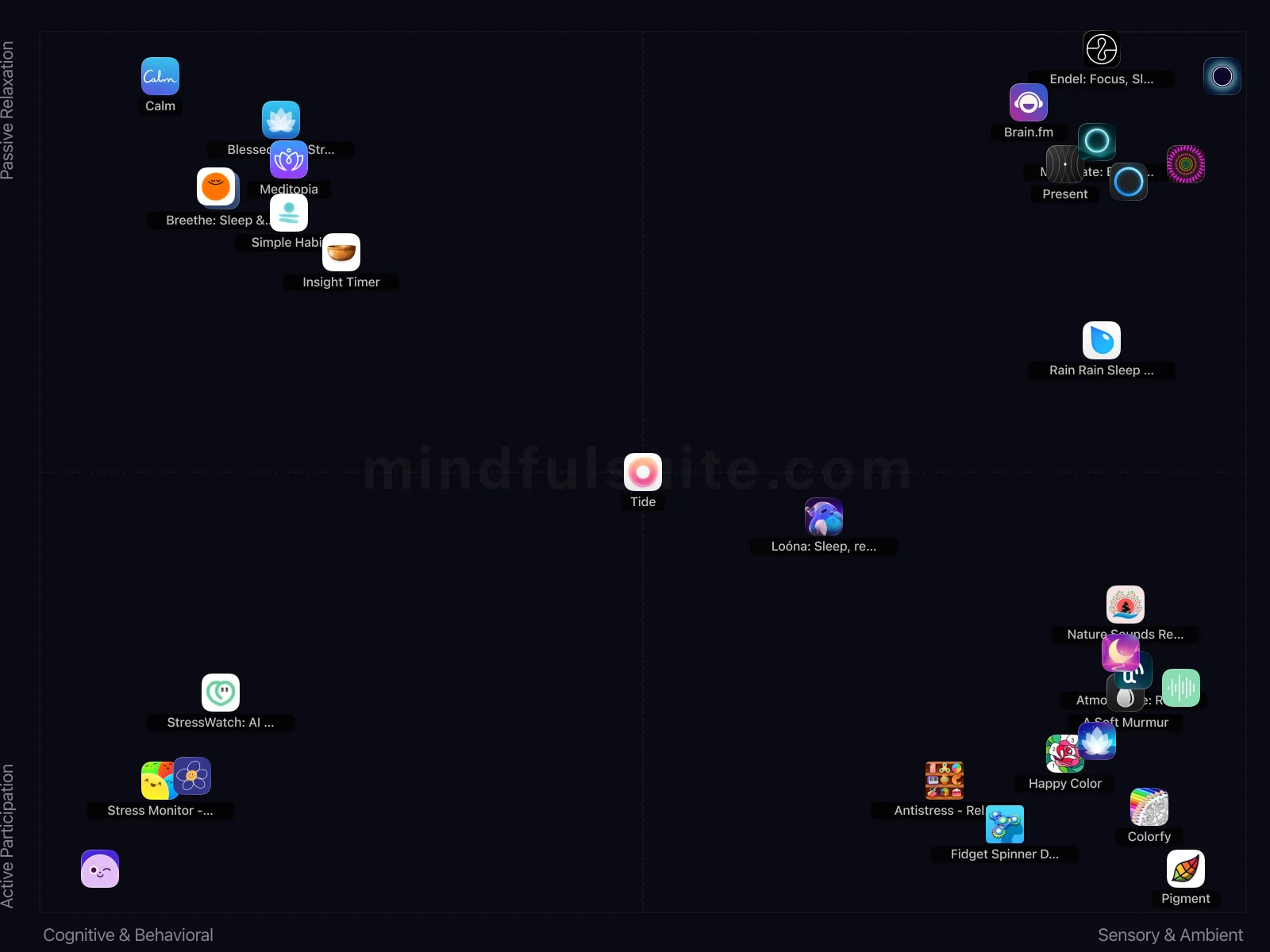
These 32 apps don't all solve the same problem. They cluster into 4 distinct groups, each built around a different philosophy. Understanding which group fits you is the fastest way to narrow your search.
Cognitive & Behavioral + Passive Relaxation
7 apps in this group, led by  BlessedPath: Stress Relief,
  Breethe: Sleep & Meditation, and
  Calm.
What defines this cluster: free with in-app purchases, free with iap, relaxation content, sleep content.
Calm.
What defines this cluster: free with in-app purchases, free with iap, relaxation content, sleep content.
Sensory & Ambient + Passive Relaxation
9 apps in this group, led by  Endel: Focus, Sleep, Relax,
  Mesmerize - Visual Meditation, and
  Moongate: Binaural Beats.
What defines this cluster: ai-powered soundscapes, personalized, adaptive audio, real-time adaptation, free (iap).
Moongate: Binaural Beats.
What defines this cluster: ai-powered soundscapes, personalized, adaptive audio, real-time adaptation, free (iap).
Cognitive & Behavioral + Active Participation
4 apps in this group, led by  Ahead: Emotional Companion,
  StressWatch: AI Stress Monitor, and
  Stress Monitor - Moodpress.
What defines this cluster: free with iap, free with in-app purchases, for anxiety, stress, anger, hrv & habit tracker.
Stress Monitor - Moodpress.
What defines this cluster: free with iap, free with in-app purchases, for anxiety, stress, anger, hrv & habit tracker.
Sensory & Ambient + Active Participation
12 apps in this group, led by  Antistress - Relaxing games,
  Atmosphere: Relaxing Sounds, and
  Colorfy.
What defines this cluster: relaxing stress relief toys, bamboo chime sound, wooden boxes play, water swipe.
Colorfy.
What defines this cluster: relaxing stress relief toys, bamboo chime sound, wooden boxes play, water swipe.
What makes them different
The core tension in this category runs along two axes. On one side, Cognitive & Behavioral apps prioritize simplicity and speed — you can be up and running in under a minute. On the other, Sensory & Ambient apps offer depth and customization that rewards investment over time.
The second axis — User Engagement — captures an equally important difference. Apps closer to Active Participation take a fundamentally different approach than those near Passive Relaxation. Neither is objectively better. The right choice depends on your personality, your experience level, and what you're trying to accomplish.
32 Apps Reviewed
We scored every app using a weighted composite of real App Store and Google Play ratings. Out of 32 apps: 19 Essential · 9 Hidden Gems · 2 Mainstream. 19 cross-platform, 12 iOS-only, 1 Android-only.
Top picks:  Happy Color and Colorfy scored highest overall.
  Headspace rounds out the top three. Switch to the Apps tab for the full list with ratings and download links.
How to Pick the Right One
Look at the cluster section above. If you already know whether you want Cognitive & Behavioral or Sensory & Ambient, that eliminates half the options instantly. Same for Active Participation vs Passive Relaxation.
Try one app for a full week before judging. Most stress relief apps reveal their value around day 5, not day 1.
Quick start: Happy Color and Colorfy represent two different approaches and both scored highest. Pick whichever resonates, switch if it doesn't click.
Making It Stick: Practical Advice
Downloading the app is the easy part. The hard part — the part that actually produces results — is what happens in weeks two, three, and beyond. These tips are drawn from behavioral research and from patterns we've observed across hundreds of thousands of user reviews. They're not revolutionary, but they work:
Practice prevention, not just reaction
Don't wait until stress is overwhelming to use the app. A daily 5-minute practice builds the resilience that prevents stress from escalating.
Start with your body
When stress is high, your thinking brain is offline. Start with physical techniques (breathing, muscle relaxation) to calm the body first, then use cognitive tools.
Frequently Asked Questions
These are the questions that come up most often — from our own testing, from user reviews, and from the broader conversation around stress relief apps. If your question isn't here, the Apps tab has detailed information on every app we reviewed.
Can an app really reduce stress?
Yes. The techniques these apps deliver (breathing exercises, meditation, progressive muscle relaxation) have strong evidence for reducing physiological and psychological stress markers. The app is the delivery mechanism; the techniques themselves are well-validated.
How much time do I need to spend daily?
Even 5 minutes of daily stress management practice shows benefits. 10-15 minutes is ideal for most people. The key is consistency — brief daily practice outperforms occasional long sessions.
The Best Stress Relief Apps for 2026
Notice your jaw right now. Is it clenched? Are your shoulders creeping up toward your ears like they're trying to hide? We carry our stress physically, mentally, and emotionally, often without even realizing it until we're utterly exhausted at the end of the day.
When life feels like an endless to-do list, someone telling you to "just relax" is about as helpful as tossing a cup of water on a house fire. You don't need empty platitudes; you need practical, accessible tools to break the cycle.
That's where your phone—usually a prime source of our daily anxiety—can actually become the antidote. Whether you need to quiet a racing mind, keep your restless hands busy, or let algorithmic soundscapes wash over you, there is a release valve waiting in your pocket. We've tested the best options out there so you can find exactly what your nervous system is craving today.
When You Need to Zone Out
Sometimes, trying to sit quietly with your thoughts is a recipe for a panic attack. When your brain is buzzing, the best relief is often a simple, tactile distraction. These apps let you channel restless energy into repetitive, low-stakes activities that naturally quiet the mind.

Present
A beautiful meditation timer featuring 100+ soundscapes and 6 bell themes to help you find stillness anywhere.
- Over 100 high-quality nature and ASMR soundscapes.
- Minimalist design that stays out of your way.
- Available as a Chrome extension for working peacefully.

Happy Color
Happy Color is a hugely popular color-by-number game. With thousands of free pictures, it provides a structured and satisfying way to create beautiful artwork and unwind.
- The truly enormous, diverse collection of free color-by-number images offers endless relaxation.
- Simple tap-to-fill mechanics make it a perfect, mindless de-stressing activity for anyone.

Colorfy
Colorfy is a digital coloring book for adults filled with intricate designs like mandalas, florals, and animals. It's a simple and relaxing way to engage in a creative activity and reduce stress.
- The vast and diverse collection of coloring pages, from mandalas to intricate patterns, ensures endless creative relaxation for users.
- Its simple interface and focus on stress reduction make it an accessible and genuinely calming digital art experience for adults.

Antistress - Relaxing games
Provides a collection of digital toys for stress relief, including bamboo chimes, wooden blocks, and water simulations.

Pigment
A digital coloring book app, it offers a wide range of tools and a vast library of illustrations for a realistic coloring experience.
- Offers a genuinely realistic coloring experience with a wide array of brushes and tools, mimicking traditional art supplies digitally.
- The vast and continuously updated library of illustrations provides endless creative possibilities for a diverse user base.

Fidget Spinner Designer 3D
For those who find that fidgeting helps them focus, a digital fidget spinner can be a discreet tool for meetings or quiet environments. This app simulates the experience, providing a simple, non-distracting sensory input that can help manage restlessness when you need to be still.
- Offers a digital fidget tool providing a low-stakes outlet for restless energy without physical distraction.
- Customization options for spinners can provide a brief, engaging creative break from intense focus tasks.
The Classics: Guided Mindfulness
If you're ready to sit with your feelings rather than escape them, these giants of the meditation world offer structured, expertly guided relief. They act as a friendly coach, pulling you out of your spiraling thoughts and bringing you back to the present moment.

Headspace
Your friendly guide to meditation, Headspace makes mindfulness feel accessible and fun, with mood tracking integrated to help you see your progress.
- The playful, accessible animation style and beginner-friendly "Basics" course make mindfulness far less intimidating for newcomers.
- Its diverse collection of "mini-meditations" and "SOS" sessions offers quick relief for specific daily stresses or situations.

Meditopia
Offers guided meditations and sleep stories for stress reduction and improved sleep. It's for users seeking mindfulness practices and relaxation techniques.
- Offers a well-rounded collection of guided meditations, sleep stories, and soothing music at an accessible price point.
- The app provides a good balance between introductory and advanced content, catering to various user needs.

Insight Timer
Imagine a massive, free library for your soul. Insight Timer offers an incredible collection of meditations and talks, with a simple journal to capture your mood along the way.
- Its truly vast library of over 100,000 free guided meditations and talks makes it unbeatable for budget-conscious users.
- The community features, like "meditating with others," add a unique social dimension to personal practice.

Calm
Famous for its soothing meditations and sleep stories, Calm also includes a lovely mood check-in feature to weave mindfulness into your daily reflection.
- The vast library of high-quality Sleep Stories, narrated by soothing voices, genuinely helps users drift off to sleep.
- Its daily meditations, like the "Daily Calm," provide consistent, accessible guidance for mindfulness beginners and regulars.

Simple Habit
As the name suggests, this app wants to make mindfulness an effortless part of your daily routine. It specializes in short, 5-minute meditations tailored to specific, everyday situations, making it incredibly easy to squeeze in a moment of calm.
- Its core strength lies in quick, accessible 5-minute meditations, making mindfulness genuinely achievable for busy individuals.
- The diverse library covers specific situations like "before a meeting" or "commuting," providing practical, immediate relief.

Breethe: Sleep & Meditation
Breethe is your all-in-one toolkit for unwinding. It goes beyond standard meditation, offering everything from hypnotherapy sessions to masterclasses on finding happiness. It’s for anyone who wants a broad spectrum of resources to de-stress and sleep like a champ.
- The personalized content recommendations genuinely tailor meditations and sleep stories to user needs.
- Offers a comprehensive library of guided meditations, music, and masterclasses for diverse relaxation.
Audio Escapes: Drown Out the Noise
Close your eyes and transport yourself. Sometimes the easiest way to de-stress is to put on a pair of noise-canceling headphones and curate your sonic environment. From adaptive AI soundscapes to perfectly mixed thunderstorms, these audio tools create a protective bubble around your brain.

Rain Rain Sleep Sounds
As the name suggests, this app specializes in high-quality rain and other nature sounds to aid with sleep and relaxation.
- Specializes in an extensive, high-quality collection of rain and storm sounds, offering nuances like "Rain on Tent."
- The simple, focused interface makes it incredibly easy to find and play your preferred rain sound quickly.

Portal
An iOS app that delivers immersive, spatial audio soundscapes from beautiful locations around the world, combined with smart lighting integration.
- Integrates dynamic soundscapes with stunning visuals, creating a truly immersive sensory experience.
- Features scientifically-backed sound frequencies and binaural beats specifically for focus and sleep.

Endel: Focus, Sleep, Relax
Endel creates soundscapes that are alive. Using a patented AI, it generates personalized, adaptive audio that changes in real-time based on inputs like your heart rate, the weather, your location, and the time of day. This means the sound is never repetitive or boring. The "Sleep" mode is specifically designed to soothe your mind and body with scientifically engineered sound, making it a futuristic and fascinating way to rest.
- Its unique "adaptive soundscapes" truly personalize the auditory experience, dynamically adjusting to environmental and biometric data.
- The scientifically-backed approach and real-time adjustments feel genuinely innovative in the ambient sound category.

Atmosphere: Relaxing Sounds
Atmosphere provides a wide variety of relaxing sounds that can be mixed to create personalized soundscapes for sleep, meditation, or focus.
- Allows extensive customization by mixing a wide range of ambient sounds to create truly personalized soundscapes.
- The high-quality sound library and intuitive mixing interface make it superior for creating perfect background noise.

Tide
Tide is a beautifully designed app that integrates sleep, meditation, and relaxation with nature sounds. It also features a Pomodoro timer and breathing exercises.
- Its beautiful, minimalist interface with elegant nature animations creates an immediately calming visual experience.
- Offers a free "Focus Timer" with built-in nature soundscapes, making it great for productivity and relaxation.

Brain.fm
Brain.fm provides 'functional music' scientifically designed to help you focus, relax, meditate, or sleep. The AI-generated soundscapes are created to stimulate the brain and help you achieve your desired mental state.
- Scientifically designed "functional music" claims to directly impact brainwaves for focus, relaxation, or sleep.
- Offers distinct programs for various states like "Focus," "Meditate," and "Sleep," each with tailored audio.

Moongate: Binaural Beats
Uses science-backed sound therapy to help users fall asleep, release anxiety, and stay focused. It's for individuals seeking help with sleep, anxiety, and focus through binaural beats and frequency healing sounds.
- Leverages "science-backed sound therapy" like binaural beats to specifically target focus, anxiety, and sleep improvement.
- The impressive 4.8★ Android rating from 23,000 users indicates its effectiveness and user satisfaction.

Sleepa
Sleepa provides a great collection of HD sounds that can be mixed into the perfect relaxing ambiences for sleep or focus.
- The collection of HD sounds is impressive and can be effectively blended to create custom, relaxing ambiences.
- Its intuitive mixing interface makes combining multiple sounds and adjusting volumes incredibly simple for users.

TaoMix 2
TaoMix 2 allows you to create your own unique and evolving soundscapes for relaxation, meditation, or sleep by dropping sounds onto a board.
- Its innovative "evolving soundscapes" feature creates dynamic, non-repeating audio environments, truly unique.
- The visual mixing interface is incredibly intuitive, making custom soundscape creation genuinely engaging.

A Soft Murmur
A straightforward and elegant ambient sound app that lets you mix various sounds like rain, thunder, waves, and coffee shops to create a calming atmosphere.
- The minimalist interface makes mixing ambient sounds incredibly simple and frustration-free, a breath of fresh air.
- Its focus on a core set of quality ambient sounds prevents overwhelming choices, perfect for quick relaxation.

Nature Sounds Relax & Sleep
It offers nature sounds for relaxation, meditation, and sleep to relieve stress and anxiety.
- Offers a truly vast library of nature soundscapes, making it easy to find specific calming environments like rain or ocean.
- The ability to mix and match different sounds creates personalized ambient noise perfect for focused relaxation or sleep.

Noisli
Noisli is your minimalist escape hatch for focus or relaxation. With a beautifully simple interface, you can mix high-quality sounds like a bustling coffee shop with gentle rain or crackling fire. It’s perfect for creating a distraction-free bubble to work in by day or a serene cocoon to sleep in by night.
- Empowers users to fully customize soundscapes by mixing multiple distinct sounds with individual volume controls.
- Features a clean, minimalist design that effectively highlights the sound-mixing functionality without distractions.
For the Data Nerds
If you're the type of person who feels better when they have the facts, these apps turn your physiological data into actionable insights. By tracking heart rate variability and real-time moods, they help you actually see your stress levels and understand what triggers them.

StressWatch: AI Stress Monitor
A watch app that monitors stress via HRV and offers habit tracking to help lower bio age.
- Its unique focus on Heart Rate Variability (HRV) provides objective, data-driven stress insights.
- Seamless Apple Watch integration delivers continuous stress monitoring and bio-age tracking.

Stress Monitor - Moodpress
Tracks stress, real-time emotion, mood, activity, and sleep to monitor the user's overall state.
- The integration of HRV data for stress monitoring provides a unique, physiological insight into emotional states.
- Comprehensive tracking for sleep, activity, and real-time emotions offers a holistic view of well-being.

StressEase - Stress Monitor
Analyzes real-time stress levels using Apple Health data, providing personalized insights into daily stress trends and influencing factors.
Alternative Paths to Peace
Not everyone finds their zen by focusing on their breath or listening to a babbling brook. If you've tried traditional relaxation techniques and found them lacking, these unique approaches offer something completely different—from visual trips and emotional coaching to interactive bedtime stories and spiritual comfort.

BlessedPath: Stress Relief
BlessedPath provides bedtime Bible stories and sleep stories to help users find inner peace. This app is ideal for users who seek stress relief through relaxation and spirituality.
- Its unique faith-based approach, with bedtime bible stories, provides spiritual comfort and guidance.
- Catifies specifically to users seeking solace and peace through religious and devotional content.

Ahead: Emotional Companion
Teaches emotion regulation skills, helping users manage anxiety, stress, and anger through behavior-change techniques.
- Its science-backed curriculum, developed by behavior-change scientists, focuses on skill-building.
- Provides structured lessons to understand and manage emotions, rather than just temporary distraction.

Mesmerize - Visual Meditation
Offers a unique audio-visual meditation experience to promote relaxation and clear the mind. It's useful for users seeking a sensory approach to meditation and anxiety relief.
- The unique audio-visual meditations offer a genuinely hypnotic and immersive relaxation experience.
- High-quality visuals are a refreshing change from purely audio-based meditation apps.

Lumenate: Explore & Relax
Utilizes research-backed light sequences from your phone's flashlight to guide you into an altered state of consciousness for meditation and relaxation.
- Utilizes unique, research-backed light sequences for a genuinely novel meditative experience.
- Offers a powerful, non-ingestible way to explore altered states of consciousness for deep relaxation.

Loóna: Sleep, reduce anxiety
Uses sleepscapes that alter your mood to help prepare you for sleep and reduce anxiety.
- Unique 'sleepscapes' combine interactive storytelling with calming visuals for profound unwinding.
- The app's exceptional aesthetic design and narrative structure create a truly immersive experience.
Finding the right stress relief tool isn't about forcing yourself to meditate if you hate sitting still. It's about experimenting until you find the exact frequency, distraction, or data point that tells your nervous system it's finally safe to power down. Start small: download one or two that caught your eye, and give them a trial run during your next lunch break. You might be surprised by how much lighter you feel when you finally exhale.